


The days are long, but the years are short.
My mother told me that soon after my daughter was born, but she was far from the only one. Not for me, I thought. Throughout my life, I’ve felt the passage of every day, every week. The years couldn’t go quickly enough. That was, in part, because I wanted to be beyond most days. I had enough bad days, bad weeks, that the idea of a year scooting by almost unnoticed was too good to be true. I always wanted to be a year from now today. I would fantasise about being in a coma, or have access to some kind of time slip that would allow Future Me, the one I’d consistently leave today’s problems for, to deal with the years on auto-pilot before Now Me would emerge, a year later, and everything would be better — like simulating a few months in the old Football Manager games.
But then I met my daughter three and a bit years ago. Last week, I was taking her for a spin to Ballingarry to see if she might sleep for us after a particularly hairy afternoon when she was overtired and like a briar. She always sleeps in the car, and the lazy turns and rolling hills on the way to Ballingarry are perfect for just that.
She eventually nodded off just before Ballingarry, after a few sing-alongs of “Golden” from K-Pop Demon Hunters — I was not allowed to sing along, to be clear — and we pulled in by the petrol station to take a photo of my now snoring daughter for my fiancée. “Finally off”, I typed in the car park. Hit send. My fiancée replied, “soon she won’t go for a nap at all”, and she was right. She’s getting to that age now.
My phone, listening to everything I say and do — a kind of benevolent dystopia — soon prompted me to look at my Google Photos, where, after a few swipes of holidays and Christmas, and the big scary giant in a St. Patrick’s Day parade through Rathkeale, I was shown a dozen other photos in the last few years from more or less the same spot.
Asleep in Ballingarry. In the photos, all taken as selfies, she was six months old. Varying segments of my face were included in each one, all in the same car park. Then she was a year old. Two years. And then now. A snoring three-year-old, dreaming of whatever three-year-olds dream about.
I didn’t notice the time passing because I had been focused on something bigger than myself. The days were long, but full of naps, bottles, being the night-night parent, pushing a buggy, then walking, then following a bike to the playground, or up the road to buy a bag of carrots for the horses dotted around Rathkeale that we always stop to say hello and goodbye to.
I drove slowly back home. It was raining a light, persistent drizzle, so I took the curves and bumps a little bit slower than normal — I drive like an old lady out for the newspaper on a Sunday morning at the best of times — but I wanted this drive to be a little longer.
I sat with her in the car instead of bringing her to the couch for the next hour. In part, because I knew the drizzle would wake her, but in part because I knew it wouldn’t be long until she doesn’t really nap at all anymore. She won’t drift off with her mother nearby, or me, and soon she’ll be heading off to school, and then secondary school with the will of God.
The years fly by, and I can’t slow them down. She’ll always be my little girl, even when she’s the one driving to Ballingarry.
The days are long, but the years are short.
***
Time moves quickly in professional sport, too. I was doing a run on Munster’s early-season performances for a different article this week and realised they felt much further away than just eight months. The season is long up here, as Clayton McMillan is finding out, with far more downtime than you have in New Zealand. There, you have a by-week, but everything else is really compressed. Preseason, Super Rugby, test window. It’s got an order to it.
Here, you have preseason, first block of URC, break for the November test window, back into Europe on a sprint with some URC derbies sprinkled in, then before you know it, it’s February, and you have one game in six weeks, before sprinting to the end of the season.
It makes you think you have time, but you never really have enough of it. When you break it all down, accounting for the down weeks that the squad need where they aren’t hammering into tackle bags or sitting in meetings, it amounts to around two weeks where you aren’t preparing for a game at the weekend.
It’s not even two weeks, because you’ve only got around three training days in those weeks to layer in new stuff. Six days, really.
No time at all.
In an article earlier in the week, I spoke about the philosophical differences that emerged between McMillan and Prendergast over the season when it came to the way Munster wants to play. The reality is, those philosophical differences were baked in during the preseason, because there’s no realistic way to alter them dramatically as the season is in motion. You can change a few bits here and there, review and correct small things, but there just isn’t enough time. There aren’t enough sessions in a day, in a week, to make any changes to something as fundamental as the attacking side of the ball, especially when most of those concepts are hardcoded in over the previous three years.
For almost every side in the game, you are who you set out to be in the preseason, one way or another, for good or ill.
Then I realised that it’s March. The season is over in June, one way or the other. I still think this team can make a URC final, and perhaps a Challenge Cup final along the way, but it won’t be long until there’s a new attacking vision in charge of Munster Rugby for next season.
The blocks are long, but the season is short.
As it stands, the favourite for the role is in New Zealand. Roger Randle — the Chiefs attack coach who worked with McMillan for a few years — is a natural favourite, purely because that makes the most sense if we’re talking about implementing McMillan’s vision. It’s only natural, I suppose, that in a situation where the attack coach role is available, McMillan would look to work with someone he’s worked with extensively. There are a few other names in the mix — Jason Holland is available, albeit highly sought after — but I think it’s a fair assumption to make that what McMillan wants on the attacking side of the ball will be tilted more towards what he knows has worked.
Whoever it is, I’d expect Munster to be playing a deeper, more transitional style next season that bakes in a little more natural spacing than what we’ve seen this season.
In a general sense, for the last few seasons Munster have mostly played in front of defences to punish any compression or corner with multiple runners. This is the “flat” attack I have spoken about. It’s not always flat, but it is mostly so and relies on tight handling in multiple looping runners — with split midfielders — to activate the space.
It hasn’t really worked in the dregs of winter; it rarely has, but it will look better in the Spring. It wasn’t the plan to make a change at Senior Coach, but now that a change is inevitable, we can start to grapple with what McMillan might look to go for, now that he has a free hand.
As I said, it’s hard to look beyond what the Chiefs are doing at the moment. They, like ourselves, are still very much playing what Clayton McMillan would have built over the previous four years under Roger Randle.
Looking at the Chiefs — and New Zealand rugby in particular — there’s been a real shift towards a more transitional game, with a lot of the forward work being focused on direct carrying, with limited use of screens.
The Chiefs, when they do go through on-ball phases, are either very narrow through the forwards, before hitting depth off #10.
If you look at this Chiefs set up off a ruck, you can get a good feel for the difference. Five layers of attack in approximately 23 metres of depth, spread across 50 metres of ground.
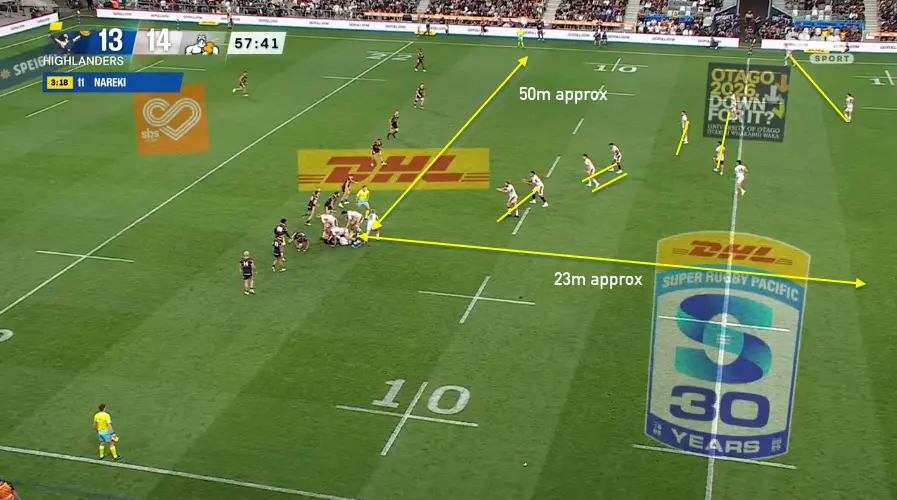
It makes sense for the Chiefs. They have a lot of pace in their backline group, and Jacobsen adds some forward punch from the third layer of the attack as a decoy/hard line option.
This was off a transition run back, so they’d have more depth here anyway, but I think it’s a good example all the same. We tend not to use the same kind of depth on our attacks — most of them anyway.
This is an imperfect comparison position-wise, but we tend to look at a lot like this on many of our attacking possessions. A shallower depth, a narrower structure, with fewer attacking layers.
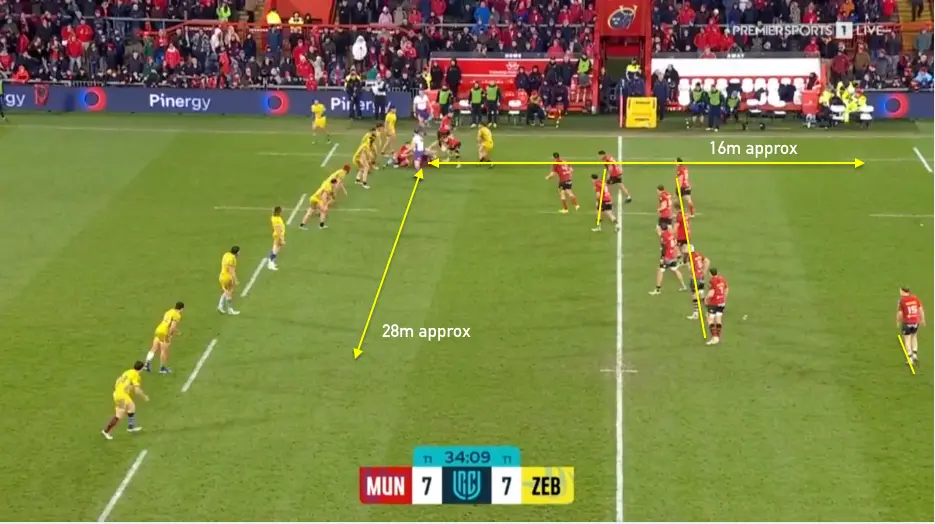
The reason for this is mostly practical.
We don’t have a ton of pace in our outside backline as it stands, and the pitch in Thomond Park is incredibly heavy, or was against Zebre anyway. You can see it here behind Patterson after a box kick.
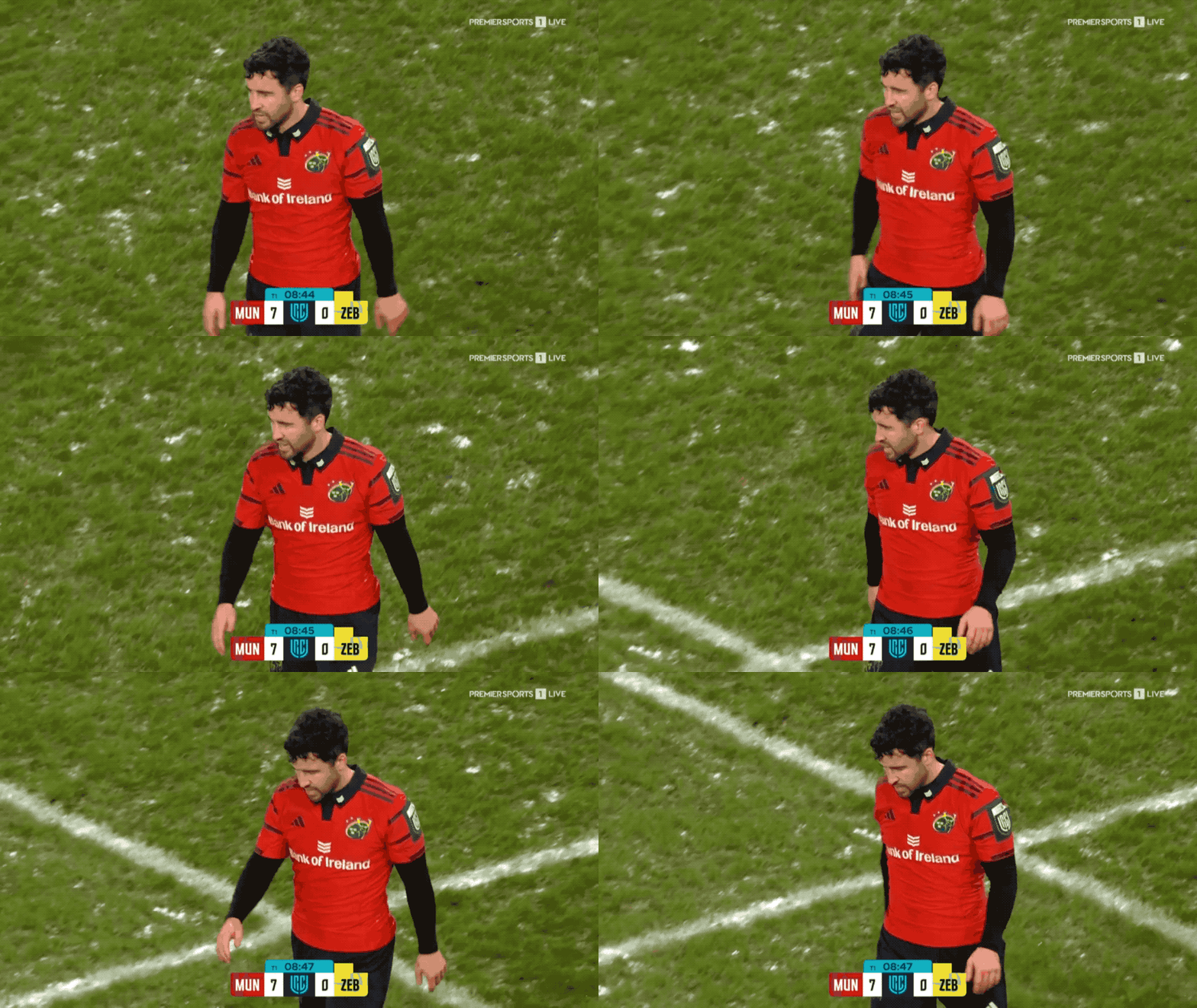
On a track like this, too much depth can empower the defence if you play too deep because you have to be evasive, they do not.
I do feel like there’s a middle ground, though.
On this one, we get good width, but we’re still quite narrow and shallow for the main thrust of the shape.
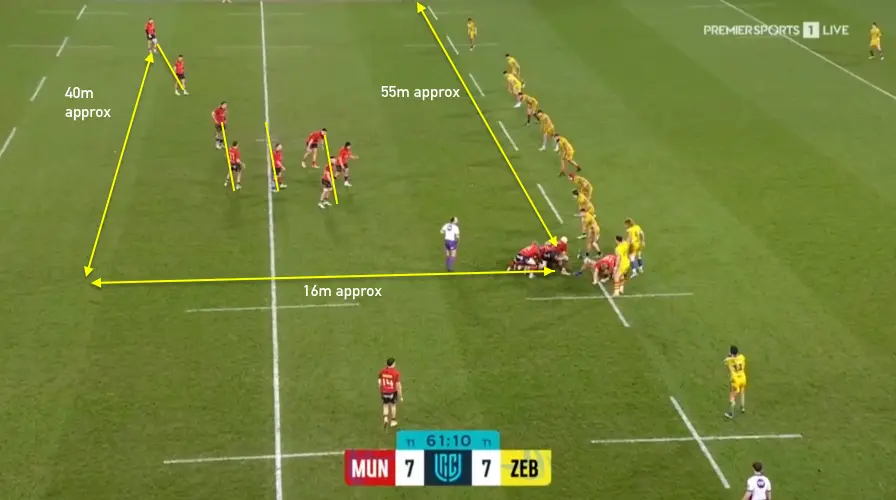
That leads to static carries and difficult passes under pressure. It’s why we love the tip-ons in that front pod. Even with the gainline win after the tip pass from Wycherley, the outcome is still the same — a flat bridge pass over the top to a static runner on the edge, who has to cut back inside.
When we come back to the other side on the next progression, you can see that approximate 16m of depth on the next sequence too, so the attack wanes and we, eventually, box kick.
The box kick is the right call — most NZ teams would kick here too — but our pass accuracy can’t really support the depth we mostly play in at the moment. Shallow depth requires higher levels of pass accuracy, but compensates for a lack of pace and evasion. A deeper structure makes for easier passes, but requires pace, power and high levels of evasion to fully click.
This is where the signing of Marnus Van Der Merwe was so important to Munster’s future. He is the closest player we could sign to Samisoni Taukei’aho, bar signing the man himself.
Taukei’aho is a key part of the Chiefs’ tight game — which we’ve tried to duplicate this season in part — but we don’t quite have the horses as yet. The Chiefs use Taukei’aho in the way we will use Marnus Van Der Merwe, as a lead tight carrier in and around the ruck.
You can see there how the Chiefs’ tight carry game is something they can go back to over and over again, but it also hints at the build. Props that are all game carriers without having to be collision dominant every single time, with Taukei’aho as the main outlet. A second row that are all comfortable lead carriers with two of the backrow being bruising operators around the ruck point.
There is scope for a wider, quicker forward in this system, but the Chiefs — a lot like us at points this season — usually only leave one forward outside of the #10 on the openside of plays like this to prioritise forward compression. The heavy use of the blindside scans with our usage this season — increased 7/8% year on year — but the key is the depth that the Chiefs’ release to.
The play narrow-to-depth and width, whereas we play with a consistent width and depth all the way through a progression.
Watching the Chiefs — and the Crusaders, Blues and Highlanders — I was struck by how little rugby they play in their own half, on everything except transition. They take two or three phases max, mostly narrow through the forwards looking for momentum. They mostly limit their on-ball phases to inside the opposition’s 10m line, and they’ll kick until they get the kind of possession they want.
Because they play with more depth, their tip-on game has more space to breathe, because everyone is moving that bit quicker onto the ball.
There’s always an option you can hit a relatively comfortable pass to, because it’s at a safer angle for a pass to be made relative to the position of the defence.
As with anything, a change in attacking depth requires a different build. I don’t think you can play with extra depth and, for example, have Tom Farrell and Mike Haley in most of your first-line squads. They don’t really have the pace to make it work. You also need a front five that is more comfortable carrying in close, rather than necessarily being more set-piece or ruck support-focused. Jean Kleyn’s departure — when we would, traditionally, move heaven and earth to keep him — is another sign that we’re looking to change certain aspects of our build.
A system will ultimately settle on the players best placed to support it.
