


In a three-test series, the second test is always the most important.
It’s part decider, part redemption. Sure, a good start is half the battle, but the second test is almost always the one that defines the series. Part of this is maths. If you win the first test and then the second, you win. However. If you win the first test but lose the second, all the momentum flows with your opponent, and all of a sudden, your good start from the week before feels like it barely happened at all.
One that sticks out to me in recent memory is Ireland’s second test win over the All Blacks in 2022, after losing the first. The stakes were about the same as here — Lions tours aren’t what they were, and this one has felt like a glorified end-of-season tour at times — and the vibes for Ireland were broadly the same as the Wallabies. Didn’t perform as a unit or individually. Gameplan didn’t work. Lost the physical battle.
For the Wallabies, it brings clarity. You either win this test and save the series, or lose and be the first home team since the 1974 Springboks to go 2-0 down to the Lions.
For the Lions, it’s all about doing whatever it takes to close the series out.
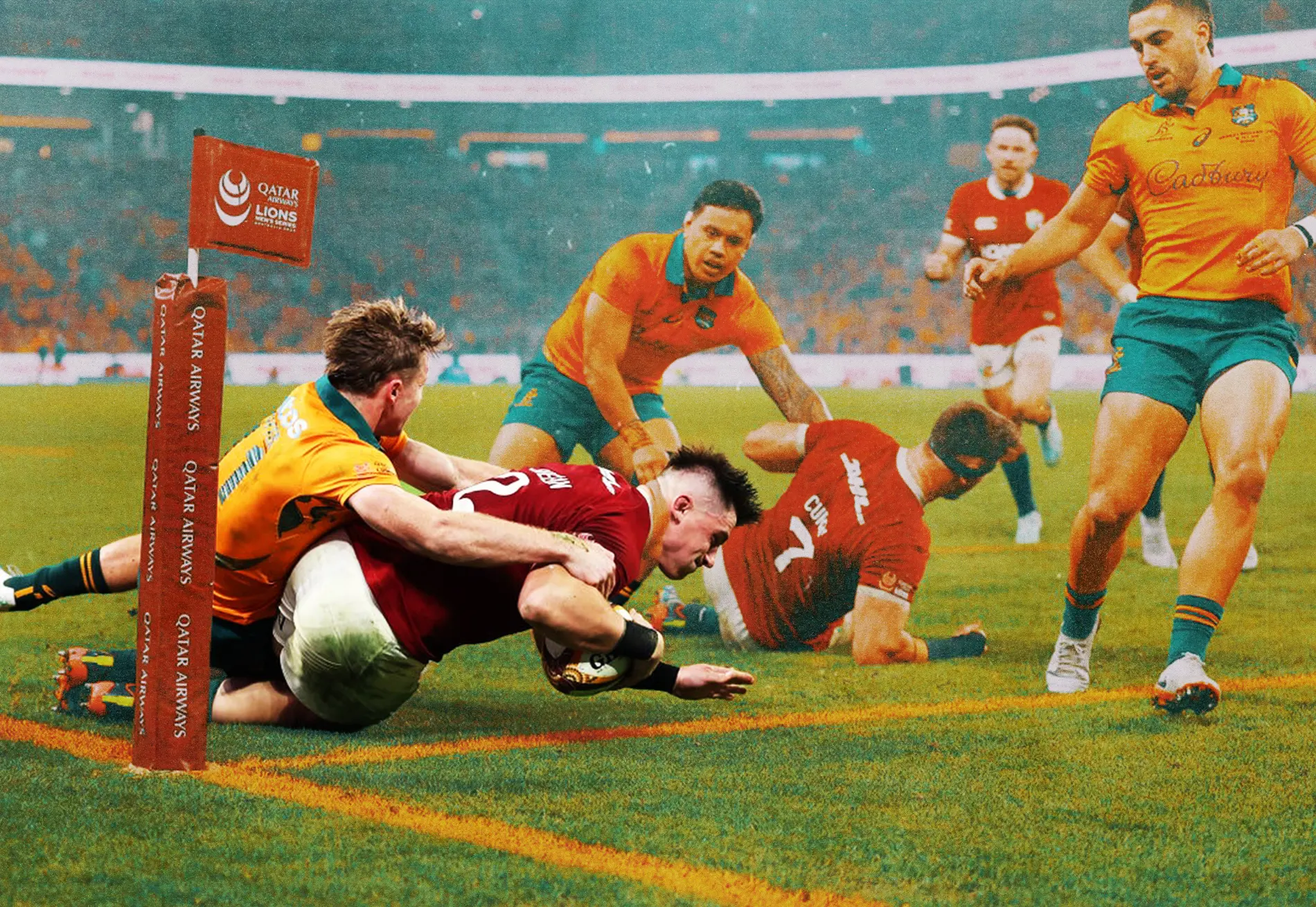
That was the aim, of course. That feels like a truism; every team intends on winning a series, but the Lions needed a win here after a winless last two tours. All they’ve spoken about since the start of this cycle is winning this series, which, to be fair, the Lions have tended to do historically and contemporarily. The Lions have a losing record against the Springboks and the All Blacks, but have won seven out of nine tours to Australia. Beating the Wallabies here not only enriches everyone involved on the playing side of the tour, but it also does the usual 12 year job of showing that the Lions can actually win these tours, and thus that they are viable threats.
But Andy Farrell won’t be thinking about that.

He’ll be thinking that, by hook or by crook, any win this weekend secures him a slice of history and a chance at winning 3-0 in Australia. The last head coach to do that for this team was Arthur O’Brien way back in 1904. Farrell has taken risks with this selection in key areas — some injury forced, some not — that risk blowing up in his face for the series if the Lions lose, but he’s going to gamble against a Wallabies side he perceives as weak and not in the Lions’ weight class.
One way or the other, someone is going to be vindicated this Saturday at the MCG.
Lions: 15. Hugo Keenan; 14. Tommy Freeman, 13. Huw Jones, 12. Bundee Aki, 11. James Lowe, 10. Finn Russell, 9. Jamison Gibson-Park; 1. Andrew Porter, 2. Dan Sheehan, 3. Tadhg Furlong, 4. Maro Itoje (c), 5. Ollie Chessum, 6. Tadhg Beirne, 7. Tom Curry, 8. Jack Conan.
Replacements: 16. Ronan Kelleher, 17. Ellis Genge, 18. Will Stuart, 19. James Ryan, 20. Jac Morgan, 21. Alex Mitchell,22. Owen Farrell, 23. Blair Kinghorn.
Australia: 15. Tom Wright; 14. Matt Jorgensen, 13. Joseph Sua’ali’i, 12. Len Ikitau, 11. Harry Potter; 10. Tom Lynagh, 9. Jake Gordon; 1. James Slipper, 2. Dave Poreki, 3. Allan Alaalatoa, 4. Nick Frost, 5. Will Skelton, 6. Rob Valeteni, 7. Fraser McReight, 8. Harry Wilson (c).
Replacements: 16. Billy Pollard, 17. Angus Bell, 18. Tom Robertson, 19. Jeremy Williams, 20. Langi Gleeson, 21. Carlo Tizzano, 22. Tate McDermott, 23. Ben Donaldson.
For the Wallabies, they have two key areas to adjust.
The first is winning some key collisions on either side of the ball, something they didn’t really manage when the game was truly in the balance in the first test. For the most part, this comes back to personnel, because at a base level, they lost almost every man-on-man engagement, and didn’t help their case in most collisions with tight latching.
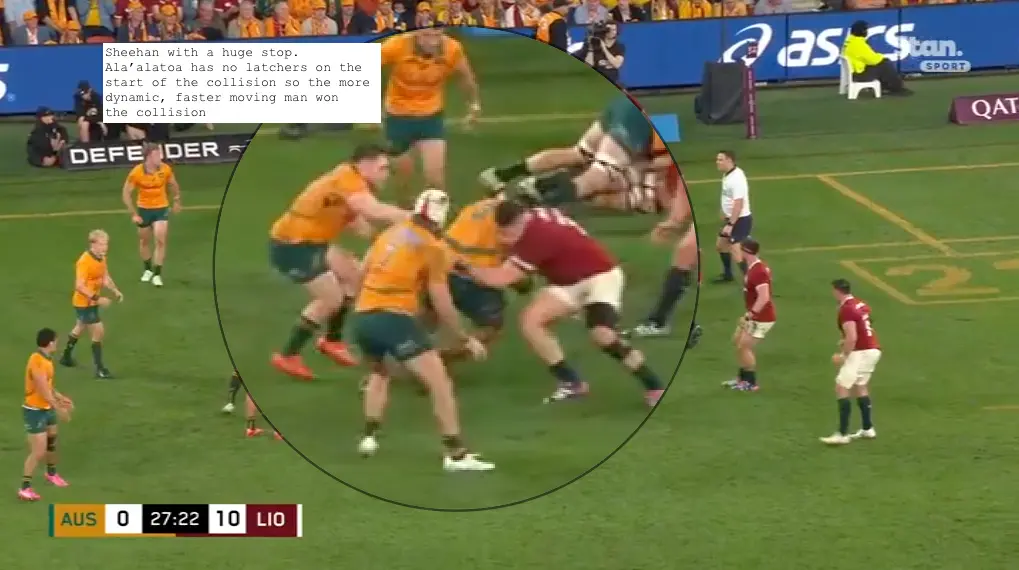
The Wallabies played really tight rugby, especially in that first half, but hit collisions like they were in open space and got stuffed almost every time. No latching, no two-point collisions, just gold jerseys running into a red brick wall.
The Lions will mop that up all day, and that’s mainly down to two reasons: one, the Lions kicked at a pretty high volume, so they mostly defended on their terms, but they did so with an early 10-point lead, so the Wallabies were always chasing ground. Rob Valetini and Will Skelton will improve the Wallabies’ ability to win these tight collisions on Saturday morning, but they have to be winning those collisions closer to the try line.
That’s probably the biggest thing the Wallabies need to change.
From a data perspective, I have three main work-ons for the Wallabies ahead of this test.
What Australia Need to Adjust for Test 2
Option A: Increase 22 Entries (+2 minimum)
Why it matters:
Australia only managed 7 attacking entries in the first test. Historically, their best wins against Tier 1 opposition—England, Georgia, the third Wales test—come when they breach the 22 at least 9 times.
Tactical Paths to More Entries:
- Play with a quicker tempo off set-piece, especially off lineout platforms. Against the Lions, delaying phase 1-3 saw momentum stall.
- More attacking kicks (grubbers, crossfields) to force lineouts in the 22 rather than playing multiple phases into it.
+2 attacking entries could yield +5.4 net points (based on Australia’s recent attacking average of 2.7 pts per entry in Test 1).
Option B: Limit Lions’ Entries (≤7)
Why it matters:
The Lions had 9 attacking entries in the first test. When they stay at or below 7, their scoring drops to under 2 tries/game on average. That keeps the scoreline within reach, even with modest attacking output.
Tactical Adjustments:
- Choke the kicking game: Australia must contest more aggressively in the air. A 6.8:1 pass-to-kick ratio left them vulnerable to being turned around repeatedly.
- Counter-ruck more selectively: Too much commitment to breakdowns exposed Australia in defensive transition. Better to fan out defensively and deny easy width.
- Shortened defensive lineouts: Keep an extra man wide to deny edge breaks off first phase — a clear feature of the Lions playbook under Farrell.
If the Lions get held to ≤7 entries and Australia can hold them to 2.0 pts/entry or lower, Lions’ total drops to ~14 pts — a winnable threshold.
Option C: Convert Possession into Territory More Efficiently
Why it matters:
Australia played high-phase, possession-dominant rugby in Test 1 with a 6.8 passes-per-kick ratio, but it translated to very few entries and more long-distance pressure.
By contrast, the Lions kicked early and shaped territory, forcing Australia to play from deep. The result: more rucks (116 to 78), fewer entries, and less efficient scoring zones.
What Needs to Change:
- Kick earlier and smarter — especially exit kicks off 9 with aggressive chase (McDermott to Sua’ali’i and Jorgenson).
- Use touch-finders from midfield to force Lions lineouts in their half.
- Exploit zone-kicking: chip behind the wings or into the coffin corner with kick pressure to generate errors or quick lineouts.
Reducing to ~4.5 passes/kick (closer to Lions’ 4.1) would let Australia play more rugby in the right zones, even if they have slightly less ball.
Combined Impact: The Test 2 Blueprint
| Adjustment | Impact | Why it works |
|---|---|---|
| +2 Attacking Entries | +1 try’s worth of points | Historical strike rate supports it |
| -2 Lions Entries | -1 try conceded | Keeps game within a two-score range |
| More Tactical Kicking | More 22 entries, less fatigue | Territory-first rugby wins in tight tests |
This isn’t about more ball. It’s about where and how the ball is played.
Australia tried to control Test 1 with possession and ruck dominance, but the Lions don’t play that game. They’re a kick-pressure-transition team, and that style won out on the scoreboard and territory.
Australia must:
- Be more brutal in transition,
- Kick more cleverly, and
- Get into the 22 more often, not just with structure, but via disruption.
Because right now, the scoreboard efficiency gap between the two teams is narrower than it looks — but territorial discipline is what decided the first test.
The first two options are self-explanatory; get one or two more 22 entries, deny the Lions one or two at the other end, and if the normal efficiency rate holds, the Wallabies can flip that two-score differential they were struggling against for almost the entire game.
Defensively, they can probably help that by competing a little less at the breakdown and playing with a higher blitz line. That comes with risks, yeah, but surely defending this passively against multiple layers of runners comes with more.
This play didn’t work for the Lions, but it came off the back of a box kick exit that, again, was defended incredibly passively on transition.
Surely you shut down this outside space? By staying flat, you give Finn Russell — a good runner but far from the most explosive — a passive shoulder to hit because you must worry about the space outside him.
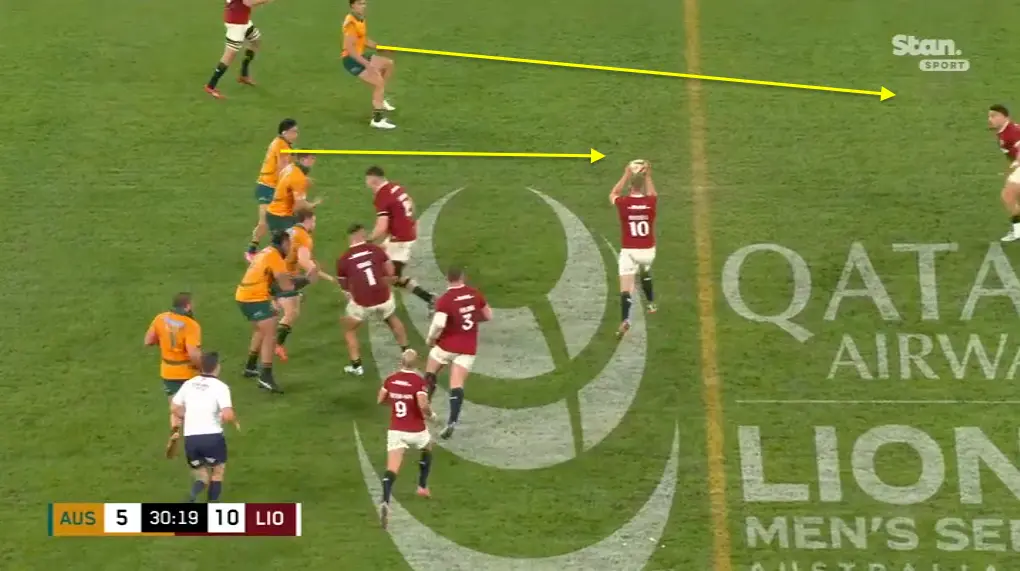
If they compete less often at the breakdown, you have more options to flood this zone. Again, the way Australia defended against Ireland in November 2024 — which they did not do here — has already shown that it can be successful against Farrell’s layered attacking system.
The biggest factor in the Wallabies keeping the series alive is Option C. This relates directly to their kicking volume. In the first half, Australia only had four attacking possessions start inside the Lions’ 10m line.
One scrum, one turnover, two lineouts (that was lost, one was scrappy, leading to a tight series of phases that got stuffed). Their try in the first half came from a 50/50 on a contestable breaking decisively in their favour, but that’s no way to build into a test match.
How do you get better launch points? You kick more aggressively and force the Lions to exit to you at a volume you can work with.
Squeeze the ground, win the game.
