


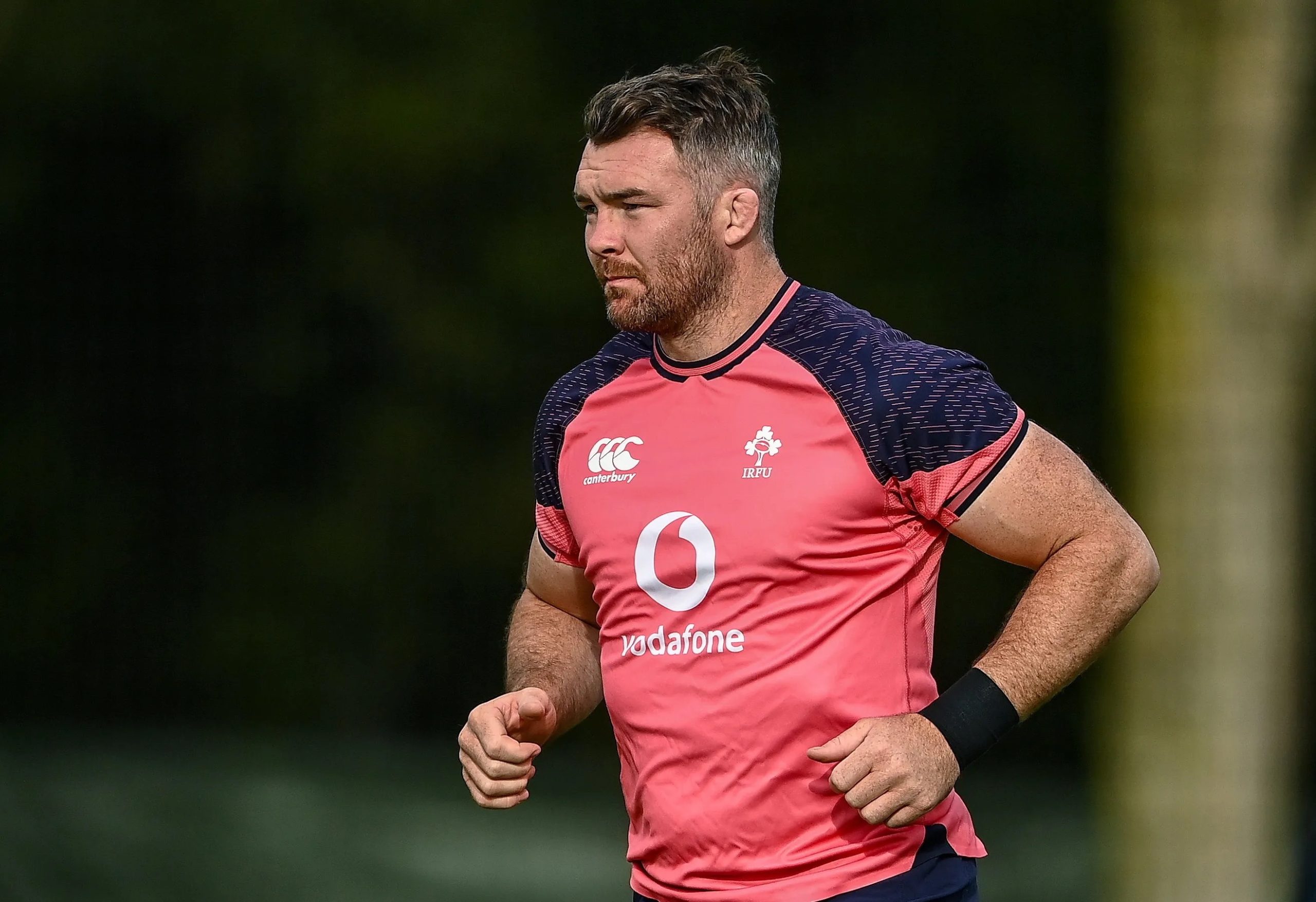
Scotland and Ireland hate each other.
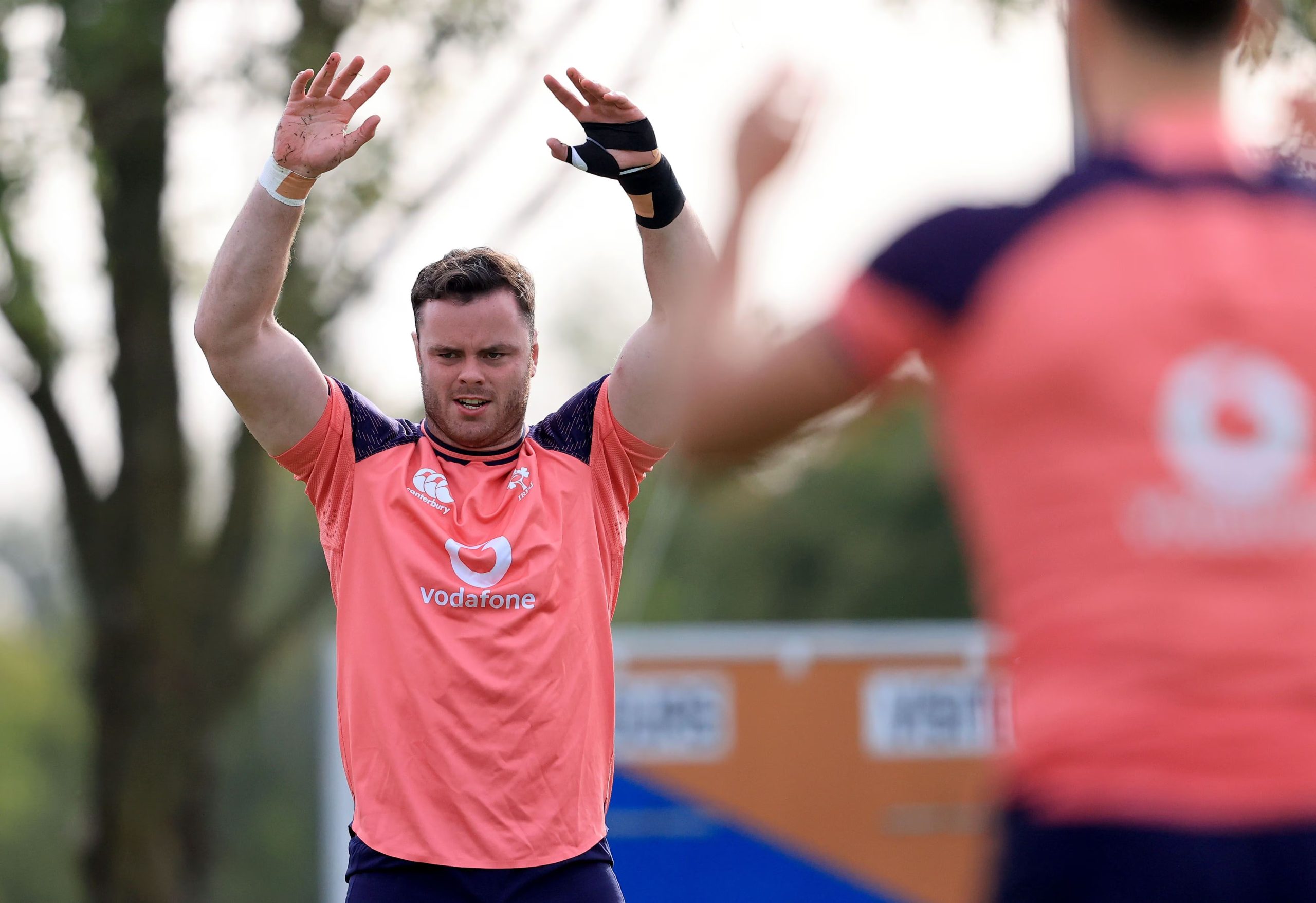
Understanding why is… difficult. I know that this game is on my Can’t Lose list, even more so than the Boks game last time out. Why is that? Ireland have lost once to Scotland in the last 10 years. Ireland beat Scotland back in March with Josh Van Der Flier throwing into the lineout and Cian Healy scrummaging at hooker.
Yet, this game has more venom on the line than a top-of-the-world clash against South Africa as far as I’m concerned.
But why?
Jean Kleyn spoke a little bit about this week in the media.
“There’s a little bit of animosity between the Irish and the Scots and there always has been, especially from a rugby perspective. At club level, you look at teams like Munster and Glasgow there’s always been this underlying – I wouldn’t call it hatred – but there’s a little bit of knife in the back.”
Jean, my guy, I have to disagree with you.
“I wouldn’t call it hatred.”
I would.
Munster and Glasgow hate each other, but we’re far from alone in that. Connacht, Leinster and Ulster have all had different levels of run-ins with Glasgow – and to a lesser extent, Edinburgh – but provincial-level niggle jumping up to test level doesn’t quite cut it.
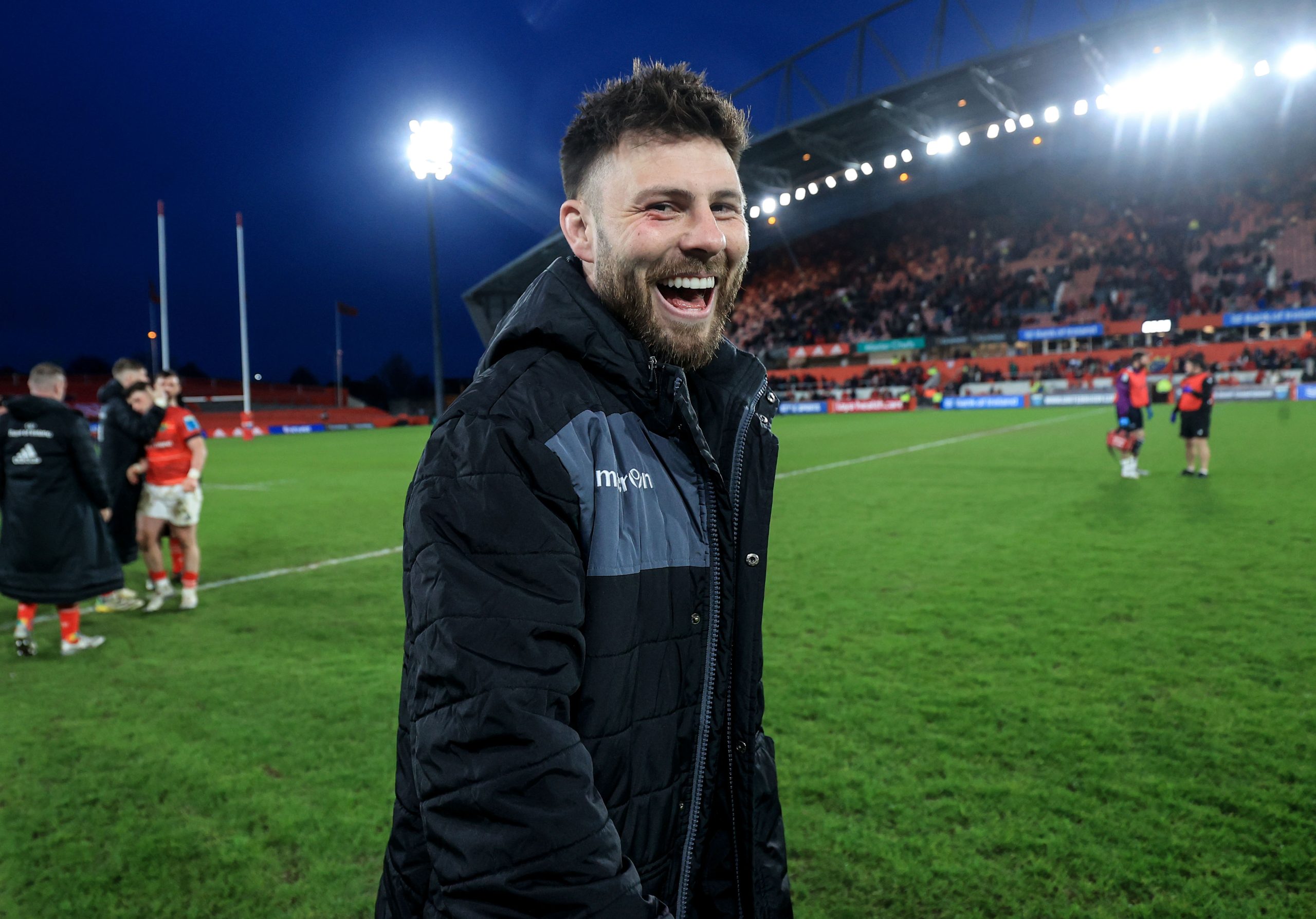
In 2019, we ended their World Cup knockout bid before it even started with a dominant win. They’d been talking themselves up all summer but it ended the same way – Ireland won, Scotland lost.
In the four years since, Scotland have picked up big wins over England, France and Wales in multiple Six Nations, went on a great run that looks like it might end in a Triple Crown or even a Six Nations title… only to lose to Ireland home and away. Every. Single. Time.
Can you blame them for hating us?
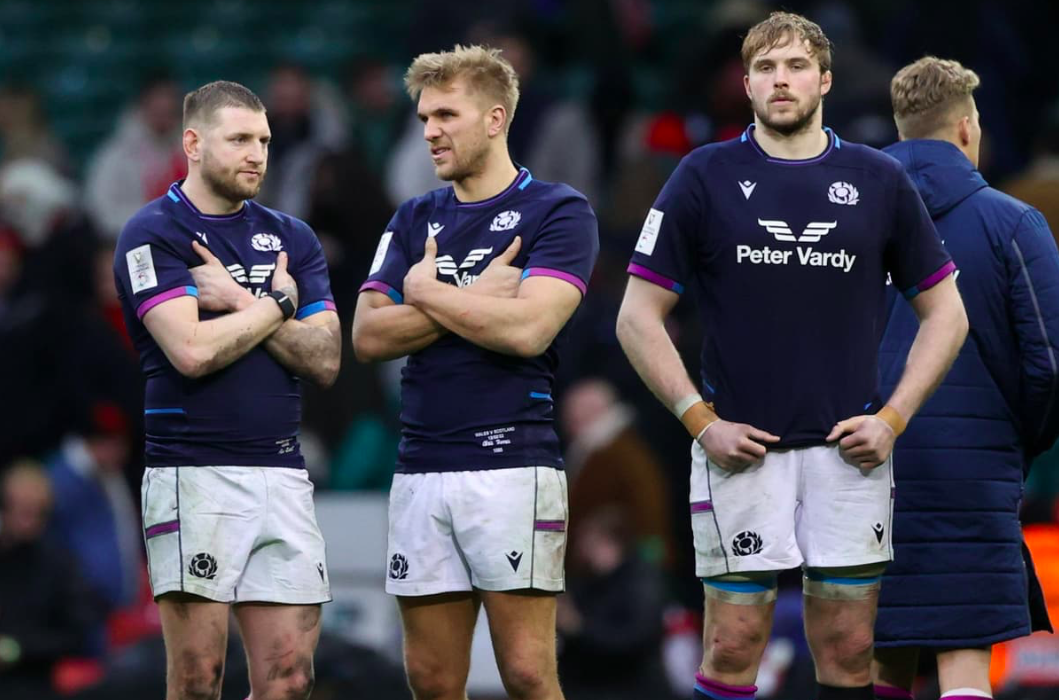
I’d hate us too, in their place.
Some people have tried to convince me that we hate Scotland because they voted for France in the World Cup bid for this very World Cup but I don’t buy that. I think we hate them because they hate us. Glasgow weren’t shit when I was growing up. They were a nothing team that I would expect Munster to beat every single time come what may. I remember when we were playing them in a PRO12 final in 2015 and you know what I thought? Light work.
But they weren’t light work. They hammered us. It’s like they felt my disrespect through the TV screen and shoved it back my throat. On a grander scale, I feel that’s where the Scottish resentment – if that’s the right word – comes from. We don’t rate them and it kills ’em. Worse again, they know how dismissively the Irish rugby bubble talks about them over here and that, as of yet, they’ve been unable to shut us up when it counts.
I also think that the Irish Rugby bubble’s hubris – let’s call it what it is, we’ve earned it – resents that Scotland still sees themselves as rivals to us when we’re looking at France, South Africa and the All Blacks as our peers.
And this Saturday night, one of two things will happen.
Scotland will finally land a knockout blow on Ireland that could send us out of the World Cup.
Or.
Ireland will slap Scotland around, toss them out of the World Cup like Uncle Phil toss Jazzy Jeff out of his house on the Fresh Prince before leaning into the mic and saying for the entire world to hear.
“Light work”.
Ireland: 15. Hugo Keenan; 14. Mack Hansen, 13. Garry Ringrose, 12. Bundee Aki, 11. James Lowe; 10. Johnny Sexton (c), 9. Jamison Gibson-Park; 1. Andrew Porter, 2. Dan Sheehan, 3. Tadhg Furlong; 4. Tadhg Beirne, 5. Iain Henderson; 6. Peter O’Mahony, 7. Josh van der Flier, 8. Caelan Doris.
Replacements: 16. Rónan Kelleher, 17. Dave Kilcoyne, 18. Finlay Bealham, 19. James Ryan, 20. Jack Conan, 21. Conor Murray, 22. Jack Crowley, 23. Stuart McCloskey.
Scotland: 15. Blair Kinghorn; 14. Darcy Graham, 13. Huw Jones, 12. Sione Tuipulotu, 11. Duhan van der Merwe; 10. Finn Russell, 9. Ali Price; 1. Pierre Schoeman, 2. George Turner, 3. Zander Fagerson; 4. Richie Gray, 5. Grant Gilchrist; 6. Jamie Ritchie (c), 7. Rory Darge, 8. Jack Dempsey.
Replacements: 16. Ewan Ashman, 17. Rory Sutherland, 18. WP Nel, 19. Scott Cummings, 20. Matt Fagerson, 21. Luke Crosbie, 22. George Horne, 23. Ollie Smith.
Scotland are something of a conundrum in that they have all the hallmarks of a counter-transition team – the long kicking metres off #10, the light back five build, the defensive transition specialists – while also showing a lot of on-ball team tendencies.
To break it down at its best, Scotland will kick really often and really long off Finn Russell, primarily. If you run the ball back, their back row of small forwards will stuff you in the tackle before your forwards make it back in line with your run, which forces a turnover – they then play off that turnover where they’re really dangerous or they win a penalty.
If you decide to kick it back, they have a transition unit in Darcy Graham, Blair Kinghorn, Duhan Van Der Merwe, Finn Russell, Huw Jones and Sione Tuipulotu that will absolutely tear you up on the first phase of a kick return.
They will then tend to go into long on-ball sequences – far longer than traditional counter-transition teams – with Finn Russell, in particular, looking to find the perfect pass or kick or offload that breaks open your defence on phase 10, or 15, if needs be. In the last few years, Russell has matured quite a bit with some of his decision-making in spots like this but if Scotland gets good tempo ruck to ruck – and they often do because they play with a lot of width – they’ll keep playing even beyond the point of what would be described as “sensible” if they smell a try.
At least initially, there will be a lot of pressure on transition rucks and the first few phases of post-transition phase play. This is where Ireland and Scotland are both really good. Defensively, Scotland are a little more vulnerable to conceding directly off a kick return but not by much. They have the back row and midfield to cover a lot of ground and they’ll be looking to hurt Ireland with defensive breakdown penalties.
Our breakdown work will almost be more important against Scotland than it was against South Africa.
To get a better look at how that might play out, I’ve brought a feature I usually use on the €10 tier to the everyone tier to illustrate what I mean.
We need to look at the last few relevant games to get a better read of where and how Ireland might go against Scotland at the breakdown. I’ve focused on our most recent Tier 1 opponents to eliminate the noise generated by the blowouts over Romania and Scotland. Now, a quick note that you’ll notice later is that I included Samoa in the metrics, despite them being a Tier 2 side. I did this because of the difficulty Ireland had in that game against a hugely physical opponent in horrible weather conditions and felt it was credible enough to use in my calculations.
First, let’s look at the individual Offensive Ruck Work scores from our last game.
IRELAND’S OFFENSIVE RUCK WORK SCORE vs SOUTH AFRICA
- A Dominant Clean is an action that decisively secures possession when the ball carrier takes contact. A Dominant Clean does not have to be the first arrival at the breakdown but it is rewarded in the context of effectiveness. We will assign this action 3 points.
- A Guard Action is where a player plays a role in helping to retain possession after we have “re-won” the ball on the floor. Sometimes this can happen on a carry/ruck point where there is no active contention by the opposition. Let’s assign this action 2 points.
- An Attendance can be anything from standing as a “kick shield” on a ruck to adding a bit of bulk to ward against a counter-ruck. I’m marking this down as being worth 1 point.
- An Ineffective Action is a blown cleanout, a lean, a breakdown penalty or an action that I couldn’t see any direct benefit for. This will be worth -2 points.
| Dominant Clean | Guard Action | Attendance | Ineffective | Ruck Work Score | |
|---|---|---|---|---|---|
| Porter | 1 | 9 | 5 | 1 | 24 |
| Kelleher | 1 | 9 | 1 | 19 | |
| Furlong | 2 | 16 | 5 | 1 | 41 |
| Beirne | 4 | 17 | 1 | 44 | |
| Ryan | 6 | 3 | 5 | 5 | |
| O'Mahony | 3 | 3 | 15 | ||
| Van Der Flier | 2 | 25 | 3 | 2 | 55 |
| Doris | 7 | 11 | 1 | 1 | 42 |
| Gibson-Park | 2 | 1 | 8 | ||
| Sexton | 1 | 3 | |||
| Lowe | 1 | 3 | -4 | ||
| Aki | 2 | 11 | 1 | 1 | 27 |
| Ringrose | 2 | 6 | |||
| Hansen | 1 | 3 | 9 | ||
| Keenan | 8 | 1 | 14 | ||
| Sheehan | 1 | 4 | 11 | ||
| Kilcoyne | 0 | ||||
| Bealham | 1 | 2 | |||
| Henderson | 1 | 3 | 9 | ||
| Baird | 1 | 2 | |||
| Murray | 0 | ||||
| Crowley | 0 | ||||
| Henshaw | 2 | 4 | 14 |
Top Five ORW Scorers
- Josh Van Der Flier – 55 points
- Tadhg Beirne – 44 points
- Caelan Doris – 42 points
- Tadhg Furlong – 41 points
- Bundee Aki – 27 points
When we break down the overall numbers, we can start to see the pattern of the game emerging and, by focusing on individuals, we can start to see how we engaged the South African defence.
The first player under the spotlight is Ireland’s Canary in the Coalmine – Peter O’Mahony.
The Irish #6 role requires a few specific jobs to be done but the primary one is that of the edge forward;
If you watch Ireland on settled phase play, you’ll often see Peter O’Mahony as the furthest forward away from the previous ruck holding the edge of the play. What does this mean? Well, it’s not minis rugby so all of the players – forwards in particular – have specific zones of the field that they will generally operate in depending on their own skill-set and athletic profile.
Peter O’Mahony is deceptively quick, an incredibly aggressive and accurate offensive breakdown operator and he’s got excellent handling ability with offloads, short and even mid-range passes in his locker. That’s why he’s in the edge forward role but how does he end up there?
O’Mahony is one of our core lineout forwards and he’s either a lifter or a jumper on the majority of our lineouts. After completing the lineout, he progresses to the nearest touchline and waits for the ball to hit his zone. He doesn’t “go looking for work” because, once again, this isn’t minis rugby and his job is to run that space. If the ball goes there and he’s not in that space to either carry, pass or secure the breakdown, he’s not doing his job.
When this Irish team are playing at their best, they hit that zone quite regularly so O’Mahony’s offensive breakdown involvements naturally increase as a result.
With an ORW score of 15 here – and more direct carries of the ball than we’d usually expect from O’Mahony – we can take it that Ireland struggled to move the ball to the wide areas, almost as a direct result of South Africa’s edge blitz. That action naturally compressed Ireland’s play and put a lot of pressure on our middle-line forwards to win collisions and impose themselves at the breakdown – most of them did just that, and then some.
The Big Four
Furlong, Van Der Flier, Beirne and Doris had top-quality games.
As I watched Ireland vs South Africa progress, I could actually watch how Andrew Porter was minding his involvements to ensure he stayed properly conditioned for the scrum. Ronan Kelleher was in the same boat, in some ways, but Porter really managed his energy well against South Africa and, as a result, he scrummaged really strongly. Your output around the field is linked to your performance at the scrum, especially when you’re an athlete like Porter who Ireland expected to play 70 minutes plus.
Furlong, on the other hand, took up a lot of the breakdown output load to compensate. Furlong has moved away from the all-singing, all-dancing ball carrying that might have been a feature of his game a few years ago but he’s replaced it with a very active breakdown game when he’s at his best. The sixteen guard actions he showed here showcase a modified role for him – an inside barrel cleaner on the pod. He’s still able to exert a lot of physical pressure on the opposition but he’s not needed to truck 6/7 carries per game at 120kg+. Against Pierre Schoeman, I’d expect those numbers to be reversed, however, as Schoeman has a body type that’s more suited to causing Furlong problems than Kitshoff. In scrummaging, styles make fights and Porter should – in theory – be able to up his involvement around the field when he’s packing down against Fagerson.
Josh Van Der Flier, Tadhg Beirne and Caelan Doris basically carried the load for the middle line of the Irish pack, ably assisted by Hugo Keenan and Bundee Aki. One of the big standouts of this game, actually, was how well Aki and Keenan imposed themselves at the breakdown, and how well they were able to cover from their starting central positions in the Irish system.
South Africa forced Ireland to play a more compressed, claustrophobic game than we would have liked but we had the firepower to compete. Van Der Flier racked up massive numbers in his usual ruck-tracking role and had a game-high 32 involvements with an excellent 0.58 ORW per involvement. It’s incredibly rare that Van Der Flier wastes energy at the breakdown and if you want an example of what I mean, just watch this game back. Time after time, ruck after ruck, he snaps in and creates an offside line with the bare minimum of energy expended in his line running and his entries. He is efficiency personified.
That efficiency going to be massively important against Scotland who have a back five selected specifically to beat us to the punch on these progression rucks and Josh Van Der Flier is one of the best in the business at winning the race to the ball carrier, even if he’s out of position.
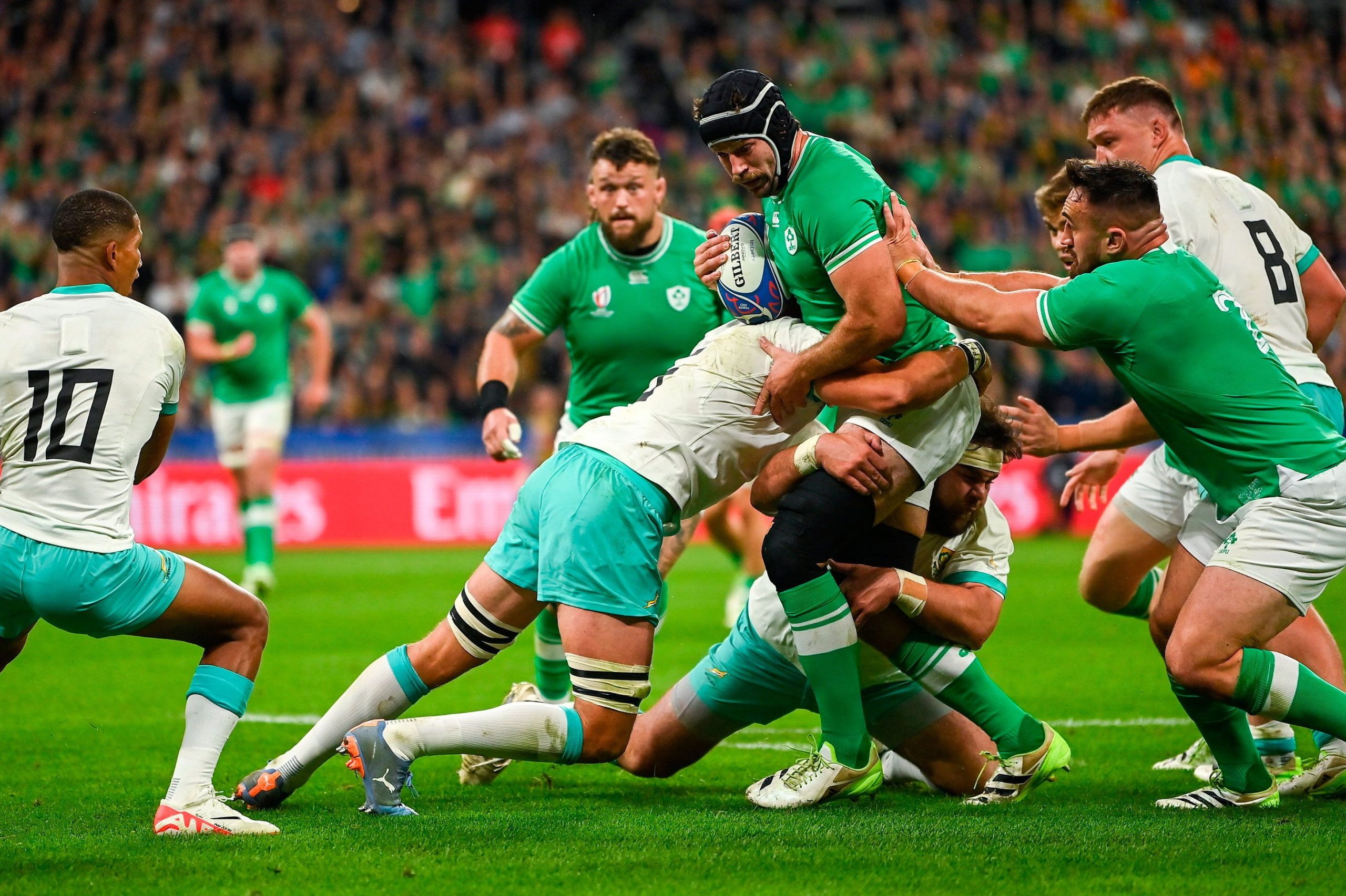
Caelan Doris is the purest example of a Heavy Combo Flanker out there right now in that he’s more than capable of taking on a primary ball-carrying role while also maxing out his offensive and defensive breakdown contributions. The ground he covers alone would make your Fitbit explode but when you include how decisively and powerfully he played against South Africa to prevent their counter-ruck game from taking shape, you’ve got an all-timer of a performance. Scotland’s defensive breakdown focus is a large part of the game but Doris’ whole pitch coverage will be a constant threat on both sides of the ball for Ireland to utilize.
Tadhg Beirne’s output against South Africa is exactly what we’ve come to expect. He just does everything and he’ll be needed to do the same against Scotland. A bit like Porter, you can see the spans of time when Beirne takes his foot off the pedal to ensure he gets the full 80 but when he does get involved, it’s almost always quality and his average ORW per ruck action is a very respectable 0.5.
When South Africa cut off regular access to the edges, these four forwards ensured that the green machine kept turning, even against one of the most physical defences out there.
If we map our rolling Collective ORW average for the four quarters of the game onto the previous games I earmarked, we see a clear picture emerging of our patterns.
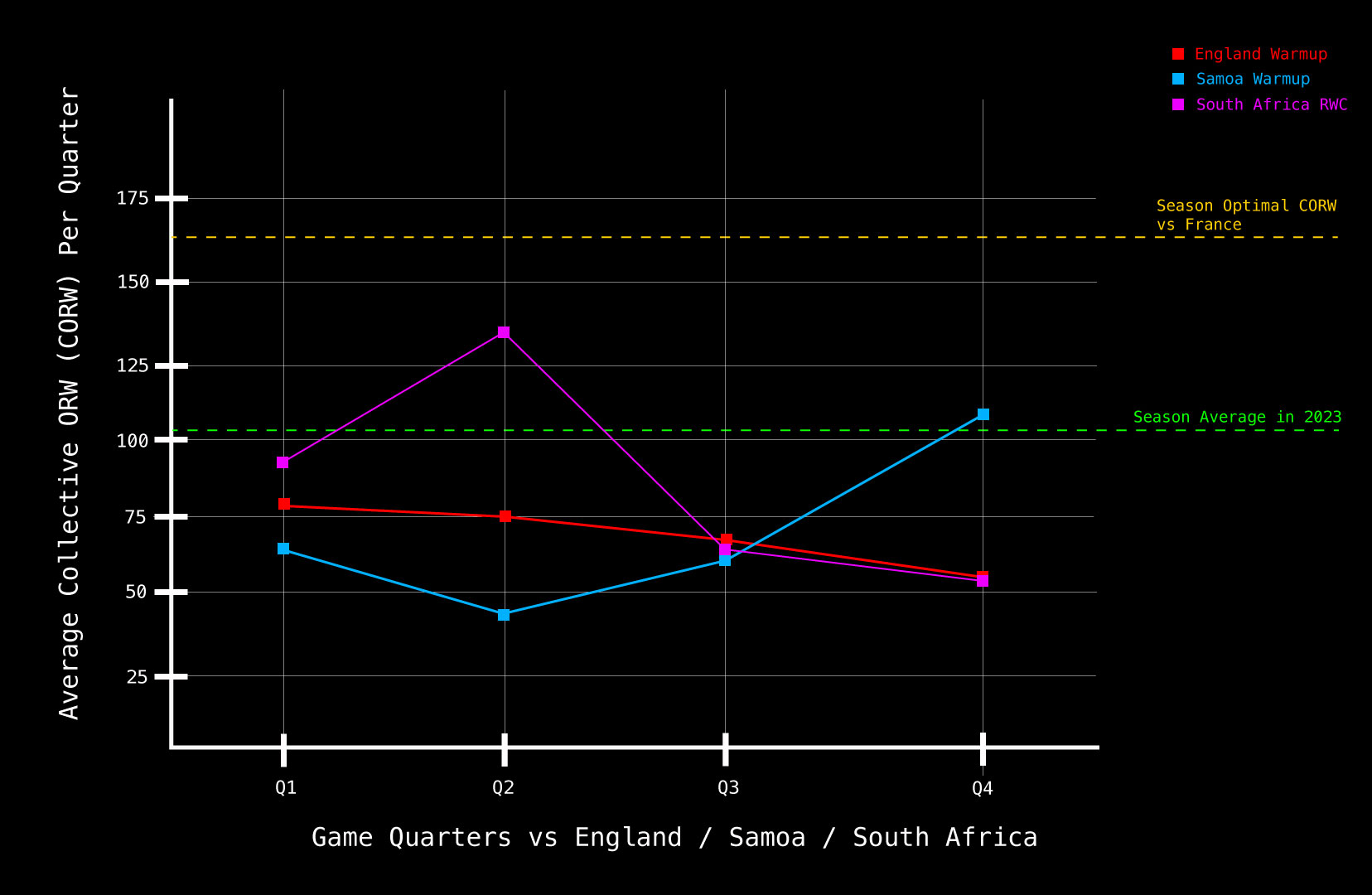
Our first quarter in all three mapped games is quite similar, our second quarter against South Africa won the game for us, essentially, but our third and fourth quarters have seen a fairly similar drop-off, with the Samoan game as an outlier.
A similar return to the South African game against Scotland should see a comfortable win, even with the second half drop off.
The James Ryan Conundrum
By now, you’ll have noticed James Ryan’s ORW score of five, for an average ORW score per ruck action of o.3 which is really poor. It’s one of the worst offensive breakdown performances I’ve seen from him. In the last two years, Ryan’s offensive breakdown work has been defined by inefficiency. What do I mean by inefficiency?
- Diving off feet on rucks that we’ve already won, taking himself out of the next phase needlessly.
- Risking a penalty by flopping into rucks or shooting in from oblique angles
- Making a decision early on an entry but not being able to adjust when the picture changes
I don’t know if Ryan has been rotated to the bench off the back of his performance against South Africa – poor offensive breakdown + muddled lineout calling + a wrist niggle last week – or if it’s a decision to bring the energy and undoubted defensive physicality he brings at his best in the last third of the game.
Ryan’s lineout calling is also a problem, in my opinion. He has a tendency to over-call throws on himself, even when he’s heavily marked and sometimes I feel he can start double-crossing himself in his decision-making on calls. In this instance, for example, Ireland have a key lineout opportunity in the South African 22 but the South Africa managed a steal to relieve the pressure.
But look at the picture right before Ryan makes the call to throw to the tail – itself a risky call given Ireland’s issues in the lineout to that point – and you’ll see a key danger. Franco Mostert, South Africa’s best counter-jumper on the field at that point, with Frans Malherbe bound on him for an immediate launch on the throw.
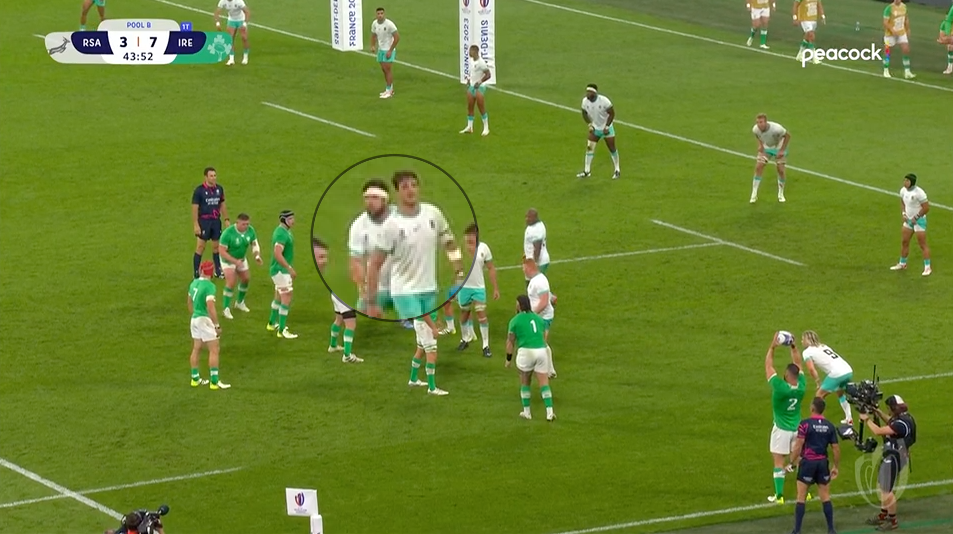
At that point, Ryan should – in my opinion – realise the space that he has to step back to Furlong and that O’Mahony has to step forward into is too far in both cases for a high-velocity contested jump. The call has to be the alt-option; Beirne at the front lifted by O’Mahony at the back and Porter at the front.
Ryan calls it on himself – he wants the responsibility, which is never a problem with him – but his speed into the air isn’t what it needs to be. You’ll often see Ryan just missing out on a pace throw to the middle or the back of the middle because his speed into the air isn’t what it needs to be for those throws. I think he is a little miscast, both by O’Connell and perhaps his own read on his game, as a contested middle-line jumper when he’s a banker front-ball guy at this stage of his career.
The problem is that Ryan’s status demands he be the pack leader and lineout caller when he’s on the field. That isn’t to say that Iain Henderson is better – I’m not sure he is – or that Beirne is ready to do it after only a year or two of experience calling for Munster. I think as the pressure gets higher and the competition increases, our lineout will only come under more pressure and sooner or later, we’ll come across a team who realises that hurting our lineout is best done by limiting the number of lineouts we have and hurting our completion of those.
By the same token, I think Scotland are vulnerable to the exact same sort of lineout pressure and if we want to get the ball off the field on longer transition sets, Beirne and O’Mahony, in particular, can get real joy out of attacking Gray in the middle.
With that in mind, Scotland is a decent defensive lineout team in the air but if we manage to get around Gray, Gilchrist and Ritchie, we can hurt Scotland again and again on the lineout. It’s why our calling of the lineout is so important in this game. From a transition perspective, we’re very evenly matched on the offensive and defensive side of the ball with Scotland. The biggest potential mismatch for us is, for me, attacking Scotland in the maul and off-maul feints going after Russell, Tuipolotu and Jones as a unit.
There are a lot of scores and critical breaks of 5+1 lineouts with the threat of Doris and Aki, especially as Scotland will be headhunting Sexton early on. I think he’s crabbit enough to use that against them at least two or three times, and no better place than off the lineout. Look for a three-phase strike play that works Aki between Schoeman and Fagerson on the same side as the original lineout.
I can’t wait to see how it all turns out.
