



This current iteration of Scotland has a mental block with this current iteration of Ireland.
This is not unusual in the history of both nations. Between 1986 and 1999, Ireland only beat Scotland once, drew once, and lost six times, then five times in a row with that 6-6 draw in 1994 sandwiched in the middle. It’s hard to believe now, but for the guts of 15 years, we looked at Scotland the way they now look at us.
The quality gap was bigger back then. Ireland in the 90s, as we’ve covered at length, were Not Great. Scotland were, genuinely, very good. For most of the 90s, I was more preoccupied with the Teenage Mutant Hero Turtles — someone over here didn’t like the negative connotations of “ninja”, so they were called “hero” turtles — and Batman, The Animated Series, so I wasn’t all that bothered about what Ireland did (lose) or didn’t do (win) in that time. I can guess, though.
Losing to Scotland almost every single time was a sign that we were always second-rate, third-rate on a bad night. Not that Scotland weren’t good, but they weren’t New Zealand, or England, or Australia, or France; we almost expected to lose to those sides, but Scotland’s continued dominance in the Five Nations, as it was, told us, every year, that we can forget about ever being a top side because if we can’t ever beat them, it’s all for nothing.
In 1987, we beat England 17-0 in Lansdowne Road — great! — but then lost to Scotland in Murrayfield in the next round, who would go on to lose to England in the rescheduled Calcutta Cup game at the end of the tournament.
We finished second that year.
In 1993, we lost to Scotland in Murrayfield in the opening round — par for the course — before beating Wales away and then England again in the last round.
In the last 15 years, it’s been completely reversed, but with a twist. In that time, Scotland have beaten almost everyone else bar the Springboks and the All Blacks repeatedly — France, England (over and over again), Wales, Australia, Argentina — but they haven’t beaten Ireland since 2017. If we go back to the last time we had something close to parity, it was between 2009 and 2013, when we traded wins back and forth.
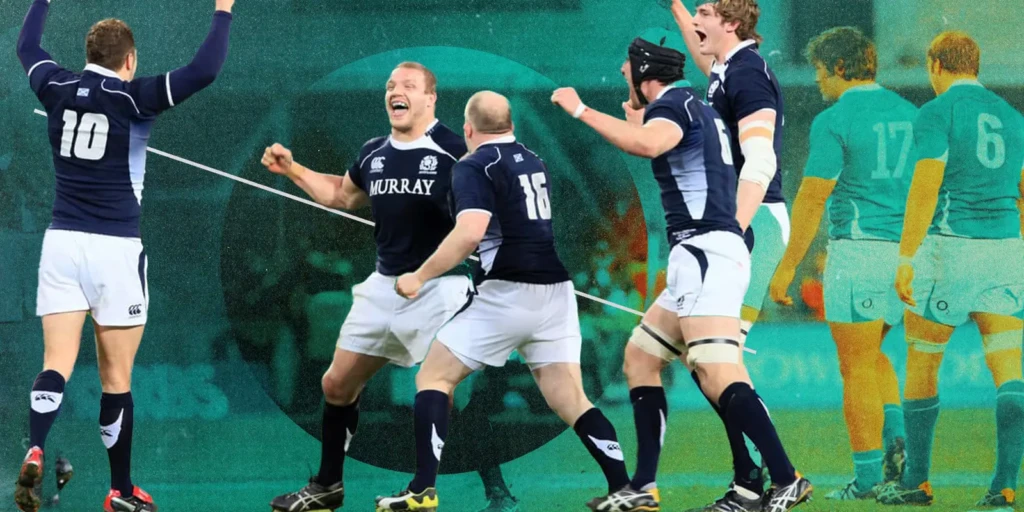
Since 2014, twelve years this Saturday, Ireland and Scotland have played sixteen times, and Scotland have won just two of those games.
It’s a complete anomaly, especially lately, because Scotland are good. At their best, they’re great. Go through their team, and you’ll start checking off the names of British & Irish Lions, top players playing for big bucks at big clubs, and a lot of guys playing for the side that finished #1 seed in the pool stages of this season’s European Cup.
They should have beaten Ireland more — especially at home — in the 2020s, but they simply didn’t. Year after year, Ireland have been playing well, poorly, somewhere in between, but it didn’t matter. The result stayed the same.
Last season, Ireland were objectively playing pretty average stuff heading into Murrayfield, but somehow, Scotland conspired to make us look like world beaters, aided by Finn Russell and Darcy Graham concussing each other 20 minutes into the game, right after Duhan Van Der Merwe copped ten minutes in the bin for a needless yellow card.
They went 17-0 down in the first 20 minutes, and they were never able to make that score back.
They’re plenty good enough to win this game on Saturday. They’ve just come off back-to-back home games where they’ve slapped 81 points on England and France combined. But will they?
In Ireland — well, in the Irish Rugby Media, which is a different beast to most people — Scotland are “windy”. They love talking themselves up, by all accounts, something you’d never see the Irish Rugby Media do about Ireland. They simply would not be capable of it, not in the Best Small Country in the world to do rugby production lines in. So every subsequent defeat that came Scotland’s way was further proof of their delusion.
Thinking about it now, it reminds me a lot of Ireland’s relationship with the All Blacks in the middle of the 2020s. We were good enough to beat them — a few times we almost did — but we always, every time, found a way to lose.
Until we didn’t.
Are Scotland ready to take that step this weekend, when a win could mean a shot at winning a Six Nations title for the first time, and what would be their first championship since 1999?
It would be particularly in line with recent history if Ireland were to win — again — and give ourselves a shot at a Six Nations title that looked incredibly unlikely on the opening night of the tournament and for long stretches against Italy and Wales, but that’s what will happen if England can beat France in Paris, and Ireland can beat Scotland.
That should be my focus, of course, but I have a specific interest in hoodoos, hexs and mental blocks, especially when a trophy is on the line. Will the curse extend, or be broken?
Ireland: 15. Jamie Osborne; 14. Rob Baloucoune, 13. Garry Ringrose, 12. Stuart McCloskey, 11. Tommy O’Brien; 10. Jack Crowley, 9. Jamison Gibson-Park; 1. Tom O’Toole, 2. Dan Sheehan, 3. Tadhg Furlong; 4. Joe McCarthy, 5. Tadhg Beirne; 6. Jack Conan, 7. Josh van der Flier, 8. Caelan Doris (c).
Replacements: 16. Rónan Kelleher, 17. Michael Milne, 18. Finlay Bealham, 19. Darragh Murray, 20. Nick Timoney, 21. Craig Casey, 22. Ciarán Frawley, 23. Bundee Aki
Scotland: 15. Blair Kinghorn; 14. Darcy Graham, 13. Huw Jones, 12. Sione Tuipulotu (c), 11. Kyle Steyn; 10. Finn Russell, 9. Ben White; 1. Pierre Schoeman, 2. George Turner, 3. Zander Fagerson; 4. Max Williamson, 5. Grant Gilchrist, 6. Matt Fagerson, 7. Rory Darge, 8. Jack Dempsey.
Replacements: 16. Ewan Ashman, 17. Rory Sutherland, 18. D’arcy Rae, 19. Alex Craig, 20. Magnus Bradbury, 21. George Horne, 22. Kyle Rowe, 23. Tom Jordan.
On the face of it, the holder of the hoodoo — Ireland, in this instance — don’t need to think too much about this game. They’re actually better off not really putting too much emotional energy, other than the default required to play test rugby at all, into it.
That’s Scotland’s job, as the victim of the hoodoo.
But it’s a delicate balance. In one way, Gregor Townsend, Finn Russell and Sione Tuipulotu don’t need to say all that much ahead of this game. What could they say that hasn’t been said last year, or the year before that, or the year before that one?
There’s a freedom in that.
That said, of all the teams that Scotland have played so far in this year’s Six Nations, Ireland are — on paper — their worst stylistic matchup.
Scotland are an on-ball, possession team — mostly. They have the fewest kicks in the Six Nations so far, and the lowest kicking metres, but their two statement home wins over England and France were done in different ways.
Against England, they were all about a heavy counter-transition game, against an English side who were keen on trying out an on-ball game of their own on the way to getting pumped two weekends in a row.
Against France, Scotland were ruthless at the set-piece and in possession against a team that had, until that point, been the best defensive side in the tournament.
If I were Gregor Townsend — and I’m bald enough to pass for him at a distance — I know what I’d be doing against Ireland. Kicking, pressing, and bringing Scotland’s excellent tackle completion rate and aggressive breakdown game to the fore against an Irish attack that has stumbled more often than not this season.
Scotland’s scrum is a bad matchup for ours, certainly as it stands, so use that to kick more off White, pressure Ireland down the field, and then take your chances.
Townsend, however, like Pep Guardiola — another Bald Fraud (I can say that, as I’m also a Bald Fraud) — has a habit of overthinking games just like this.
Against France, Scotland were more likely to take 3/4 rucks in their own half before kicking on a stop. France, by comparison, were using their usual 1/2 rucks maximum before kicking and chasing.
Scotland got the better of the kicking battle in Murrayfield, against both England and France, and I think they’ll back themselves to do the same in the Aviva. Without kicking all that much, they’ve got the second-best kick retention rate in the championship so far. They sit at 20.4% — the only team other than France to break the 20% mark. Ireland, for context, currently sits at 16.4%.
So I expect Scotland to kick quite a bit here. It’s an area they’ll probably feel they have an advantage, and it’s shown to be effective against Ireland.
On the ball, Scotland are dangerous the way that Glasgow are dangerous; they play with incredible pace, deception and relentlessness when they have momentum.
They’re especially dangerous on these short-side punch plays.
They’ll hit one or two phases tight off a lineout, stack numbers on the short side and then rip through, especially against a blitz defence or a defence with a blitz profile.
If Ireland play with flat width to maximise Jamison Gibson Park’s skillset, Scotland play narrow and deep to get the best out of Finn Russel, Sione Tuipulotu and Huw Jones.
This sequence here is classic Scotland.
Russell uses Tuipulotu as a no-look pinch to hold the edge of a defence — Tuipulotu will often use Jones as a pinch to hit Russell on a loop line in the same way — while Jones and Kinghorn loop around Russell, with Graham as the super-evasive finish option on the edge.
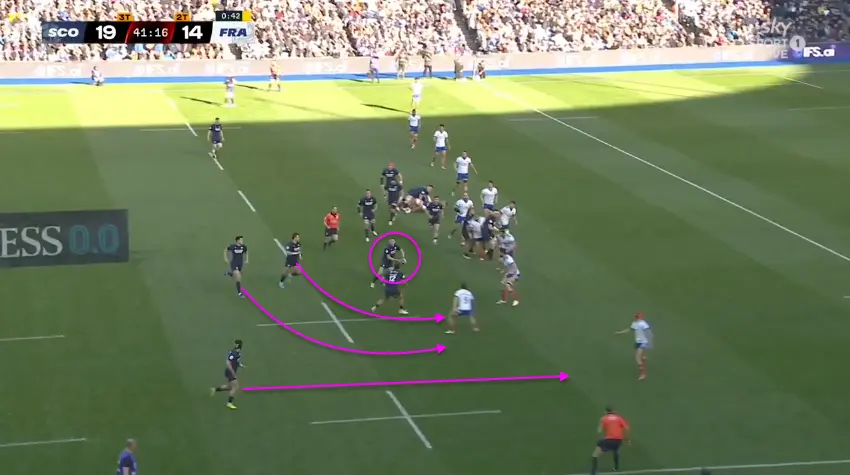
That triangle of Russell, Tuipulotu and Jones is usually at the heart of everything good that Scotland does, especially with their punchy, well-balanced backrow running onto those deep set up 3-2 phases in the middle of the field, and the likes of Schoeman and Fagerson winning, or at least holding, tight collisions off #9.
The balance of this game will come down to Ireland’s ability to dominate Scotland in contact on these on-ball phases, and how many defenders it takes to do it. Our starting selection definitely hints at playing bigger and more impactful at the defensive ruck in anticipation of that type of game.
Scotland are really good — at their best, it’s the best thing they do — at winning quick ball with only one or two cleaners max, which allows them to pull and drag defences all over the place, especially on back-to-back blindside plays. This is a long clip, but it highlights something Scotland are really good at.
If Ireland get purchase at the defensive breakdown and parity, at least, at the scrum, then I think this game ends only one way. An Ireland win, and likely a big one as the game breaks down and Scotland start to chase.
If, however, Scotland get into their rhythm around our 10m line, their scrum holds to par, and they can get that maul going, this could be a proper firefight. That’s the key for Ireland, though, massive pressure at the defensive ruck, even with the defensive risks that come with it against Scotland’s deep-lying attack.
And, at the very least, we’ll have another Triple Crown. Didn’t have many of those in the 90s, as Scotland can tell us very clearly.
