


This is the game that always seems to trip Ireland up, even when things are going well.
When the IRFU are arranging their November series, they try to sign two or three games against the usual Southern Hemisphere “big three” plus a combination of Argentina and a Tier 2 opponent like Fiji or Samoa. The reasons for this are mostly commercial. Any kind of game against New Zealand or the Springboks is a guaranteed sellout at whatever price you want to set it at and is likely the biggest game in the sport that weekend.
It’s a vital testing ground and a commercial success you can take to the bank the second it’s announced. Two games of that stature in any given November bring in seven figures, before expenses and are vital to the running of Irish rugby. In a non-World Cup year, you’ll usually see the IRFU organise a four-game November Series if we have the France/England home schedule in the Six Nations. If Ireland are on the Wales, Italy and Scotland home game schedule in the Six Nations, you’ll usually see three games arranged in the previous November.
That gives you 12 guaranteed home games in any two-year cycle, six every season, and you can start to build your finances around those gate receipts. The summer tours give the Southern Hemisphere sides a chance to do the same, with a Lions tour thrown in every 12 years. They don’t tend to use the one-off fixture model and have preferred using tours or series to cut down on travel costs for the visiting union.
The IRFU like to make sure that most of the “big” games feature what you would call a Category A or first-choice selection. This is a proving ground, after all, but there’s a business element to it also. The IRFU hope that the visiting union goes with a first-choice side as much as possible to make sure that these fixtures feature the best players in the world. This helps sell the fixtures in advance as being competitive games featuring big-name players. It’s why the IRFU almost always goes super strong when we tour Australia, South Africa or New Zealand every summer. We want to get what we give, so to speak. We’ll go full-strength where possible if you will.
Quite simply, we need the money and so do they, so nobody can afford to send shadow teams. The one union that doesn’t need the money – the FFR – are probably the only union that doesn’t play by these unwritten rules because, quite simply, they don’t have to.
There is always room for one or two “development” games against Tier 2 sides where the idea of reciprocity isn’t required. There is the match fee, which the visiting union is hugely grateful for, and then a chance for the Irish head coach to experiment. We have games like this every November. In 2018/19, we played the USA, Argentina and the All Blacks in Dublin and Italy in Chicago – a game we were compensated for enough on the back end that the loss of a home gate wasn’t a problem.
Post-pandemic in 2021, we played Japan before two “big” games against New Zealand and Argentina. In 2022, we played Fiji – our opponents this weekend – in between two big-money clashes against the Springboks and Australia.
During Andy Farrell’s reign as head coach, these are the games where he does the bulk of his capping. Farrell has capped 36 players during his four years as head coach, 66% of those caps were handed out against tier 2 sides like Italy in the Six Nations and then Georgia, Japan, USA and Fiji on various tours or home series.
These are often the only windows of space he has to experiment en-masse which, for a coach who is as reluctant to change from his winning formula as Farrell seems to be, is a dangerous thing. During the last Lions tour in 2021, Farrell played a very rotated Ireland team at home to Japan in a 90% empty Aviva Stadium due to the ongoing pandemic and we only barely won, 39-31. Japan led early in the second half and were only one score back for most of the last quarter until a late Joey Carbery penalty sealed the win.
Farrell learned his lesson. When we played them again in November, we selected that squad like it was the All Blacks and blew Japan out the gate 60-5.
In 2022, Fiji was the obvious “opportunity” game and Farrell rotated heavily again. Jack Crowley, Jeremy Loughman and Cian Prendergast all got their debuts alongside sub-ten cap guys (at the time) like Kieran Treadwell, Nick Timoney, Robert Baloucoune, Jimmy O’Brien, Mack Hansen, Dan Sheehan, Craig Casey, Tom O’Toole and Max Deegan while also keeping established guys like Healy, Furlong, Doris, Beirne, Carbery and Henshaw around to bind the whole thing together against a Fiji who were themselves a little rotated.
We won 35-17 but it was far from straightforward, especially when Fiji had 15 men on the field which they only managed for twenty minutes of this game; they had three yellow cards and one red card in the 45th minute.
That was the last real example we saw of rotation in any game outside of a World Cup warmup… until this weekend.
But Andy Farrell has learned his lesson. There is no wild rotation for this one; he has stacked depth guys, newbies and established veterans in every single unit to avoid this potential Fijian nightmare. Gus McCarthy starts at hooker, but it’s alongside Andrew Porter. Sam Prendergast starts at #10 but he’s got the ultra-reliable service of Craig Casey at #9 with Josh Van Der Flier and Bundee Aki inside and outside him to try to prevent him from getting turned into a smooth pink paste by the Fijian backline at set piece.
Izuchukwu makes his debut at #6 in an ultra-settled and established back-five combination. This is sensible stuff, guys but we have to be wary as Andy Farrell almost certainly is.
This game against Fiji would be a banana skin if Ireland were playing well, it’s a landmine when we’re not.
I’d pick the banana skin myself.
Ireland: 15. Jamie Osborne; 14. Mack Hansen, 13. Robbie Henshaw, 12. Bundee Aki, 11. Jacob Stockdale; 10. Sam Prendergast, 9. Craig Casey; 1. Andrew Porter, 2. Gus McCarthy, 3. Finlay Bealham; 4. Joe McCarthy, 5. Tadhg Beirne; 6. Cormac Izuchukwu, 7. Josh van der Flier, 8. Caelan Doris (c).
Replacements: 16. Rónan Kelleher, 17. Tom O’Toole, 18. Thomas Clarkson, 19. Iain Henderson, 20. Cian Prendergast, 21. Conor Murray, 22. Ciarán Frawley, 23. Stuart McCloskey.
Fiji: 15. Vuate Karawalevu; 14. Jiuta Wainiqolo, 13. Waisea Nayacalevu (c), 12. Josua Tuisova, 11. Ponepati Loganimasi; 10. Caleb Muntz, 9. Frank Lomani; 1. Eroni Mawi, 2. Tevita Ikanivere, 3. Luke Tagi; 4. Mesake Vocevoce, 5. Temo Mayanavanua; 6. Meli Derenalagi, 7. Kitione Salawa, 8. Elia Canakaivata.
Replacements: 16. Sam Matavesi, 17. Haereiti Hetet, 18. Samu Tawake, 19. Setareki Turagacoke, 20. Albert Tuisue, 21. Peni Matawalu, 22. Vilimoni Botitu, 23. Sireli Maqala.
The key to beating Fiji in this game is bossing time by bossing possession.
This isn’t a game of two halves or four quarters, it is a game of sixteen five-minute blocks. Each block of five minutes you use well increases pressure on the opposition in the next block of five minutes to respond. By the same token, two bad five-minute blocks without the ball and conceding points back-to-back are very difficult to recover from. Win the first block, the opposition has 15 five-minute blocks to respond. Win the third last block of five minutes and they only have two.
This comes back to efficiency. How quickly can you move the ball up the field? How efficiently can you convert that earned territory into points?
From the 65th minute to the 70th minute against Argentina, Ireland had three sequences of possession lasting 16 seconds, 7.54 seconds and then 124 seconds. That’s 2.45 minutes of possession in a game where Ireland had 20.1 minutes of possession in total. That’s 12.1% of our total possession resulting in zero points while burning five minutes of in-game time.
So it comes back to efficiency. Moving up the field. Creating linebreaks or their non-union equivalent of forcing penalties to get close to the 22 and then executing that position into points through your set piece, your tight game or some space-exploiting phase play sequence to generate point-scoring opportunities.
Can Ireland do this against an immensely physical Fiji side?
Yes. We don’t even need to play particularly well to do it.
Fiji concede an average of 10.5 22 Entries per game and an average of 3.35 points per entry in 2024. So they give up a lot of scoring opportunities and then a lot of scoring to those opportunities. They concede most of their tries within three phases of a lineout, so if Ireland can get any kind of lineout platform and stable lineout possession, we will score points if we can keep the turnovers in contact to a minimum.
The key for Ireland will be managing the upfront physicality of… pretty much everyone on the Fijian team. They have demolition men in the tight, middle and edge spaces who will light you up if you try playing it cute. At the same time, you’ve got to win collisions against them because they really go hard after the ball at the breakdown. That actually suits Ireland – we love to play layered rugby against compressed defences – but we’ve got to be careful of their poaching threats of Mawi, Derenalagi and Salawa in particular.
We need far better at the offensive breakdown than we’ve gotten from Porter, McCarthy and Doris from a volume perspective in the last two games. From an involvement perspective, I feel it would be a mistake to move away from the split handling of the last two weeks – we need to keep Prendergast out of the front line of the attack and use him as a layered distributor.
Offensively, we want to watch out for Fiji tracking Prendergast like this;
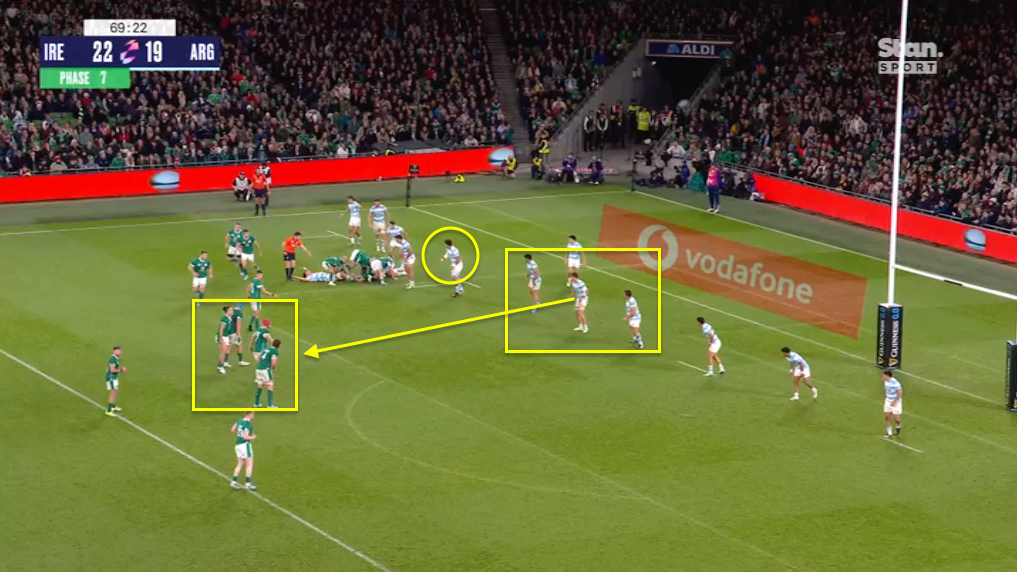
A flanker loitering on Prendergast’s inside shoulder, a gap outside him almost baiting Prendergast to run for it and Fiji mirroring up on the Irish attack pod. What that allows Argentina to do is push out onto Ireland’s layers because they aren’t concerned about the carry to the gap.
This means Ireland can’t get quick ball – which really hurts us inside the 22 – and with Fiji’s size, they can really gum us up in this key area. When Argentina don’t have to worry about the carry off the screen, they can push out onto the targets of Prendergast’s passing.
After five or six minutes, Argentina started pushing out onto Prendergast’s pass targets and Ireland’s attacking threat evaporated. Argentina stopped focusing on hitting Prendergast and focused on hitting the guys he was passing the ball to, early and often.
I’d love to see Prendergast take a deeper role to spread the ball to the edges and use his kicking game to pin the Fijians in place. He doesn’t need to fall in love with “taking the ball to the line” because there’s not much value in that for him, unless he’s being relentlessly and recklessly headhunted. Even then, is the juice worth the squeeze.
For Ireland, we just need to retain the ball; stay somewhat narrow and, with accuracy at the breakdown, there are penalties to be mined out of Fiji at the ruck. Get the ball down the line, nail the lineout and scores will come.
What we do not want to do is give Fiji too many scrum platforms to attack off because they can hurt us there relentlessly.
