



The last two weeks have been something like a fever dream.
The Irish Rugby press corps has mostly taken on the exultant demeanour of a ten-year-old who’s just seen their dad win the egg-and-spoon race at a school sports day after Ireland’s excellent win over England in Twickenham. Decline? What decline? Did you not see the egg-and-spoon race just now?
That’s the Andy Farrell effect.
If Ireland lose, the players didn’t show enough “intent”. If Ireland underperform against a team they should comfortably beat, the quality of the players, unfortunately, just isn’t there.
When Ireland win, by God, Andy Farrell has cracked it. He has performed his alchemy once again. Intent? They had it this time. Quality? They simply required Andy Farrell to ask them if they were better than their opposition, and, lo, they were. Why didn’t that happen previously? Well… don’t think too much about that.
It’s a weird quirk of how the discourse around Irish rugby seems to have worked since the pandemic. Start at the point where Andy Farrell must be right, and then work backwards from there. Sam Prendergast was the man, because Andy Farrell said he was through his selections, until he wasn’t and was banished to the long dark in the last two weekends. Now we don’t talk about Prendergast. He wasn’t selected for this game against Wales, despite injury issues in Ireland’s backline, and it hasn’t so much as warranted a passing mention. If you start from the position that Andy Farrell must be right, then you also own his decisions, rhetorically. That can be an uncomfortable thing to revisit.
I’m not sure how that’s supposed to work in a professional media environment. “You’re only as good as your last game” only works in the team environment, where having a short memory is part of the job description. In the media, it’s best to have a long memory, so you don’t turn into a weather vane, swinging wherever the wind blows you in that second.
I learned this the hard way during Van Graan’s last season at Munster. I liked the head coach, so I applied reverse logic to outcomes. There was credit in the bank, or so I assumed, but I never actually walked into the bank to check.
No head coach, especially one in situ as long as Andy Farrell, can have too much credit in the bank. The only coach with that kind of tenure who is an exception to that is Rassie Erasmus, because he’s a back-to-back World Cup winner. Everyone else, from Fabien Galthie to Gregor Townsend, to Andy Farrell, can only — should only — really be judged on their last five games against their peers.

Anything else is applying the outcome we’d like to be the case in reverse.
In the last 12 months, where Ireland’s decline has been most visible, the only traditional and contemporary “big four” team we’ve managed to beat has been… England. We lost to France twice during that time, and we lost to New Zealand and South Africa. We’ve beaten England twice. So while the win in Twickenham was impressive and hugely cathartic — I’m sick to death of covering Irish losses in those bigger games — I don’t want to be a weather vane either. So while Ireland’s win over England was great, its only use now is as a data point as part of a wider pattern.
When we look at it like that, and judge against the teams we are judged on, Andy Farrell’s record in the last five peer games is one win — against England last week — and four losses to France (x2), New Zealand and South Africa.
So there is work to do, a lot of it, relative to the peer group we insist we want to be judged on.
***
Friday night’s game against Wales is going to be a three-way test. How much did Ireland learn from the win over England, the narrow win over Italy and the loss to France? How much did Wales learn from those games from an analytical perspective, and how capable are they of applying what they learned on the field?
I think what Ireland learned is that, against the right opponent playing the right system — as far as we’re concerned — we can break up almost anyone. Will Wales? I think it’s almost inevitable that they’ll kick to Ireland at volume in a way that England did not, and as a result, our test will be how we overcome that.
England allowed us to defend in depth and counter-punch after they blew themselves out. Before England could catch their breath, the game was over.
Wales, I think, should run out of gas in Dublin too, but they have a base game that can cause us problems, because it’s similar to what caused us problems against Italy and France.
What has hurt Wales — both this Six Nations and in general over their own decline post 2023 — has been their efficiency on both sides of the ball.
Ireland, for all the issues that have beset the team recently, are still relatively efficient when it counts, and that should be the differential here.
If Wales can, somehow, fix that efficiency problem this Friday night, however, this game could get very, very unpredictable.
Ireland: 15. Jamie Osborne; 14. Robert Baloucoune, 13. Garry Ringrose, 12. Stuart McCloskey, 11. Jacob Stockdale; 10. Jack Crowley, 9. Jamison Gibson-Park; 1. Tom O’Toole, 2. Ronan Kelleher, 3. Tadhg Furlong, 4. James Ryan, 5. Tadhg Beirne, 6. Jack Conan, 7. Nick Timoney, 8. Caelan Doris (c).
Replacements: 16. Tom Stewart, 17. Michael Milne, 18. Thomas Clarkson, 19. Joe McCarthy, 20. Josh van der Flier, 21. Nathan Doak, 22. Tom Farrell, 23. Ciaran Frawley.
Wales: 15. Louis Rees-Zammit; 14. Ellis Mee, 13. Eddie James, 12. Joe Hawkins, 11. Josh Adams; 10. Dan Edwards, 9. Tomos Williams; 1. Rhys Carre, 2. Dewi Lake (c), 3. Tomas Francis, 4. Dafydd Jenkins, 5. Ben Carter, 6. Alex Mann, 7. James Botham, 8. Aaron Wainwright.
Replacements: 16. Ryan Elias, 17. Nicky Smith, 18. Archie Griffin, 19. Adam Beard, 20. Olly Cracknell, 21. Kieran Hardy, 22. Jarrod Evans, 23. Louie Hennessey.
Wales and Ireland’s Six Nations have been a lot more similar than we’d like to think.
Our scrum completion rate is actually worse than Wales. Our lineout completion and steal rate based on lineouts faced are practically identical. Where we differ is our efficiency.
The biggest marker here is our xT, attacking and defensive. This is a stat that I know will inherently bother some people, but it’s worth looking at. An xT is an Expected Try. Based on the field position, numerical advantage and time of the opportunity, you can create a baseline for each possession a team has. Based on the average team, how many times would they be expected to score — or concede — a try in any given possession? A possession on the 5m line, for example, is rated as a high xT position because most teams would expect to score a try from that position, all things being equal.
Of course, all things aren’t equal, mostly, so we have to account for that, too, and we will.
So what does the Six Nations data show?
Here’s where it gets interesting for Friday’s game. Wales have a higher xT For (4.4) than Ireland (4.1) through the first three rounds. On the face of it, that suggests Wales have actually been generating more threatening attacking positions than Ireland across the tournament.
Yet Ireland have scored 10 tries. Wales have scored 5.
That gap between expectation and reality is the key detail here. The context here is that Wales have played two of their most difficult games in that block — France at home, England away — but Wales are reaching dangerous positions. They’re moving the ball into areas where, statistically, tries should come, but they are consistently failing to finish. Their red zone conversion rate of just 41.2% (5th in the Six Nations) is the clearest expression of that failure. When Wales enter Ireland’s 22, the data tells us that points are probably — usually — not following.
Why does this matter?
Two reasons. First, it tells us Wales’ attacking problems are not simply about creating opportunities — they are creating them. The breakdown happens at the point of execution: decision-making in the red zone, finishing under pressure, converting field position into points. That is a mental and tactical issue as much as a physical one.
Second, and perhaps more ominously for Wales, they are travelling to play Ireland — a side that leads the Six Nations in red zone denial (70.6%). Ireland are the best team in the tournament at ensuring that when opponents enter our 22, those visits lead to nothing. Some of that stat is bloated by England’s inefficiency in Twickenham two weeks ago — 12 entries with only three tries scored — but it’s still there, nonetheless.
The xT figure should be a reminder that Wales are not as toothless as their try tally suggests, but without the finishing to match, it remains a number on a screen, and that’s all it is. The only question is whether it becomes a number on the scoreboard on Friday night.
***
One thing that sticks out about Wales is their kicking, and the pace they have almost all the way across their backrow, halfbacks and outside backline.
Most of their tactical kicking is done via the box kick — Tomos Williams — and they generally kick really long. That goes some way to explaining their lack of attacking kick receptions — they don’t really kick to compete directly. They will use their incredibly quick chase to close ground, harry the transition receipt and then get one of their three small forwards or midfielders to try and get over that transition ruck.
Their control over these scenarios varies, but unlike England — who selected to kick long and harry, but then didn’t — Wales will stick to this pretty religiously.
They kick long, use their pace to pressure the receiver, and then try to force a turnover, which they will almost always play through the hands to get the ball to one of their pace guys, of which they have many.
It should work a lot more than it has, to be honest.
When they attack, you’ll notice how deep they tend to stand off any linebreak or wide ruck position because they want to use their pace to isolate edge defenders and break linespeed.
Have a look at the depth here.
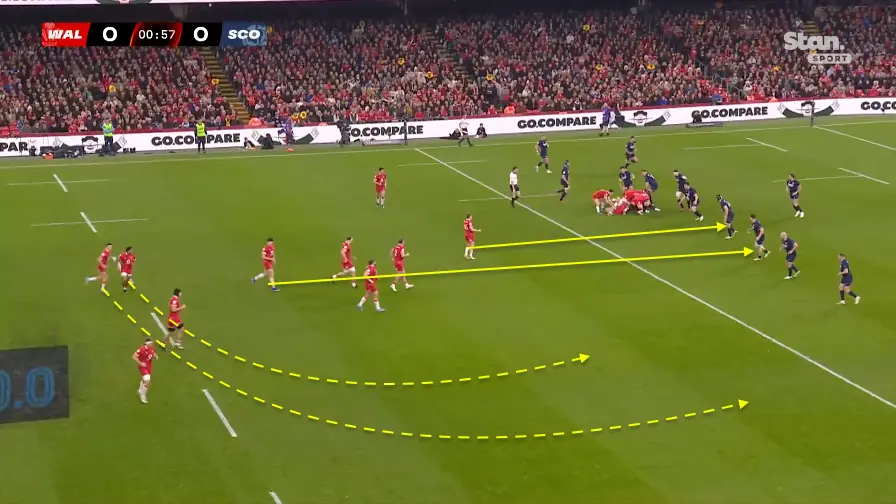
Costellow is 10m away from the Scottish defensive line, the first pod is 5m behind him, and the deeper layers — with some loop action — are rotating 15m/20m back from the Scottish defence. This structure is designed to highlight the pace and evasion of their backline and small forwards, who they deploy in alternating edge positions almost constantly.
With the likes of Mee, Rees Zammit and Adams, alongside Wainwright, Mann and Botham, Wales can absolutely sting us here if we give them a sniff, never mind what Tomos Williams can do at scrumhalf if he’s on.
For Ireland, we don’t have to overcomplicate it. Mop up Wales’ long transition starters and kick most of them back to burn out their chase and open up their front five to a lot of movement up and down the pitch without the ball. We have to stay patient. If we get hurried on transition, Wales will, in particular, get after Jamie Osborne as our initial transition run back option. We have weapons in Stockdale and Balocoune, in particular, but we have to be careful when and how we use them, off the kicks we are 100% going to face.
Defensively, Stockdale, Ringrose and Baloucoune are going to have to make very good reads if Wales get into decent positions, but I think they can and will.
Wales are particularly allergic to penalty concession, and they’ve gotten into the bad habit of getting refereed like a Tier 2 team in the last few years, so if they’re even marginally off on their jackal attempts — and they’ll be going after that if we lose patience — they are really vulnerable to coughing up back to back penalties that they almost always concede off, one way or another.
Ireland are a team that dominates with penalty ladders, and I think Wales will give us them — maybe not in the scrum — but through the natural outlet of their defensive transition game, which they hope will give them a foothold in this game.
