


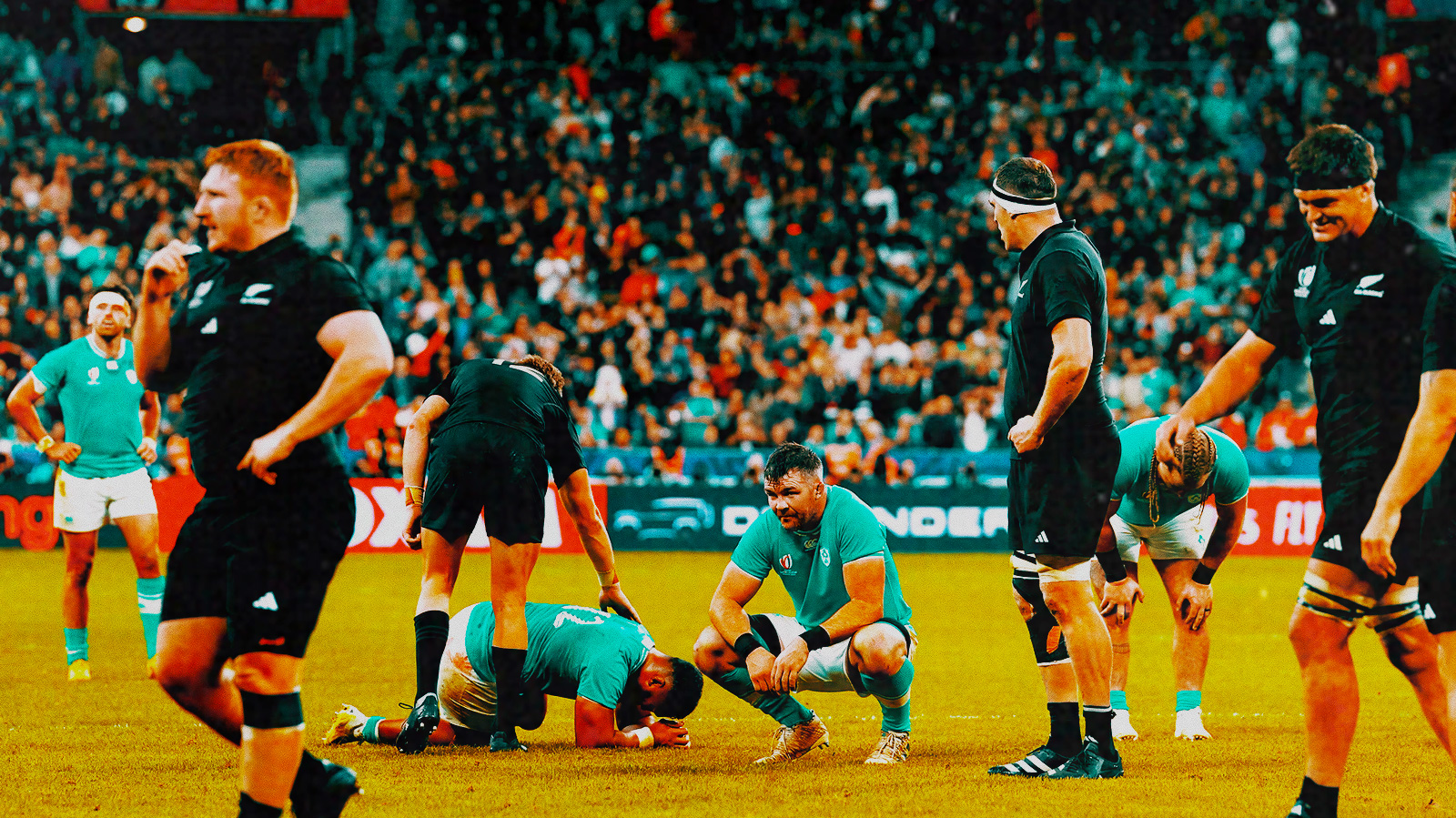
There’s a lot of bullshit in modern sport.
I am 100% showing my age here, but nothing winds me up more in the cartoon world of sports on the TV than seeing lads yucking it up with the opposition before, during or after a game. I know it’s meaningless. I know they all mostly know and like each other outside of “work” in real life.
But still. I yearn for the days of simmering interpersonal rivalries between a group of players who do not – and could not – like each other. I want less pictures together on Instagram sent just out of the shower after the game, more Michael Jordan sociopathy.
Is that too much to ask? A little bit of sociopathy? As a treat?
That’s why the current relationship between Ireland and New Zealand is so compelling to me. We hate them, they hate us, and we earned that hatred begrudgingly. The All Blacks rugby bubble would love it if we were still like Wales or Scotland, stuck firmly in the Chuckle Zone. By god, we had to kick and scratch to get out of there.
We dealt with their contempt for long enough, so their hatred is like a week in Lanzarote by comparison. It feels real.
This Friday night, both sides are coming into the game with more than a bit of heat. Johnny Sexton’s actually quite boring autobiography served more than just providing Sexton with an artist’s tax exemption. It gave us some of the best close-ups we’ve seen so far of the rivalry between Ireland and the All Blacks. Sexton’s last minutes on the field as a pro-rugby player were consumed by this exchange with Rieko Ioane.
“And as I stand there, hands on hips, staring in disbelief at [referee Wayne] Barnes, Rieko Ioane still comes up to me and tells me, ‘Get back ten metres’,” Sexton wrote.
“‘Huh?’
“‘Penalty,’ he says. ‘Back ten.’ And then, after Barnes blows the final whistle, he says, ‘Don’t miss your flight tomorrow. Enjoy your retirement, you c***.’
“So much for the All Blacks’ famous ‘no dickheads’ policy. So much for their humility. I walk after Ioane and call him a fake-humble fucker. It doesn’t look great, me having a go at one of them just after we’ve lost. But I can’t be expected to ignore that.”
Imagine that being the words that stick with you after a World Cup exit in your last ever game as a professional. And he was far from the only player to get it in the neck on-field after that one. Maybe it’s poetic timing that Sexton made his return to the Ireland camp as a… whatever it is he’s doing there in the last week.
What Johnny and a lot of people fail to realise here is that the All Blacks’ “no dickhead” policy isn’t about making sure only paragons of the human spirit play for New Zealand, it’s about making sure you aren’t a dickhead who interrupts the internal equilibrium of the All Blacks. Being a dickhead to the opposition, especially to rivals, is encouraged.
When it comes to games like these, you can’t just pretend to hate them. It can’t be a thing you switch on for this week and then switch off again at the full-time whistle. This All Blacks team is rocking up to Dublin to put this Irish team back in their box. They want to answer the series loss in New Zealand with a big win in the Aviva this Friday night. They will use any means necessary to do it. Remember, the All Blacks don’t win because of highlight reel tries on transition – they win because they brutalise you in the tight collisions.
By any means necessary.
If you want an idea of what the All Blacks will do in a game that really matters, this is the only clip you need to see.
World Cup final. Three minutes in. Boks with a 7-1 split bench and a 36-year-old back row covering hooker on the bench.
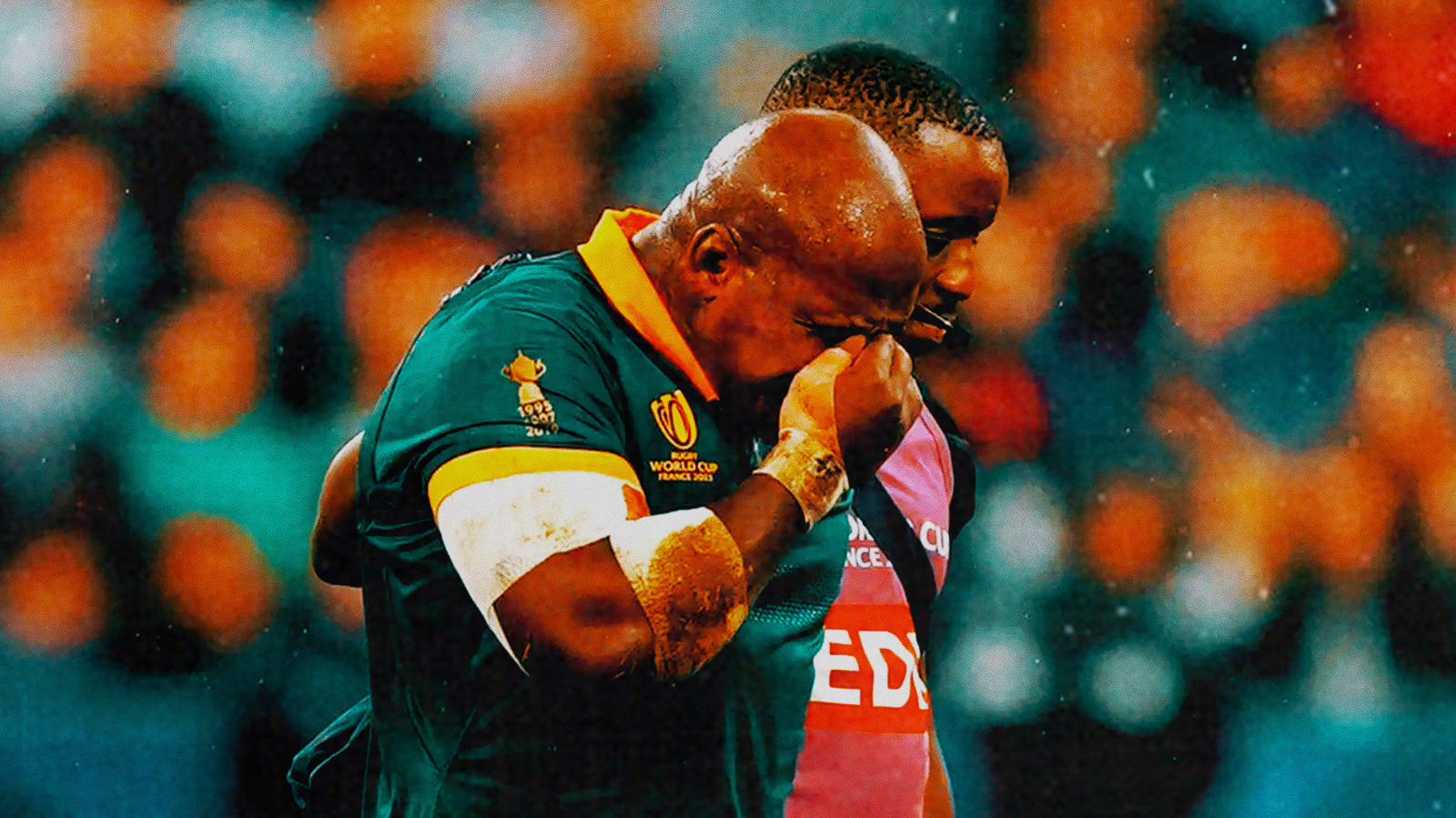
Shannon Frizzell knows what he needs to do. Nobody needs to tell him or need a player’s meeting to plan it. They all know the equation. Bongi Mbonambi off the field of play = a bigger chance of the All Blacks winning. So they take their chance to make that happen.
Are they going out to deliberately injure Mbonambi? That’s the wrong way to look at it. They know he’s got an outsized importance to the way South Africa were going to manage that final so they all instinctively knew that he needed specific targeting to wear him down to the point he got off the field well before South Africa would have liked.
It’s the part of their game that I admire the most, above any of their fantastic handling, instinctive line-running or rock-solid basics; it’s their willingness to go further than you will when it counts. They engage with only a few opponents on these terms; the Springboks, France and now us.
If the Springboks are the ultimate physical gut check in our sport, the All Blacks are the biggest test of your bottle. Just how are you willing to go? When it matters, that’s what they’ll ask you repeatedly. Your answer always has to be “one step further than you”.
This one will be for sociopaths only.
Ireland: 15. Hugo Keenan; 14. Mack Hansen, 13. Garry Ringrose, 12. Bundee Aki, 11. James Lowe; 10. Jack Crowley, 9. Jamison Gibson-Park, 1. Andrew Porter, 2. Ronan Kelleher; 3. Finlay Bealham, 4. Joe McCarthy, 5. James Ryan; 6. Tadhg Beirne, 7. Josh Van Der Flier, 8. Caelan Doris (c)
Replacements: 16. Rob Herring, 17. Cian Healy, 18. Tom O’Toole, 19. Iain Henderson, 20. Peter O’Mahony, 21. Conor Murray, 22. Ciaran Frawley, 23. Jamie Osborne.
New Zealand: 15. Will Jordan; 14. Mark Tele’a, 13. Reiko Ioane, 12. Jordie Barrett, 11. Caleb Clarke, 10. Damian McKenzie, 9. Cortez Ratima, 1. Tamatai Williams, 2. Asafo Aumua, 3. Tyrel Lomax, 4. Scott Barrett (c), 5. Tupou Vaa’i; 6. Wallace Sitit, 7. Sam Cane, 8. Ardie Savea
Replacements: 16. George Bell, 17. Ofa Tu’ungafasi, 18. Pasilio Tosi, 19. Patrick Tuipulotu, 20. Samipeni Finau, 21. Cam Roigard, 22. Anton Lienert-Brown, 23. Stephen Perofeta.
“Good Access”
Every so often, World Rugby introduces a new law interpretation midseason that throws out entire swathes of ingrained meta the game had built up to that point. Remember a few years ago when the referees were given a specific instruction to crack down on double banking at the maul and then the next 12 months seemed to have two or three of those called every other game?
This year, it’s allowing the kick-chasers to “access” the catcher. The term you will probably hear a lot is “good access” from referees when the defending team does not “escort” the kicker.
As of a week or two ago, referees will penalise any attempt to block off the catcher with a wall of retreating defenders, something teams have been rigorously drilling for the last few years.
Why have they made this change? To encourage more chaos, more back-and-forth play, and fewer dummy sequences of play that we’d often see over the last few years. You know the ones. The opposition box kick against a set defence, we drop back along the line of the kick en-masse in an ever-shrinking wall that slowly closes off any lanes the catchers might have to challenge for the ball the catcher and then the catcher takes the ball uncontested, to be cleaned out by the wall of defenders who are on-scene to do just that.
Then we play a few tight phases, the opposition stuff us and we set up to box kick at them, where they will do the exact same thing.
World Rugby want a fast game with active phases and possession traded back and forth, both voluntarily and accidentally.
For now, that means that aerial contesting is back on the menu. For example, what would have happened last month on this box kick? Would Jordi Barrett have moved out of the way to allow Cunningham-South to smash Beauden Barrett one-on-one on the drop?
No chance. He’d have stood his ground, forced Cunningham-South around the corner and opened up a spot for Beauden Barrett to take the kick uncontested. As of two weeks ago, that action is now considered an offence worthy of a full penalty.
How will this affect tonight’s game? I think it could have a slightly bigger effect than we think. Both Ireland and New Zealand love to kick the ball and regardless of any law tweak, you were going to see a pretty involved kicking battle in this one. But when you combine the tweak of the last few weeks with the Dupont law brought in over the summer, you see that World Rugby have essentially tied up both sides of the kicking game with jeopardy.
Kick long and your pack have to give the opposition space on transition where they are moving into space you’ve had to retreat from, kick in the short and mid-range and you get a chance to nail the receiver and force a turnover.
So do you go for territory? Or look for a turnover to retain possession? The meta has changed and is changing as you read this.
***
Long story short, I think we’re going to see a pretty deep and involved battle at the lineout in this one. The kicking tweaks we’re seeing at the moment only allow certainty in one area; that if you get the ball off the field from your own 22 or with a bounce if you’re kicking anywhere else, there will be a lineout of some description.
That is an area where Andy Farrell and his team have selected players specifically to attack the All Blacks. We’re playing a three-lock pack in this game specifically to do two things; pack the middle space of the field with big defenders to match up against the All Blacks – more on that later – and choke off their lineout with big counter-jumpers.
Here are some facts to compute about the All Blacks lineout.
- Against England last week, they through 27% of their lineout ball long, to a player running in from midfield. They through another 20% of their lineout ball to the tail of the lineout, with a jumper getting into the air between 13-15m from the hooker.
- So that’s almost half of their lineout ball thrown to the back of their lineout and beyond, with a 71% success rate. Not elite numbers.
- The other interesting thing is that the other half of their lineouts were almost all to the front – 5-7m away from the hooker. They went 7/7 in this area.
- Asafo Aumua had an average throwing distance of 10.1m with the fastest throw speed but the lowest throwing efficiency.
What does this tell us? Ireland should mark wherever the All Blacks are clustered on any given lineout with two distinct lifting pods. These pods will have James Ryan guarding the tail as a counter jumper and Tadhg Beirne guarding the middle with the space to chase the space where the All Blacks are not.
You can see the space the All Blacks are leaving as an option on this one. It’s almost an inverse of the “give them the front” gambit by leaving that space as an obvious run and launch.
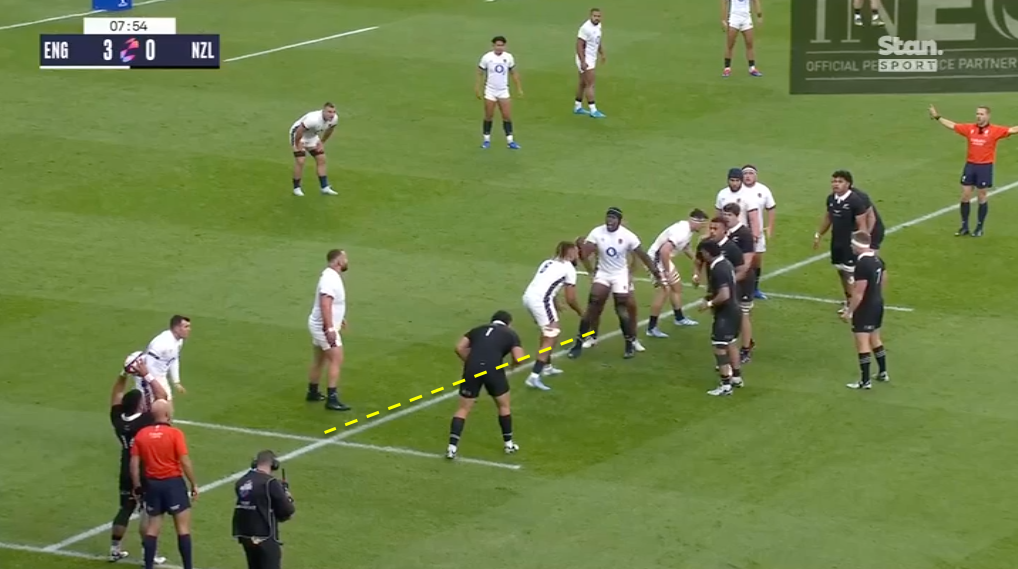
Your quickest counter-jumper – Beirne to start, O’Mahony to finish – should be leading the mark in the middle of the lineout. In this example, the All Blacks went long over the top, something I think they scheme with Aumua because his throwing action lacks control compared to Cody Taylor. He’s either accurate at firing it at the front or hitting a deep throw over the top, but anything that requires hitting a contested window is potluck.
Look at this six-man scheme from the All Blacks late in the game. England are marking the cluster. Don’t give the All Blacks any space by default and force Aumua to make contested throws to difficult zones when the All Blacks need something.
This is where we’ll want James Ryan getting that big swipe action of his to disrupt Aumua’s throws, which are fast in the air and always give you a target to get at with that low spin rate.
If we can force a few errors from the All Blacks at the lineout, they’ll shrink it to a five-man scheme, where they will almost always have Aumua throw to the front of the lineout to a pace jumper like Sititi.
The All Blacks put Sititi up just 5m away from Aumua on this one and England were a little unlucky to concede a penalty on the defensive phase afterwards just before Itoje won a clean turnover.
In the aftermath of a lineout, the All Blacks will get into a very segmented structure and play quite a narrow PPC game amongst the forwards. It’s not that they never tip the ball on to each other – they do that pretty often – but ball retention will take priority over hunting a forward linebreak in almost all cases.
Ireland must stack “beyond the C” against this All Blacks team and I think it’s part of the reason why the three-lock pack to start the game was so attractive. It allows Joe McCarthy to use that size and line speed of his in defence to get after the wide pods off #9 that the All Blacks use to get the most out of Raitama’s passing range.
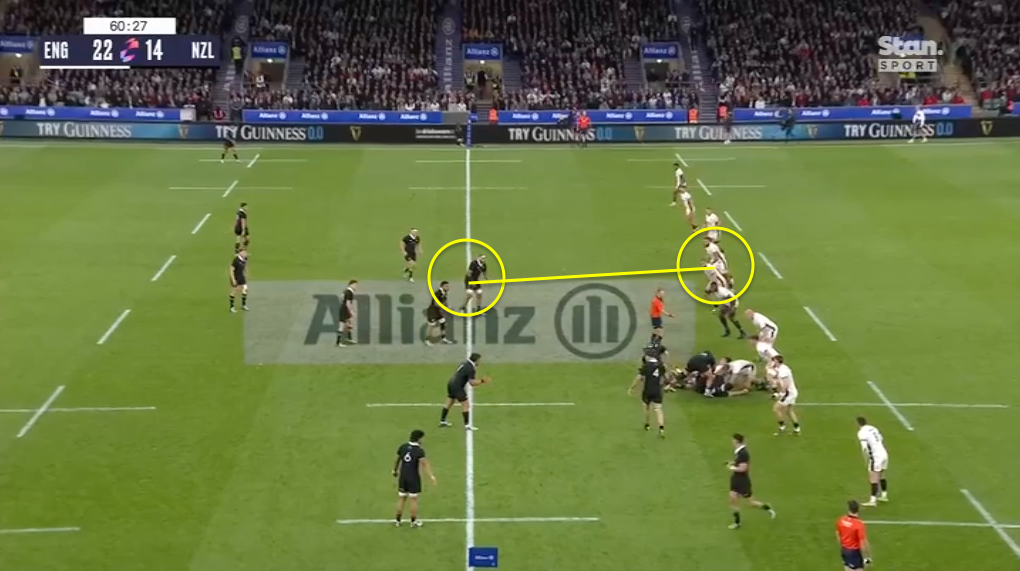
Raitama passed longer per pass than any other scrumhalf last week and his ball speed was really good. The All Blacks will use that extra with – 7.9 metres per pass on average – to extend that first collision point from the ruck so we’ve got to make sure impact defenders like McCarthy, Porter and Ryan, high volume trackers like Van Der Flier and elite poaching threats like Beirne and Doris can force the All Blacks to kick at a higher rate than they’d like. There are breakdown turnovers and spilt balls out of the tackle on offer here as long as we can get that bit of width on defensive sets post lineout.
