


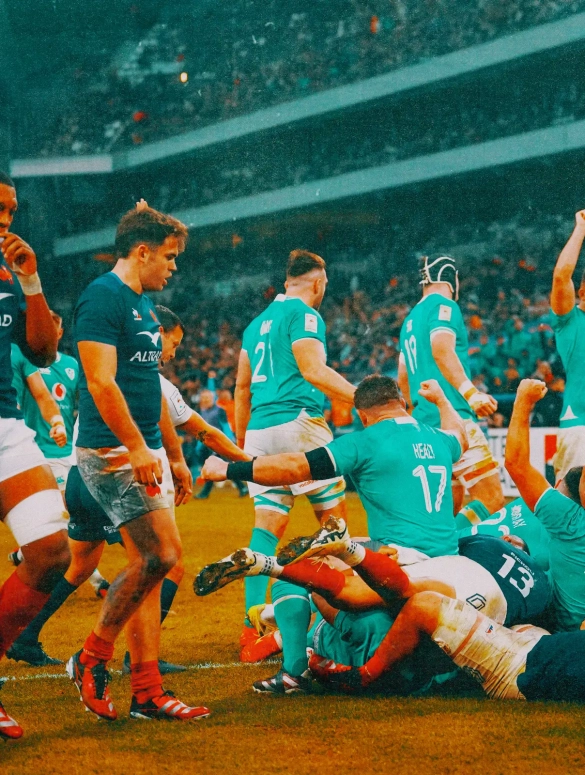
This is the game of the 2025 Six Nations and will ultimately decide if Ireland are going to win three titles in a row, or whether this French side packed with generational talents can deliver on that talent with a trophy.
In that way, it’s a bit like a knockout game; with all the pressure and “no tomorrows” that entails. Is that a good or a bad thing for Ireland? Traditionally, it hasn’t been for any Irish group. In the last four years, this Irish team excel in league play where their consistency, cohesion and tactical fluency counts for double. Look at the last two Six Nations. Look at the World Cup pool in 2023. When this Irish team has five games to do their business against other sides who also have to business over five games, I’d back Ireland every time.
The problem is and has been that when the stakes go up, this Irish team has consistently failed when there’s been “no tomorrow”. When there is a tomorrow, they come back stronger with lessons learned.
First test in South Africa last summer? Ireland lost. Came back to win the second game.
World Cup quarter final? Lost to a team we’d beaten repeatedly in the last four years.
First test in New Zealand in 2022? Lost it, but came back to win the next two to take the series.
Even last year, we had France up first and seem to be empowered by the fact that, whatever happened, we’d have four more games to do our business. We won it, as you’ll remember, with a fantastic performance. Sure, France didn’t have Dupont last season and had a red card inside the first half, but winning that dominantly in France happens so rarely that it’s notable.
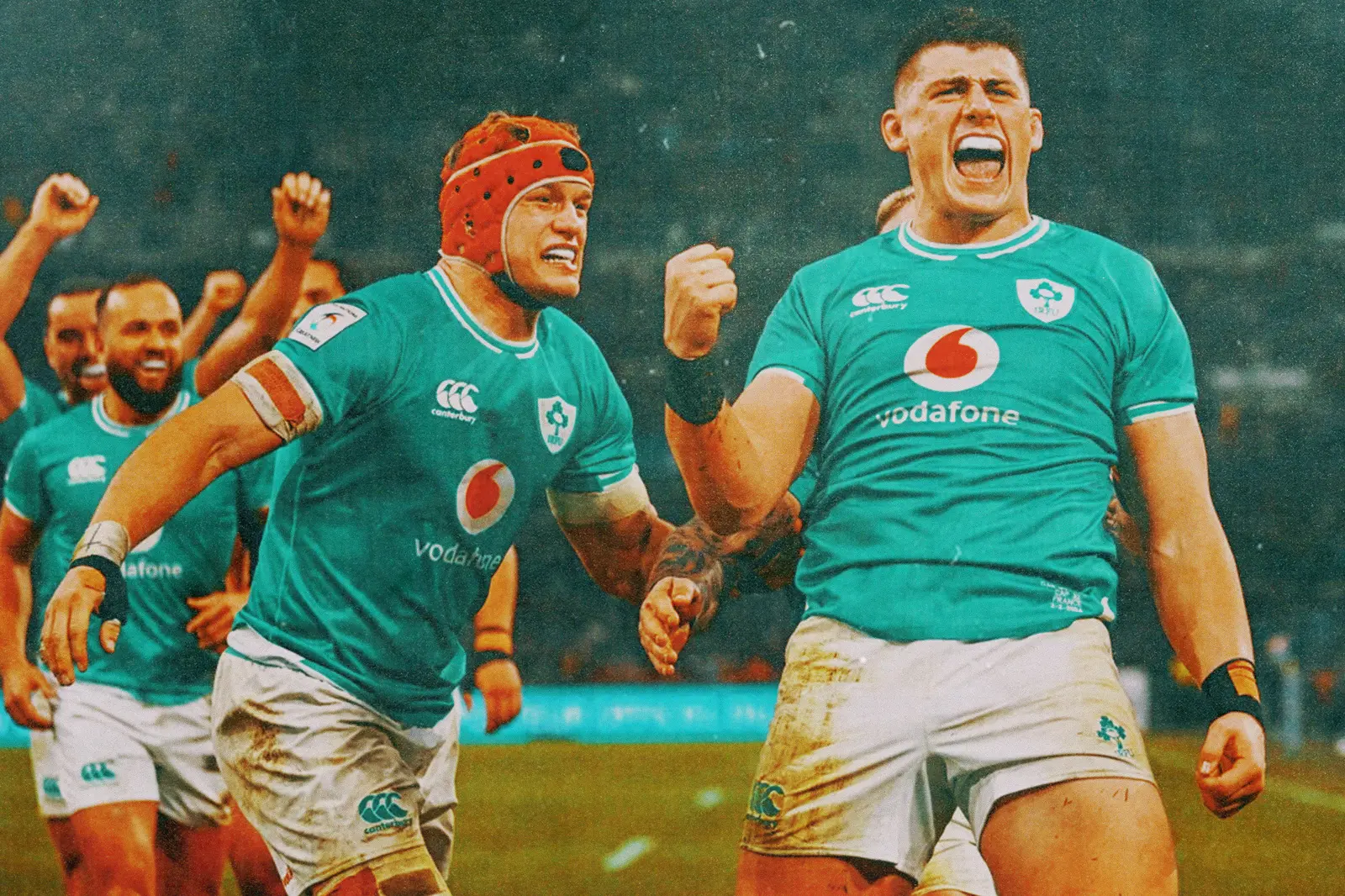
That match was Ireland at their hive-mind best putting away a hesitant, uncertain team riddled with indiscipline and shorn of their best, and probably best ever, player, captain and talisman.
When a team shows up to play this Ireland team with any kind of inconsistency or hesitancy, they will always lose. So that begs the question; what type of French team will show up for this Six Nations title decider?
If France play how they’ve played across the last three games before this – even with the loss to England – and Ireland do the same, I think France will win. Yes, this coincides with my general theory that Ireland haven’t been playing well so far this championship in key metrics like tries scored, 22 entries, points per entry, line out completion and linebreaks. I’m almost certain this directly relates to Ireland’s style change over the last three years, and Easterby must fix the problems while winning the championship.
So has that certainty equation changed? France, with a narrow loss to England already under their belts, know that this game is do or die for them. Will that be enough to focus them? Snap them out of any complacency that might hang around this group like a cold they can’t quite shift? If they bring close to their best, it’ll be the stiffest challenge Ireland will have faced since the All Blacks last November in the Aviva Stadium.
The biggest x-factor will have been the two-week break between rounds. What have Ireland learned about France? What have France seen in Ireland? I get the feeling that this game will be decided in the video room as much as it is on grass.
Ireland: 15. Hugo Keenan; 14. Jamie Osborne, 13. Robbie Henshaw, 12. Bundee Aki, 11. James Lowe; 10. Sam Prendergast, 9. Jamison Gibson-Park; 1. Andrew Porter, 2. Dan Sheehan, 3. Finlay Bealham, 4. Joe McCarthy, 5. Tadhg Beirne, 6. Peter O’Mahony, 7. Josh van der Flier, 8. Caelan Doris (c)
Replacements: 16. Rob Herring, 17. Cian Healy, 18. Thomas Clarkson, 19. James Ryan, 20. Jack Conan, 21. Ryan Baird, 22. Conor Murray, 23. Jack Crowley.
France: 15. Thomas Ramos; 14. Damian Penaud, 13. Pierre-Louis Barassi, 12. Yoram Moefana, 11. Louis Bielle-Biarrey; 10. Romain Ntamack, 9. Antoine Dupont (c); 1. Jean Baptiste-Gros, 2. Peato Mauvaka, 3. Uini Atonio; 4. Thibaud Flament, 5. Mickael Guillard; 6. Francois Cros, 7. Paul Boudehent, 8. Gregory Alldritt
Replacements: 16. Julien Marchand, 17. Cyril Baille, 18. Dorian Aldegheri, 19. Emmanuel Meafou, 20. Hugo Auradou, 21. Oscar Jegou, 22. Anthony Jelonch; 23. Maxime Lucu.
The main game I referenced for this piece was France’s defeat to England. There wasn’t much to see against Wales and Italy, other than France completely overwhelming two sides that had very little for them. Seeing as how England map onto Ireland quite closely from a style perspective – we are a more cohesive version of them at the moment with significantly better game changers – that game is the best example.
Watching the first twenty minutes of that game was genuinely remarkable because I have no idea how it stayed 0-0. France should have scored two or three times and been out of sight but somehow bumbled their way into going at halftime 7-7.
Most of France’s best work in that half came from the back of transition run backs, which they generated by kicking to England and knowing that England were always going to kick back to them within two phases of receiving the kick.
Get used to seeing sequences like this early in the game while both sides vie for a tactical foothold in the game.
Dupont will kick long off the box kick to Ireland’s back pin, Ireland will reset back infield through Osbourne or Lowe directly or through one of those players hitting Keenan coming up the middle.
Ireland will then reset with Prendergast dropping far deeper than Smith did in the above kick and targeting the French back pin either side of Ramos, who Ireland (quite rightly) feel is deeply flakey.
The initial exchanges and momentum in this game will be decided by the outcome of these moments. France are really dangerous on any kind of transition, so Ireland can’t afford to have a loose day under those high balls or when it comes to loose reset kicks.
France have the kind of pace and creativity in the 3/4 space to kill you stone dead if they get any kind of separation directly from the point the ball was lost.
Mostly, however, France will play like this directly after receiving kicks if they don’t get an obvious opportunity to break.
All the playmaking is being done by Dupont on the back of those direct carries. He knows very well that he’s the focus of every single defensive presentation in the previous week, and he exploits that.
“We can’t let Dupont break around the ruck”.
Look at the way the English pillar defence and first defenders are hyper focused on him here;
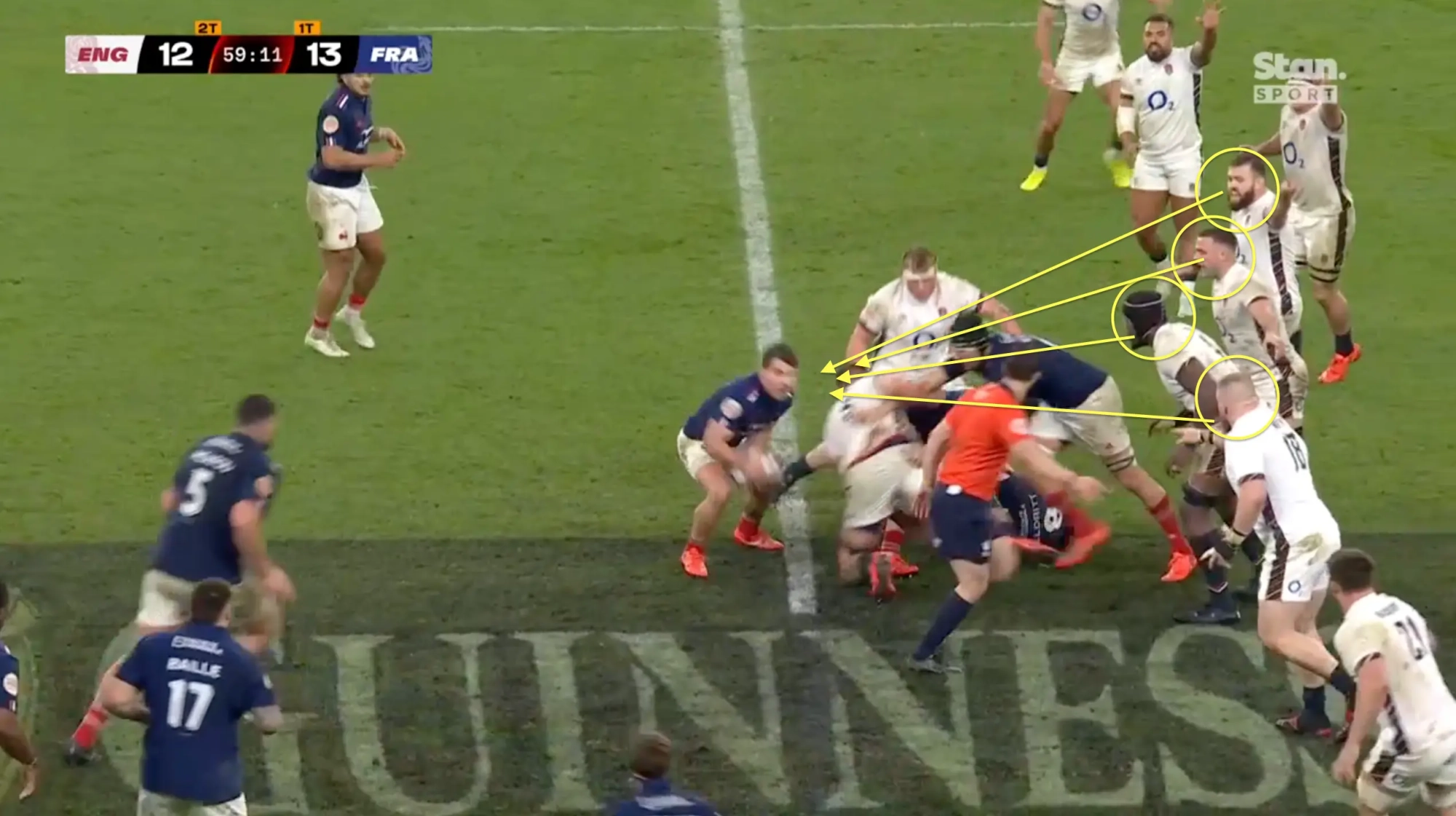
No other scrumhalf in the game can draw that kind of attention and, essentially, create a compression all on his own. France use their heavy forward rumbles – usually without any kind of tip on or screen action – to narrow and compress the opposition transition defensive line. When you add in the compression’s that Dupont creates all on his own in these phases, space presents itself on the edges that shouldn’t really be there.
Dupont finds Jalibert on this play and France, all of a sudden, have a blindside to exploit with some of the most dangerous runners in the game swarming around him, including Dupont himself on the inside.
On Saturday, it’ll be Romain Ntamack running from the point at this kind of spacing.
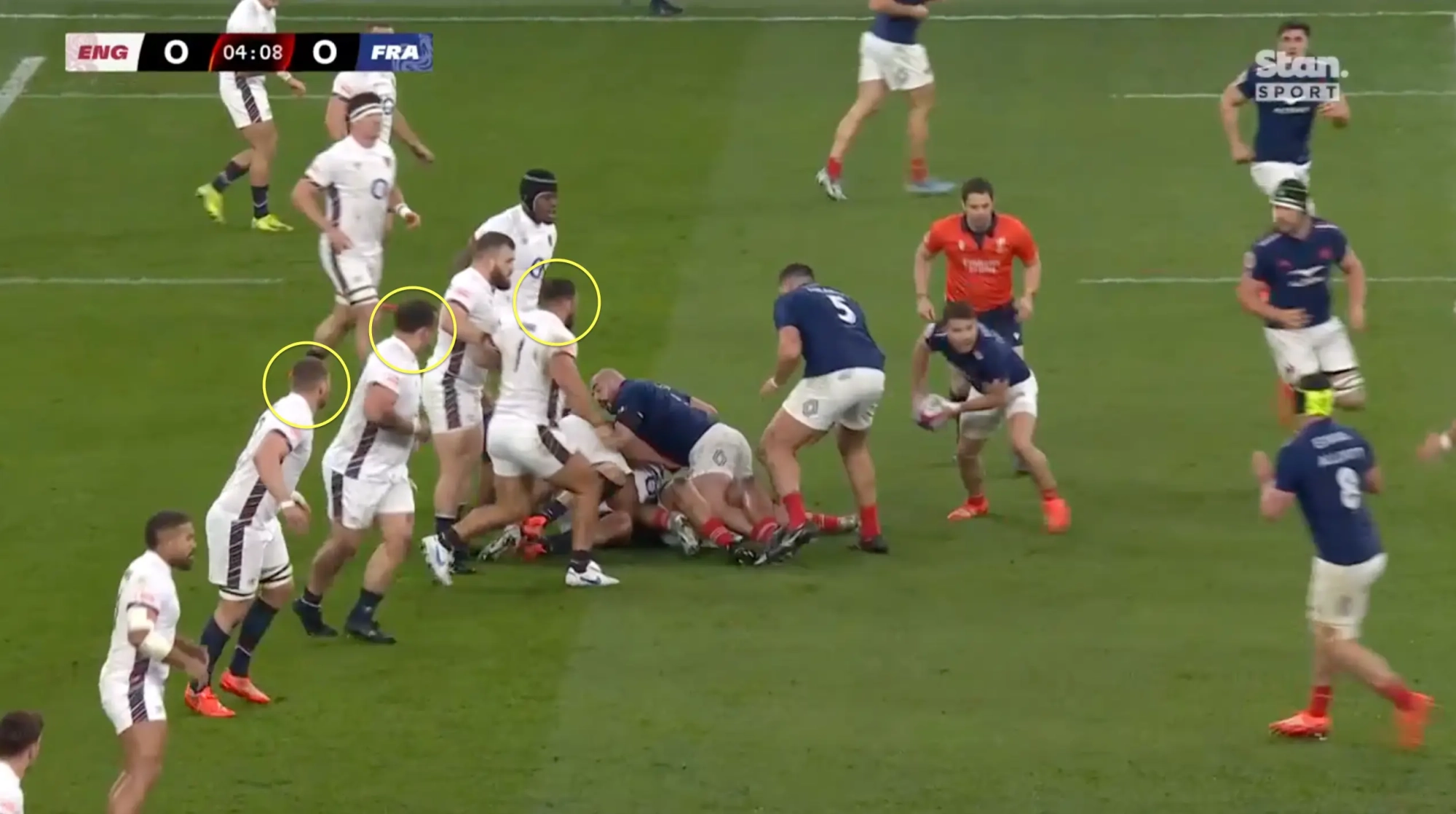
Here’s another example of this tight, tight, release sequence from an English kick receipt. This is relevant because Ireland will be kicking to the same spots in more or less the same manner.
It’s the exact same principle; the two tight phases give the backline time to set into position and, with all eyes on Dupont, the spacing appears on the edges. With new laws giving scrumhalves an extra few heart beats of space and time to work in, you can’t make any assumptions with Dupont. He can carry through a gap and hand off a forward to do so, he can freeze you and offload around you, he can angle back and kick crossfield to a runner outside.
So you watch him like he’s a guy who just walked into a bank wearing a black and white hooped jumper and who has a bag on his back with SWAG written on it.
The big talking point this week has been how France might target Sam Prendergast’s defensive weaknesses, but I genuinely think that over-focusing on him would be a mistake for the French. Sure, there will be palpable anxiety around the Aviva Stadium the first time Prendergast has to stand with any kind of separation between him and other defenders off a lineout or scrum, in particular, but I think Ireland will go to great lengths to hide him. Easterby well knows that the sight of Aldritt or Boudehent running through Prendergast at a lineout or seeing him flailing at mist if he has to defend Bielle-Biarrey or Penaud or Ntamack and Dupont in any kind of space will destroy the lad’s confidence. So Ireland will hide him – that means compressing around him on the first phase and then buying him time so he can get to the backfield with either Osbourne or Lowe covering for him in the primary line until he’s out of the way.
We shouldn’t expose a player who was shredded by Wales two weekends ago to France unless absolutely necessary.
The lineout is the biggest fool’s gold but watch out for France threatening to expose Aldritt to Prendergast on the crash to suck in Aki, Henshaw and Van Der Flier. If Ireland overcompensate on Prendergast off the lineout, France will hurt Ireland outside of Henshaw, inside of Osbourne and force Keenan into covering 30m of backline space with the Irish scramble being a step or two behind the play.
That’s the worry with Prendergast – not that he’ll look like an inflatable tube man in a hurricane flapping at French tacklers, but that in trying to ensure that doesn’t happen, Ireland leave too much space elsewhere for a side that have excelled in finding that space this season.
It’s set up to be the definitive battle of this year’s Six Nations – I just hope it lives up to the billing.
