


Nobody serious fears Munster’s pack anymore.
It hurts to write, but it’s true, and I don’t intend for it to be a flashy, attention-grabbing lead.
As I wrote here, both our scrum, maul and ball carrying were at dangerous lows last season and, in reality, they have been for some time. In a lot of ways, what we’ve been doing over the last few campaigns has been designed around mitigating against that.
But that isn’t us.
Clayton McMillan has been here for a year now, pretty much, and his first season gave him all the information he would have needed.
We didn’t win enough collisions, we were something of a washout in the scrum, and our maul was nothing to write home about. Nobody intended for that to be the case, but it was.
We need a change in identity or, rather, a return to an identity we’re familiar with; the game needs to fear a Munster pack again.
We’ve spoken about this before, though. In 2022/23, I remember being on a presser with Andi Kyriacou, who spoke about doing this very thing — restoring the Munster pack to something to be feared once again — and it didn’t quite turn out that way, not in the long term at least.
For a few years under Rowntree we had a genuinely excellent scrum but, when he departed the club, his coaching impact waned, especially as core parts of the scrum — our tightheads, primarily — aged out or were beset by injury from 2023/24 onwards.
Scrum coaching is important, but it’s only a part of the story; it’s a personnel set piece as much as anything. You could put the best scrum coach in the game — Daan Human or Jason Ryan, for my money — and if they don’t have the right players in place, you’ll wonder what all the fuss was about. More so than any other unit, the quality of your front row dictates the success of your scrum.
With the signing of Jack Aungier, Marnus Van Der Merwe, Kieran Brookes and the retention of Michael Ala’alatoa, never mind the quality of Jeremy Loughman and Michael Milne, I think we have the raw materials in place to improve that area of our game radically.
But that’s not really what I’m talking about.
Success in modern rugby is about many things, but one fact remains — if you get over the gainline more often than your opponents, you will win more games, accrue more points and go further in knock-out games.
I said earlier that nobody serious fears Munster’s pack anymore, but not only is this well known to those within Munster, it’s a key point of focus this off-season. That’s where Jimmy Duffy comes in.
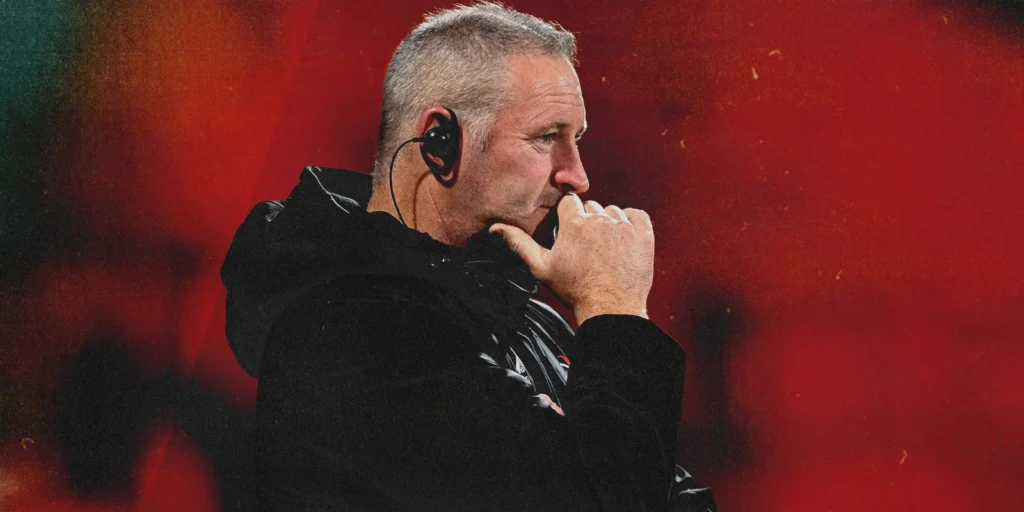
Duffy has been the forwards coach at Ulster for the last two seasons and, while their scrum and lineout has been decent to good at times — their biggest step up under his coaching was in their collision dominance.
This has always been a core part of Duffy’s coaching, going all the way back to his time with the Irish 20s, and well before it, but his work with Ulster’s forwards was a step up again.
I pulled every club in the URC, the Premiership, the Top 14 and Super Rugby Pacific last season — 51 teams — and ran their attacking numbers against how their seasons actually went. Gainline success came out as the strongest relationship in the entire dataset, and nothing else was close. Kicking to end possessions, the thing we argue about endlessly, had no measurable relationship with winning at all. Neither did how long teams held onto the ball.
So how did Duffy’s Ulster pack do against us on it?
They crossed the gainline 54.8 times per match in the URC last season, fourth in the league. We managed 51.6, seventh. Ulster carried more often than us — 125.8 to our 119.9 — and got over the advantage line more often as a result.
But the interesting part is underneath that, because it tells you what Duffy has actually been coaching.
Ulster v Munster · per carry · URC 2025/26
Ulster got more out of every carry
How much more Duffy’s pack produced from each carry than Munster did, once you control for the fact that Ulster carried more often. Hover or tap a bar for the underlying numbers.
Both packs crossed the gainline on roughly 43% of carries. The separation came after contact: Ulster ranked 2nd in the URC for dominant contact rate, Munster 13th.
Per carry, the rate at which each pack crossed the line was nearly identical — Ulster 43.6%, us 43.0%. Sixth and eighth in a sixteen-team league. At the moment of contact, we were not far off them at all.
Everything after that moment is where they pull clear.
Per carry, Ulster produced 37% more dominant contacts than we did. They beat 23% more defenders. They made 35% more clean breaks. They got 13% more post-contact metres. Their dominant contact rate was 17.8% of carries, second in the URC; ours was 13.0%, thirteenth.
I went through our carrying numbers unit by unit in the Hard Reset pieces here, so I won’t put you through all of that again. The one figure worth repeating is this: across those 51 clubs, we ranked 50th for dominant collisions.
We arrive at the gainline about as often as Ulster do; we just arrive without doing any damage. Our carries cross the line and don’t cause enough damage. Theirs cross it and keep going, and that compounds across eighty minutes into the volume gap you see in the match totals.
Ulster’s answer was not complicated. They carried into two or more tacklers more often than almost anyone — eighth of the 51 — and still came out in front. They went looking for congestion and won it. Then they held onto the ball: 20.3% of their possessions went past five phases, the highest rate of any club across all four leagues. Not the best in Ireland. The best of the fifty-one. Now, how effective was it for them in the grand scheme of things? They ran out of steam at key points once they couldn’t manage their energy across a facile Challenge Cup pool in December and January, but the principles of their game rested on forwards getting over the gainline, repeatedly, where ours did not.
A forwards coach doesn’t own carrying on his own; attack shape and the men passing the ball have a say in who carries into what, and where. But post-contact metres, dominant contact rate and the fight after the tackle are as close to a forwards coach’s fingerprints as this sport leaves. On those three, Ulster were second, third and third in the URC. We were thirteenth, twelfth and eleventh.
Who better than Jimmy Duffy to mark this change in identity? He’s got the CV, the data to back the CV up and experience working with core young players in this pack at 20s level. His remit is clear. Turn a group of players who were dominant ball carriers at 20s level under his coaching, and scale them up at senior level, all of a solid set piece.
Do that, and teams will fear coming to the boneyard on the Cratloe Road once again.
