


Eaten bread is soon forgotten.
The most significant marquee signing of the Rowntree Era – long anticipated and, in places, demanded – has already happened. The marquee signing in question?
He’s already played for Munster multiple times.
His name? Oli Jager.
When Jager was announced as joining Munster on a three-and-a-half-year deal – itself a wild anomaly in Irish Rugby due to the length of the deal – in November 2023, it passed under the radar a little bit. Maybe it was the hangover from the World Cup and the relatively low-key build-up to the league and European season that followed. Maybe it was because he was Irish Qualified; not as sexy as signing a capped Springbok or All Black. Or maybe it was the one or two niggles that Jager picked up on arrival; look either way, his signing didn’t get people’s pulses going for whatever reason.
Yet, on paper at least, Jager was every inch a marquee signing. He’s a multi-time Super Rugby winner with the Crusaders who played a key role in most of those Super Rugby victories, while also having the elite-level size and power everyone needs at tighthead these days. He was a few badly timed injuries away from becoming a capped All Black on more than one occasion.
On grass, Jager had a mixed season; primarily defined by injury, both to himself and those around him. The back half of the season was defined by a pre-existing knee injury from his Crusaders days that was aggravated during a Six Nations camp with Ireland.
He had a procedure done on the knee, missed the guts of two months and only started one more game that season; Munster used him primarily as a power option off the bench as part of the “Beast Unit”. That was in part to manage the workload on his knee but also to utilise his power at the business end of games.
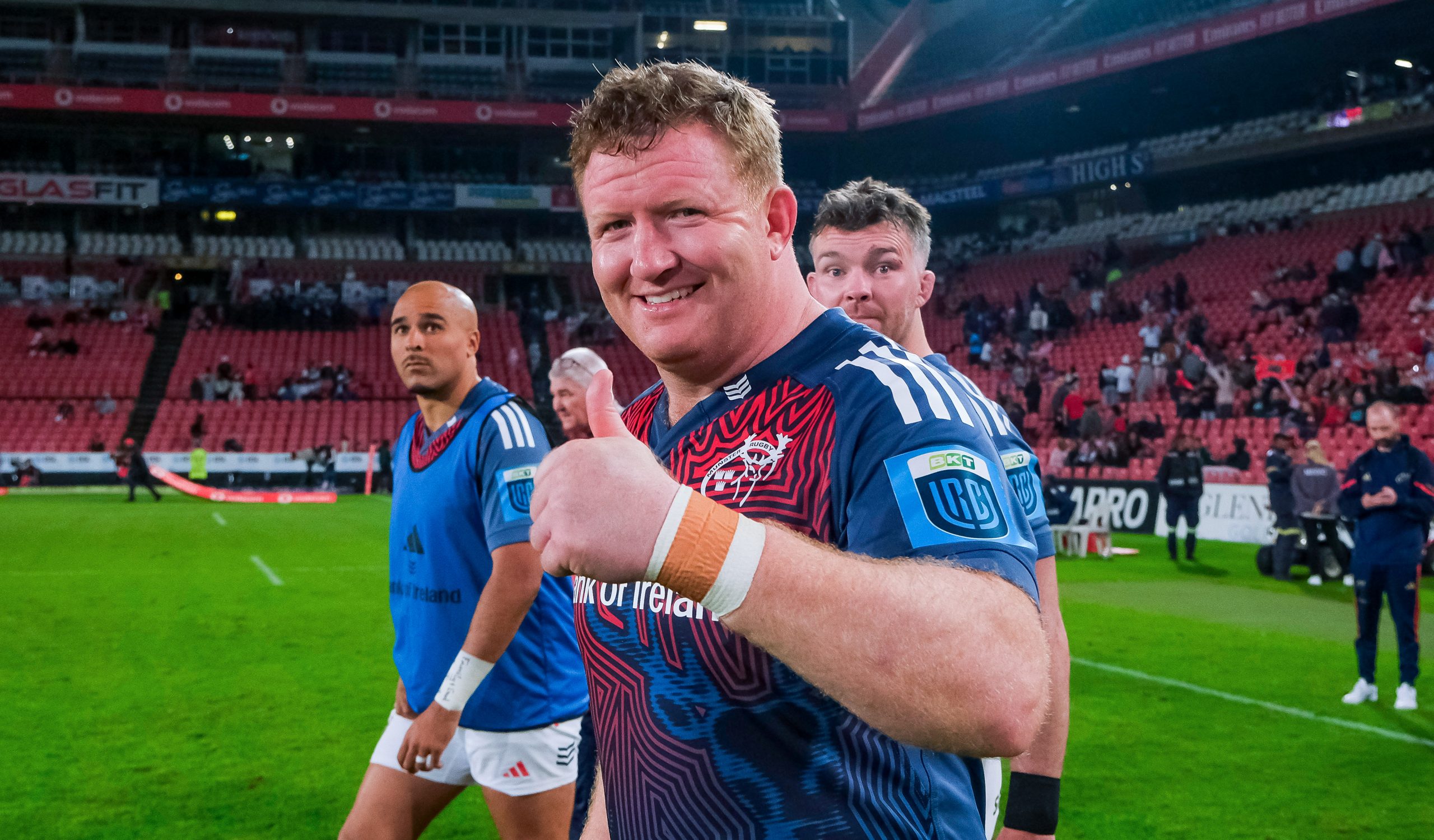
On Munster’s tour of South Africa last season, Jager won two crucial scrum penalties in back-to-back weeks as well as adding punch around the field as an impact player. All that being said, I would argue that he wasn’t signed to be an impact option. The problem is that without Jager coming off the bench – even if it was to manage an injury – we had no elite power to use as impact off the bench.
We had hardy, technically quite good lads but no physical game-changers. If the equation was starting with one of two guys in their mid-30s and finishing with Jager or getting 50 minutes out of Jager and finishing with one of two guys in their mid-30s, the answer was obvious.
Regardless, Jager had a relatively low-key end to the season, as did most of the Munster pack, but that shouldn’t detract from the scale of his signing; if we get most of that we saw from Jager last season for 20+ appearances next season, we’ll have a top ten tighthead in Europe and the natural successor in the short to mid-term for Tadhg Furlong at test level. He is, without question, the only CORE 1 talent we have in the position.
But Jager’s quality hides an unstable tighthead depth chart.
- CORE 1: A vitally important player who will start most games or play an important role in them.
- CORE 2: An important senior player who will likely make squads as a starter or replacement in elite games.
- SQUAD 1: A player who can slot in for one of the CORE 1/2 players if they are injured and can be a match day 23 player for lower tier games as a starter or replacement.
- SQUAD 2: A player who is an intermittent option in the match day 23 regardless of opposition.
- FOUNDATION 1: A young player – under 25 – who can become a CORE 1 player.
- FOUNDATION 2: A player expected to top out around CORE 2 or SQUAD 1 level.
- PRIORITY 1/2/3: A player who needs to be cycled out inside one year (most pressing), two years (wiggle room) and three years (ageing but not a pressing matter)
| Player | Role | Age on Jan 31 2025 | Contract Expiry | Rating |
|---|---|---|---|---|
| Oli Jager | Tighthead Power Forward | 29 | 2027 | CORE 1 |
| John Ryan | Veteran Heavy Scrummager | 36 | 2025 | REPLACE 1 |
| Stephen Archer | Veteran Heavy Support Prop | 36 | JAN 2025 | REPLACE 1 |
| Roman Salanoa | Tighthead Power Forward | 27 | 2025 | ASSESS 1 |
| Ronan Foxe | Heavy Scrummager | 21 | ACAD | FOUNDATION 2 |
| Darragh McSweeney | Tighthead Power Forward | 22 | ACAD | ASSESS 1 |
Last season, I hypothesised – wrongly – that it would be the last season for John Ryan or Stephen Archer. My logic was that, as both men were in their mid-30s and on expiring contracts, there would only be room for one of them. John Ryan was signed to a new one-year deal – to be expected – but that was followed by Stephen Archer signing a six-month deal to take him to January 2025.
What was going on? Well, it’s entirely related to Roman Salanoa’s ongoing knee injury, but I’ll get to that in a minute.
Both Archer and Ryan are perfect examples of veteran cover, with the only downside being a collective drop in the quality and impact of their output against elite opponents. That is just a fact of life to be expected at 35/36 playing at this level. As part of a big pack build, that wouldn’t be an issue but both men found themselves scrummaging in front of and playing in tight phase play units that just didn’t have elite size and power consistently last season.
In a tight five, you can easily carry veteran tightheads as either starters or finishers if you have a consistent rotation of power around them in the second row, in the other front row spots and alternating with the veteran player in question. So you could easily make a guy like John Ryan work – who can cover both tighthead and loosehead scrum roles to a pretty high level – even if he doesn’t pack a massive punch in the middle of the field anymore – by putting him in units that do the punching for him. That way, his role is squarely on scrum dominance whenever he comes on, be it minute 0 or minute 60, along with a focus on cleaning rucks, passing out of screens and carrying very occasionally.
The problem last season was that, for long stretches, we were backing up John Ryan with Stephen Archer and vice-versa while our lock depth chart was burned down to the bone. There was no scope to get the best out of a veteran in that environment but, even then, both men had very good seasons.
Contract-wise, signing John Ryan on a one-year deal made perfect sense. He’s got the least miles on the clock of the two – or so it seems – and his scrum focus is a valuable tool to have in the locker over a season. He also covers loosehead, as he did to good effect last season, so that adds to his value in the squad.
In my opinion, if Roman Salanoa was fit – or even close to being fit – we’d have probably seen Stephen Archer retiring at the end of last season. That Archer signed a six-month deal to January 2025, mid-season essentially, tells us that Salanoa’s fitness is far from a guarantee. We know exactly what we’re going to get from Archer at this point, who’s had a top-class Munster career since his debut in 2009. I won’t pretend that Archer didn’t have a rough middle of the 2010s – like Munster as a whole, you might say – when he was dealing with a serious neck issue, but since 2018/19 I’d be comfortable saying that he’s been our most consistent front row game to game. He’s a good scrummager against all but the most dominant short, butty, aggressive elite looseheads. He’s a decent carrier, without being a power player. He’s durable as they come. He’s a good handler, with some proper deftness in his locker. He’s a decent defender, albeit with a tendency to give away more than his fair share of not-rolling away penalties. He’s a fantastic mauler and lineout forward.
But that kind of all-around solidity is exactly what you’d want from a veteran cover guy – if you didn’t already have John Ryan at the club.
The thing with tightheads is that they’re expensive.
Signing a tighthead anywhere near their prime (which I’d put at 24-33) is a pricey business and it’s usually why most clubs carry a few more looseheads than tightheads.
If you look at Leinster, they have five senior looseheads and only three senior tightheads. Ulster have Marty Moore and Scott Wilson with rumours that Tom O’Toole could be switching to loosehead.
Connacht have Aungier, Bealham and Illo as senior tightheads. Carrying any more than that outside of the rarity swing prop is cost-prohibitive because tightheads are still a highly valuable commodity in the modern game. Having two elite tightheads in your squad – as Leinster did for the last three years with Furlong (1A) and Ala’alatoa (1B) is an expensive business only made possible by Furlong’s contract being covered in full by the IRFU.
Look at the likes of Toulouse or Bordeaux or even La Rochelle in France – they don’t have two
Tightheads aren’t usually the highest-paid position in the pack anymore – the scrum being nerfed somewhat over the last few years has brought average salaries at prop down – and the general importance of the lineout and phase play has seen the value of locks skyrocket. Good tightheads are still highly valuable though, especially if they are bringing elite power around the field in phase play to the point that they are a level raiser for you, as opposed to “just” a solid body in the scrum.
So, ideally, you’ll have a stratified depth chart being paid in the following descending order and used on-field in a horses-for-courses manner depending on keeping players fresh, your result needs week-to-week and the strengths of a particular opponent on a given day;
- CORE 1 level talent
- CORE 2 level talent, generally two years younger than CORE 1 player.
- SQUAD 1/PRIORITY 2 level veteran, usually with a scrum first focus
- FOUNDATION 1/2 level academy talent
- FOUNDATION 1/2 level academy talent
Your wage structure should follow this religiously, in my opinion. In the Irish system, the IRFU pay for the academy so any players you can get 5/6 games usage out of from Year 2 academy onwards are gold-dust.
At Munster right now, Roman Salanoa should be the CORE 2 level talent in that chart with all the qualities you’d love in that player as a Tighthead Power Forward. He’s physically explosive, incredibly powerful around the fringes on both sides of the ball, a powerful mauler and absolutely perfect to spring off the bench against Category A opposition. Salanoa’s scrummaging is pretty decent too, even if he gets into trouble against crafty, smaller opponents.

The problem is that he missed the entirety of last season after an outstanding 2022/23 where he made 20 appearances, including an excellent run on the way to the final of the URC. And there’s no end to that injury hell in sight either as he comes into a contract year. Salanoa was initially meant to be out for the first half of the season in September of last year after he had a knee issue taken care of in the off-season. Complications with that surgery meant that he had to get another surgery in February of this year and it’s uncertain what the time scale on that injury is.
Munster will give him every chance. Players with Salanoa’s role profile don’t grow on trees and the quality we saw in 2022/23 is enough to have him viewed in a positive light with contract negotiations on the horizon, likely before he’s back training fully.
I think Stephen Archer’s six-month deal is, in all likelihood, insurance in the case that Salanoa doesn’t make it back onto the pitch before the new year. If Salanoa can’t get back running by November/December, however, it’s unclear how we will proceed.
At the moment our depth chart looks like this;
- CORE 1 level talent
- SQUAD 1/PRIORITY 2 level veteran, usually with a scrum first focus
- SQUAD 1/PRIORITY 2 level veteran
- FOUNDATION 1/2 level academy talent
- FOUNDATION 1/2 level academy talent
That is a recipe for trouble until we can get some clarity.
In the academy, we’ve been snakebitten by injuries in the same vein. Darragh McSweeney, a 6’3″/130kg tighthead power forward build player has all the physical stuff required to get URC minutes this season if his scrummaging can hold up, which is something of a question mark. I’ve seen him play a good bit for Shannon in my last two seasons doing AIL content and he’s fluctuated from game to game in that area of the game. If he can get some consistency when it comes to scrummaging at his size – learning to use it effectively, which is no easy feat – there’s a possible long-term option there but he needs a run of fitness after a heavily disrupted season last year.
He’ll need to showcase that he’s ready for 2/3 URC-level games quite quickly this season if he’s to progress to a senior deal.
Ronan Foxe, another tighthead who missed all of last season with injury, is a really interesting player to me. All of his u20 rugby came in the 2023 World Championships where he soon displaced Paddy McCarthy over to loosehead to become the starting tighthead. His scrummaging in that tournament was really advanced while up against some serious size and power. The important thing in these clips is that he’s not just overpowering a smaller opponent; he’s breaking them up with his body shape.
At 20’s level you often see physical freak props overpowering their opposition but that rarely translates to senior level; Foxe was different in that he had the power, sure, but there was real scrummaging instinct behind it.
Foxe’s injury-ridden first year in the academy afforded a lot of gym time along with the rehab and the signs of that work can be seen this off-season where he’s looking in great shape while playing north of 120kg.
It would be incredibly ambitious to expect anything more out of Foxe this season than a few early URC appearances but I’ll put it this way; Munster’s tighthead depth chart is prime for a young stud to make a big move. In the last two seasons, Rowntree has taken a proper cut at our tighthead depth charts. I rated both James French and Keynan Knox as foundational talents back in 2021 but now both men are playing lower-league rugby. French is with the Cornish Pirates in the English Championship and Knox is playing with Bourgoin in the French third division.
This just goes to show (1) how hard it is to predict how tightheads, in particular, will mature and (2) just how tough it is to make it to the elite end of the game. Both French and Knox are good players who, at different times, have looked like they were destined for bigger things. They might well end up doing so yet but if they do it feels like it’ll be the long way around.
Johann Van Graan told me back in 2019 that he fully expected Keynan Knox to play for Ireland if, and it was a big if, he got his act together defensively and dialled in on toughness. James French had that performance away against Wasps in Europe that looked like he’d been playing European-level rugby for a year or two, around the field at least.
But when you see a team parting ways with two young tightheads that they had invested multiple years into and, in Knox’s case, two senior contracts, it tells a pretty stark story.
So I won’t go overboard in what I think Foxe can do but I will say that at 6’2″ and 120kg+, he’s got all the physical tools to make a run at possibly earning himself a senior deal this season if he can earn some minutes early in the season and showcase durability.
Ultimately, a lot of the future of this depth chart relies on the fitness of Roman Salanoa.
If he can return close to the player he was – and relatively soon – it gives Munster some breathing room when it comes to next season’s contracting. If Salanoa can’t get back fit, the position will inevitably require a signing as both Archer and Ryan might well be retired by July 2025, barring a freakish breakout season by Foxe or McSweeney.
