


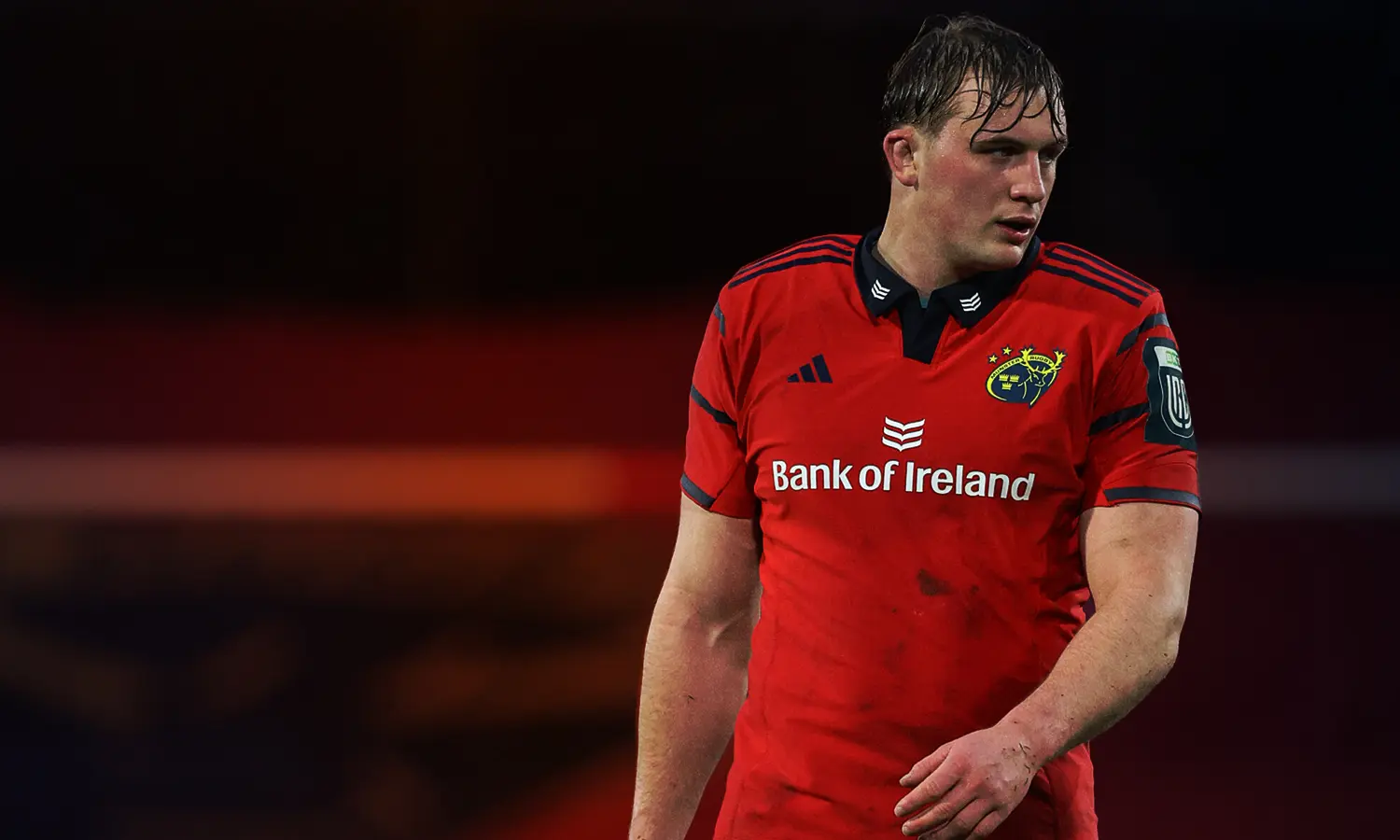
On paper, the back row is Munster’s strongest chart when it comes to established quality — certainly at European level — and high-level potential, but both contractually and systemically, it’s got the highest boom-or-bust potential in the squad.
I’ll explain why.
On the positive side, we’ve got some of the best, highest-potential young backrows on the island who, if they can sync up their U20 performances with full senior rugby, are arguably some of the highest-potential players in Europe.
We’ve also got some high-quality senior backrows who are available for the entire season, injury allowing, so there’s plenty of scope to cover multiple games without overloading anyone.
On the negative side, last season didn’t really offer any of our backrows an opportunity to have a breakout season, and there are a few reasons for this. Badly timed injuries in Gleeson’s case; he broke his elbow right after a dominant opening half an hour in Croke Park against Leinster. Most everyone else fell into a systemic malaise. Our edge forwards seemed to wither in a framework that never really managed to get them the ball in a position where they could do actual damage; our players who played more centrally passed as much as they carried, and that was all wrapped up in a pack that couldn’t really maul, was fitful at the lineout in general, and conceded an average of three scrum penalties a game in the URC.
That will have to change this season — obviously — but I think our success under the new system being implemented this off-season will be most clearly seen in the back row, if it is to be successful at all.
Let’s have a look at the chart itself.
Back row — depth chart
Munster, next season · contract expiry in brackets
- Core
- Expiring
- Departure risk
- Development
- Academy
Tier 1 · first choice
Gavin Coombes (2027) Expiring · difficult re-signing
A reliable and often impactful anchor at No. 8. Struggled to show his true quality last season, in part through heavy usage. Expiring deal, and potentially expensive and difficult to renew given his exclusion at test level.
Brian Gleeson (2028) Core · high potential
High-potential young player with expanded minutes last season — more but for injury. A strong, physical ball carrier. New deal to 2028 reflects his value.
John Hodnett (2028) Core
Impactful and useful, often deployed off the bench. Signed through July 2028 on a new contract.
Jack O’Donoghue (2027) Extension · likely to depart after
Highly experienced veteran and a classic glue guy — a lot of the unglamorous work that makes him valuable. On a one-year extension; likely to move on at its end given his age, depending on how the younger options develop.
Alex Kendellen (2027) Expiring · likely retained
Used in tandem with Hodnett last season. Capable of big impact but tracking as a glue guy rather than a true impact player. Expiring, and a likely re-signing — though a supporting role may not suit his ambition.
Sean Edogbo (2028) Core · breakout candidate
Jumped early to a senior deal amid interest from abroad. A lineout option and dominant ball carrier who will get a lot of opportunity if fit — could easily have a breakout year. New two-year deal reflects his potential.
Tier 2 · rotation and development
Ruadhán Quinn (2027) Development · retention watch
High potential, but caught in role flux under the previous system — the frame of a power carrier, yet drawn into ruck arrivals and tackle work. Needs a standout offensive feature. Should be an easy re-sign for Munster, but usage will decide it; expect interest from Connacht and Ulster.
Luke Murphy (ACAD3) Academy · extension likely
A few injuries in recent seasons, but the physical tools to be a proper impact player over the next two. Expiring, with at least a one-year extension likely — a two-year offer may be needed given probable interest.
Oisin Minogue (ACAD2) Academy
On paper a blend of what Hodnett and Kendellen offer in a true small-forward build, with a high skill set and a big impact at AIL level. Needs minutes. Likely another academy year barring breakout form.
Alex Lautsou (ACAD1) Academy · one to watch
Just into the academy; this season is mostly preparation for his Ireland U20 campaign. A high-volume tackler and defensive impact player with incredible athleticism — a senior deal could follow a prominent 20s year.
On last season’s usage, there are only two clear 1A players in the back row, and they both play in the same position. First, let’s get to Gavin Coombes.
Coombes has averaged 22 games a season for Munster over the last four seasons. Last season, he had his lowest percentage of starts in that usage since his breakout season in 2020/21, but that seemed to be more about keeping him fresh than anything else.
I’d also suggest that, despite some notable high points, last season was a disappointing one for Coombes overall. Not just because he “only” scored four tries — he’s averaged a completely freakish 10 tries a season since he broke through in 2021/22 — I mean, in general. In a lot of ways, Coombes tracked Munster’s general level of malaise as the season went on, where there was obviously a lot of hard work, but not much in the way of end product when it came to punching holes consistently.
The good news is that you can get reasonably close. If you take a player’s post-contact metres, dominant carries and dominant tackles and rank each against every other back row in the league, you end up with a fair proxy for how much damage a player is doing at the point of contact. Restrict it to forwards with 800+ minutes — the genuine week-in, week-out men — and Coombes comes out at 51 out of 100. Ruan Venter is 94, Sean Jansen 89, Fletcher Anderson 85. The middle of that group sits around 63.
What’s odd is that Coombes isn’t losing the collision. Thirty per cent of his carries were dominant, ahead of Elrigh Louw (29%) and Jansen (27%). He’s still winning first contact. The problem is everything after it. Evan Roos carried 11.3 times a game last season — identical to Coombes — and made 37.8 metres. Coombes made 21.6, the lowest of any front-line carrier in the league. Louw carried marginally more often and made 45.6. Per carry, that’s 1.9 metres against 4.5 for Francke Horn and 3.9 for Louw and Jeandre Rudolph; the lowest figure among the league’s regular carriers was 2.8. His line breaks per carry came in at 0.01, effectively zero.
Defensively, it’s less damning than it first looks. His 14.9 tackles a game is a solid volume in this company. But the dominance isn’t there — 0.3 dominant tackles, two per cent of his total, against Venter’s 13% and Ben-Jason Dixon’s 10%, in a group where five per cent is the entry point. And at the breakdown he arrived at 21.1 rucks, the lowest of any regular back row in the URC.
Here’s where it gets interesting. Coombes threw 6.4 passes a game, fourth-most of any back row in the league, and offloaded 1.6 times, more than anyone. He is doing a great deal of ball-handling for a No. 8. He’s also doing it badly: 1.4 bad passes a game and 78% accuracy, both the worst figures in that entire group. The nearest man to him is on 88%.
That, to me, is the whole story in one line. Coombes has been given a bigger role with the ball in hand and a smaller one running into people, and he’s better at the second job than the first.
I think there’s an explanation for this. In the last few seasons, Coombes has made changes to his game. He’s added more of, well, everything. More passing, more ruck arrivals, more defensive ruck arrivals, more lineout usage.
I think these are primarily related to fitting his game into something that Andy Farrell might use at #8 in his system, with the lineout as a point of difference relative to Caelan Doris, to whom he’s most often compared.
If that was the plan, it worked. Put the two of them side by side on a per-80 basis, and the convergence is genuinely really interesting. Both made exactly 14.9 tackles a game last season. Both created 0.2 line breaks for someone else. Coombes got 1.1 metres past the tackle for every carry; Doris got 1.0. Their gain-line success rates were 54% and 56%. On every measure of what happens at the point of contact, these are now the same player.
The ball-playing brief has been delivered on too, arguably beyond the spec. Coombes threw 6.4 passes a game to Doris’ 6.7, but he did it off 16.1 touches to Doris’ 20.6 — meaning that per time he had the ball in his hands, Coombes passed it more often than Doris did. He also offloaded more than any back row in the URC. Whatever “become more like Caelan Doris” was supposed to mean with ball in hand, Coombes has gone and done it.
What hasn’t come with it is everything Doris does extra, naturally, that makes him better at being… Caelan Doris.
Start with the running. Breaks per carry: Coombes 0.01, Doris 0.05. Five times the rate. Two players winning the collision identically, and only one of them ever gets beyond the first man. That is part to do with system and where they carry — Coombes carries more off #9, Doris more off #10 — and while that’s a big differential, it doesn’t explain everything away either.
Then there’s the work off the ball, which splits in two and goes against him both times. On attack, Coombes hit 21.1 rucks a game to Doris’ 28.7 — call it a third less support work, with the same gap in fast arrivals. On defence, he won 0.3 turnovers to Doris’ 0.9. So Doris is doing more to keep his own team’s ball alive and three times as much to take the opposition’s away.
In fairness to Coombes, he’s producing these numbers on nearly a thousand minutes of rugby. Doris’ club sample is a good deal smaller, with Ireland windows in between.
But that’s the shape of it. Coombes has been remodelled into a Doris-type eight and has met the brief on the parts that can be coached — the passing, the offloading, the tackle count, the work at contact. What’s been quietly filed off in the process is the one thing he had that Doris didn’t really have at the same level, which is the ability to beat defenders. In attempting to become a more rounded player to fit into what Ireland want — my hypothesis, but I think it fits — I think Coombes has lost some of the threat that he had a few seasons ago.
I suspect this was also an attempt to replace something. In 2022/23 and 2023/24, our attack was at its best with Snyman as a heavy distributor, his carrying gravity underwriting a passing and offloading platform in broadly the same areas Coombes occupies. Asking Coombes to pass more looks a lot like trying to synthesise that effect without the player who generated it.
The problem is that the passing was never the point. It worked because defences had no choice but to commit bodies to Snyman before the ball left his hands, and everything downstream flowed from that. Coombes broke the line once every hundred carries last season. Defences can afford to hold their shape against him, which means the pass goes to the same place but arrives with the defence in place.
What does this mean?
I would suggest a more direct, heavier, aggressive Gavin Coombes is now far more likely to break into the Ireland squad — if that is still possible for him with Andy Farrell — than the more subtle Coombes we saw for the last two seasons.
In fact, his best performance this past season, for me, was when he came off the bench against the Dragons in the second row, where he could just carry hard and direct. If he returns to that in a simpler, more direct framework, the impact will return with it.
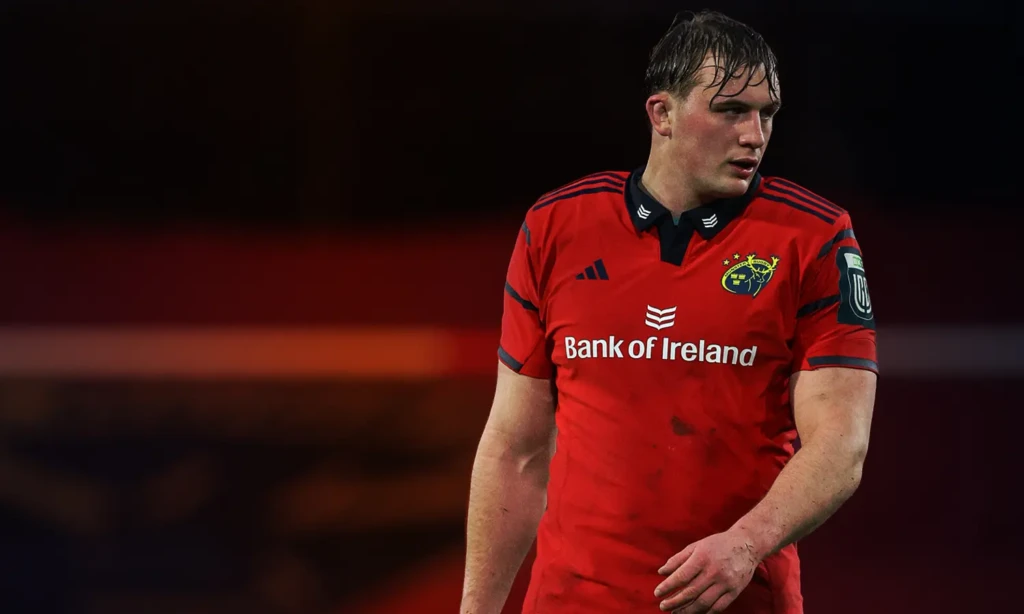
In that light, I’d easily re-sign Coombes on mostly whatever it would take to keep him, but it isn’t as straightforward as that. Not even close.
Coombes will turn 29 this season, and if he signs a new two-year deal, say, that would take him to the summer of 2029, when he’d be turning 31 the following season. If you’re Gavin Coombes, and you look at the work you’ve put into your game over the last three seasons in the hope of somehow changing Andy Farrell’s perception of you — that will play some part in it, maybe not all — only to see one cap on a summer tour mid-Lions against Georgia in five years.
Maybe there’s nothing Coombes can do that will get him into Ireland contention, and while, sure, he loves playing for Munster, I think when he combines the fact that he’s midway through his prime for a ball-carrying forward, after back-to-back-to-back-to-back 1200+ minute seasons here, he might well decide that now is the time for a big money move to France or England. The World Cup is looming large next year, and I think a good few players who are hitting their mid-prime outside of the Irish test bubble might well be looking elsewhere, as happens regularly in New Zealand, who operate a similar structure to ourselves.
I would keep Gavin Coombes in a heartbeat, but there are so many other factors to consider. Without test rugby, or the realistic prospect of it at this stage, how much could/should Munster offer to keep Coombes on a one-or-two-year deal?
His usage would suggest that he should be one of the highest paid non-internationals in the squad, but what if, at that stage, Brian Gleeson is in the Ireland squad, or verging on it? Is that an appropriate or realistic use of funds?
I think this could end up being something of a controversial one as the new season progresses.
Then we have Brian Gleeson.
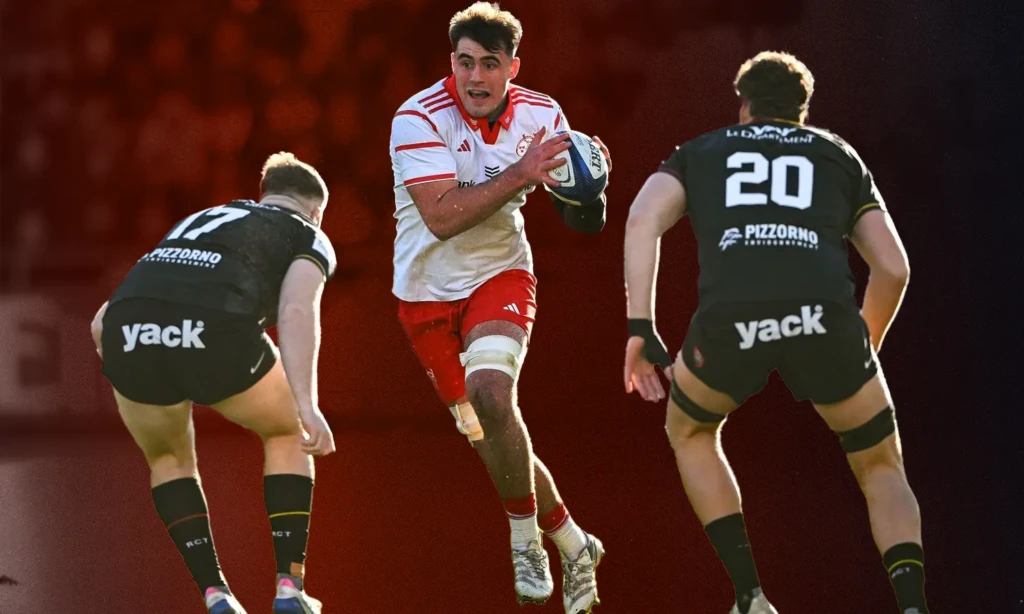
Very few players were as good as Brian Gleeson at 20s level, and you know this is true, because he was playing Champions Cup rugby for Munster in big games at 19 years old. Witheringly rare. He started last season like a killer, but a nasty elbow injury against Leinster arguably deprived him of a certain test debut in November. That injury took a while to recover from in a literal sense — he was out for two and a half months — but it took him a while to get back up to speed after it. By the end of the season, he was our starting #8, and I’d expect that to continue next season.
He carried 14.8 times per 80 last season. That’s the most of any Munster forward by a distance — Coombes was on 11.3 — and it put him inside the top ten in the URC among back rows. He made 19.1 post-contact metres a game, again the most in the province. He arrived at 21.4 rucks, 20.0 of them fast. He made 14.2 tackles at 85%. On raw workload, a player who turned 22 last season was doing more with the ball than anybody else in the squad.
The obvious criticism is that it didn’t go very far. 2.5 metres a carry looks ordinary, and 0.02 line breaks per carry looks worse. He was mainly carrying inside the opposition 22, into set defences, in the phases where there is nowhere to run and the job is to get the ball a metre closer to the line. Judging a red-zone carrier on metres per carry is like judging a prop on his passing. The 24% dominant carry rate, the lowest of Munster’s front-line carriers, comes from the same place.
He did this, by the way, behind the wobbliest scrum in Europe. Gleeson’s big strength is how scarily fast he is at 6’4″ and 116kg, and his threat off the back of a scrum that is stable or moving forward can’t be underestimated as a systemic weapon. Last season, it felt like his fine skills at the back of a retreating or shearing scrum were actively undercutting him. If we can improve that this season, watch him scare the life out of everyone.
What genuinely stands out is his ball security, and it’s the number I keep coming back to. Gleeson threw 2.8 passes a game at 100% accuracy. Zero bad passes across the entire season. He made 0.4 errors and conceded 0.4 turnovers per 80 — which, at 14.8 carries a game, works out at one turnover surrendered for every 37 times he took the ball into contact. That’s the best ratio in the squad by a comfortable margin, and it belongs to the player handling it most often. Usually the highest-volume carrier is the most exposed. Gleeson is the safest.
He’s also a better breakdown operator than anyone credits. 0.9 breakdown turnovers, 1.0 turnovers won in the tackle, 0.2 interceptions. Behind Beirne, he was Munster’s most productive jackal last season, and Beirne played six games in the shirt.
The holes are real, though, and they’re specific. He touched the ball 17.2 times per 80 — more than anyone in the squad — and passed it 2.8 times. Ball goes in, ball comes out through the ruck. He offloaded 0.02 times per carry and registered no line-break assists at all. His 1.0 penalties per 80 is among the highest in the group, and he made no dominant tackles worth recording. He is, at this stage, a battering ram with exceptional hands and a decent jackal.
Which brings me to the thing I’d want us to be careful about. The entire Coombes section above describes a player who was given more passing, more distribution, more responsibility away from contact, and who lost his threat somewhere in the process. Gleeson is the same archetype at 22 that Coombes was at 24. The temptation to round him out will be strong, and the evidence of the last three seasons suggests that, under the old system, we’d be looking to turn Gleeson into a more indirect player. I hope that is not the case this season, and I don’t think it will be. Gleeson is a player who excels at running over the top of people. Let that continue.
He’s tracking well regardless. 15 appearances at 48 minutes a game says a young player being managed carefully, and the elbow he broke in Croke Park cost him what looked like a breakout run. He carries at URC volume, he doesn’t lose the ball, and he wins it back.
Leave him alone for one more season, give him the ball in the opposition half rather than only inside their 22, and the Ireland conversation starts writing itself. If he works out as he’s tracking, he will be a top international player.
I’ll get to the other players in this chart shortly, but first I wanted to assess the back row as a combined unit.
Every axis is scaled from 0 to 100 against the best of these nine, so each chart shows relative shape rather than absolute quality. The bar under each name is minutes played, on a common scale.
Turnovers won against penalties conceded. Above the dashed line a player wins more than he gives away — and even that flatters them, since a penalty usually costs 40 metres while a turnover only returns possession. Hollow markers are the three players with fewer than eight matches.
| Player | Min | Mts | Carr | M/carr | Tack | BD TO | Ruck | Pass | Pens |
|---|---|---|---|---|---|---|---|---|---|
| Gavin Coombes | 978 | 17 | 11.3 | 1.9 | 14.9 | 0.3 | 21.1 | 6.4 | 0.7 |
| Jack O’Donoghue | 842 | 15 | 6.2 | 2.3 | 12.7 | 0.8 | 24.2 | 4.6 | 0.6 |
| Brian Gleeson | 721 | 15 | 14.8 | 2.5 | 14.2 | 0.9 | 21.4 | 2.8 | 1.0 |
| Tom Ahern | 527 | 8 | 4.6 | 4.2 | 9.0 | 0.1 | 14.2 | 2.9 | 0.1 |
| John Hodnett | 508 | 12 | 8.2 | 4.6 | 15.1 | 0.8 | 17.0 | 3.0 | 0.5 |
| Alex Kendellen | 498 | 10 | 8.2 | 2.5 | 17.0 | 0.3 | 23.6 | 7.7 | 1.1 |
| Tadhg Beirne | 442 | 6 | 5.2 | 1.8 | 10.8 | 2.0 | 23.8 | 3.8 | 0.9 |
| Ruadhan Quinn | 245 | 6 | 9.5 | 1.9 | 16.3 | 0.0 | 25.1 | 3.6 | 0.3 |
| Sean Edogbo | 211 | 4 | 7.6 | 4.0 | 9.9 | 0.0 | 19.7 | 4.2 | 0.4 |
All figures per 80 minutes, from appearances at loose forward only. Impact is metres per carry; jackal is breakdown turnovers won; ruck is ruck arrivals, which vary little across the group and so separate players less than the other axes. Beirne and Ahern also play lock, so their samples here cover only part of their season and the collision measures rank them against back rows rather than second rows. Quinn, Edogbo and Beirne have fewer than eight matches each — read their shapes as a first sketch, not a verdict.
Look at the nine forwards Munster used in the back row last season, and the thing that jumps out is shape. Every one of them has a spike and a corresponding hole. Gleeson is volume. Hodnett is collision. Kendellen is work rate and passing. Beirne is the breakdown. Quinn is ruck arrivals. Edogbo is dominant carrying. The only genuinely round player in the group is Jack O’Donoghue, who is good at everything and elite at nothing — which is exactly why he played 842 minutes at 32 years of age.
That’s fine if you can pick three complementary shapes every week. It’s a problem the moment injuries make the selection for you, and last season they did.
The bigger issue is what none of them does. Across the entire group, the best line-break rate was Hodnett’s 0.12 per carry, and everyone else was 0.09 or below — Coombes at 0.01, Gleeson at 0.02. Line-break assists topped out at 0.2 for the whole squad. Munster’s back row won collisions, secured ball and tackled at volume, and generated very little outside them. Whatever attacking threat the team carried came from nine and ten, with the loose forwards operating as a delivery mechanism. That is the statistical signature of the malaise everyone watched.
Which brings us to the lock usage, because that’s the decision underneath all of this. Beirne played 442 minutes at six, Ahern 527. That’s 969 minutes — the guts of 60% of Munster’s available blindside minutes handed to, nominally, second rows.
You can see why. The pack couldn’t maul, the lineout was fitful, and putting a genuine jumper at six is the obvious fix. But look at what it cost. Ahern* touched the ball 7.2 times per 80 — the lowest of any Munster back row by a distance, with Beirne next at 9.4 — and arrived at 14.2 rucks while there, again the lowest. He also had the worst error rate in the group at 1.2, and conceded a turnover once every five carries. For 969 minutes, Munster were playing a back row that was functionally two-and-a-half men in the loose.
*This dataset really sells the fact that Ahern has to focus on the second row exclusively this season, for me.
It also skewed everything else. If the guy at six can’t get to central rucks — because he’s on the edge — your seven and eight have to cover them, which means they can’t be as effective in contact as they could be, which is exactly what the numbers show.
So the read on the unit is this. We have the raw materials — the 22-year-old cluster of Gleeson, Edogbo and Quinn covers volume, collision quality and workrate between them with barely any overlap — but last season’s system asked them to do jobs that suppressed what makes each of them distinctive, and used a lineout patch at six that removed a third of the back row’s involvement.
Fix the lineout with actual locks, the scrum with functioning dominant props, and you get the back row back.
That brings us to Sean Edogbo, who, if he can break through properly this season, has the capacity to solve a ton of problems.
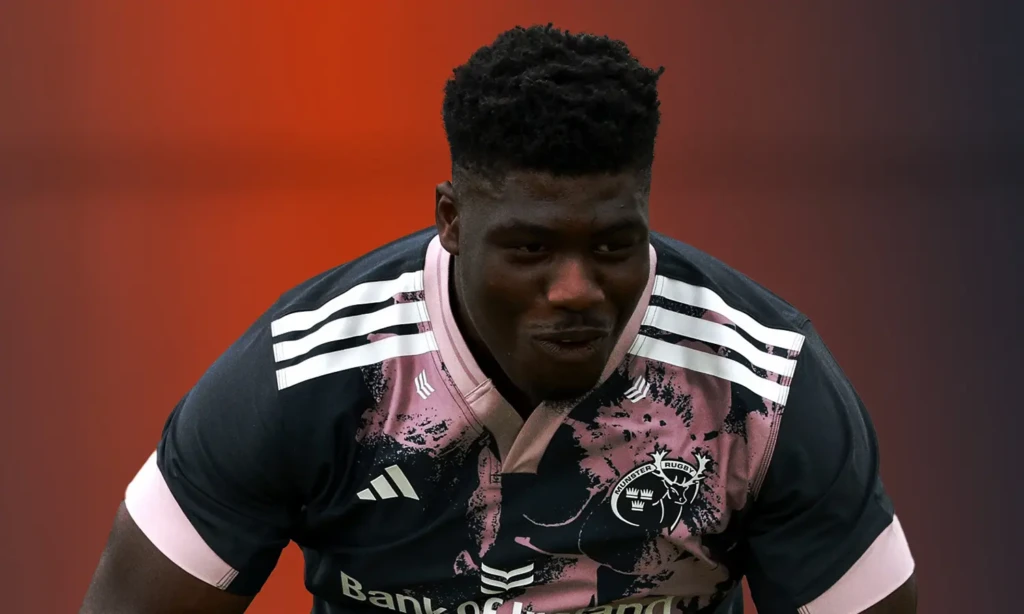
Edogbo is a very strong lineout forward, with an incredible vertical jump and explosivity off the ground. He combines this with great game IQ for his age, and some of the best dominant ball carrying we saw from any Munster forward last season.
When it comes to what Munster actually want from the #6 in the air and in contact, that is, essentially, Sean Edogbo.
Think about it — we’ve been selecting locks, essentially, at #6 to compensate for the lineout but, in doing so, we’ve lost ball-carrying impact in the areas where the #6 is meant to play. Edogbo answers both questions. The only question is if he’s physically ready to do it for 12+ games in the URC and Europe.
He played four games for us last season, but that would have been much more if not for a nasty knee injury earlier in the season. I would put it like this: nobody gets a full two-year deal out of their second season in the academy without an immediate usage in mind, never mind the fact that Sean Edogbo was highly sought after abroad for the same reasons I’ve illustrated above. Lineout-dominant back rows who are also this powerful and athletic in contact are rare. Expect him to get massive usage this season, if fit and available, because he fits exactly what we’ve been missing.
In a similar vein, I want to also talk about Jack O’Donoghue, who had a really good season in a lot of ways. From a data POV, he was arguably our most consistent back row and a valuable glue guy.
The data backs that up, and it backs it up in a specific place. O’Donoghue won 1.0 turnovers in the tackle and 0.8 at the breakdown last season, and made 0.8 dominant tackles at a 6% rate. Set those against the rest of the group, and only Beirne and Hodnett are in the same conversation, and neither of them played anywhere near 842 minutes at loose forward. He also arrived at 24.2 rucks a game, second only to Quinn, with 21.8 of those classed as fast. For a 32-year-old, that’s a man still getting to the right places on time.
The subtler number is his carrying. Six carries a game isn’t much, but 0.09 line breaks per carry is the second-best rate in the squad behind Hodnett, and his territory figure of 31.7 tells you where he’s doing it — deep in Munster’s own half, on exit ball, where the defence is set, and there’s nothing on. He’s making something out of the worst carries on the pitch.
He’s also a really valuable lineout forward, on both sides of the ball, which is a great option to have either starting or off the bench.
On the penalties, the perception and the data don’t quite line up. His 0.6 penalties per 80 is actually the second-lowest in the group. What did the damage was two yellow cards in 842 minutes, and a card costs you far more than the number of penalties suggests. If those had been ordinary infringements rather than sanctions, nobody would be mentioning his discipline at all.
So: extend or not?
The case against is straightforward. He’d be 34 mid-way through any new contract he’d sign here; his tackle success of 82% is already joint-lowest among Munster’s specialists, and every minute he plays is a minute Quinn, Murphy or Minogue doesn’t. Munster have four back rows aged 22 or under who need game time to develop, and one of the ways clubs stall young players is by keeping a reliable veteran in front of them. On the flipside, there’s a case — this season and next — that O’Donoghue will help to augment that young talent by doing a lot of the dirty work that will allow them to stand out more. He hits rucks, makes tackles, takes lineout ball, so a guy like Quinn can play more on-ball.
The compromise is what his usage already suggests: he averaged 56 minutes a game last season, so he’s not being asked to be a starter. A one-year extension on modest money, as a 50-minute offensive breakdown specialist and squad glue, costs almost nothing and covers a genuine weakness. I could see it, with that in mind.
Ruadhan Quinn looked like a cast-iron international when he played with the Irish 20s, but in the years since he jumped up to a senior deal, I think he’s struggled to find a natural role in the system we were playing. He’s got the pace and power to be an effective edge forward, but we struggled to give anyone who played on the edges last season workable ball to impact with. He’s got the heft and impact to be a viable central carrier too, but we didn’t really use him there outside of the 22. As a result, we never really got to see true impact from Quinn — like he was always just a second behind or ahead of the kind of moment that would really kick him on — and as a result, he fell into a role where we have a lot of guys who do the same thing: ruck and tackle workload.
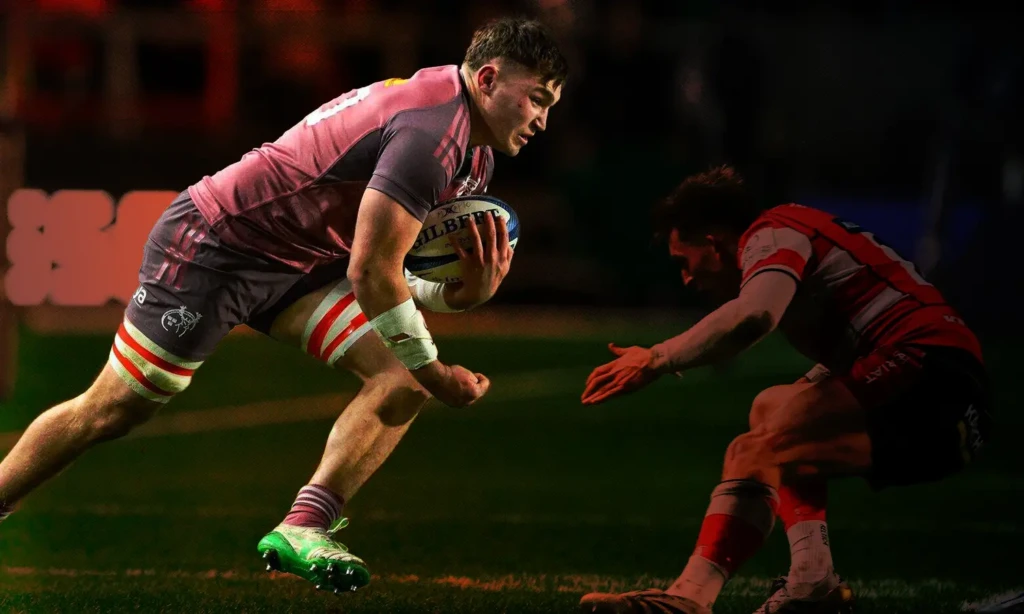
That is not going to make him a Must Pick player. If we compare him to Hodnett, the gap isn’t in workload, it’s in what happens when the ball arrives. Both men carried about the same amount last season — Quinn 9.5 times per 80, Hodnett 8.2 — but Hodnett made 4.6 metres a carry to Quinn’s 1.9, and beat 0.38 defenders per carry to Quinn’s 0.03. That’s not a rounding difference. That’s Hodnett beating a man roughly every third carry and Quinn beating one every thirty-three. That’s why, amongst other things, why Hodnett was an easy two-year extension last season.
The strange part is that Quinn is not being stopped behind the gainline. His gain-line success rate was 79%, the best figure of any Munster back row by eleven points, and 34% of his carries were dominant, which is fractionally better than Hodnett’s teammates and only a shade behind Hodnett himself at 38%. He gets over the advantage line and then stops dead. Nine and a half carries a game that all technically work and none of which threaten anybody.
So if Quinn isn’t Hodnett, who is he? He’s Alex Kendellen.
Put the two of them beside each other, and the overlap is almost complete. Kendellen made 17.0 tackles a game, Quinn 16.3. Kendellen hit 23.6 rucks, Quinn 25.1. Both are among the fastest to the breakdown in the squad. Neither registers a dominant tackle worth speaking of. Both carry at 2.5 metres or below. These are two players doing the identical job, and it’s the job Munster already had too many people doing.
Where they separate is instructive. Kendellen throws 7.7 passes a game, comfortably the most of any Munster back row, which is a genuine point of difference — he’s the closest thing we have to a link forward. But he also concedes 1.1 penalties and makes 1.1 errors per 80, both the worst in the group. Quinn does the same volume work at 0.3 penalties and 0.3 errors, with zero handling errors all season and the second-best possession security in the squad behind Gleeson. You give him the ball, we keep it.
He is the cleaner, more disciplined version of the same player, three years younger.
That’s where I think the line falls on all three. Hodnett is a genuine impact player who happens to be used off the bench — 42 minutes a game, the lowest usage of the three, and the highest collision output in the province. Kendellen and Quinn are the same player with different flaws, competing for what is realistically one shirt.
Quinn’s problem isn’t that he’s behind Hodnett. It’s that he’s level with Kendellen, and neither of them is doing the thing that gets you picked as a guaranteed starter at the moment.
Both of their contracts overlap this season, and I think that’s where a key decision will have to be made.
Kendellen and Quinn are both heavier small forward-built players, both of whom are outside Ireland consideration at the moment, although for these purposes that’s a bigger problem for Kendellen (26 this season) than it is for Quinn (23 this season).
A lot will rest on what the system demands from this role. If it’s more gainline and less link play, Quinn likely has the advantage — working with Jimmy Duffy is a big factor here too — but if it’s proven ruck work, pass action and better ball-carrying consistency now, Kendellen has the edge.
The core question here comes back to our read on both players in a new system. Both play in the #7 role as it was, and both can cover #8 off the scrum — Kendellen is particularly good at this — but if we’re going on who projects as the better, more impactful ball carrier, I think that is probably going to be Ruadhan Quinn, even if Kendellen is the better ball carrier now. Quinn is bigger, heavier and quicker, but Kendellen has better post-contact metres by some distance, albeit on double the minutes. Neither player is much of a lineout forward, although both players have tried to add that to their game.
The gap between them is real, but it’s worth being precise about what kind of gap it is.
Kendellen is the better player right now, and the two places he’s better — post-contact metres and beating defenders — are the two that matter most for selection as it stands. But neither is a fixed attribute. Leg drive after contact is largely body height, footwork in the last two steps, and the willingness to keep churning when the tackle has already technically been made. Those things get coached, and they get coached quickly when a player has the frame to apply them. Quinn is 191cm and 113kg, eight kilos heavier than Kendellen. He has more raw material to work with than the man currently out-carrying him.
The other thing worth remembering is where he was carrying. Change the framework and change the zones, and a chunk of that difference closes without Quinn doing anything differently.
Set against that, Quinn already beats him on gain-line success, ruck arrivals, tackle accuracy, discipline and errors — albeit on lower minutes, these are per-80 metrics — the habits that are hardest to install in a player who hasn’t got them.
Give him better ball and fix his contact height, and the rest should follow fairly quickly.
Is it a binary choice between both? I think a lot depends on Coombes’ contract. If Coombes can’t be kept around, Kendellen’s experience and leadership chops — especially with O’Donoghue getting to the end of the line — will be valuable x-factors that go beyond measurable data points. I think the main filter here will be the system itself, what it values and who best hits those markers. Neither will be short of suitors, so a decision will have to be made pretty quickly, especially as I feel that Quinn will not wait around for opportunities if they are not readily available to him.
Do you go with the proven, consistent guy in his mid-20s who, as yet, hasn’t managed to crack the Ireland squad, or go with the young talent who hasn’t really managed to showcase what he’s capable of yet, but who has the potential to make that same Ireland squad if he catches fire?
That could well be the decision.
On the younger side of the squad, three good players need different things. Alex Lautsou will spend this year prepping for his 20s campaign, so that means AIL, A rugby and alignment camps. He’s the kind of freak athlete that could surprise you, though, so don’t be surprised if he ends up on a 1+2 contract by the end of the season. Oisin Minogue is a talented small forward, so, given the competition for that role, he’ll need to be ready to step up for possible bench minutes this year if there are a few injuries, as he’ll need to show a point of difference in his second academy year. That said, I’d expect him to mostly play AIL and A rugby.
Luke Murphy is in the third year of his academy stint and, while he’s been unfortunate with injury, he needs something this season to kick on in what is quite a young chart, relatively speaking. He’ll get opportunities at A level, but I think he needs to force his way into some squads pretty quickly to copperfasten what should be a one-or-two-year senior offer. At 6’4″ and tracking at 110kg, I think he’s got more to add to his frame, but the potential is there, especially if Munster are looking at a post-Coombes world sooner rather than later.
