



Antoine Frisch didn’t come into Munster with a whole lot of fanfare but over the course of our title-winning 2022/23, he became the kind of player that was capable of taking us to the next level.
Ahead of this season, I speculated that we might want to play Antoine Frisch at #12 as a classic secondary playmaker inside Malakai Fektoa but we’re actually using him primarily at #13 as a Strike Playmaker instead as part of the biggest advancement in Munster back play that we’ve seen since the time of Rob Penney in 2013.
Last season, Munster were playing a far more integrated style of rugby that, in a lot of ways, tied the backs to the forward formation with an invisible suture of structural dependence. This season, Munster’s backs are sliding and looping behind the forward line with a freedom that we haven’t seen before and outside backs power it with a wide variety of complimentary role builds.
In the first few weeks of the season, we saw Goggin and Fekitoa used quite often as our starting midfield build while Frisch was away on the Emerging Ireland tour and I think both played quite well – Goggin in particular – but it didn’t fully fit with the framework. What do I mean by that? They are both good players, good short ball offloaders who can win tight collisions, but I would class both men as being players I’d prefer to see getting the killer pass as opposed to making the killer pass especially in a system like Munster’s.
Munster are trying to avoid width for the sake of it and we’re, to boil it down to a very basic level, trying to force compressions on our phase progressions between the 15m lines to open up the edge space.
Here is a rough idea of Munster’s general form of progressing with the ball in hand.
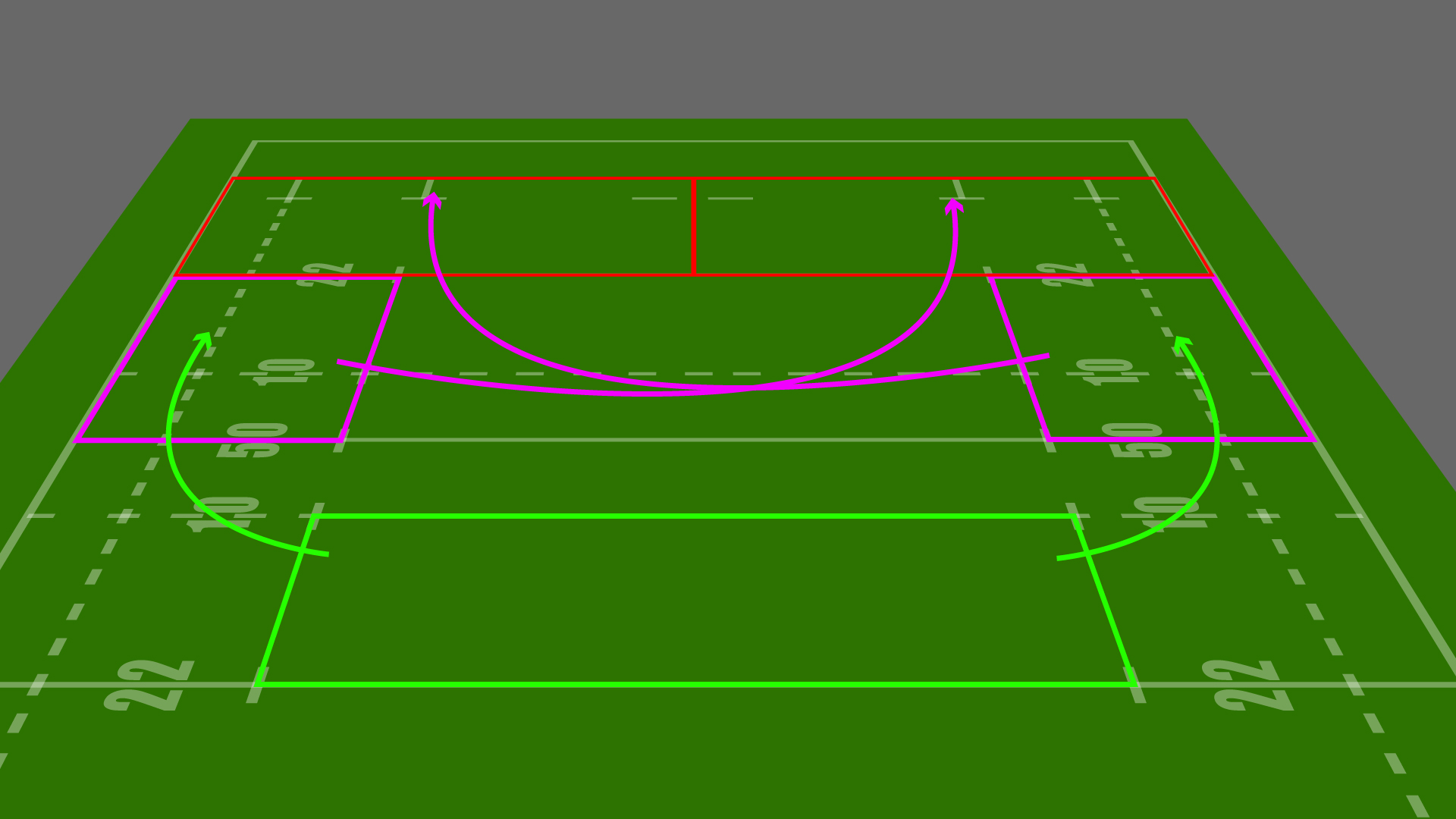
We work in narrow 3-3 pods in settled phase play to work the ball into the trams – often beyond the edge of the opposition blitz – where we do the bulk of our offloading to set up a structure where we can progress into the “kill zone” inside the 22.
To facilitate this, we’re consistently playing between a 1.3 and 1.4 PPC in every game now whereas last season we ranged from 1.6 to 0.7 across the season before trying to stabilise around 1.3 passes per carry later in the season when the ground “hardened up”. The only problem was, you can’t do what you don’t do and our attacking work looked as janky and stiff as you’d expect from a side who don’t play that way every week.
The change under Mike Prendergast’s attack coaching has been profound because he’s changed up how we play our game. We are making more carries, we are offloading more, and we are doing so at the kind of volume and consistency. In short, to hurt our opposition we are hanging onto the ball well beyond the point where, last season, we would have kicked to reset.
That style of play stresses the opposition, yes, but also our ability to retain the ball over those long stretches. As a result, no team hit as many rucks as Munster in last season’s URC because, with more carries, more passes and more possession come more rucks that all have to be resourced.
At the start of the season, we were unable to do so efficiently because our fitness wasn’t anywhere near where it needed to be because what we were doing in September 2022 was well outside the parameters of what we had done over the previous few years. And, not only that, we needed a different type of midfielder to make it all work. That man’s name was and is Antoine Frisch.
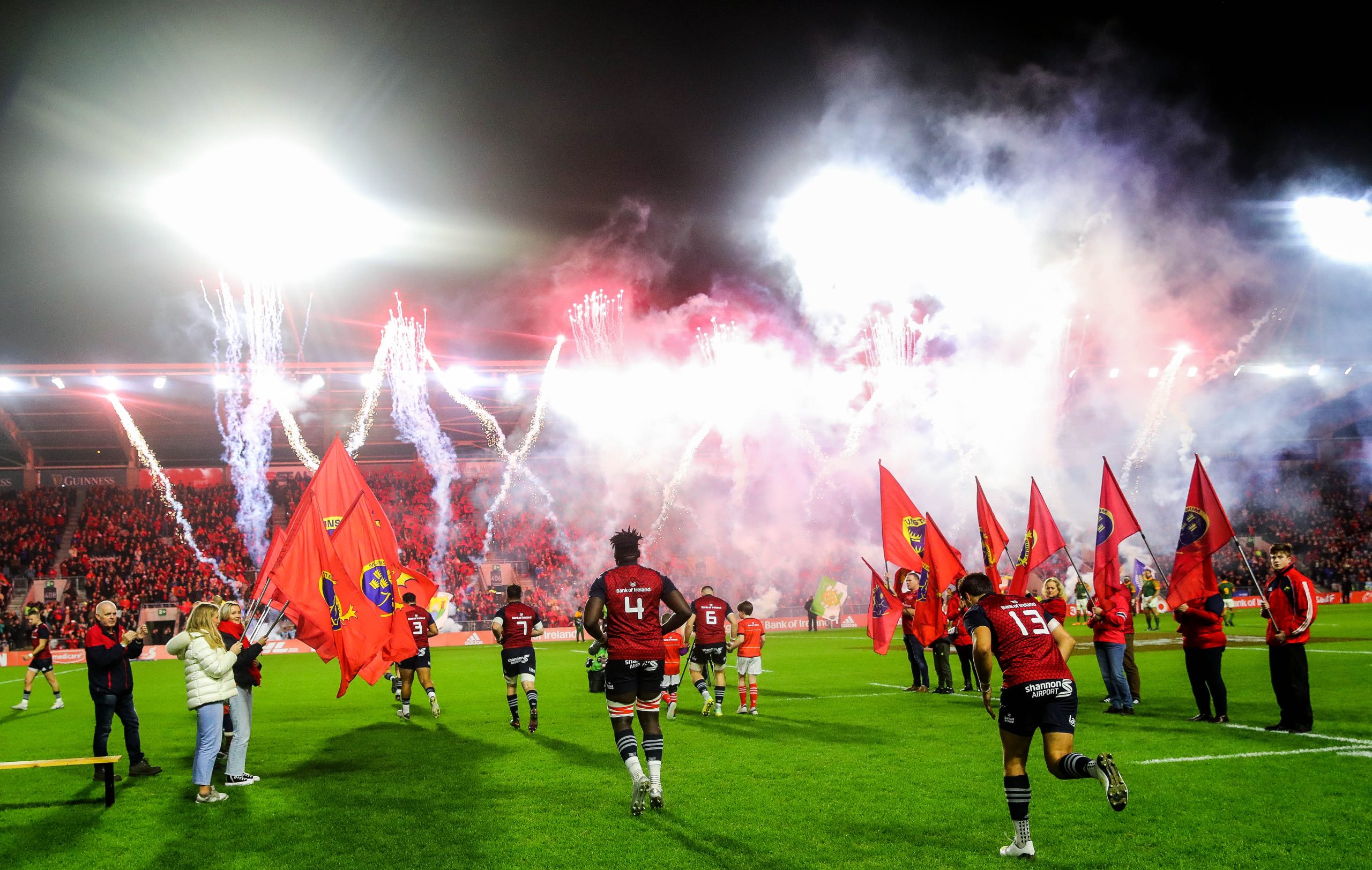
Here’s an interesting stat to start us off.
Antoine Frisch started 17 games at #13 for Munster this past season. Of those games, we only lost four times. Twice to Toulouse, once to Leinster and once to the Sharks.
That goes some way to illustrating Frisch’s importance to Munster on a systemic level. With regards to that system, I had assumed preseason that Frisch would be a playmaker at #12 but that thinking was reductive, in part because I had always associated the second playmaker role with the #12 or #15 jersey. In a way, I went against the very “numbers don’t matter” spiel I use for the forwards.
To get a visualisation of what Antoine Frisch played for Munster this season, you’re best off imagining a mix between that prototypical playmaking #12 mixed with the general positioning of a playmaking fullback.
Throughout the season, Frisch’s personal Pass Per Carry metric (1.37PPC) matched our collective Pass Per Carry for the season. He had the highest PPC of all our outside backs who played in the midfield for us this season with one notable exception.
- Malakai Fekitoa – 0.7PPC
- Rory Scannell – 1.12PPC
- Dan Goggin – 0.6PPC
- Jack Crowley* – 2.9PPC
*Jack Crowley’s starts at #12 saw him maxing out his PPC in a way that you’d broadly expect from a #10 playing in midfield.
Frisch’s pass volume took the playmaking load away from guys like Mike Haley, who had his best season for Munster by passing the ball less often than the season before.
In 2021/22, Mike Haley had a Pass Per Carry metric of 0.77. This season, he was down to 0.4 and he never looked better. One of the best parts of understanding role theory is that it often means that the addition of one player can completely shift the performance levels of a unit or the team at large by allowing others to do more of what they’re good at and less of what they’re not good at.
The addition of Frisch as a Strike Playmaker has been a crucial part of extending Munster’s ability to retain the ball over multiple phases. Our system naturally produces a lot of edge possession so Frisch, deployed primarily in those middle/wide spaces, is the perfect player to extend the play as a high volume passer.
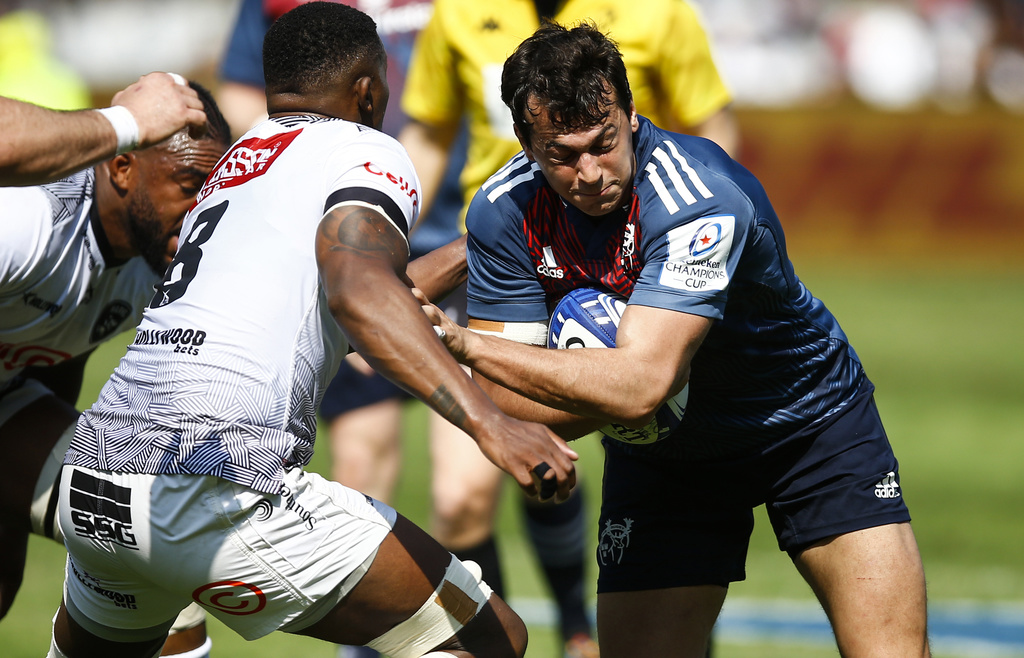
He’s got experience of playing as a #10 on his way up through the ranks in PROD2 but he’s got the size and durability to more than hold his own in the physical exchanges that happen in the wider spaces. He’s a really good short and mid-range passer with outstanding positional instincts.
Munster’s compressed attacking framework in the middle of the field means that long, slung passes are off-scheme, so it’s perfectly suited to the short, snappy range that Frisch works with. You can get a good look at those qualities in this GIF here.

It’s a no-look pass through a screen to the looped inside winger. You’ll notice that Frisch is slotted in as first receiver here and that’s pretty common for him throughout the season, both in the link position as above and on the screen like below.

In this regard, he’s very much playing like a traditional “playmaking #12” or “second-five” and that’s absolutely in Frisch’s skillset but we use him as a roving playmaker who isn’t stuck to the outside shoulder of the #10.
The way we used our #12 last season – as a power winger/flanker hybrid – basically allowed Frisch to show up as a playmaking option every other phase.
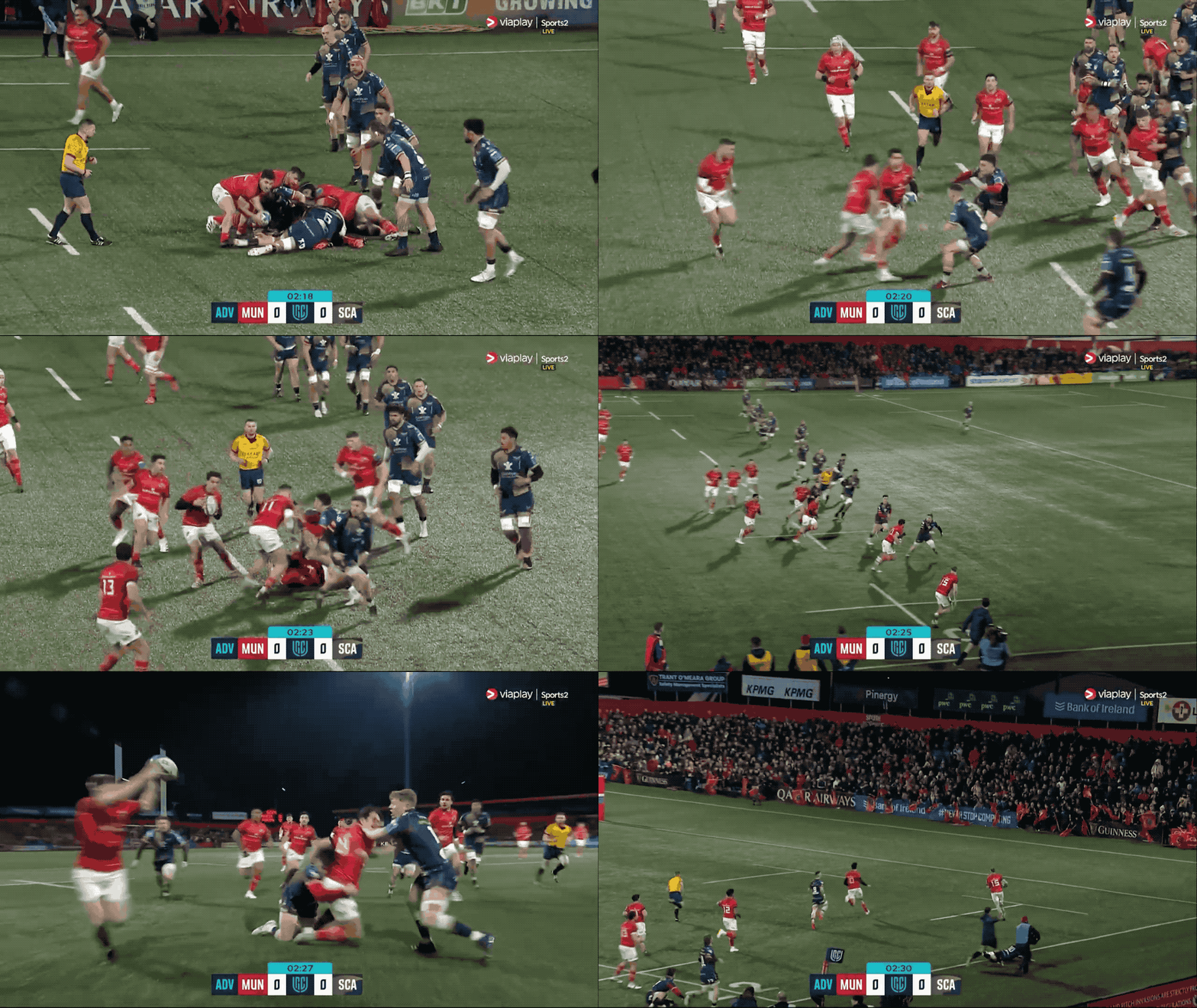
When Frisch gets the ball on the edge, he’s capable of unlocking any defence with his offloading and short passing. This is a really good example of that on a Munster breakout from the #22 – look at Scannell in a common spot for our #12 as he takes the pass. Frisch’s timing and appreciation of the need to draw the tackle just before the pass is really really good. It sounds like a basic, but it really isn’t.

That’s the bonus of having a Strike Playmaker in your midfield – he can make those passes under pressure that other midfielders hit up.
The way Frisch takes this pass from Healy is a great example of that principle;

He’s never just looking for contact here – he’s always looking to draw the defenders, defang the blitz and release.
With Frisch in midfield, Munster have a unique player build that takes our offensive system to an elite level. From Antoine Who? to Tony Fresh, Antoine Frisch has the skillset to power Munster into a title defence season where everyone is going to want a cut off the champs.
