


In the last instalment, I spent a fair amount of time explaining what the 3/4 Space is, how you can spot it on the field and why Munster’s system, in particular, is superloading possession chains into that specific zone more so than any other.
Tom Farrell has been a net beneficiary of this with an astonishingly effective season that has shown that the right player in the right role in the right system can produce incredible results.
I suppose the mistake you could make after reading that article was that the 3/4 space is the preserve of outside centres only. That was probably my mistake in tagging the article around Tom Farrell’s remarkable season. I will say that the traditional zone that you might expect to see an outside centre in both phase and set piece play is a perfect spot for exploiting the natural hinge in modern 13-2 defences, especially in the 50/22 era.
It’s this space, in essence, which is more or less the spacing dreamed up by World Rugby when they were thinking of what 50/22 might bring to the sport.
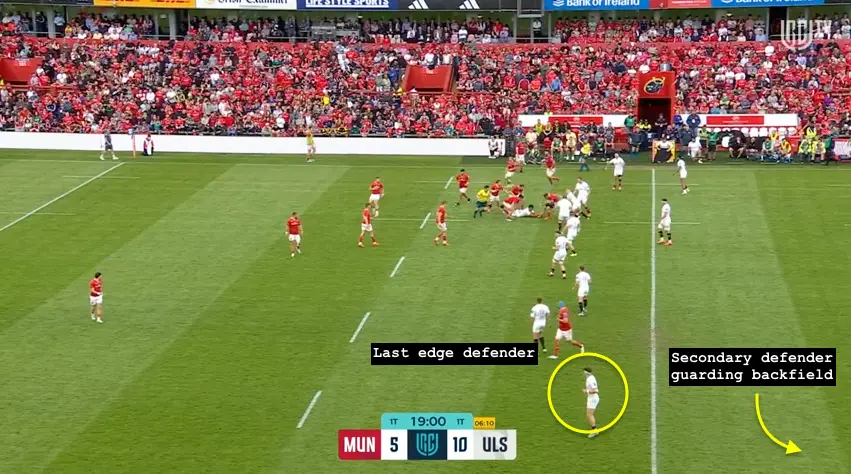
What that means, in practicality, is that on most defensive schemes at one side of the ruck – usually two passes away – there is a “hinge” in the opposition defence where one edge defender has to hold, two or three have to scramble fold and one secondary defender has to shoot up into the primary line, while another backfield defender closes the hole left by the defender that’s just shot up.
That movement creates a window. Depending on the speed of your defenders – coming from the direction of the ruck, holding the edge and shooting up – that window can be quite large or incredibly, vanishingly small. The size of that window dictates the speed and accuracy of the movement required to put someone through that window.
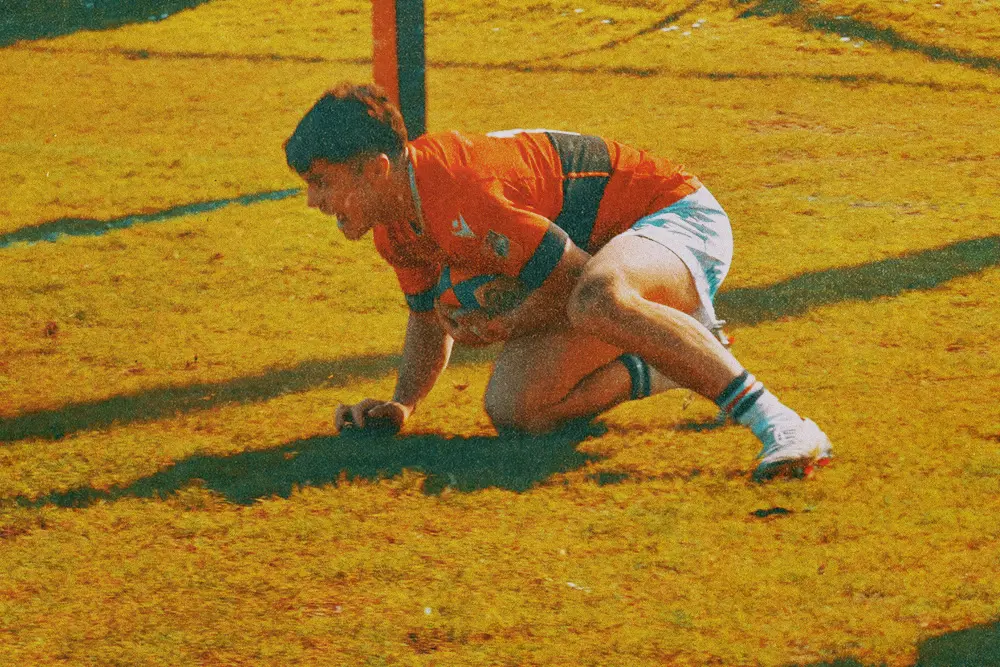
Here’s a good example of that from Munster and UCC midfielder Gene O’Leary Kareem.
He beats the defender right in the middle of that 3/4 space and then offloads away to the runner while taking out another defender.
Those two beaten defenders open up the space for the rest of the movement to work.
Here’s another example from UCC with the ball moving beyond the 3/4 space and allowing Munster’s Ben O’Connor to make a play in the “window” of space.
This 3/4 space is transferable across all levels of the game, and it’s dictating the type of players that (a) clubs are looking for and that (b) are finding success regardless of their physical stature.
In the 2010s, the big trend in the game was an increase in size in almost every position. Those trends have continued in the forwards, as you probably guessed, but they have plateaued in midfielders since the 2015 World Cup.
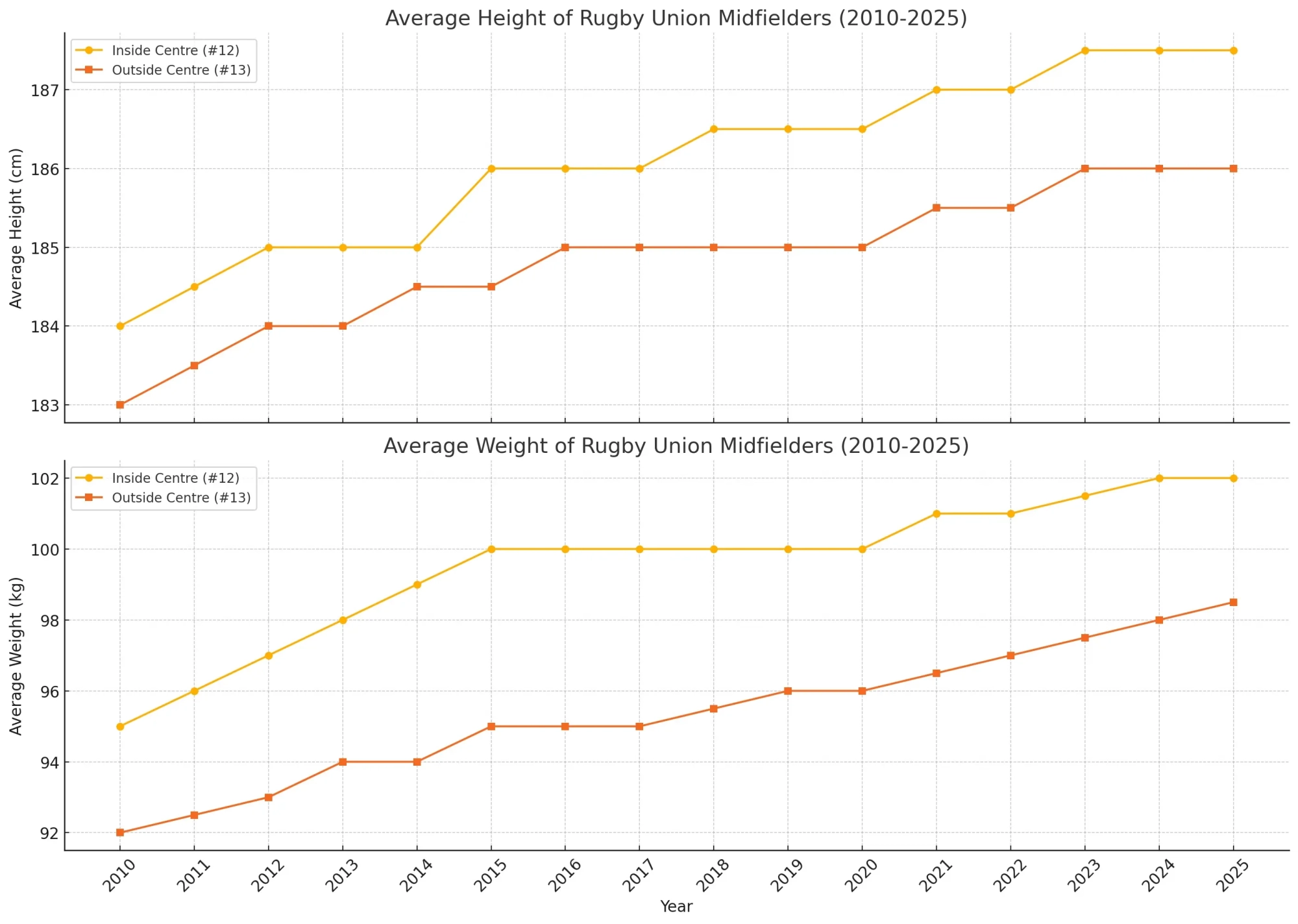
What can we take from this data?
Steady Growth (2010–2015): Early in the decade, midfielders bulked up significantly. By 2015, an elite inside centre averaged ~185 cm/100+ kg, and an outside centre ~185 cm/95+ kg – roughly 5–6 kg heavier than in 2010 on average.
This period saw the end of the smaller “second five” playmaker at inside centre; nearly all top 12s were ~100 kg by 2015.
Plateauing in the 2020s: Since about 2015, average heights and weights of centres have plateaued. Both club and international centres have remained approximately 1.85 m tall on average. Inside centres consistently average about 100–102 kg, and outside centres around 95–100 kg in recent years. Looking at the data from roughly 2010 onward, it’s pretty clear that the increase in midfielders’ size has slowed, suggesting a possible upper limit being reached in line with the workload expected of midfielders.
.
Club vs Test: Test centres tend to be slightly larger on average than club centres. National team selections often favour bigger athletes. However, the gap isn’t huge. Top domestic leagues also feature many large centres. In 2019/2020, a club inside centre averaged ~99 kg, very close to a Test inside centre. The difference may be 1-3 kg and a couple of centimetres in height, with internationals having the edge.
Positional Differences: Inside centres (#12) remain a bit heavier than outside centres (#13) on average, reflecting their role as crash-ball runners on the set piece. In recent data, the gap is on the order of ~3-5 kg (e.g. club 12s ~99 kg vs 13s ~95 kg in 2020; international 12s ~101-102 kg vs 13s ~98-100 kg). Both positions have gotten taller and heavier since 2010, but proportionally, the increase has been similar and, crucially, has stalled in the last five years.
I think we’re going to start seeing those numbers come back down in the next five years.
Look around the game today and you’ll see most of the top sides utilising players who are skill profile first, rather than size first, then skill. This isn’t confined to midfielders, either. Louis Bielle-Biarrey has been the breakout star of European Rugby this season for both France and Bordeaux. He’s 6’1″ and 85kg.
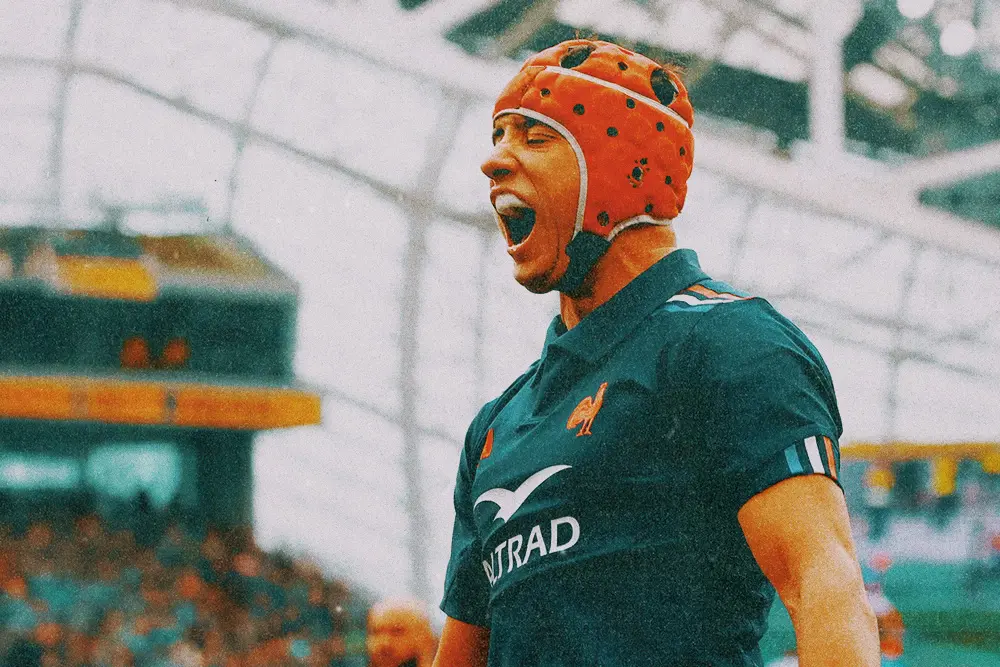
His biggest qualities are his speed, his kicking IQ and his ability to handle the ball at pace. In years gone by, he would have found it difficult to get noticed at a club because of how slight he was, never mind find the levels he has over the last two seasons, but the modern rugby side values those core skills. Look back at his youth rugby and you’ll see another key indicator – he used to play at #10.
This is vital in how UBB and France use Bielle-Biarrey as a looped playmaker, especially in that 3/4 space. This is a great example from the Champions Cup final, which was ultimately struck off for a marginal forward pass.
If you go back and watch that clip again, you’ll see Bielle-Biarrey running a tight pocket line right behind Jalibert.
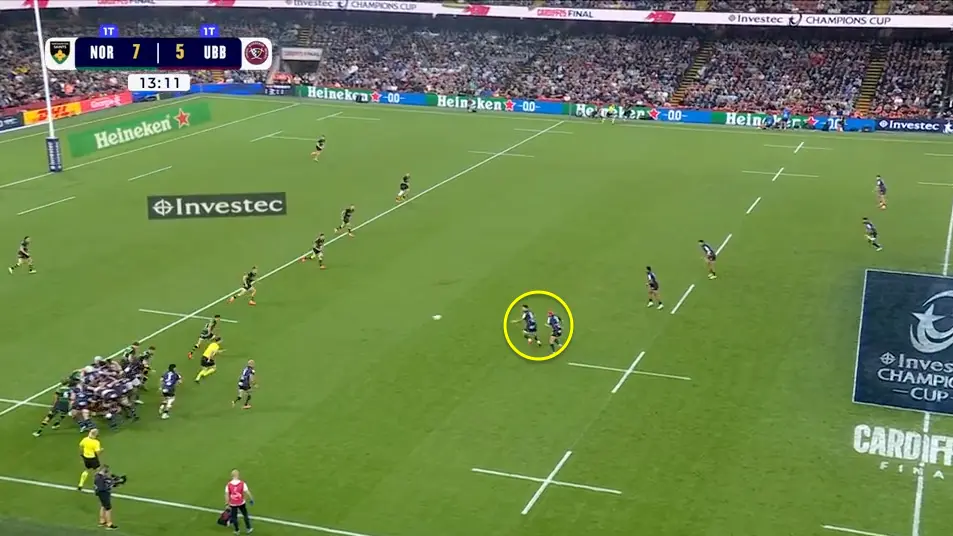
This is a really tight running line, but then something remarkable happens before they break. Bielle-Biarrey shows an inside line while Jalibert breaks outside, but this is a feint. It’s so effective that it stalls Northampton’s defensive progression.
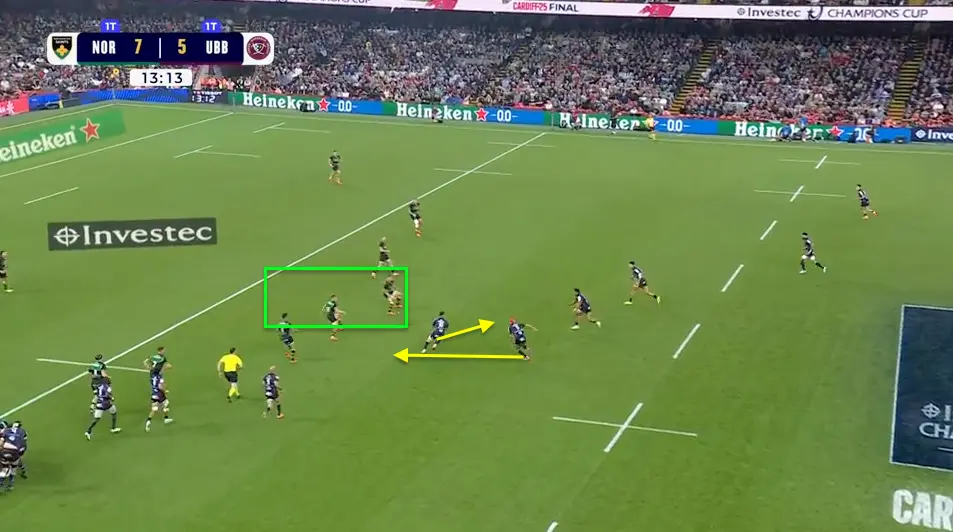
But he’s then got the pace to re-connect to that pocket route on Jalibert and get in position to attack that 3/4 space directly, essentially exploiting the space he created with his initial feint.
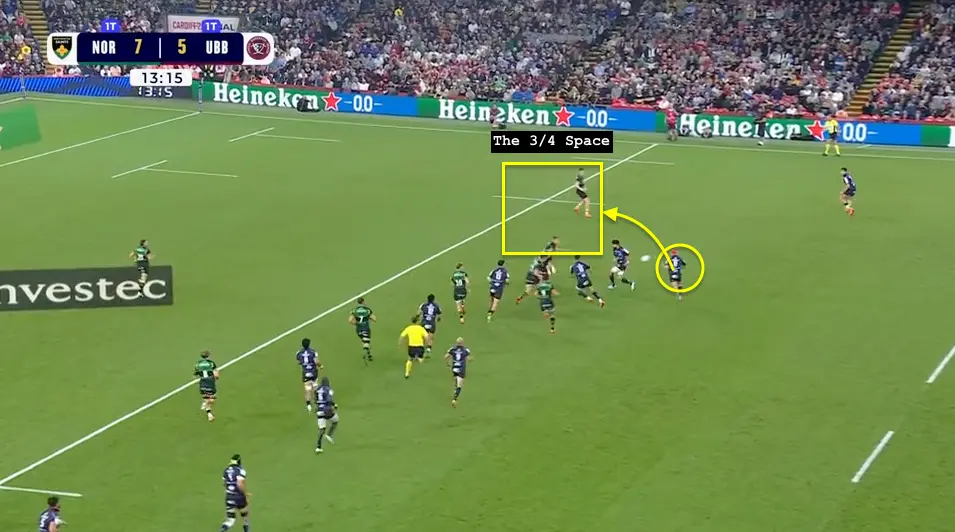
This only happens because he’s got the pace to create that 3/4 space and then exploit it. UBB are a great example of this trend because their preferred starting midfield combination features two players who weigh in under 95kg in Moefana and Depoortère. Northampton, the team they beat in that final, had a midfield combination that also weighed in under that 95kg benchmark.
Why?
They value the all-court game that those smaller, more mobile backs give you, to the point that they are the biggest driver behind the slow disappearance of the classic “small forward” role type in the pack.
Munster’s Tom Farrell would seem to be an aberration here at 6’3″ and 107kg, but his skillset fits the bill for what Munster want – at least, for now. Farrell has completed 162 passes so far this season, with another game to come against the Sharks. No other player with regular minutes at outside centre has anything close to that number in the URC. In Europe, no other outside centre has passed more often than Tom Farrell, and you have to look at players who predominantly play at #12 to find anyone close to him; Jordie Barrett is #1 with 70 passes, and then Farrell is tied with Sione Tuipulotu and Berhard Jans Van Rensburg.
This reflects Farrell’s role suitability in Munster’s system. Munster are top five in the world this season so far for attempted passes per game and are seventh in the world for the amount of ball played beyond the second receiver. Almost all of that metric is down to the output of Tom Farrell. But, looking at Farrell more closely, we can see that even with his outstanding production this season, certain elements of his game do not fit with where the game is going. He’s not the quickest, doesn’t have a varied kicking game, and he doesn’t have huge field coverage from a defensive perspective.
This will catch him, eventually, just hopefully not this season or next.
It’s why I think that, in the next three seasons, there’s a huge opportunity for Gene O’Leary Kareem to get real exposure at the highest level. Oddly enough, I’m not sure we’ll fully see it in this year’s U20 Championship because the Irish 20s don’t use a system that sends a high volume of possession to that 3/4 space. This is pretty common in low-cohesion environments at underage, where the outside centre, fullback, and looped wingers essentially become ruck support players because the ball rarely moves further than a hit-up off the first receiver.
O’Leary Kareem has all the qualities I think the modern midfielder will need; he’s a creative passer, kicker, handler and has ridiculous pace.
Munster under Clayton McMillan will not be passing less frequently – the Chiefs are third in the world for pass attempts per 80 – so the progression of possession to this space is only going to increase.
Gene O’Leary Kareem is the perfect role type to take that possession and really build something for himself in the next two seasons.
