


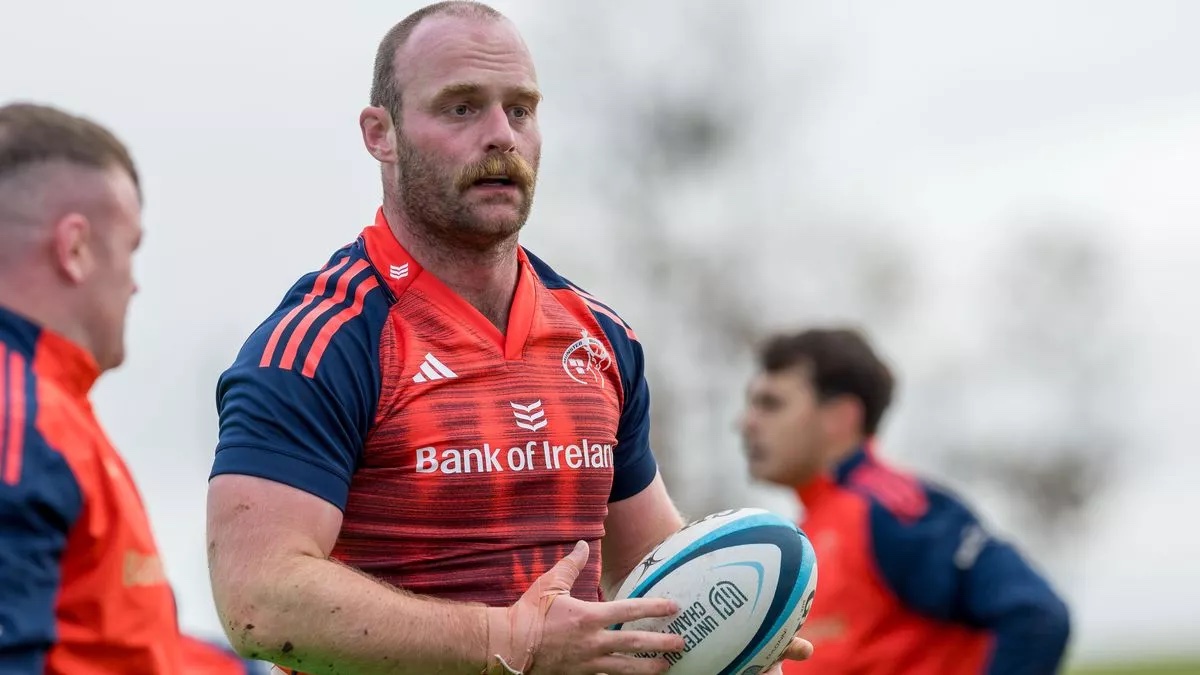
The worry about signing any prop from New Zealand and Australia – and despite growing up in Kildare, Jager would certainly qualify on those terms – is that, while their work around the field is usually top-class, scrummaging is always a question mark.
Is it unfair? I think it is. For me, it’s a copium hangover from the 2000s where, sure, Super Rugby players were more skilled, fitter, better looking and probably better surfers but could they handle the scrummaging on a wet December night in Stoke Castres?
Many Australian and New Zealand props have had good scrummaging careers in Europe.
<searches for notable scrummaging Australian capped props in European rugby>
Well, maybe plenty of New Zealand props have had good scrummaging careers up here.
John Afoa, Soane Tonga’uiha (came up through the NZ system), Owen and Ben Franks, Uini Atonio, Carl Hayman, Charlie Faumuina… the list goes on.
At Munster, though, our last prop from New Zealand was Peter Borlase, so I think some of the reticence – my reticence – is perhaps a holdover from that.
I wrote about Jager’s scrummaging quite a bit already – against Leinster and previewing how it might go before he first played – but my initial thoughts were pretty positive. In the What’s The Story With article, I wrote;
From a scrummaging perspective, I’m comfortable in saying that, bar a completely wild translation from the Crusaders to Northern Hemisphere rugby, our scrum will be improved considerably with Jager in it – technically and physically.
The first thing to understand about scrummaging is that even the most dominant scrummaging props get caught once or twice in a game with 20+ scrums and every single prop has a bad day down the shoving mines. Tendai Mtawarira was one of the best scrummagers in the game when he retired in 2019 but I distinctly remember him getting walloped by Phil Vickery in a Lions test, a week after Mtawarira had done the same to him. Frans Malherbe, one of the very best in the world, has had days where he’s looked like Bonzo the Clown in the scrum – against relatively ordinary opposition – and that’s because the scrum is not an objective event.
It’s not like goal kicking where you either make the kick or you miss it. A scrum is a dynamic set-piece event with 16 individuals, all trying to do things in unison against their opposition through the fulcrum of the bind and set. All of this is adjudicated by referees and assistant referees who are looking for the ten scrums out of a hundred that are so obviously in favour of one side that a child could call it and try to make a call on the other ninety where you could penalise either side.
And, even with that, scrummaging is both completely dependent on one man and reliant on the overall combined units to function independently of each other and, at the same time, together.
At the same time, however, if you’re a washout in the scrum it’ll be discovered fairly handy during a wet and wild December and January. What is a washout scrummager? They’re very easy to spot, especially tightheads. You’ll see a tonne of diagonal movement either from his inside shoulder out or his outside shoulder in, you’ll see him popping up while he’s being pulled across the face of the scrum or else you’ll see him resort to advanced washout tighthead tricks like belly flopping to, essentially, roll the dice that the referee blames the loosehead for pulling him down.
What do good tightheads do? They keep their shape incredibly well so even if a scrum fucks up around them, they rarely twist out of their form, they are very good at scrummaging high and they don’t need a tonne of tricks and gimmicks to cod referees into awarding you penalties.
That brings us to Oli Jager and his game against Northampton.
One of the most consistently impressive things about Jager is his body shape when he’s getting set up to scrummage and how he keeps it through the sequence. It sounds obvious but I think because he came to propping incredibly late and almost all of his coaching was in a high-end environment, he has very few bad habits and very few of the ones you typically associate with 6’4″, 135kg guys.
Lots of younger heavyweight props who come into the front row late have to learn how to use their size and weight in a scrummaging context. Jager would have been no different but the difference is the level of coaching he received from guys like Jason Ryan coming up through Canterbury and later the Crusaders.
The Biggest Mistake You Can Make Is To Get Low
How often have you heard that the best scrummagers do so while low to the ground? Maybe not often. But it’s a truism that’s out there. Low scrum = good is a concept with strong roots. The best scrummaging props do so from a high position because when you’re low, you’ve got no power.
The best tightheads scrummage like they’re in a squat rack and there’s no scrum coach better than Jason Ryan (now of the All Blacks, formerly of Canterbury, the Crusaders and Fiji) for getting your body into the right shape to be dominant. This is because Ryan has a strong understanding of biarticular lines, and why they are vital for props to get the most power out of their natural frame.
Ryan’s theory on the biarticular line in scrummaging is that, in the most powerful pushing shape you can have, there should be a straight diagonal line running from the point of contact with the opposition at the shoulder, through your knee and to your toe. Your toes are your contact with the ground – like the way an oar is your contact with the water on a rowing boat – so if everything lines up along that line, you will be at your most powerful.
Look at Jager’s yellow biarticular line on contact here;
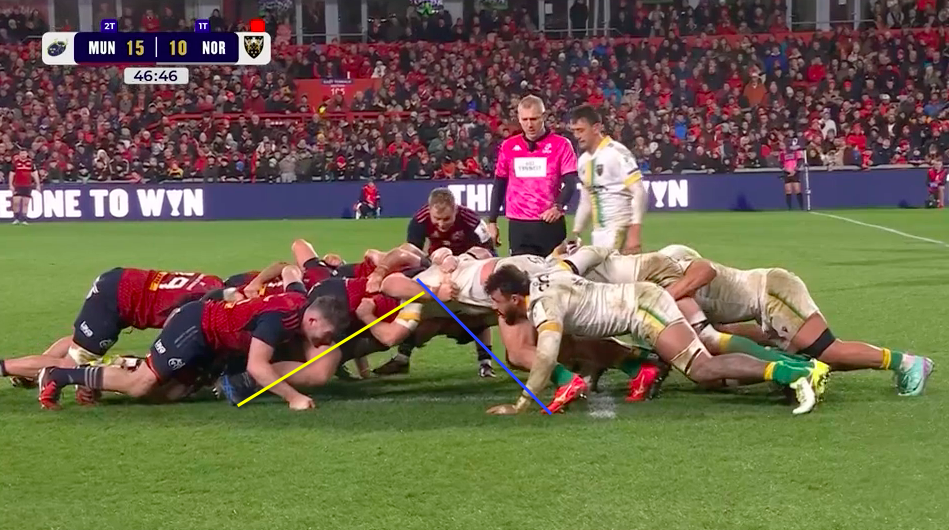
It runs from the shoulder through the knee to the toe. Compare that to the blue line, which goes from the shoulder to the toe and misses the knee completely.
What do you think happens in this scrum?
Jager absolutely destroys Waller on this one because he’s in a stronger body position and can drive through on the engage. Jager keeps that angle all the way through.
On the first scrum after Jager went off, John Ryan started off in a strong body position but lost it as the pressure came through from a very powerful, very big loosehead. Here’s the body position at the key moment.
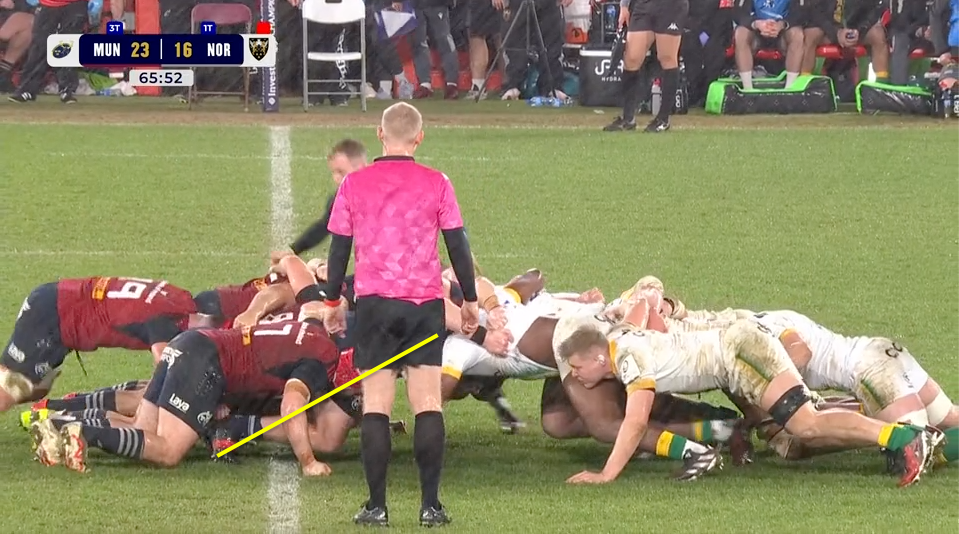
Let’s look at how that played out;
Because Ryan’s knee fell below the biarticular line, he was more likely to get popped up and driven through. That diagonal line going from shoulder to toe through the knee keeps you straight and marching forward.
When we look Jagers shoulder in the second half – the camera is on the wrong side in the first half – you can see that strong shape every time.
This is my favourite scrum of his in the game and it was right before he went off the field.
He starts in his usual strong position;
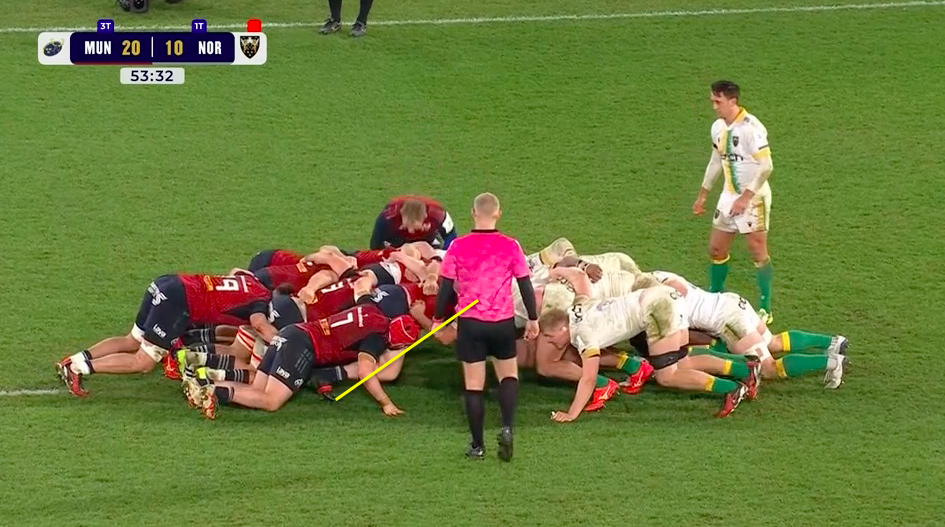
But, in his attempt to collapse Waller he overextends and gets out of the strong shape – watch the biarticular line here;
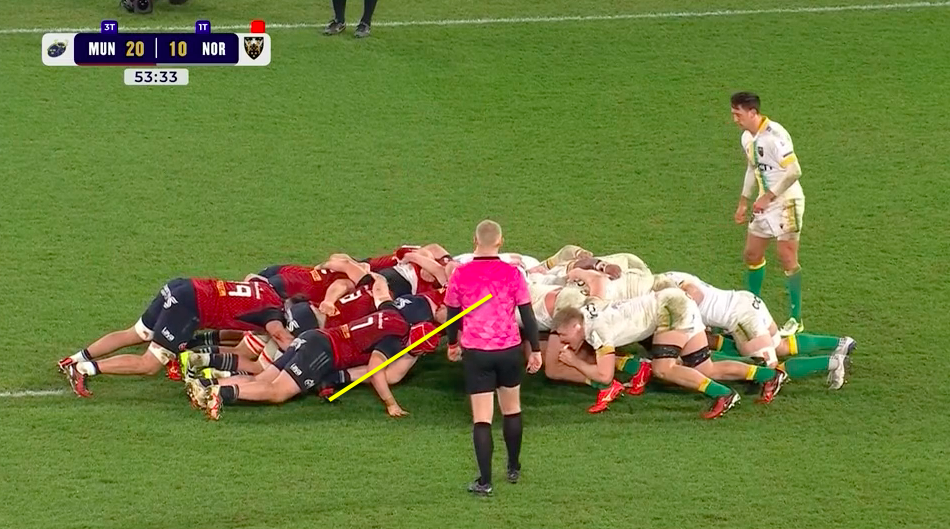
The line starts to go behind his knee which means he’s vulnerable to getting popped and lifted, which is exactly what happens. In that screenshot below, the Munster scrum should get absolutely pumped backwards.
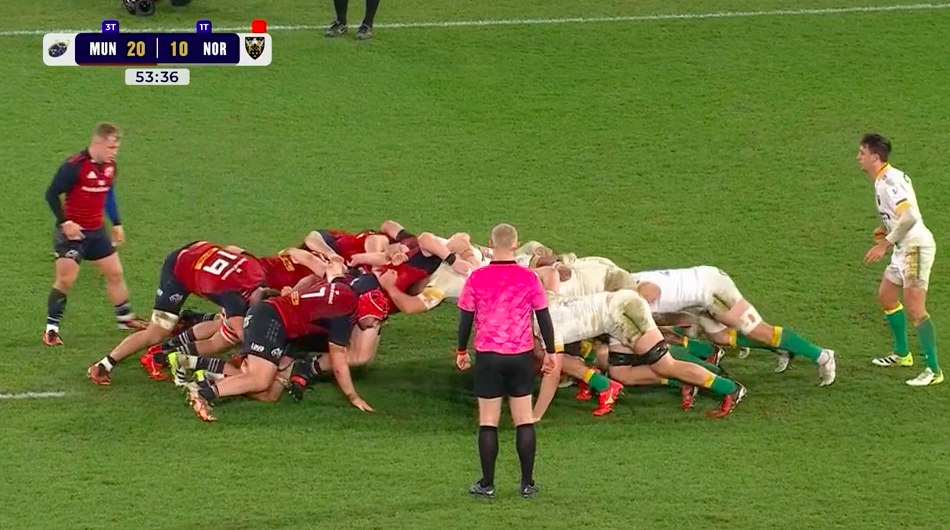
But watch how Jager recovers.
How does he pull this around? Exerting pressure with his chest at a 45-degree angle back on Waller. It was the only way he could have possibly recovered from this situation and that’s exactly what he did.
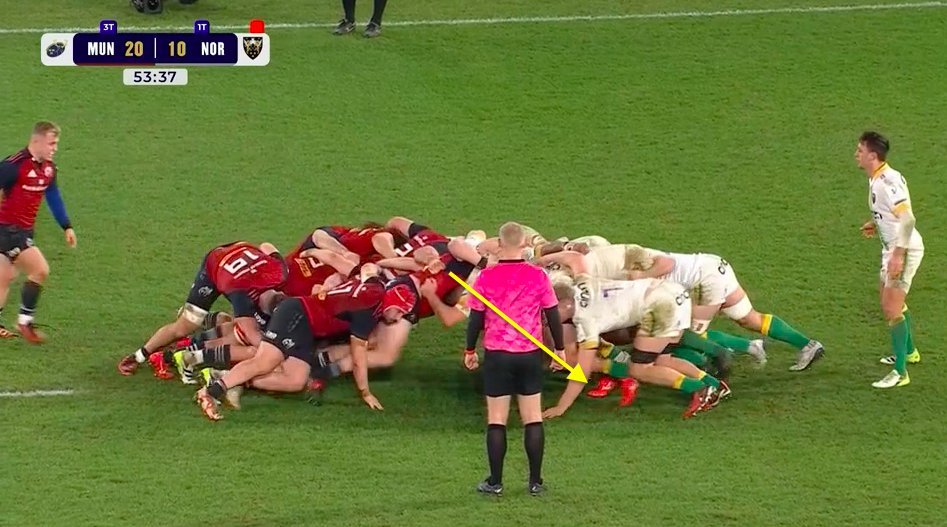
By drilling down at that angle, Jager showed his power but also his scrummaging IQ to turn around a sure-fire penalty to Northampton into a workable Munster platform.
Jager is the real deal at scrum time, and the longer he plays for Munster and Ireland, the more clear that will become.
