I could do a big stat article on this, but I don’t feel like it.
Allow me my vibes. It’s Saturday, but it feels like Sunday, because Friday felt like Saturday, and Thursday felt like Friday. It’s Six Nations Savings Time, and I’m none the better for it. Maybe there’d be a little more pep in my step had Ireland managed a bonus point or two — or even a win! — in Paris on Friday Thursday night, but instead, I’ve been ruminating on our big loss to France, and the dud performance to go with it.
I also watched the Ireland XV game, for my sins, and the less said about it, the better.
Irish rugby isn’t in a good place at the moment. Something feels off. If the achievement of having fifteen Irish Lions in 2025 (albeit selected by the current Irish head coach) was the crowning party piece of the post 2023 World Cup era, this season has felt like the fifteen pint hangover.

Sure, Australia finished the season ranked seventh in the World, but the achievement was the logical endpoint. Ireland were the best Lions-eligible team from 2022 to early 2024, and the drop off that came between the 2024 and 2025 Six Nations could, logically, be written off as a blip by Andy Farrell, who was highly motivated to think along those lines.
Since the Lions, for province and country, Ireland have looked a shadow of the team they were. Ulster, Connacht and Munster look like deeply incomplete teams in varying stages of rebuilds under new coaching units. Leinster, the most established and recently successful province, has looked most affected by the post-Lions drag, first in results and then in performance; they’ve outlasted most of the sides they’ve faced post-November, rather than put them away emphatically. Their recent performances have been better, for the most part, but their win over Edinburgh was the one that stuck with me. Shorn of almost all their internationals and leaning heavily on Snyman, McGrath and Ioane, they eventually put away Edinburgh in the last quarter as the Scots began to burn out.
That first half, though, when everyone was fresh, was instructive. When the game is fast, and the legs are fresh, Ireland’s old advantage — detail and system — doesn’t buy the same separation anymore.
My point is that the advantage the Irish provinces, and the test side in turn, have had for a lot of the early 2020s has been pared back. That’s due, in part, to players’ performance levels changing as the seasons progress — players get older, they pick up injuries, their progression stalls, or they’re held back by related units that have similar issues — and changes in the game itself, which have moved the overton window of winning rugby away from system strength into a more athletic, transitional game.
In Ireland’s most recent peak periods — between 2014 and 2019, and then between 2022 and 2024 — we had an excellent combination of good athletes, generational, highly experienced veterans (or players who would become that) and a strong core of good, highly programmable rugby players who were playing heavily scripted, low margin for error rugby in that, if the system worked the way it should do, it was almost impossible to make errors within it if you were across your detail. “Programmable” in this instance sounds like a backhanded compliment at best, an insult at worst, but it’s not meant that way; we had — have — a group of incredibly coachable players, eager to learn, who had no problem staying on script 100% of the time, with no deviations. Anyone who did look to deviate from Schmidt’s system found very little room to grow and was almost always replaced with a fundamentally less talented, but heavily scriptable player eventually.
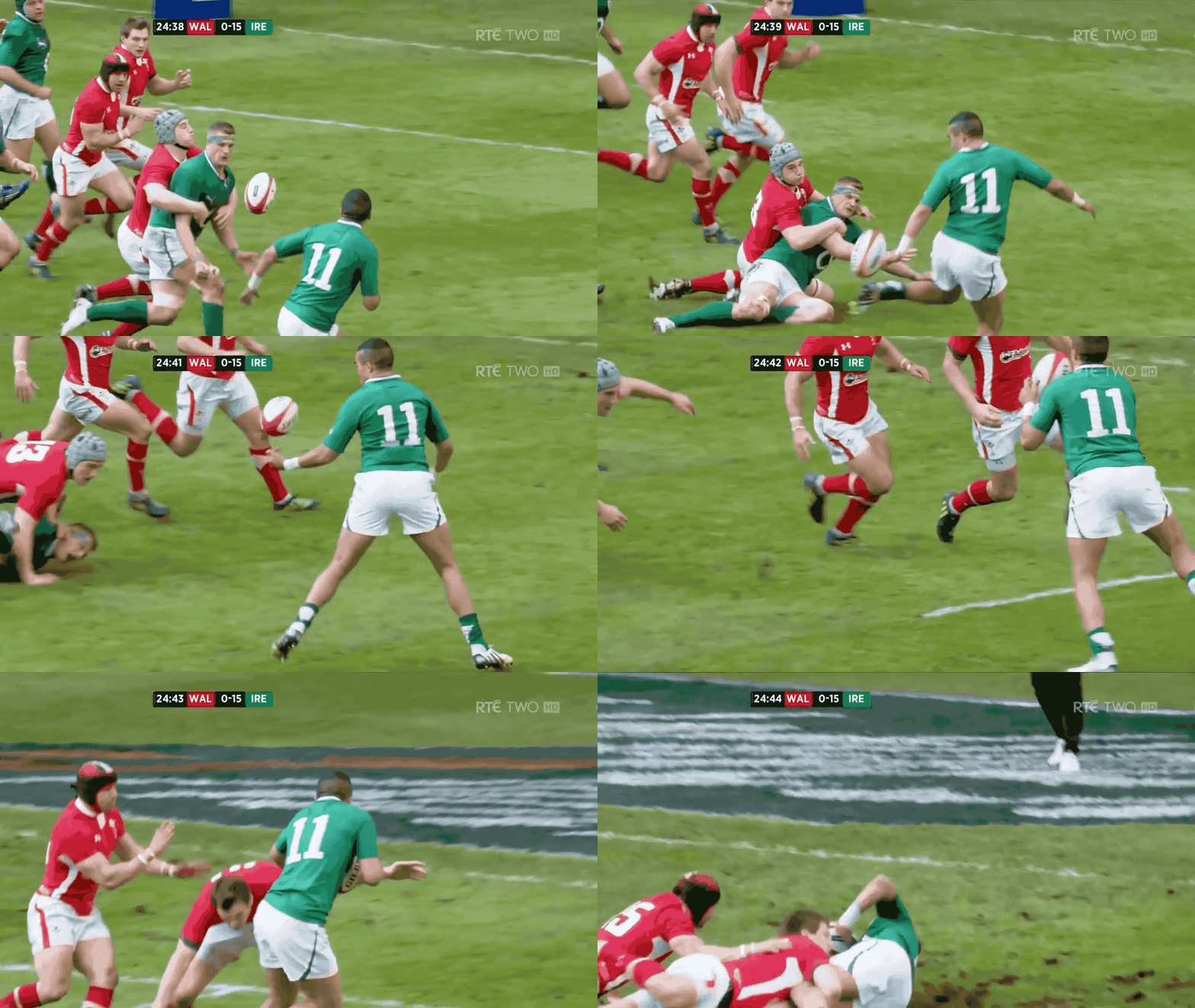 Schmidt’s system told you where you should be for each ruck, where you should stand on each pod, each screen. What you need to do on a lineout in a certain position, and where you need to be at a ruck on phase three of a strike play. In this situation, you kick. In this situation, you set up for a box kick, and then you, you and you will chase to this point and perform these exact roles to the letter.
Of course, when asked about his system, Joe Schmidt would talk about players having freedom to play it as they see it, but the realistic scope of that was pretty limited. If you’re meant to be in a ruck, but you find yourself with the ball and 10m of open ground in front of you, you can run with it.
What you couldn’t do was take a chance on a low percentage attacking read that wasn’t in the framework. The guys who played under Schmidt have spoken pretty openly about this.
The players have described a week built around process pressure: meetings, repetitions, corrections, re-running the same pictures until they’re automatic. Sexton’s line is the cleanest summary of the mental load: you could be “driven demented” midweek, because the whole point was arriving on Saturday with “every box… ticked.”
That’s where the taxing part came from: not just doing your job, but carrying the job in your head at all times. Mike Ross put it pretty well, too — once you’d internalised the standard, you played with a little Schmidt on your shoulder, because any missed detail was going to be “on the video.”
O’Connell framed Schmidt as an accuracy coach first — a man who demanded technical fluency, then demanded you express it under Test-match stress. Early on, he admitted a lot of the players who hadn’t played under Schmidt before had “a lot of technical stuff we need to get right,” and that the team hadn’t yet matched Schmidt’s obsession with “accuracy.” And when he later reflected on what Schmidt did to elite players, the key phrase was that his “way of thinking about playing and preparation had been turned on its head” — fewer emotional shortcuts, more repeatable, cognitively-drilled behaviours.

It suited the Irish rugby psyche down to the ground. Players, in particular, be they established or coming up through the levels.
It turned a complex, confusing game that Ireland had never naturally inhabited the top echelons of into something that could be broken down into repeatable chunks in a way that Eddie O’Sullivan tried but could never quite get over the line.
What Schmidt brought was a way of understanding the game that, if you hothoused it enough, would work against anyone. That suited the Irish psyche. If you work hard enough, with the right guidance, success will follow. And it did — for a time.
At the height of Schmidt’s team, we scored tries that looked like telepathy but were actually the product of hours and hours of work. It wasn’t instinctive; it was almost like an algorithm outputting a desired outcome.
In the end, it broke down for Schmidt in part because others began to understand that algorithm too, along with core parts of his team beginning to age out at the worst possible time right before the 2019 World Cup. At that point, even his most loyal players had grown tired of Schmidt’s exacting detail and hive-mind-like control of every phase, every minute of the week, never mind the game.
At its best, Schmidt’s Leinster and Ireland looked like an inevitable machine — every picture pre-solved, every contingency baked in. When it stopped working (in the 2019 Six Nations, and then the World Cup), it didn’t so much adapt as malfunction: a robot stuck in a loop, ramming the same decision into the same brick wall.
***
At the tail end of Schmidt’s time as head coach, Stuart Lancaster, who is the most influential coach in the Irish system over the last decade, even allowing for the three seasons he spent at Racing 92, took over the guts of the coaching output at Leinster Rugby.
If Schmidt built the system, Stuart Lancaster industrialised it. Leinster became the production line for “good habits”: pattern recall, muscle memory, constant review, and a kind of hard-wiring where the right option becomes the only option. Train it enough times, and you stay cool under pressure; not because you’re improvising, but because you’re executing. This wasn’t just limited to Leinster as a professional organisation either; it filtered down into every private school, every club and eventually made its way around the country as “best practice”.
And for a long time, it was a competitive advantage. When the game was slower, more set-piece led, more about strangling teams with phase accuracy and where kicking was something of a formality — you kick to us, we glove the kicker and retain — Leinster and then Ireland could again turn rugby into repeatable chunks. The decision-making burden was lowered; the error-rate fell through the floor. You could feel the opposition getting tired of being asked the same questions until they finally answered one wrong.
Led by Johnny Sexton, the leader of Schmidt’s best work in the 2010s, and a vital component of what came after, even well into his late-30s, Leinster and Ireland had an on-field expression of what the system should be. What it had to be. Part of the reason why he played well into his late 30s is that neither Ireland nor Leinster could function properly at the highest level without him.
Without him, you could see what the Lancaster-era machine really prized — and, in fairness, what it produced in bulk. Not freak athletes. Not chaos merchants. Comfortable all-rounders: tidy decision-makers, clean passers, good footwork in tight spaces, balanced skill-sets, lads who could hit their role in a pod, then fold, then appear again in the next picture without ever looking rushed. Players whose superpower wasn’t raw speed or power, but being on time, on angle, and on script — the kind of rugby brain that makes a system hum. They weren’t always the most explosive profiles on paper, but inside a well-drilled framework, they looked world-class, because the framework did half the running for them.
Lancaster would often talk about his teams being “comfortable in chaos”, but this was a managed version of chaos. Scripted, controlled chaos. That’s the point: comfort in chaos has to be trained as aggressively as comfort in structure. If your whole identity is built around being perfect inside the plan, you can become strangely brittle when the plan stops matching the picture.
A really good example of this is Ross Byrne.

For the guts of a decade, Ross Byrne was Leinster’s back-up for Johnny Sexton. If Sexton wasn’t available, Byrne gave them a lot of the same qualities.
He was about as “programme-native” as they came: metronomic, tidy, fundamentally calm, and at his best when the pictures are clear — when the pack is winning the gain-line, the ruck is set, and the next phase is already half-decided by where everyone is meant to stand.
He saw off challengers like Carbery, Frawley, and Harry Byrne with this ability. It never quite translated to test level, however, because as close as he was to what Sexton brought, he wasn’t the same level of player. The belief in him was never as absolute because… he wasn’t Johnny Sexton. He left Leinster last offseason for Gloucester and, bluntly, the transition has been rough. Byrne himself has talked about how different it is: at Leinster, everything is tilted towards Europe; at Gloucester, it’s the weekly grind, week-in, week-out, and they’ve been on the receiving end of it this season. His stint began with a run of losses that he basically never experienced in Dublin, and Gloucester’s broader form line this season has been ugly at times.
That’s not a “Byrne is bad” argument — it’s the point of the piece. When you take a player whose superpower is executing structure, and you drop him into a context where structure is different and interrupted — poor starts, broken-field swings, contestable-kick chaos, scrappy rucks — you’re asking him to win in the one arena the Irish system historically tried to avoid: unplanned decision-making.
And yet, when Gloucester have managed to slow the game down and play it on rails, Byrne’s control and goal-kicking have looked exactly like you’d expect from a Leinster graduate.
Take a cog of a machine, no matter how complex, outside of that machine, and it’ll only work if the new machine is the same. When it’s not, gears get ground, and the output becomes scatty.
Lancaster found the same when he left for Racing 92 and found a group of players who had a fundamentally different mindset and identity from what he worked with at Leinster. In Dublin, he had universal buy-in from the rugby equivalent of graduate students, who were eager to learn and be told exactly how to play the game, where to play it and when to play it. They had grown up in Schmidt’s world, and what Lancaster brought was a feeling of freedom, albeit within it’s own heavily structured environment. We moved from a small cage to a field, but the fences were still there all the same.
At Racing 92, there was no such patience for the same schoolmasterly approach. He tried to compensate in two ways: by signing in some of the power he consistently lacked at Leinster when it came to European Cup finals, and by spending huge money on Owen Farrell, whom he would try to make his Sexton surrogate at Racing.
It didn’t work. It really didn’t work. Without the universal buy-in of the players, who already knew how to play rugby as far as they were concerned, Lancaster often took on the demeanour of an out-of-his-depth substitute teacher trying to teach a class of delinquent students algebra.
Schmidt, too, has found the same issues in his post-Ireland career; never quite hitting the same heights, and everyone being left slightly disappointed that they haven’t morphed into the Irish side of 2018.
In every case, those coaches have gone to a system that already has a clear identity of what rugby is and should be. In Ireland, both coaches came into a system that was eager to be told exactly what to do and when to do it.
***
Andy Farrell was a net beneficiary of this process, and he successfully applied it to test level in-bulk.
Sexton was the key here, too. In the immediate post-Schmidt era, Farrell struggled to get Ireland playing to a decent level. This was natural. A lot of core players had retired post 2019, or were suffering from the same “miles on the clock” problem that we’re seeing now in 2026. As well as that, he was moving to a new way of playing after Schmidt’s forensic, and depreciated, rugby had been found out the previous year.