


It doesn’t get much worse than this; if it does, I don’t want to see it.
When the game was finished, I turned off the TV and sat there for a few minutes, looking at myself in the black mirror of the screen. I don’t do that often. I had a live stream to do, but that would have to wait.
There’s not much to talk about after a loss, after a performance like this. It was bad. Grim. Humiliating. Before the start of the season, Clayton McMillan spoke about raising Munster’s floor, but he’s finding out quite quickly that when it comes to this squad right now, there is no floor. There is nothing we aren’t capable of, good or, as it turns out, mostly bad, and there’s no easy explanation as to why that is.
You could say that it’s our long-held tendency to look like rubbish after a long layoff, coupled with the travel to South Africa against a side that is a stylistic matchup for us on paper — and on grass, as it turns out — and that would be true.
You could also say that we’re a side that is in a deep sense of flux as to what we are, and who we’re trying to be on the field. We seem to want to be a possession-based team that can’t seem to string a few phases together without either losing collisions on back-to-back phases or conceding a turnover when we go to increasingly complex passing sequences that get more low-percentage with every subsequent pass. And that would also be true.
You could also say that we have the worst scrum in the URC — arguably the worst scrum in the big three European leagues — and a lineout that ranges from toothlessly efficient to wildly inconsistent, with a non-functioning maul on either side of the shove, and that would also be true.
Finally, you could say that what we saw on Saturday is the product of years of making do when it comes to squad building — being told to make do, and then making do — in the hope that pressure will make diamonds, that we can break the laws of physics by pulling ourselves up by the bootstraps, and that necessity is the mother of invention. These are the things you tell yourself when things are bad, that nothing will functionally change to fix it, and that somehow reality will shift to fix these things. And that would be true, too.
First, let’s look at the maddening stuff. Get it out of the way.
We went 7-0 down in the first 10 minutes off the back of back-to-back penalty concessions. The Sharks had a 5m maul, they converted it, as they usually do. We conceded a scrum penalty — predictable pre-game — after a needless knock-on from a possession that should have been kicked a phase previous.
This is our usual 3-3 forward shape, and we hit the outside man on each progression, which means we don’t have a solid latch, so we have slow ball by default. We then decide to hit Kleyn right as he’s moved back into a deeper pod shape after losing 20m, and we knock the ball on under no pressure.
It’s like we decided on-field that we’re inside the Sharks’ 10m line, and we play inside that zone, so we stuck at it regardless. This seven-second-long contact point — from first contact to delivery — was the sign that this play was dead, but we kept at it.
Our next contact point was 3.45 seconds, the one after that 5.45 seconds. We were losing ground and time, but we kept at it. A pull-back off a screen, and then a pop pass to a guy who wasn’t expecting the ball when it left Hanrahan’s hands against a fresh Sharks defence that was already powdering us in contact.
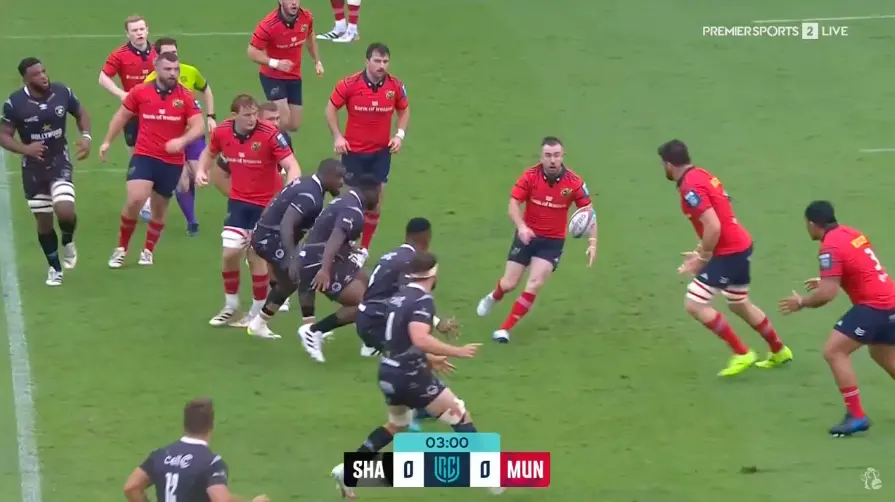
It got knocked on, but we would have conceded possession on the next phase or two anyway. Blowing ourselves out chasing “one more ruck”.
Once the Sharks got into our 22, they did what they do — play tight around the fringes and buy an offside penalty, which they got.
5m lineout. Maul. Try.
We bought that with our own money.
We won a penalty soon afterwards, and instead of taking a few minutes to steady ourselves, Coughlan decided that he was going to quick-tap to either buy a penalty for not retreating, or exploit space that only he could see.
We were turned over after another knock-on because the “out” on this play was a long bridge pass to Tom Farrell, whose only play in this moment could only have been a ball back inside to Daly, which was fully covered by Sharks’ defenders one way or another.
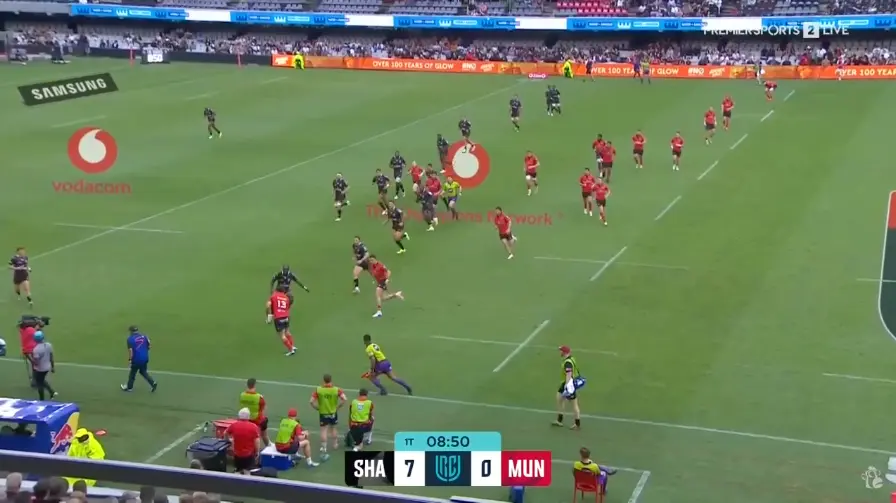
If it doesn’t get knocked on, it’s likely a turnover on the ground anyway.
The Sharks ran a simple enough exit play, and then box-kicked. We knocked on that kick. Scrum. Penalty.
You could see how it was going, even then.
We went 12-0 down soon after, but had a 5m lineout to work with after some over-enthusiastic Sharks defence gave us an in. Our maul was going nowhere, even with the take, because Coombes and Ala’alatoa were late to the shove at the front so, obviously, we got crunched from the infield side of the maul to the touchline side. No space to work with.
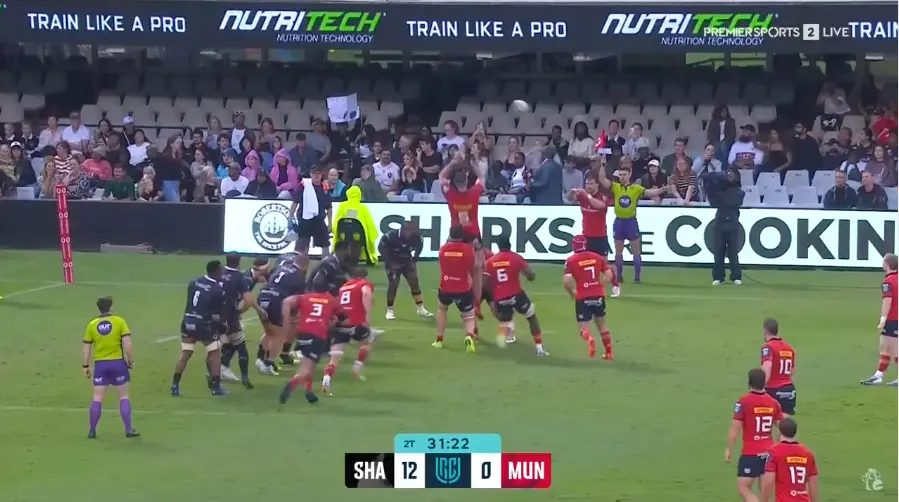
But we had another penalty, which we tapped and then blew with more inaccuracy.
The pass from Nankivell wasn’t great here by any means, but it was still catchable. Harnahan had Penxe in his eye line, took his eye off the ball, and we were scrambling.
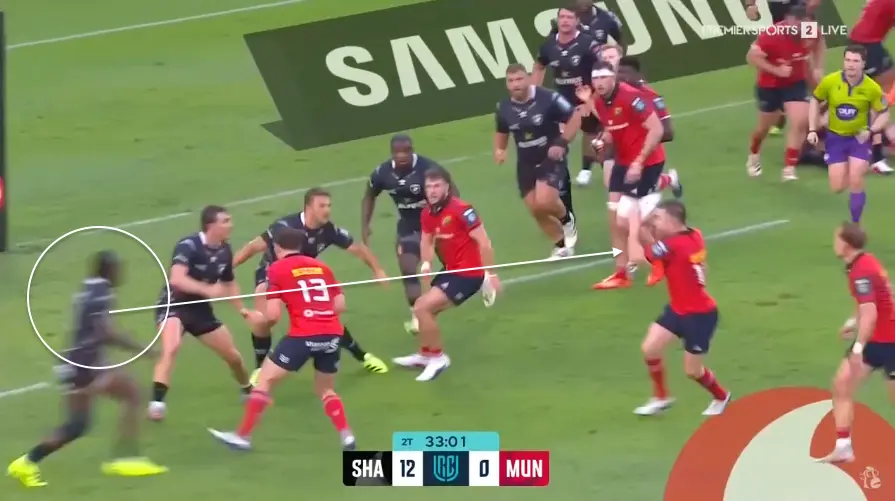
The play here was a short pop pass to Haley after drawing Penxe, but it wasn’t perfect and it often needs to be for Munster.
The fumble from Coombes was unfortunate, but even the ideal play there — a successful offload to Ala’alatoa — wasn’t a scoring play directly. Maybe it would have been on the phases after, but what actually happened was the Sharks cleared, won a scrum off a Munster knock-on under a high ball and then won a penalty.
We found it impossible to run any plays because we were under constant counter-ruck pressure, and then refused to kick at the points where it was the only sensible play.
Pull-back, flat loop, defensive pressure, counter-ruck, more pressure, scramble and then dragging our forwards up for another on-ball sequence under pressure.
Why don’t we kick here? Pressure? A lack of clarity? “We’re down on the scoreboard, I have space to run, so I will”?
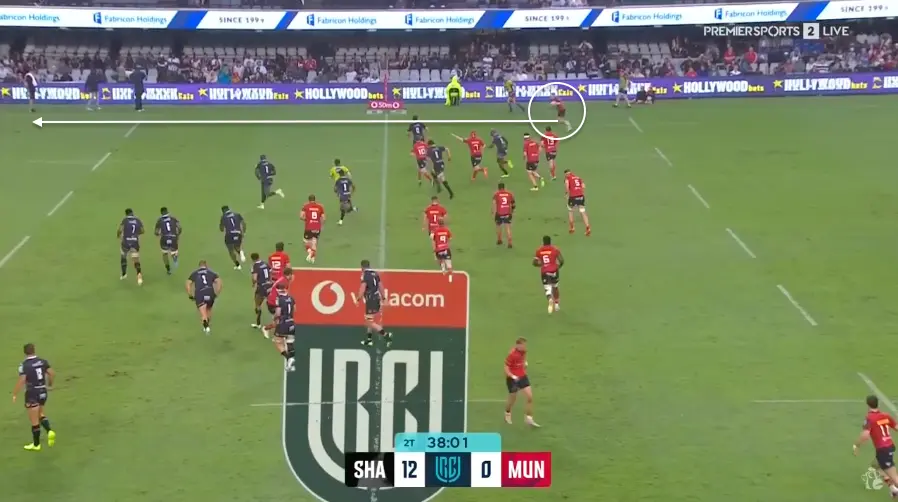
The Sharks spent most of the game kicking and chasing, as we expected them to do, while we blew ourselves out with constant phase play.
Right before halftime, we lost another 5m lineout, and that was that for the half. 12-0 down, far from insurmountable, but it got a lot worse from there.
We started to blow lineouts. On both of these, Milne was out of position because he was just back into the environment after the Six Nations, and we were looking for him to run huge 10m long switches to get to the tail in a game where he was under huge pressure in the scrum.
All of that adds up.
We did try to kick a little more in the second half — stretch the pitch, try to win some territorial position — but it was haphazard, like it was an on-the-fly Plan F.
Hanrahan’s kick here wasn’t great; he was under pressure immediately, but even if it doesn’t go directly to the Sharks’ fullback, that back pin was being guarded by Tom Farrell.
It was 19-0 soon after we conceded that 50/22. It was functionally game over. Even then, we had to shoot for tries, and we looked completely incapable of doing so.
We had no lineout, no scrum, and our attack looked as flat and slow as it has all season long, on top of throwing offloads to nobody under more pressure than we could live with.
This is as bad as you’ll see, all off the back of a scrum on our put-in that got skittled backwards so fast it would have triggered a speed camera.
It got worse from there.
You don’t need to see it.
I didn’t need to see it.
Munster will be better this week against the Bulls. At least, I think so. They’ll be a little sharper after last week’s game; they almost always are. But the big issue, as I see it — and it’s crystal clear after this game — is that our lack of a set piece is the biggest issue facing this squad.
Our attack is really poor, and that infects almost everything, but a functional scrum, lineout and maul would allow us to use that attack more sparingly.
We can’t kick at volume against a team with a big scrum, because we’ll just concede penalty after penalty after penalty if any of those kicks end in a scrum, which they do more often than not. That’s not being dramatic, it’s just a fact. Without Jeremy Loughman and Oli Jager in this squad, we don’t really have natural “scrum first” props, and that’s particularly visible at tighthead, where Michael Ala’alatoa and John Ryan are at the tail end of their careers and showing it quite visibly.
We also can’t really afford to be a possession team for broadly the same reason — every error becomes a potential penalty and a massive loss of ground.
Everything leaks from there.
This, for example, should have a Sharks exit that we could then play off, but instead it’s a full penalty.
There’s no shame in getting pumped by Ox Nche here — it happens to guys in their prime, never mind a 37-year-old John Ryan — but it was happening all game long.
This would have been another Sharks exit while it was still 12-0, but instead it’s another loss of ground and more defence.
A flat, predictable attack that’s bedevilled by overplaying can’t function with a scrum like this, but neither can an off-ball, counter-transition game that would allow us to defend on the front foot, because it ends the same way, with a massive loss of ground one way or another.
The Sharks have a big scrum, don’t get me wrong. I flagged it in advance, not because I’m a very clever boy, but because the data shows it. When we’ve lost this season, the scrum has been a root cause almost every single time because every decision tree we could plausibly make comes back to it one way or the other.
If you’re a possession team, you need a big scrum. If you’re an off-ball team, you need a big scrum. To be a decent version of either of these, you need a passable scrum, and we don’t even have that as it stands. Our attack, poor as it is, as unsuitable as it is for this team without Crowley and Casey in it, is like the high temperature you get with the flu. It’s a problem, yes, but not the root cause of the sickness.
Until that changes, we’ll struggle against any side with even a passable scrum, especially when our lineout is also so prone to blowing up week to week.
There are many things we need to be doing better, but watching this game — and going back to watch others in the time between Saturday evening and this morning — our scrum, or lack thereof, is at the heart of it and often compounded by a lineout that either functions without threat, or actively undermines any attempt we have to stem the bleeding from the scrum.
That’s how you end up getting nilled by a Sharks team that didn’t even play all that well, all things considered. You can half-backs playing scatty, hairbrained rugby. You can have an attacking structure that highlights all your flaws and dampens your strengths, you can have a daft, inconsistent lineout, you can have a poor, rabble of a maul, but if you have no scrum, there’s nothing much you can do about anything in this game.
That was true in 1998; it’s even more true in 2026.
| Players | Rating |
|---|---|
| 1. Michael Milne | ★ |
| 2. Diarmuid Barron | ★ |
| 3. Michael Ala’alatoa | ★ |
| 4. Jean Kleyn | ★ |
| 5. Tom Ahern | ★★ |
| 6. Sean Edogbo | ★ |
| 7. John Hodnett | ★ |
| 8. Gavin Coombes | ★ |
| 9. Ethan Coughlan | ★ |
| 10. JJ Hanrahan | ★ |
| 11. Shane Daly | ★ |
| 12. Alex Nankivell | ★★ |
| 13. Tom Farrell | ★ |
| 14. Calvin Nash | ★ |
| 15. Mike Haley | ★ |
| 16. Lee Barron | ★ |
| 17. Josh Wycherley | ★ |
| 18. John Ryan | ★ |
| 19. Edwin Edogbo | ★★ |
| 20. Fineen Wycherley | ★★ |
| 21. Paddy Patterson | ★ |
| 22. Dan Kelly | ★★ |
| 23. Brian Gleeson | ★★ |
