


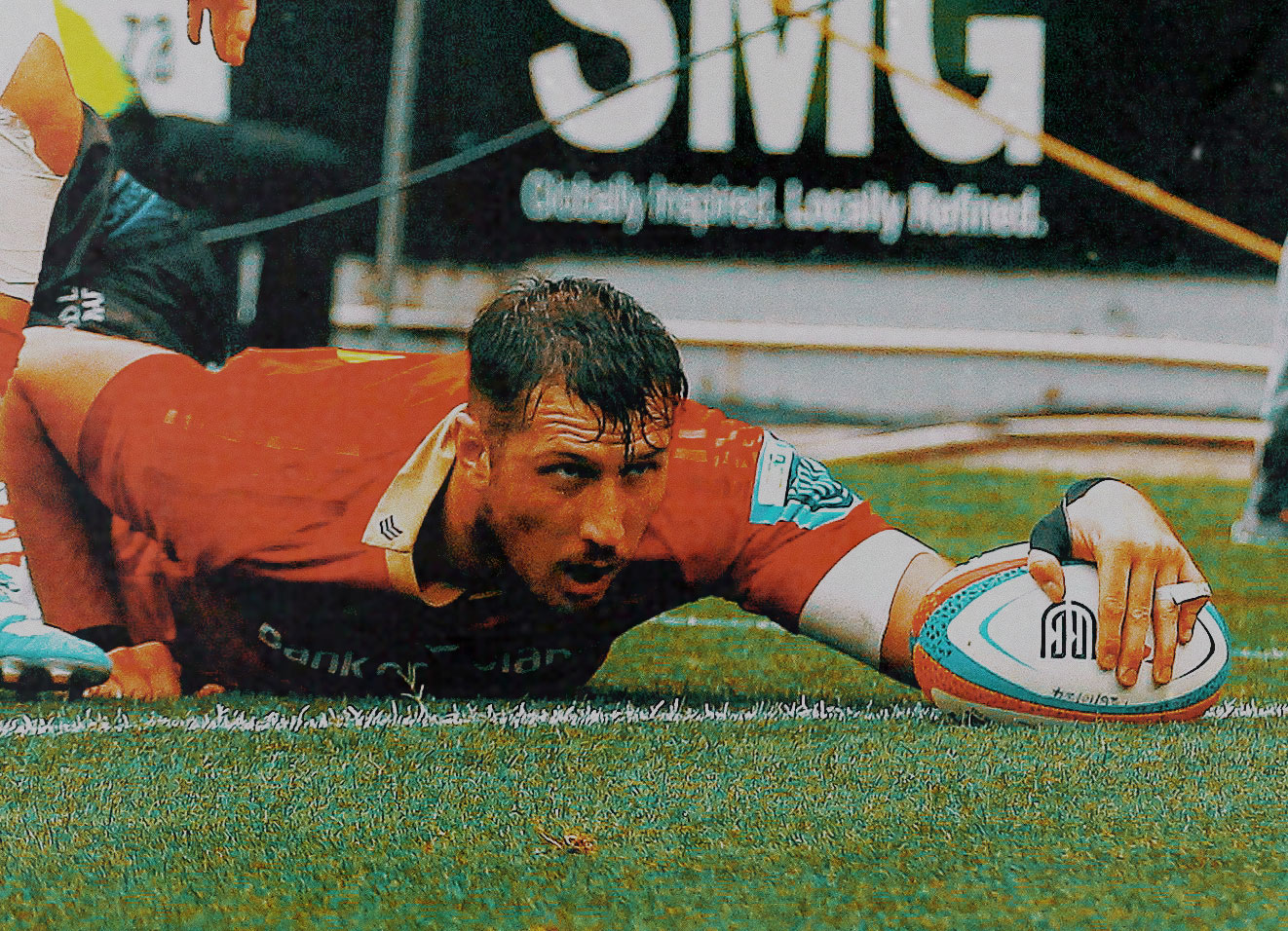
The scoreboard tells you everything you need to know.
We were well beaten when it mattered but scrapped until the last moment to leave with something. I spoke before the game about how Munster getting anything out of this game would be some achievement and I’m not going to renege on that now. When we think back to this game in a year and compare the quality and renown of the two packs, we’ll be gobsmacked that we even managed the four tries. I’m lying there, of course, because nobody will remember this game in a year. That’s how it works. With a bit of luck, I won’t remember it by next week.
My main takeaway from this game is that we were so comprehensively out-muscled and outpaced in the first 30 minutes that winning from there was almost impossible. From the 36-minute mark – after Esterhuizen’s try – this became an exercise in scoring two more tries. At that point, we had two in the bank already but with the result beyond all doubt, our job changed from competing to win the game to competing to get something out of the game.
One point at least, shoot for two, and if the impossible happens, then it happens.
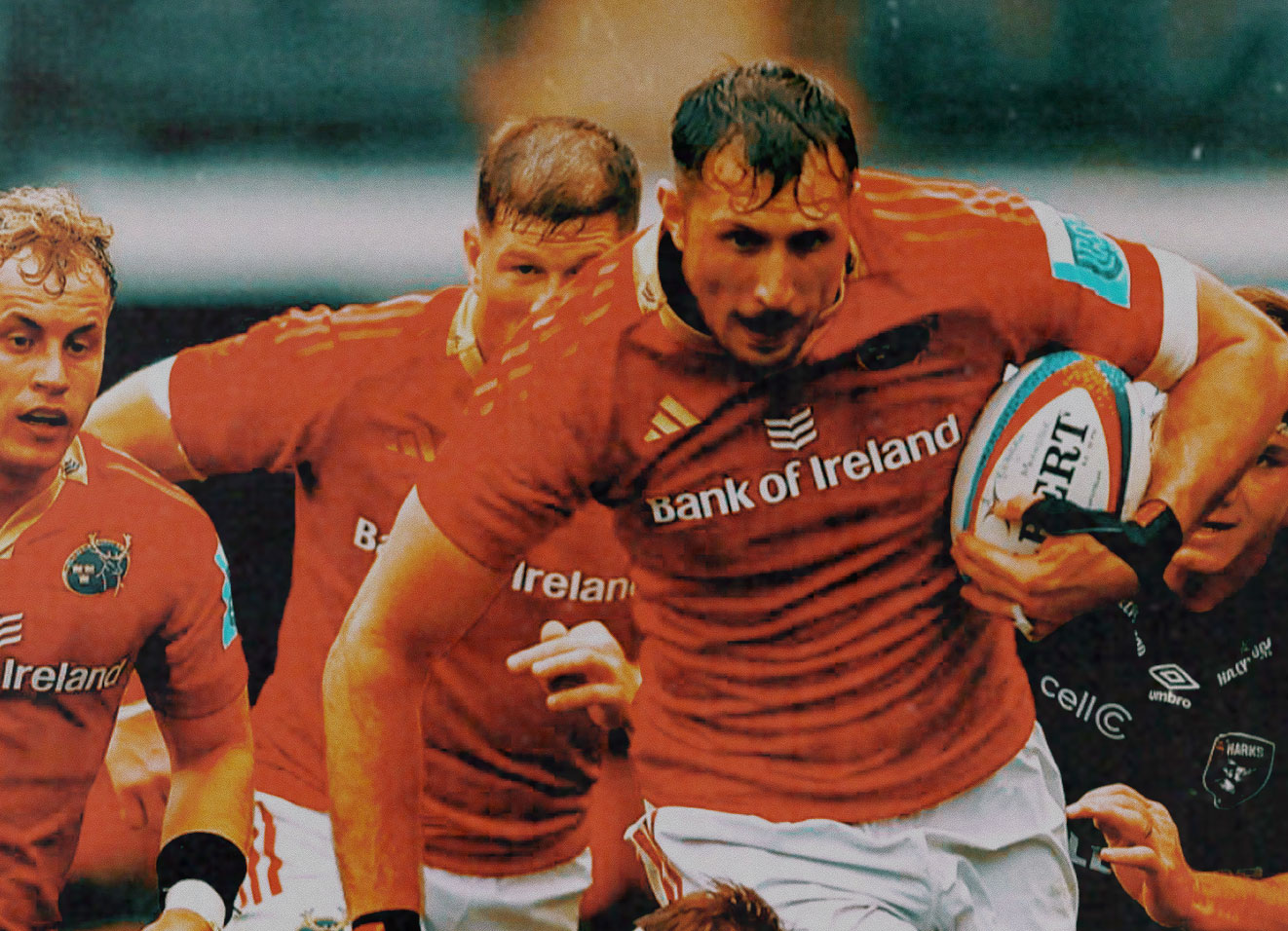
The impossible didn’t happen but we left with something. And that’s a positive. Not a massive one. Not something to be crowing about. But something. After the bloc that was, you’ll take something – anything – but there’s no hiding from the fact that we’re sitting in 12th after six games.
Context is key, of course. We’ve only played two home games. That’s always a factor in points accumulation. But there’s no hiding from the fact that our away form has dramatically fallen away from last season’s standards. We’ve conceded 143 points in four road games. That kind of fall-off is damaging, regardless of the context around injuries, which has been an all too common issue at the club for three years in a row now.
We must see context, but also see reality for what it is.
Have we gone backwards or forwards since the 2022/23 season? The only honest answer is “backwards”. Some of that has been caused by budget cuts at a national level. But can all of the blame be left there? I’m not sure.
On the one hand, I don’t think anyone could look at the squads we had to name in the last two rounds of the URC to see where the issue is; front five, front five, front five.
Think of all the top sides in Europe right now and name their starting front five and replacements. To avoid confusion, think of six front rowers, two locks, and one lock replacement. The best sides in the tournament – Leinster, La Rochelle, Toulouse, Bordeaux – all have top, top players and top earners in those spots.
Now think of the next rung down on that ladder – Northampton, Saracens, Glasgow, Sharks, Stormers, Bulls. There’s still quality there, but maybe not the same depth or budget spend, bar the Sharks.
If you keep going down the list there, you’re probably at another rung or two before you get to where Munster’s ranks right this second. That shows you the problem. Given the personnel has stayed the same since two years ago – minus Snyman, of course – it’s the same guys just two years older. You have genuine class like Beirne and Kleyn – even though both are showing a few miles on the clock at this stage – but then you’ve also got guys who were ageing club legends in 2022, never mind 2024.
On the other, it feels like we’re making the same three or four mistakes every week for the last 12 months. Bad starts, coughing up try-scoring opportunities, set piece imploding and an all-encompassing lack of composure. Take your pick.
Ultimately, those are within our hands.
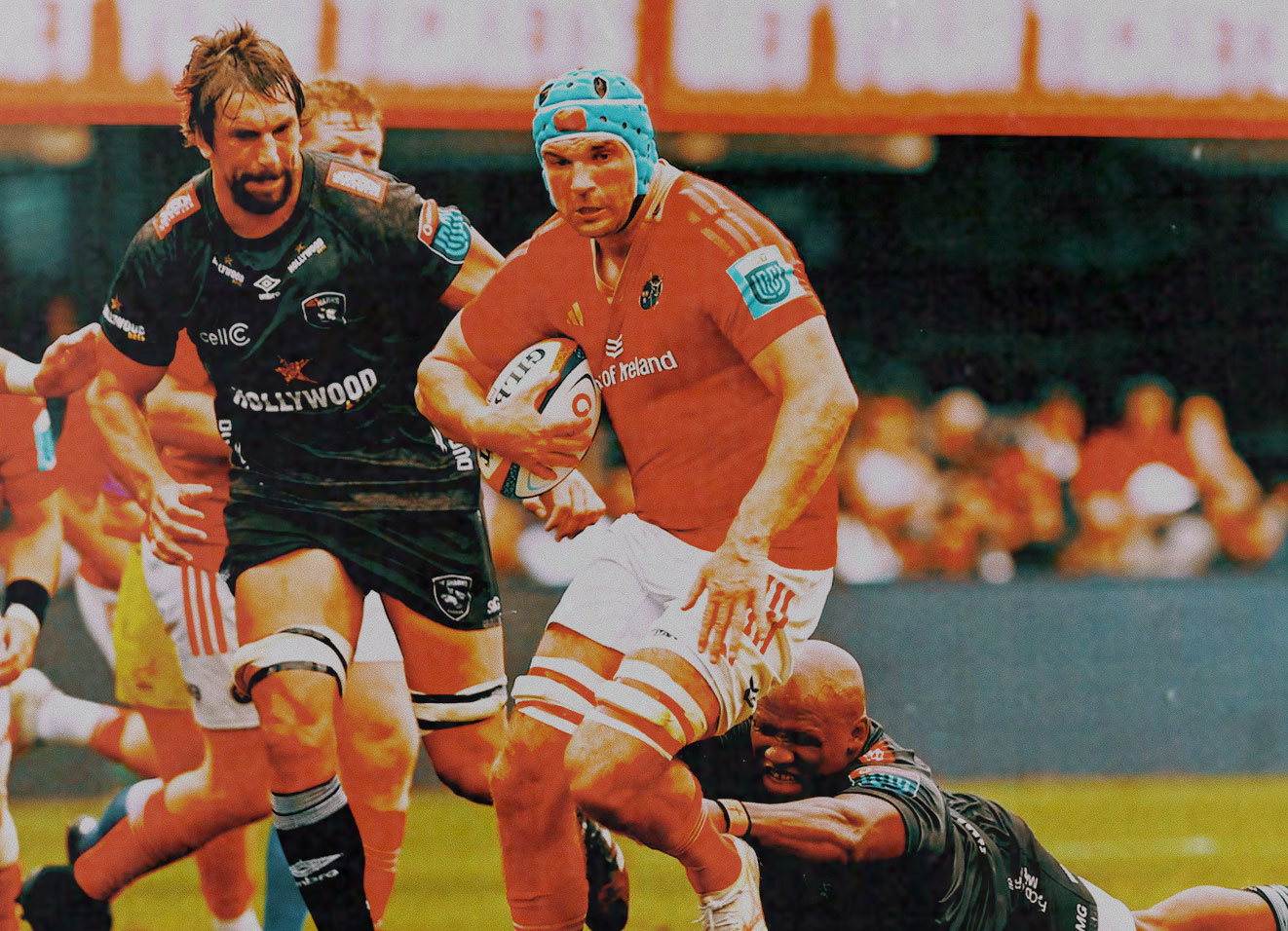
In this game, we had 13 22-Entries. The number of entries you get to the opposition’s 22 is a great indicator of attacking progress and good teams get into the 22 more often than their opponents. It’s a consistent and easy-to-follow baseline metric – like xG in soccer – that shows you the hidden machinery of a performance.
Essentially, the more you can get into the opposition’s 22, the more likely you are to score, which means you are usually more likely to win. In every game this season bar one, Munster have made more 22-Entries than their opponents. In the one game where that wasn’t true – against Leinster – we were tied. In every single game so far outside of our win against the Ospreys, our opponents have outscored us on their points per 22-Entry.
Munster have racked up an average of 8.2 22-Entries per game this season which stands up there with some of the best in Europe, especially when you consider the personnel issues we’ve had. Leinster, the best team at this metric in the URC, have 9.2 22-Entries per game on average over the same period. Yes, they were playing weaker sides so far, but the metric holds.
They score an average of 3.6 points per entry, which is good, efficient work. We’re sitting at 2.9 points per entry, on average, and that drops down to 2.5 points per entry if we remove the Ospreys game as the aberration it would appear to be.
So Leinster are making one more entry to the 22 on average than we are – nothing, really – but they are scoring close to a point more per entry than we are on average, which is a massive difference. So we are creating close to the same kinds of opportunities, but we’re just not executing them. When the game is still in the balance, we look less likely to score the closer we are to the tryline which is bizarre.
Here’s a really good example from early in the game when we had a chance to bring it back to a one-score game. We had a lineout on the 5m line and… let’s watch.
The lineout goes well and we get right into the green zone – less than two metres from the tryline. At this point, it becomes about your ability to execute your tight game. There’s a premium there on getting back to your feet and adding your weight at the right time to make a try inevitable. Leinster are one of the best teams in Europe at this.
In this instance, we get John Ryan back off his feet first and load up Beirne for a carry into Vincent Koch and Eben Etzebeth.
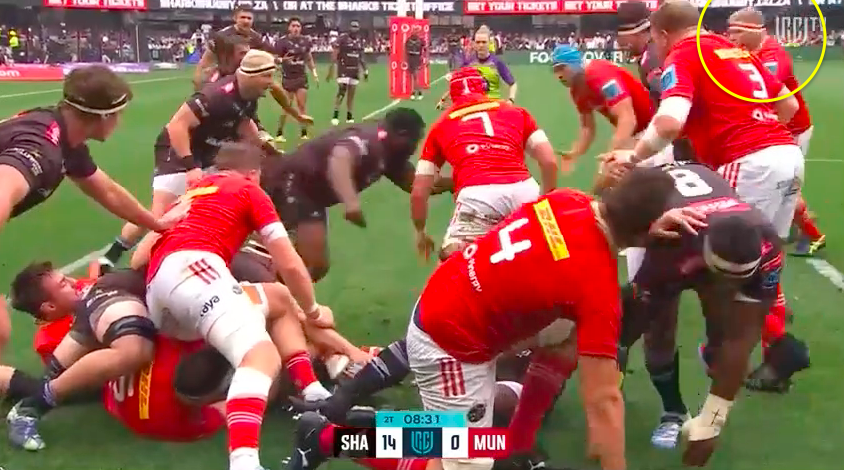
John Ryan arrives as a late latcher after Beirne has made contact with the defence. This is a common tactic of ours, as opposed to a pre-bind and we do it to add some dynamism to a collision that might be at a stalemate in the moment. The late latcher, if timed correctly, can dynamically turn the collision in your favour when executed correctly but it relies on the initial collision being taken on even terms. A late latcher also runs as a possible tip-on option – a concept we like – but that comes with the risk we see above.
By the time Ryan makes his impact, Beirne is completely wrapped up, and the Sharks win a goal-line dropout. There was never any other outcome after the initial contact, when Etzebeth and Koch completely dominated the engagement, as you would expect in a two-on-one defensive collision.
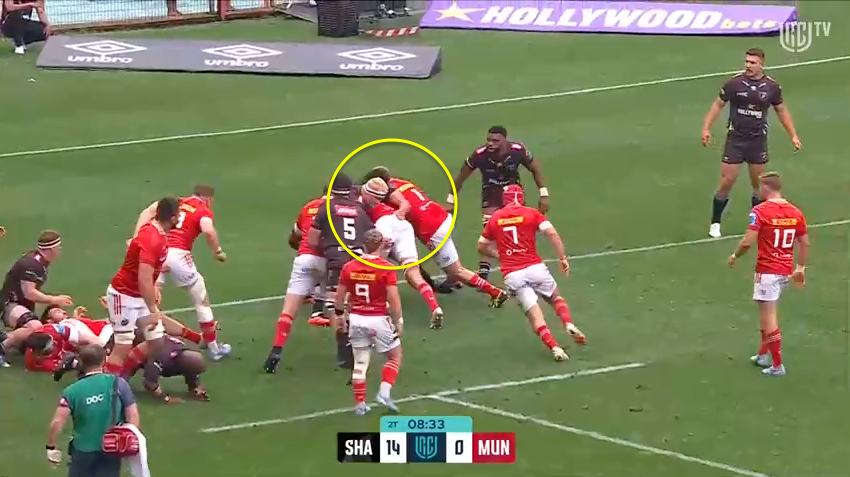
Beirne does well go even goes forward here but Etzebeth and Koch know what they’re doing too. My point is, for nearly a second of tight collision contact, Beirne was struggling against two of the most renowned tight defenders in the game on his own.
This is another failed entry from the second half – I know it’s a little out of sequence – but it’s the same principle. Late latchers attacking after the defensive contact is made.
In my opinion, it enhances our big weakness right now in that we don’t have a massively powerful pack when it comes to ball carrying so our late latching doesn’t add value to the contact.
We got turned over on the next play off a tap and go;
Again, the issue isn’t Ahern arriving late at the contact to take out Tshitsuka on the late latch; it’s any kind of scheme where O’Donoghue is taking one-on-one contact with Eben Etzebeth in and around the goal line.
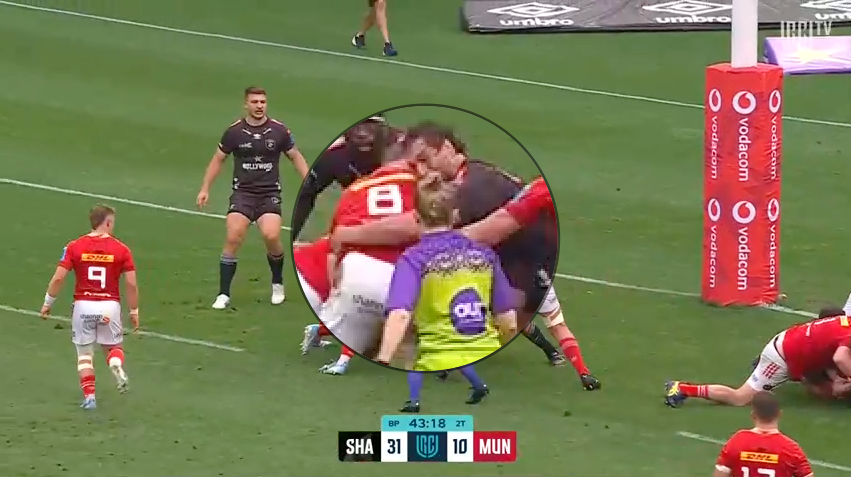
That’s a recipe for lost collisions and slow rucks in one area of the field where you really can’t afford them in subsequent phases. If you watch us for long enough deep in the 22, you’ll see this over and over again.
In this instance, Alex Kendellen was held up over the try line because he was essentially in a tight two-on-one collision with Luhkanyo Am and Hendrikse.
O’Donoghue is there but again tries to late latch rather than binding and driving immediately. This should have been another two tries on the board before the 55th minute.
But let’s get back into sequence.
Here’s our second 22-Entry. It’s a nicely executed blind-side move.
O’Brien does well to get past the initial edge defender but he gets stuffed by the smallest player on the pitch in the backfield and the ball goes out of play. That lack of power and/or top-end pace has been an issue for us on the wing for the last two seasons but O’Brien is particularly vulnerable to it. Ahern does well but even then, the next forward into shot is Stephen Archer around two seconds after the ball hits the deck so the likelihood is that this ball was getting turned over or, as has become increasingly common in the last few games, our primary playmaker is in clearing rucks instead of dictating play in important moments.
Our next entry came on the next lineout when the Sharks got spooked by Ahern’s front jumping and overthrew. We picked the ball up on the tail and surged through on prime turnover ball.
We end up passing the ball forward and into touch.
Why is this? Because we don’t have the power to play simply. In an ideal world, you’d pop this off to an Alex Nankivell, who makes a speciality of beating defenders and creating linebreaks in this very scenario. Or you could run it through your tight forwards to drive deeper into the 22 with short, error-free passes. Instead, we’re having to throw loop route dummies to open up a 17m+ pass off the left hand to a winger on the edge – a difficult pass playing on the front foot, next to impossible on the back foot.
We scored on our next entry when Rory Scannell picked up a loose ball at a ruck before popping it off to Ahern for a power finish. Our first points of the game took 19 minutes and four entries. The O’Brien one was far from a slam dunk but I maintain that if things were producing at even a normal rate, we’d have two tries on the board from the other two entries.
We left four tries behind us in the first 60 minutes. That’s another twenty points at least in a game we lost by 17 points.
Our inability to play with simplicity anywhere on the field to advance up the field is our biggest issue at the moment. The defensive errors here were what they were and, a bit like the lineout issues last week (that disappeared this week), our inability to convert the time and energy we spend attacking into points means we are always under pressure.
Like last week and the week before, you can concede a try or two early on and it won’t kill you IF you can fire back on the scoreboard when you have the chance. At 17-0, this game was pretty much dead and buried but the problem was that it should have been 14-10 long before. When the opponents have to play with a tight scoreline, they can’t play with freedom. We equalise the pressure. When we can’t convert the opportunity, all the pressure falls on us.
That’s been true three weeks in a row now.
But even with that, I can’t say that a majority of the team played badly here or well below their level. My star ratings reflect that which I think is another issue. We need a bit of power back in the team, yes, but I think we also need to attack tight opportunities like we’re aware of how lacking in power we are.
At least now we have over a month to sort the issue, one way or the other.
| Players | Rating |
|---|---|
| 1. John Ryan | ★★★ |
| 2. Niall Scannell | ★★★ |
| 3. Stephen Archer | ★★★ |
| 4. Jean Kleyn | ★★★ |
| 5. Tadhg Beirne | ★★ |
| 6. Tom Ahern | ★★★ |
| 7. John Hodnett | ★★ |
| 8. Jack O'Donoghue | ★★ |
| 9. Craig Casey | ★★★ |
| 10. Jack Crowley | ★★ |
| 11. Sean O'Brien | ★★ |
| 12. Rory Scannell | ★★ |
| 13. Tom Farrell | ★★★ |
| 14. Calvin Nash | ★★★★ |
| 15. Mike Haley | ★★★ |
| 16. Diarmuid Barron | ★★★ |
| 17. Keiran Ryan | ★★★ |
| 18. Ronan Foxe | ★★★ |
| 19. Fineen Wycherley | ★★★ |
| 20. Ruadhan Quinn | ★★★ |
| 21. Ethan Coughlan | ★★★ |
| 22. Billy Burns | ★★ |
| 23. Alex Kendellen | ★★★ |
