


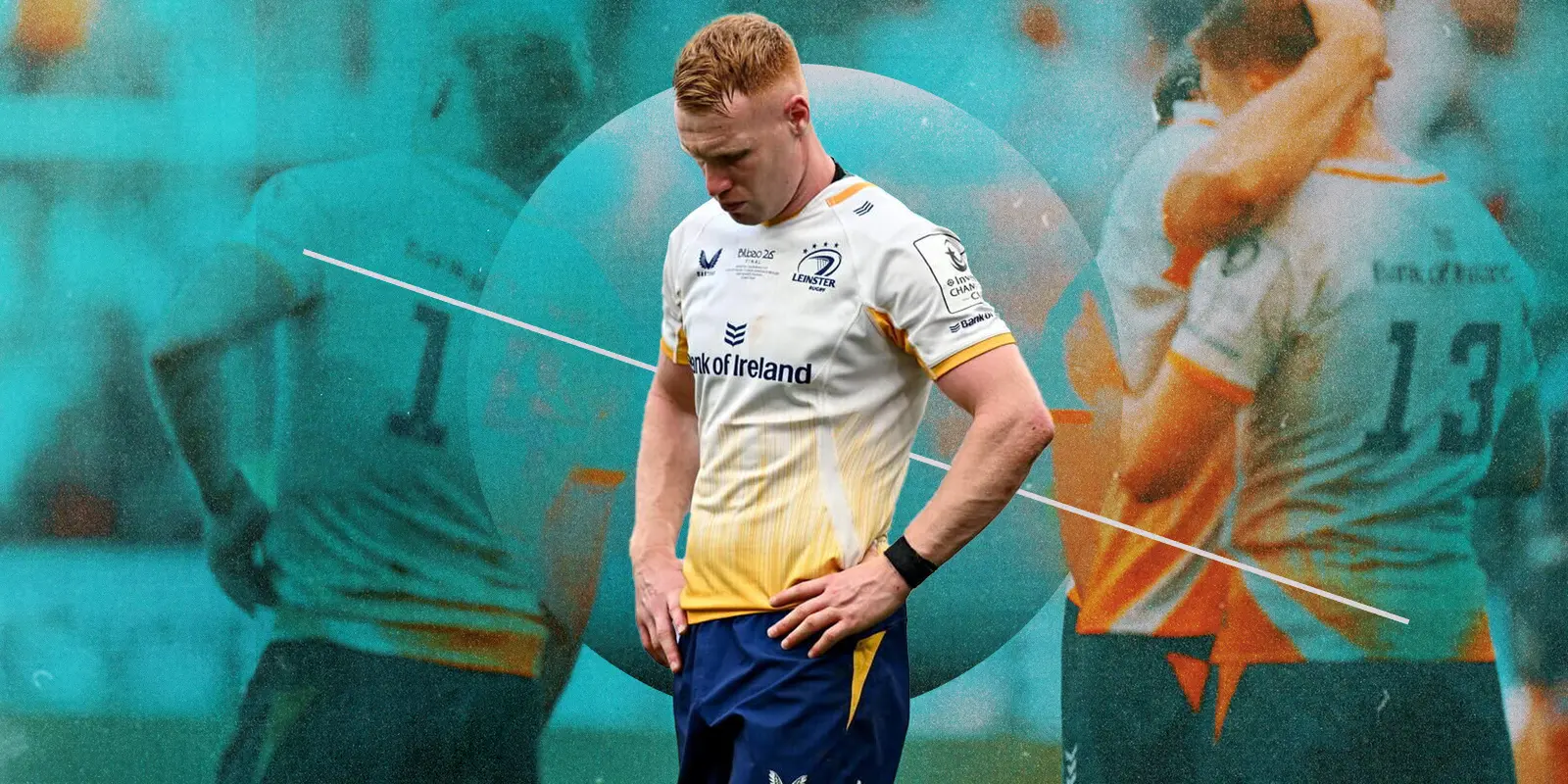
When results are below expectations, the easiest change to make is in the coaching staff. At a basic level, you have one or two senior coaches who set the vision for the club, and if that vision isn’t working out, it’s easier to remove a coach than it is to change a whole swathe of players.
Without being too obtuse, that is what’s happening at Leinster in the aftermath of their loss to UBB in the Champions Cup final, with a lot of talk in the media about changing out Neinaber, Cullen, or both for whatever big-name coach takes your fancy. This kind of talk is natural after a defeat like that, and the real feeling that Leinster are “missing their window” as a top two or three side in Europe. In a way, that’s only the natural cycle of things. Dominant teams rise; they have their time when they look invincible, and then they fall back to the chasing pack. Sometimes you can sustain that for ten or so years, with some luck mid-cycle — like the All Blacks from the 2005 Lions tour to the 2015 World Cup — but time comes for every great club side eventually, and it always happens the same way.
- Generational talents don’t get replaced because it’s functionally impossible to do so back-to-back without insane luck and timing — and luck and timing have a much bigger part to play in that.
- A few prospects don’t work out, either through injury or failing to live up to their potential.
- Some big signings don’t quite work out.
- Core players pick up injuries that they never fully recover from
- Core players begin to age out at the same time, dropping a few percentage points from their peak.
That’s how it always goes. It happened to Leicester, Munster, Wasps, Toulouse, and now I believe it’s happening to Leinster.
Every team has their window, and when that window passes, it’s almost impossible to get it open again with the same squad. It doesn’t mean Leinster have become a bad team overnight, or even an average team; it just means that, barring a collapse with their rivals like UBB and Toulouse at that super elite level, Leinster will continue to fall short in Europe for the next two to three years until a squad reset can take place post 2027 World Cup.
This is where we come back to coaching — what a club looks for in a coach, and what a coach actually does.
When you see fans and media talking about how Leinster seemed to have moved away from their identity or “DNA”, it’s the coaching that comes under the spotlight. This, again, is natural. Coaches determine a team’s playing identity and are judged on it. Win when you’re going against what fans feel is the natural identity of the team, and you can get away with anything. Lose, and the pressure builds.
We’ve seen this at Munster a lot in the last 15 years. When the great team of the 2000s began to fray at the edges, a change in style was attempted under Rob Penney as both a response to a lack of recent success and to move to a style that might suit the game as it stood at that point in the early to mid 2010s.
It was not successful. Fundamentally, if you’re bringing in a new way of playing to a team of experienced, multi-cap internationals, you’re trying to teach an old dog new tricks.
The players who had won everything their way were now being asked to unlearn it, and the half-second of hesitation that creates — do I trust the system or my instincts? — is the gap between a clean break and a turnover at the worst possible moment. Penney wasn’t a bad coach, and the ideas weren’t bad. They would broadly work for Connacht under Pat Lam during the same period.
The timing was simply wrong, and the squad he inherited was built for a different kind of game.
That’s the trap waiting for whoever Leinster turn to next, if they turn to someone else post 2027. The temptation, after a final like that, is to believe the problem is philosophical — that the team has drifted from its DNA and the right appointment will simply restore it. But a coach can only work with the bodies in front of him. You can hand the most celebrated attacking mind in the world a squad that’s a fraction past its peak, carrying three or four players who’ll never quite be what they were, and the problems will stay broadly the same. Coaching isn’t alchemy. It can sharpen a group, organise it, give it conviction — what it cannot do is manufacture the half-yard of pace or power or the freshness in the legs that age and miles on the clock take away.
And that leads to a more fundamental issue: is the current Leinster squad capable of playing what fans identify as “the Leinster way”? I often hear that they do it for Ireland for Andy Farrell, but is that fully true in the last few years post-Sexton? Ireland have lost to France heavily in the last two years and beat them in France in 2024 with no Dupont, and with France playing sixty minutes with 14 players. We’ve managed to beat South Africa once in that same period, thanks to two last-minute drop goals, and have lost to New Zealand three times in a row since 2022 for the first time since we beat them for the first time in 2016.
Sure, we’ve beaten England, Wales, Scotland, Australia and Italy regularly in that time, but these teams are not in the elite conversation at test level.
From the outside looking in, I don’t think Leinster have been a particularly notable creative attacking team at any point in the last seven or eight years. It might have looked like that at points under Lancaster, but even then, a lot of the best stuff in that period either orbited around Sexton specifically or was heavily scripted. What they have always been in that period is an incredibly tough, well-drilled defensive team.
In the post-Lancaster era, I think Leinster and the IRFU were right to double down on this strength with the hiring of Jaques Neinaber. It was the right decision at the time, and while blame can be left at the coach’s door for Leinster’s failings in Europe in the last three seasons, I think that’s a smaller part of the equation than many think.
Say Leinster were to somehow break Noel McNamara out of his UBB deal, would he be able to come in and turn Harry Byrne or Sam Prendergast into Matheu Jalibert? Or Henshaw and Ringrose into Moefana and Dooportier? Or Tommy O’Brien, James Lowe and Hugo Keenan into Rayasi, Penaud and Bielle-Biarrey? No. And it’s fanciful to think that he could. Noel McNamara’s vision works because his vision for attack fits perfectly with the talent already at UBB before he arrived. He didn’t turn the Sharks into what we are now seeing at UBB because he worked with the talent he had — because that is the job.
So the question Leinster should be asking isn’t “who replaces Cullen or Nienaber?” It’s “what are we actually trying to fix?” If the honest answer is that the window is closing on this group — and the pattern at Leicester, Wasps, Toulouse in the 2010s, and Munster says it is — then changing the coach is treating the symptom rather than the cause. The real work is the reset: the unglamorous, multi-year business of rebuilding a spine while managing decline. No marquee hire shortcuts that. A big name might make the fans feel better for a season. It won’t pry the European Cup window back open. Can Leinster retain the URC this season? Yes, especially if they continue their usual home run to the final, but is that enough?
That’s the ultimate question to ask, and to which there is no easy answer.
