



As I explored in last week’s article, Munster’s prospective approach to the top-end NIQ market has to consider several factors: career timing, lifestyle, arranging the family’s move with the player, and cold, hard cash.
For example, a hypothetical push for Taniela Tupou as explored last week needs a lot of money and for him to ignore everything he sees and hears about the weather over here for that hypothetical deal to work in everyone’s favour. Just because he’s available, and you have the money, doesn’t mean that you get the signing over the line. It’s not a video game.
I don’t think Munster are looking at Tupou, to be honest. Maybe they have and I don’t know about it but his value is only useful as an example. As I wrote last week;
Most props you’re likely to sign will be either good for 50 minutes or 30 minutes, so the value per minute on that player is… expensive. So if you’re going to be taking approximately €400k-€600k out of your provincial budget on a prop with those power forward tendencies you’re looking for, you have to accept that (a) they will be playing just over or just under half the games you’re signing them for, (b) they usually come with a lot of knocks built in across the season and (c) the x-factor of the scrum means their impact can sometimes be negated entirely.
This is the thinking Munster will likely follow. If Oli Jager is on a significant PONI contract for the next three seasons, does it make sense to sink the guts of €850,000 into your tighthead chart? Do you get the best bang for your buck in the modern game by putting that much money into one position?
A lot of modern thinking about contracting says ‘no,’ and wage patterns across the game show this. A great example of this can be found in the Gallagher Premiership’s most recent Salary Cap report from the 2022/23 season.
You’ll see there that locks are the third highest-paid position on average but also that their value jumped by £10k season to season, the highest jump of any forward position, with hooker coming in second with a £9k increase on average year on year. More on that later.
Looking at the payments per position, locks have the highest percentage (12%) of forwards earning more than £350k per year, with three or more lock profile players featuring in matchday squads.
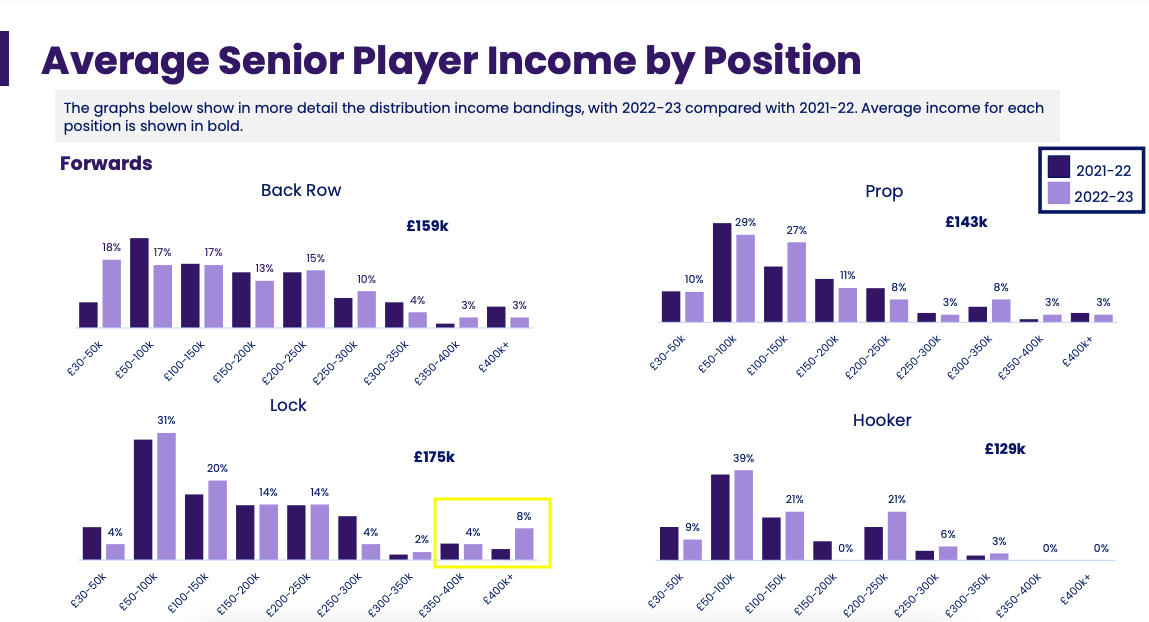
Only fly halves have more players earning over that elite £350k mark.
What does this tell us? If we follow the money, Premiership teams who have to operate under a pretty tight and restrictive salary cap see more value (more wins) by spending more on locks than any other positions on average.
This correlates directly with the importance of the lineout as a try-scoring origin, both for most teams and against most teams. I think the bump in hooker wages accounts for this also, but that’s a little more nebulous.
There is massive value in signing an 80-minute lock to round out your tight power. Whenever I’ve spoken to coaches about this, the reasons have been;
- You can have multiple locks in a pack and create different builds with your roster. When you sign a big prop, he gives you 50 minutes and then starts to degrade.
- You can’t construct a pack build around a big prop signing, only use them as a point of emphasis either starting or off the bench.
- Signing a lock with any kind of elite size and athleticism gives you the ability to put real size in your back five through the utilisation of a half lock.
- This means you can keep your tight power levels constant for the full 80 minutes more cost-effectively than getting the equivalent level raisers in six front row spots – starting and finishing loosehead, hooker and tighthead.
When it comes to increasing your tight power, the logic seems to be that there is better value per minute in locks, than there is of props of the same status.
For example, Munster have been linked with the signing of Pieter-Steph Du Toit in the last few weeks. Say those rumours are true – and I’m not suggesting they are – what would Munster be dealing with?
One – a massive financial and logistical package depending on the potential offer. If we’re potentially offering a one or two-year deal, you have to account for relocating the family. If it’s a six-month deal, you probably won’t have to factor that in. What are his commitments to the Springboks like?
Does that affect his cost per game to unacceptable levels? How much of a premium do you have to pay to keep him from heading back to South Africa?
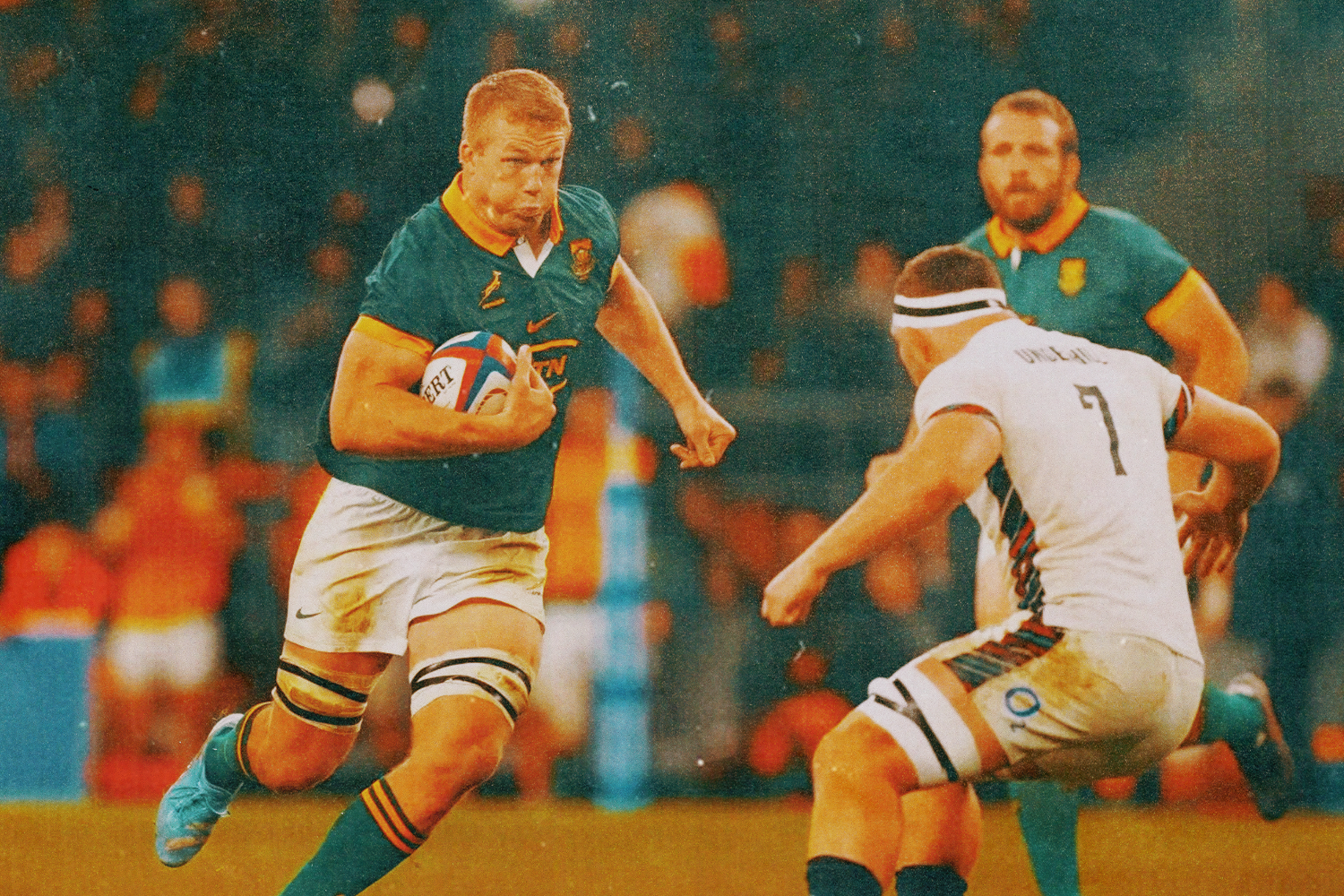
All of these factor into the contractual equations, as they would for any player of Du Toit’s status.
From an on-field perspective, increasing your tight power through the medium of lock-build players just makes a tonne of sense. To use Du Toit as an example, he played 1995 minutes between the Springboks and Toyota Verblitz last season – that’s 26 appearances averaging 77 minutes per game. You won’t get that kind of on-field impact from any prop worth signing at the size profile we’re looking for.
If he is available, and if Munster can strike a deal, Du Toit is the kind of player who would instantly beef up Munster’s back-five rotation as either a half-lock or a second-row. That improvement isn’t simply the preserve of prop forwards.
It would be expensive, but real power always is.
