


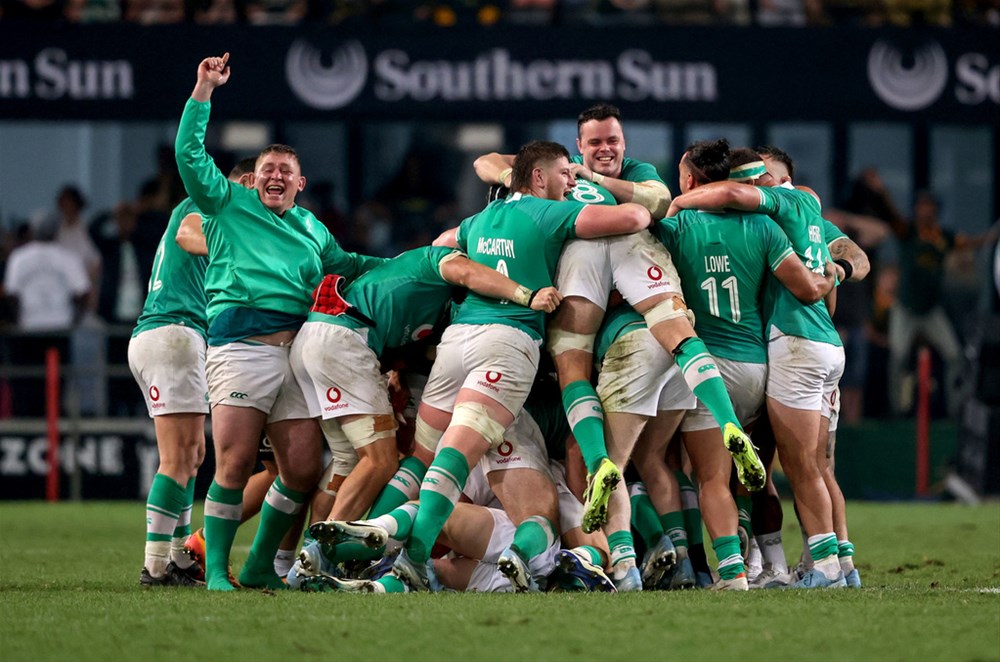
Ireland’s win over the Springboks in Durban last week was a proper thriller with a memorable end. It might have been a drawn series, but I think both games more than lived up to the expectation that this would be a heavyweight rumble between the world’s #1 and #2 teams.
One thing remains true in this game; you don’t beat any serious South African side in South Africa without overwhelming physicality. That is how Ireland lost the first test but it’s how we won the second. And that’s where things start to get interesting. Why? The manner of that victory suggests that Ireland could and should be looking at a permanent change to the back five build if this win is as meaningful as we hope it is.
From this point, do Ireland need to consider running a three-lock pack as our standard build? In the last season under Farrell, Ireland have, fairly consistently, used the Combo-Flanker, Heavy Combo-Flanker and Strike Wing Forward back row with a Swing Lock and, as of this season, a Tighthead Lock Power Forward in front of them.
James Ryan has been operating as a Heavy Swing Lock off the bench in this 2023/24 build. Against South Africa in the second test, we went with;
Heavy Swing Lock / Tighthead Lock Power Forward
Swing Lock/Heavy Combo Flanker/Strike Wing Forward
Let’s have a look at the ORW and see where it leads us.
| Dominant Clean | Guard Action | Attendance | Ineffective | Ruck Work Score | |
|---|---|---|---|---|---|
| Porter | 1 | 17 | 2 | 1 | 37 |
| Kelleher | 1 | 8 | 1 | 2 | 16 |
| Furlong | 4 | 17 | 1 | 47 | |
| McCarthy | 5 | 8 | 2 | 3 | 27 |
| Ryan | 4 | 10 | 2 | 3 | 28 |
| Beirne | 2 | 10 | 2 | 1 | 26 |
| Van Der Flier | 18 | 2 | 1 | 36 | |
| Doris | 13 | 2 | 1 | 26 | |
| Murray | 1 | 2 | |||
| Crowley | 4 | 8 | |||
| Lowe | 6 | 12 | |||
| Henshaw | 6 | 12 | |||
| Ringrose | 2 | 6 | 1 | 16 | |
| Nash | 2 | 1 | 5 | ||
| Osbourbe | 5 | 10 | |||
| Herring | 4 | 8 | |||
| Healy | 4 | 1 | 9 | ||
| Bealham | 8 | 16 | |||
| Baird | 1 | 1 | 5 | ||
| O'Mahony | 1 | 3 | 9 | ||
| Blade | 0 | ||||
| Frawley | 1 | 3 | |||
| McCloskey | 1 | 2 | 7 |
Now, this is just one game but two things stick out to me:
- Porter and Furlong had their best ORW scoring games as a starting pair in several games.
- Our lock core – McCarthy/Ryan/Beirne – all had similar ORW scoring as a starting trio.
Doris’ ORW scoring is lower because he ended up carrying 15 times in this game – a good bit more than his norm. This was because the Springboks kept kicking to Doris (and Osbourne) throughout the game. I think that, in both cases, they felt they could rough up Doris and Osbourne in defensive transition but they were unable to do so. La Rochelle and Toulouse have used this kicking strategy to beat up Doris a little bit off restarts and dropouts but the Springboks couldn’t make it stick and their targeting of Osbourne in the air ended up being a complete bust as the young Kildare man mopped up every contestable they sent his way.
The last time Ireland used this back-five build – against Romania in the 2023 World Cup – it produced some similar trends. All three starting locks had broadly similar ORW numbers, the player in the #7 role had an outsized day at the breakdown and Doris scored less than his average.
That was against Romania, though, and the biggest change game to game from the last time we used this build was that our starting props dominated at the breakdown.
Top Five ORW Scorers
- Tadhg Furlong – 47 points
- Andrew Porter – 37 points
- Josh Van Der Flier – 36 points
- James Ryan – 28 points
- Joe McCarthy – 26 points
I spotted Porter doing this live but Furlong was so good at the breakdown on a detailed watch that I bumped him to a full Five Star performance despite his issues at the scrum.
Ryan and McCarthy were far better than their average ORW scoring at the breakdown this season for Ireland. McCarthy had way more ruck entries compared to the first test but he was way, way more effective with a number of very solid shots. It seemed like he was tighter to the breakdown as part of our lower PPC average. In the first test, we ran at 1.42 passes per carry. In the second, it was 1.21 passes per carry. That narrower attacking pattern behind off-ball kicking tactics suited McCarthy down to the ground. James Ryan continued his excellent performance off the bench in test one with a bruising game at the breakdown in the second test, for broadly the same reasons that McCarthy did.
That improved ball retention led to Ireland bossing key time blocks in this game and, importantly, coming away with points from almost all of them. Straight away, you can see where Ireland improved relative to our three previous games against super heavyweight opposition.
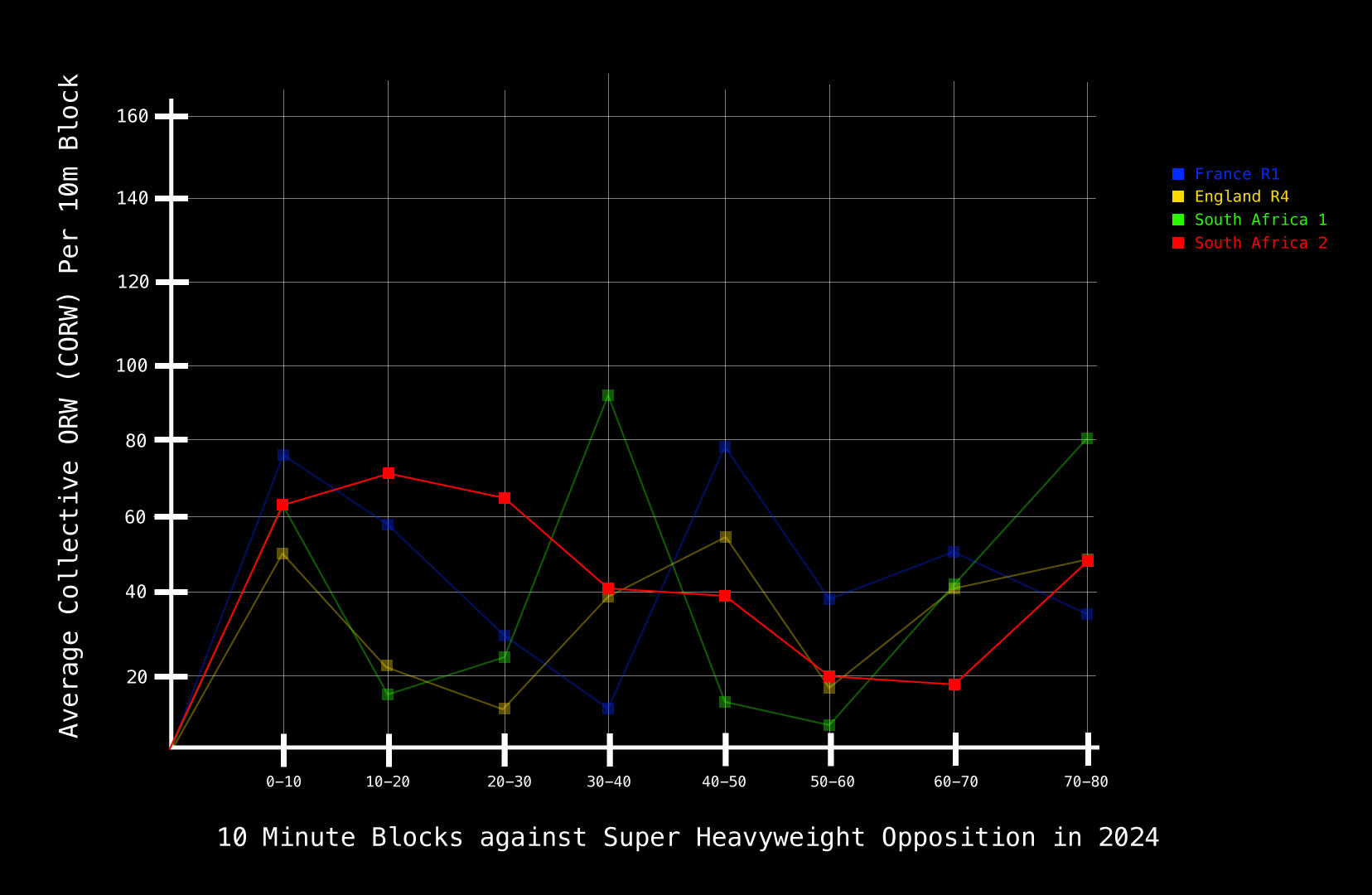
Those three 10-minute blocks – the first half an hour – essentially featured massive ORW scoring on 3.5 passes per kick. What does this mean? Essentially, it means Ireland were unbelievably efficient relative to the same period last week. Ireland almost always start well when it comes to Collective ORW scoring but that second ten-minute block drop-off has happened against England, France and in the first test against the Boks. This time, Ireland improved on that first block of scoring and only tailed off slightly in the third block.
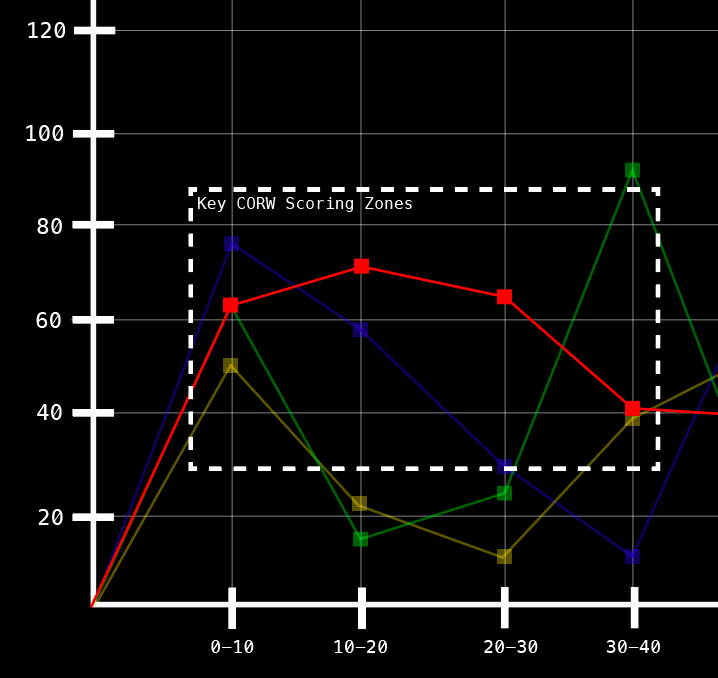
We scored 13 of our 26 points in these zones, which is a huge improvement on the first test. Even when our CORW began to drop after half-time, which was always going to happen in reality, we were able to get points on the board against the flow of the game through Crowley’s boot.
Those three points in the 58th minute, as our CORW was cratering in the face of 12 unanswered Springbok points in the two blocks after halftime, put us in a position to win the game.
Our last block of 10 minutes had just enough effective possession to give Frawley a platform to kick the winning points against the flow of the second half to that point. Our build to start the game, along with a tighter, off-ball game gave us the platform to play but once we moved away from it (and our starting locks got tired) you could see our effectiveness drift away from the optimum level.
It’s something I think you’ll see Ireland lean into more as they move away from Peter O’Mahony this coming year.
