


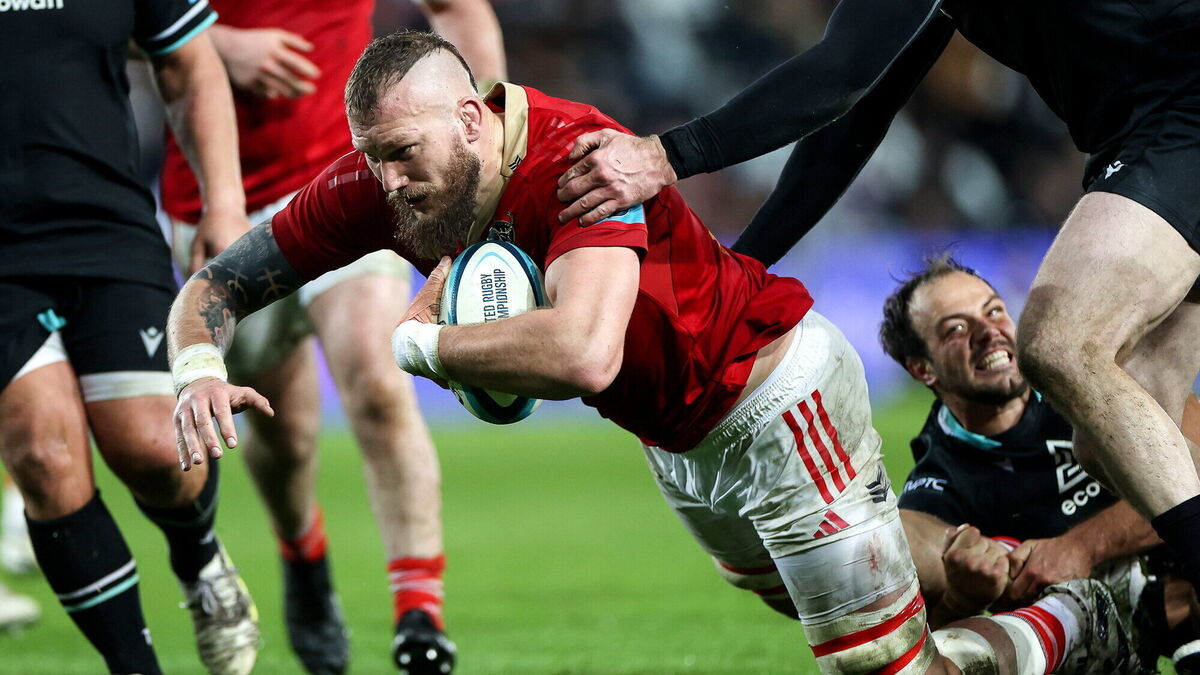
It ended up being a great weekend for Munster in the URC, but none of that would have mattered if it wasn’t for the bonus point win we picked up on Friday evening against a gritty, well coached Ospreys side.
On Sunday, when all the dust had settled, we found ourselves sitting in fourth with four points of a buffer to fifth place Stormers. Suddenly we’re in range of Glasgow in third while Ulster and Edinburgh, who we sat behind at the state of this round, have slipped back a few places. This block of games was the perfect time to go on a run after our nightmare schedule at the start of the season but it wouldn’t just happen – we’d have to make it happen and it’s so far so good on that front. Three games, two away, one at home and 15 points in the bank. If we can back this run up with another win, ideally with a bonus point, against Cardiff next weekend we’ll have picked up more points in these four games than we did from the start of November 2023 to the end of January 2024.
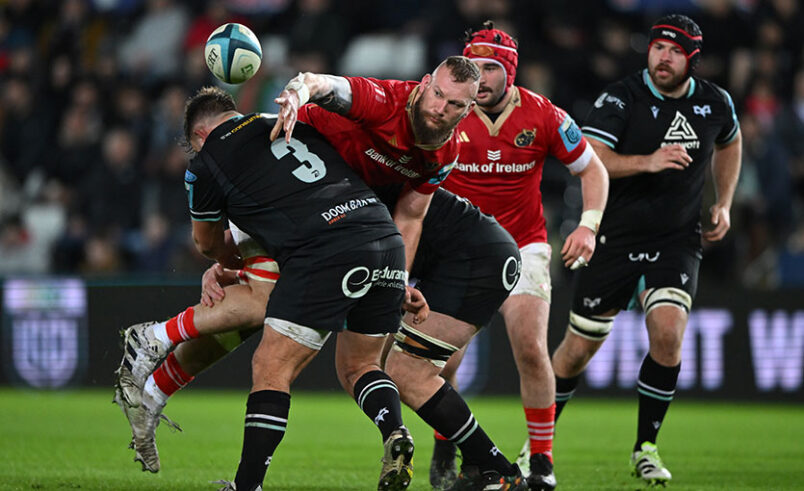
That is a real stat.
In those six games (five of which were against last season’s playoff sides) we earned 17 points total. Any win against Cardiff next week will give us 19 points in four games.
Momentum, momentum, momentum. And right when it’s most valuable, too.
***
If your initial watch of this game gave you the feeling that something looked different from the Munster you’ve been watching all year, you were right. It was different.
Typically, Munster plays with a very high pass-to-kick ratio – between 8 and 12 passes per kick on average in most games – even when weather conditions are difficult with a high pass-per-carry ratio on phase play.
Put simply, Munster under Graham Rowntree is not the Munster that you remember from the 2000s or the pastiche of what our game was perceived to be under Van Graan. We are an expansive, attack-orientated on-ball, high-possession team who wear teams down with the ball in hand, kick very infrequently and starve the opposition of the ball for long sequences.
But we weren’t against the Ospreys.
No, in Swansea on Friday night, we played lock-down, off-ball kick pressure rugby with very few risks being taken on phase play. Why? I’ll get to that later.
First thing to note, the weather for the game was really good up until the rain in the second half but the ground was a lot wetter and greasier than it might have seemed on TV. Munster knew this coming into the week and planned accordingly, not just for the projected weather but specifically for the Ospreys too.
In the Press Preview on Tuesday, Graham Rowntree was effusive with his praise of Toby Booth’s Ospreys and let me assure you, that was not blowing smoke or damning them with faint praise. Munster were incredibly wary of Ospreys turnover threat and their ability to stick in games primarily off the back of the opposition’s errors.
That’s how they turned over Ulster – literally and figuratively – and the game felt like a bit of a style’s make fights ambush.
A high-kick volume counter-transition team that leans into off-ball rugby against “bigger” teams playing against a high volume possession on-ball team on a greasy pitch with rain forecast?
We’ve seen this story before. We saw it this time last season when a janky Munster side integrated back in some wider squad internationals off a long stretch without a game and got turned over, rumbled and ultimately pumped by Glasgow Warriors at home. We had 146 carries in that game and 216 passes but we were 22 days without a game and looked it.
This game against the Ospreys was our longest stretch without rugby this season. As an example, the gap between the Crusaders friendly and Scarlets was 13 days. The gap between Harlequins and Scarlets was 8 days. The gap between Zebre and Ospreys was 21 days – three full weeks.
So, with an identical gap between games with returning test guys in key roles and playing against a side that specialises in forcing turnovers off the back of a conservative counter-transition game, what do you do?
You go off-ball.
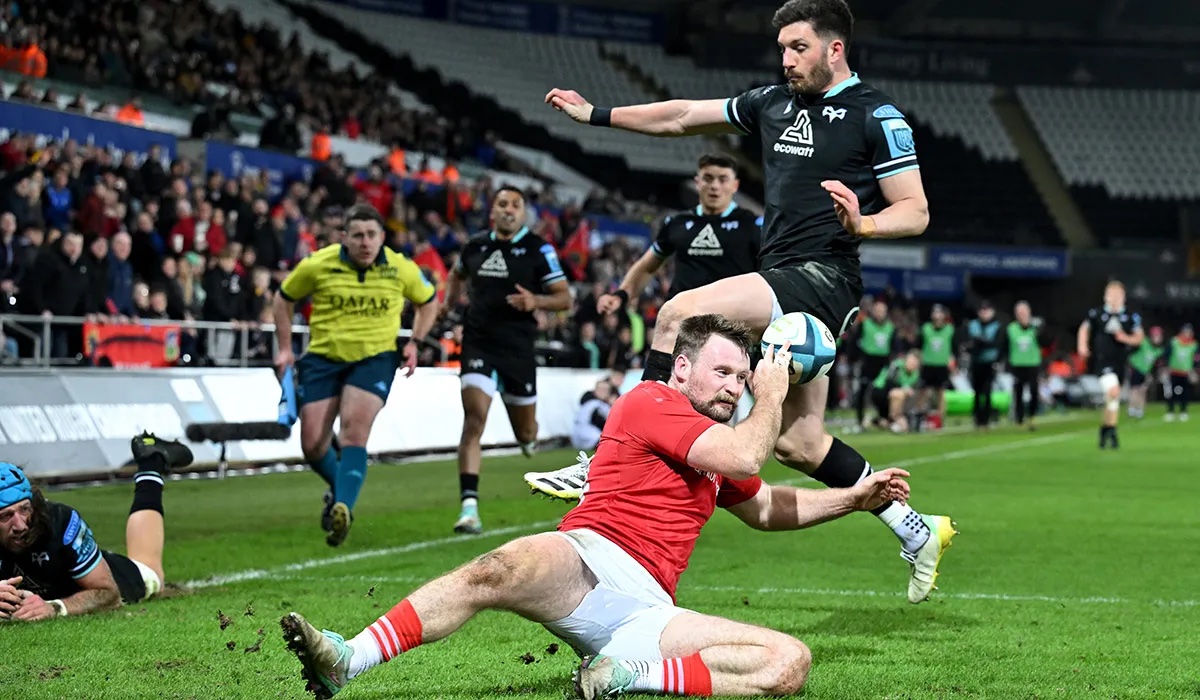
Make them play. That’s exactly what Munster did. We have the joint-best defence in the league under points conceded and we have the second-best when it comes to tries conceded. In this game, we leaned fully on our defence for the first time this season and, in doing so, removed the issue that time-off does to this team’s usual on-ball style. When you play on-ball rugby, the biggest killer to that style from your end is a lack of game sharpness. Simply put, if you’re going to be attacking at the volume on-ball rugby demands, everything must be in sync with everything else.
If your ruck cadence is off, you lose. If your passing understanding from player to player on layered schemes with five or six moving parts is off, you lose. If you are not game-conditioned to play that style, all the mistakes that follow from the first two issues are compounded and… you lose.
Our pass-to-kick ratio in this game was one kick for every 3.4 passes. That’s our lowest ratio all season. Our pass-per-carry ratio was 1.17 – again, a seasonal low.
We fixed the cohesion problem by doubling down on the easiest thing to drill with no game – defence, kick chase and set piece.
Carbery, Haley and Casey kicked long all day and we only really played off turnover ball – where we’re one of the best teams in the league for converting turnovers into tries.
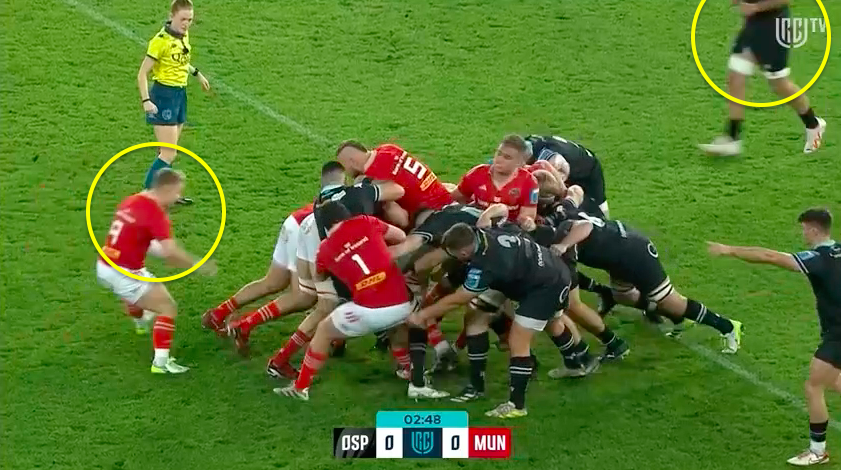
Our first try came from a perfectly drilled maul break, which used the Ospreys skittishness on maul defence to isolate and pick open an isolation on the edge for Mike Haley in that 3/4 space.
Watch how we time the break for when all of Ospreys’ fringe guards commit to the maul.
When we break it down, Casey only moves to break when he sees the Ospreys midfield small forward Rudolf step up to the maul front from his position guarding Williams in the 10 slot.
Casey then fires a 20+m pass right to Rory Scannell, which cuts out two of the remaining defenders and all of a sudden, we have that isolation to work with. The quality of Casey’s pass – it’s unbelievable – opens up so much time for Carbery on the loop that he can fling another long pass and still preserve the spacing.
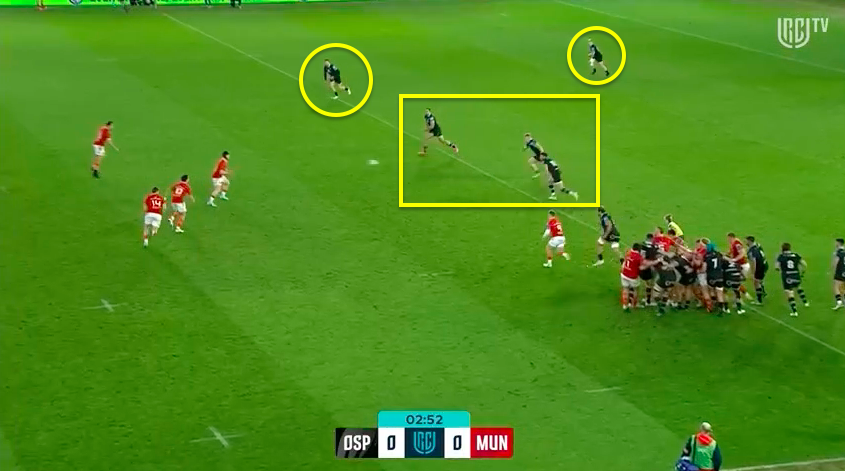
O’Brien’s pocket line on Carbery, combined with Frisch’s well-run option line to hold Boshoff, left Cuthbert on an island and when Carbery found the right pass to Haley, we knew the drill to finish.
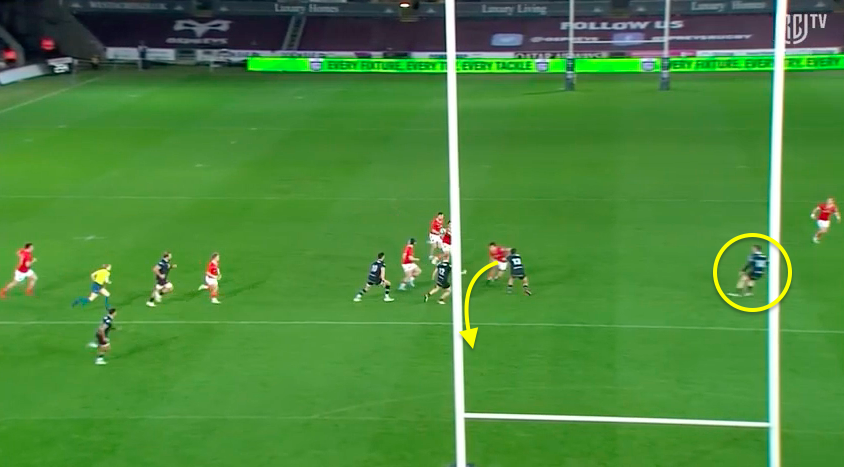
We would have run that play all week, knowing that, to counter-punch well, you have to execute on those first-phase strike plays.
To back that up, we would have to exhaust the Ospreys and pull them off-scheme. We knew they’d kick long to us on starter plays so we wanted to lean into that and kick it right back to them to generate a high ball in play time. When we hit them first off that lineout play, they had no choice but to play and we intended to make them go through the motions.
They are primarily a kicking team so for them to, all of a sudden, have to resource 145 carries and 228 passes would be physically exhausting. It is easier for an on-ball team to go off-ball, than it is for an off-ball team to on-ball. Ospreys’ error count went through the roof and, if it wasn’t for the massive scrummaging of Nicky Smith in the first half an hour, they’d have bounced off our defensive pressure, fallen back and been nilled.
We put them under real pressure. This 14-1 press around our own 22 with Haley defending in the primary edge line and Carbery tracking in the backfield produced an intercept for Sean O’Brien as Ospreys tried to pass around the wall of red jerseys in front of them. Watch them bounce through these fairly basic 3-2 phase shapes until they go for broke with a pass to the edge.
It was never on, really, but Sean O’Brien punished them ruthlessly.
When they were 12 points down, they could only press harder for something – anything – to get them back into the game and all we had to do was fill the field, make our shots and kick to start the process all over again. We used a 13-2 shape further out to tempt kicks out of them but we mopped those up too, on the whole.
A few errors right before and right after half-time made the game more sweaty than it needed to be for a spell but when we decided to put the foot down on an 0n-ball sequence, we snapped right into it and earned the bonus point to get out of Swansea with the maximum with minimal fuss.
That’s the kind of efficiency that we know we can bring now so it’s another tool in the chest for us to use when necessary. Ospreys away at the end of a test window when they have more test guys back than you do is a tricky one, but we navigated it really well from almost two weeks out.
And all of a sudden, we’re exactly where we need to be.
| Player | Rating |
|---|---|
| Josh Wycherley | ★★ |
| Niall Scannell | ★★★★ |
| John Ryan | ★★★ |
| Tom Ahern | ★★★★ |
| RG Snyman | ★★★★★ |
| John Hodnett | ★★★★ |
| Alex Kendellen | ★★★★ |
| Gavin Coombes | ★★★★ |
| Craig Casey | ★★★ |
| Joey Carbery | ★★★ |
| Shane Daly | ★★★ |
| Rory Scannell | ★★★ |
| Antoine Frisch | ★★★ |
| Sean O'Brien | ★★★★★ |
| Mike Haley | ★★★★ |
| Eoghan Clarke | ★★ |
| Jeremy Loughman | ★★ |
| Stephen Archer | ★★★ |
| Jack O'Donoghue | ★★★ |
| Ruadhan Quinn | ★★★ |
| Ethan Coughlan | ★★ |
| Tony Butler | ★★★ |
| Shay McCarthy | ★★ |
