


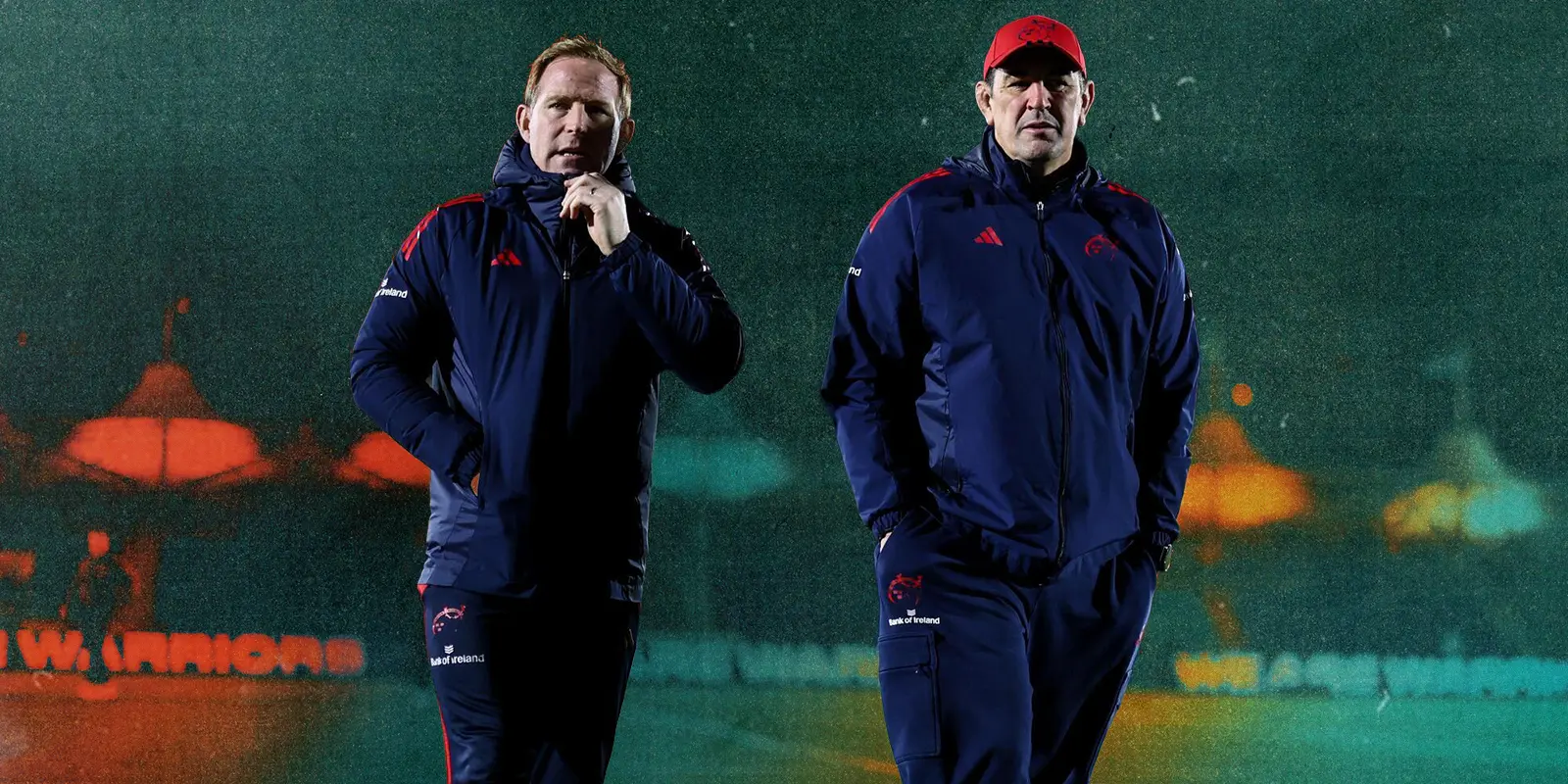
When the official announcement came on Thursday afternoon, on the back of some excellent reporting in the Irish Independent on Wednesday, Munster fans around the world had a similar thought cross their minds.
“Not again“.
Another season, another bout of coaching disruption, at least that’s how it feels on the face of it. It’s the reality of it, too. Mike Prendergast leaving at the end of the season — to Johann Van Graan’s Bath, most likely — is a blow. There’s no other way to describe it.
Prendergast, who joined the club in the summer of 2022 as our attack coach, right after Van Graan’s mid-contract departure in a similar vein, was, somewhat ironically now, seen as an immediate repudiation of the rugby that Munster had been playing under Van Graan.
It’s funny how the game moves.
Van Graan didn’t really have a distinct “style” at all, and Bath’s impending signing of Prendergast is a great indicator that Van Graan will sign whoever he thinks will work best with the group of players he has at his disposal. Van Graan and Stephen Larkham, the previous attack lead at Munster, immediately before Prendergast, concluded that a variant of kick pressure worked best for the group at their disposal. This was broadly criticised at the time, myself included.
In the 2021/22 Anatomy of a Season article, I quoted this piece from an earlier article that season.
We are a chimaera. A hybrid of many qualities, without necessarily being a European leader in any of them, bar maybe our defence. Van Graan understands the game deeply as an analyst. As a coach, I think that translates into a team that is usually incredibly prepared for the opposition’s strengths and quite set up to attack those. Munster’s kick-heavy approach against Leinster in the PRO14 semi-final of 2019/20 was laughed at post-game, but was duplicated by Saracens to great success a week later.
If it seems like Munster fluctuate week to week depending on the opposition I think it’s because of this reactive, shape-shifting, intellectual quality that Van Graan has. It’s often easier to define Munster’s style by how we play certain opponents. We reflect their strengths with our approach more often than not. When it’s Peak Leinster or another “big” side that we give up a power differential to, we tend to kick a lot. When it’s a mid-level opponent, we can do any number of things, but we rarely play a mid-level opponent when it comes to knock-out rugby, so, really, what value is it?
My main criticism was that we didn’t have a visible attacking identity. The hiring of Mike Prendergast was Graham Rowntree’s immediate answer to that question. We were going to move from a relatively low-intensity kick-pressure team to a high-intensity on-ball, possession team. Mike Prendergast was the man whom he had specifically head-hunted to lead that change.
It wasn’t without pain. Munster’s start to 2022/23 was incredibly difficult as the squad — disrupted by an early Emerging Ireland tour — looked like a newborn deer trying to learn how to walk. We were awkward. We knew, intellectually, what we were meant to do, but we didn’t have any practice in doing it.
The season was looking like it would be a complete disaster — a transitional write-off — before an incredible late-season surge saw us win the URC title against the Stormers in Cape Town, playing a way that had seemed impossible just a season before.
The gamble, such as it was, worked. Munster had won a title for the first time in 12 years, and Mike Prendergast’s attacking vision was a core part — the core part — in that success.
But success never stands still.
***
In the seasons to follow, Munster seemed to drift a little. As I’ve been over elsewhere, the needed rebuild never really took flight for a variety of different reasons, and the URC title win was something of a high-water mark. Coaches were expected to do more with less, and there was a real feeling in Munster that the concurrent budget cuts were something of a punishment for winning the URC. Almost like “See! You didn’t need any extra players or resources, aren’t ye doing great!”
In successive years, we really leaned into what Mike Prendergast’s attacking philosophy had given us, because we didn’t really have any other choice.
In 2023/24, we signed Alex Nankivell and, eventually, Oli Jager, as well as a return for the veteran John Ryan. That was understandable, in a way. Our success in the previous season had come too late for any “bonus” to be applied. Nankivell was a defactor replacement for Malakai Fekitoa, who we released a year into his deal.
2023/24 finished disappointingly. We lost out in Europe in the Round of 16 again, and lost a home semi-final against Glasgow, where it felt like we could have played for four hours and still not broken them down.
That off-season, we lost Antoine Frisch, Carbery, Snyman and Zebo but signed Tom Farrell, Diarmuid Kilgallen, Thaakir Abrahams and Billy Burns. The squad wasn’t necessarily getting stronger, even allowing for three of those four departures being closer to the end of their elite usefulness than they were to their primes, and most of the signings were direct replacements for those players, even if they weren’t meant to be when they were originally pursued.
The concept, at the time, was that the forwards we needed to bring in were either outside of our dispensation at the time or unavailable, so we doubled down on pace and creativity in the backs.
If we couldn’t play through teams, we would play outside them. A workaround to the workaround.
Prendergast’s attacking scheme suffered, as the rest of the squad did during a disastrous start to the 2024/25 season that ultimately cost Graham Rowntree his job. It wasn’t fully about the bad start either — problems had been visible there for a while — but there was a functional choice at the time between what Rowntree wanted to do, the read at Munster and the IRFU on his ability to guide that, or sticking with the principles that had been successful in 2022/23.
When Rowntree departed the province, almost everyone I spoke to thought that Mike Prendergast would get the head coaching role. I thought at the time that it was the obvious choice and the one that Munster and IRFU’s contracting hinted at.
A few weeks after Rowntree left the province, Leamy and Prendergast were announced as having signed new, two-year deals. It wasn’t fully the case that it was either Leamy and Prendergast or Graham Rowntree, but that’s certainly the impression I got in the weeks and months that followed, rightly or wrongly.
That was not the case, and the process was messier than it needed to be, even if Munster and the IRFU ultimately appointed an excellent, experienced head coach. Should Leamy and Prendergast have gotten those new deals without clarity on who the head coach would be? For me, absolutely. The alternative was Munster possibly going into a new season needing an entirely new coaching ticket, all of whom would have to be hired after the head coach, on which there was no timeline.
Clayton McMillan was announced as the new Munster head coach in February 2025, and the immediate reaction was (a) excitement and (b) concern over the impact on Mike Prendergast, who was widely favoured for the job internally, to the point where multiple people I spoke to felt that he was about to be announced imminently around January where he had spoken openly about putting his name into the hat for the role in press conferences earlier in the season. As I said, it was messier than it needed to be.
Prendergast was appointed as the Senior Coach in a revamped rugby program, but it’s not the head coach. It’s an enhanced unit coach role, with more say than he had in his previous role, but it is not the head coaching role. Not the final say.
Was there disappointment? Sure. Of course there was. If you go for a promotion in a place you’re already working, only to see the role go to someone outside the organisation, you’re going to be incredibly disappointed. Still, a promotion to Senior Coach, plus the Ireland coaching roles that followed that summer, were a positive sign of progression.
Even with that, I felt at the time that the style McMillan used at the Chiefs would dovetail well with what Prendergast had built here. As I wrote in that article;
From a style perspective, what McMillan brings is broadly similar to what we already have here in Munster. His philosophies on the game will sync up well with Senior Coach Mike Prendergast.
Yet, further down the article, I wrote this.
McMillan likes his forward ball carrying to be quite direct. The Chiefs forwards wouldn’t have as high a Pass Per Carry ratio as Munster’s do at the moment, so that’s something that will probably change.
That was a part of a problem that, in hindsight, might not have been so easily resolved.
I still believe Prendergast and McMillan have similar visions on how the game should be played, but it’s a bit like the similarities between Italian and Spanish. Enough there for communication, but when the pressure is on, the differences stand out more than the similarities.
I think the main motivating factor in Prendergast’s departure can be summed up in two related issues.
The first is that he sees a clearer path to being a head coach outside of Munster as it stands. If, as expected, he moves to Bath, I think there is a clearer route to a top job there as Van Graan, while under a long-term deal, is increasingly sought after at test level.
McMillan is in situ here for another two seasons after this one, and Mike Prendergast’s current contract expires at the end of next season. That’s where the philosophical issues that I feel have influenced this move come into play.
As it stands, McMillan and Prendergast were not the natural stylistic fit that I hoped they would be. There are enough differences to be meaningful.
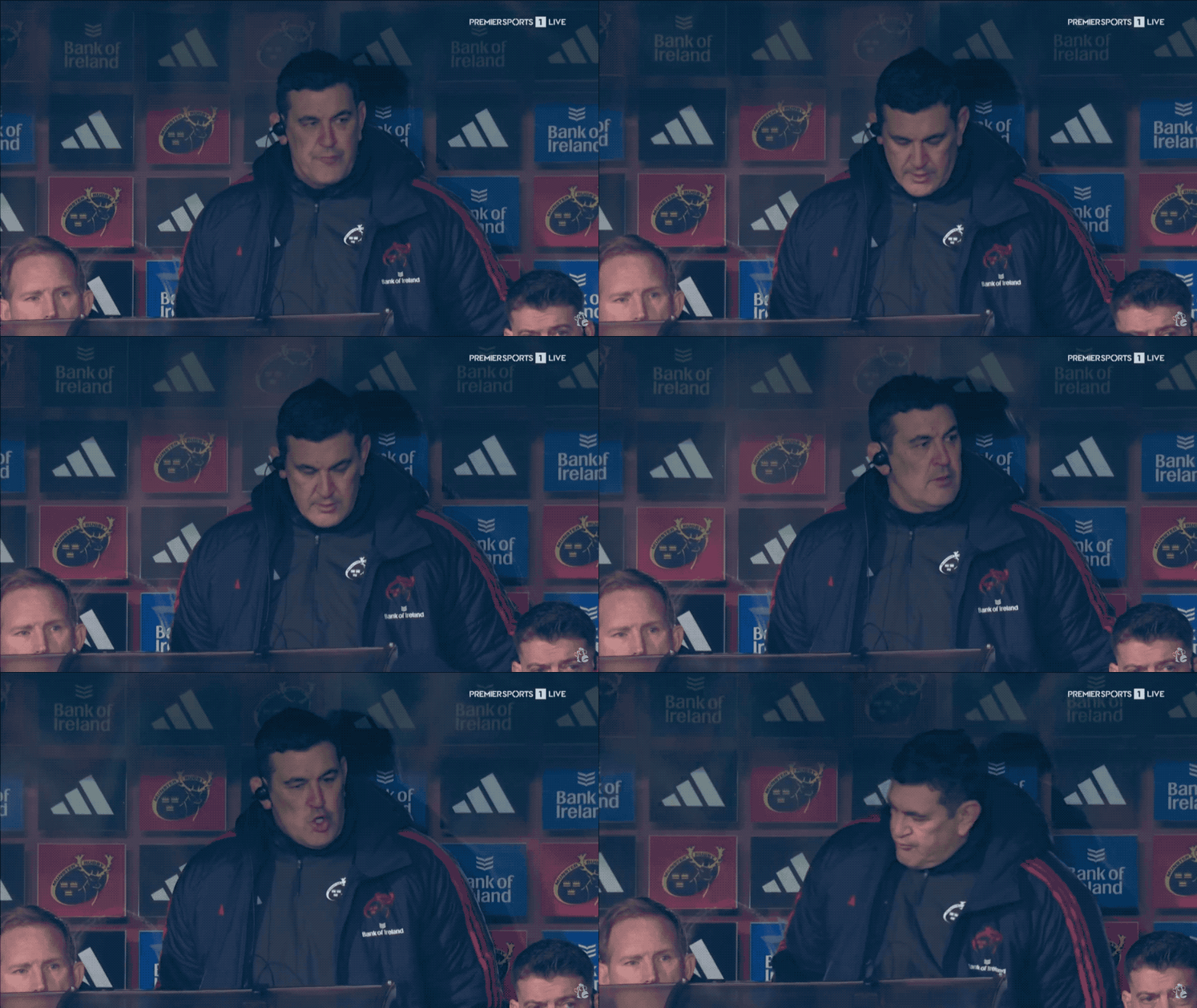
It’s often the case that, in the aftermath of a departure like this, clashing personalities and interpersonal fallouts are often highlighted as being a factor, but that really isn’t the case here.
Clayton McMillan, as the head coach and focal point of what the organisation want to build around over the next few years, has a specific way that he wants this team to play. Mike Prendergast, as the senior coach and attack lead, sees things differently in enough ways that it can’t be meaningfully resolved without one or both men changing fundamental pillars of how they see, how they coach the game.
One way or the other, that was going to become a problem, either this season or next, when Mike Prendergast’s current contract would come due.
Looking at both of those points together, it makes all the sense in the world for Mike Prendergast to take up a role at another big club where he has a real shot at progression to head coach in the next few years, which is far more likely than here, as it stands, and where he can apply his vision to how that looks on the offensive side of the ball.
Mike Prendergast WILL be a head coach somewhere, and I am convinced that he will eventually coach at test level. He is that good.
For Munster, it now allows Clayton McMillan to start putting his stamp on core areas of the squad — attack, elements of the set piece and attack in transition — in a meaningful way with coaches he has identified to work with the exact style he has determined after the guts of a season on board.
At this level of coaching, small deviations in the vision of how you want the team to play have wide-ranging impacts, from the review to training, to match prep, and then to the game itself.
That can cause a lack of clarity, and a lack of clarity can be destabilising. We also can’t get away from the fact that, along with the scrum, our attack has been a clear weakpoint this season, as I’ve gone over in a few different pieces at this point. That isn’t all on Mike Prendergast, either, I should add, because everything in this game is interconnected, but after that December/January block — and after Castres, in particular — I kept coming back to the concept that something about how we attack needs to change.
[…] All produced from an attacking sequence that got blown because of one decision — a young winger passes instead of running through. Should everything be that low margin, though?
It feels like we stretch the play so much — and our attacking line in turn — that any turnover of possession forces a radical compression of the transition defensive line to react, leaving huge edge space to compensate.
[…] All duck or no dinner. Too often, as of late, there’s been no dinner. We play too wide for the forward line we have, and lack the pace across the back three to consistently offer loop threats. Too much of our play ends up wiring ball to Tom Farrell in the hope he can produce an offload or a short ball moment that breaks open a defence. He doesn’t really create chances with space around him, so everything is dependent on high-speed, low-percentage short passes hitting their mark under pressure.
How much of this was a compromise? How much of this is trying an approach to see if it fits with the pitch to use it? I kept coming back to how so much of what hasn’t worked this season was also not really working at the highest level last season, either. That we were bedevilled by the same catch-22s.
I believe that what we were doing this season was to build a way of playing that improves our attacking output in a meaningful way next season, with key additions helping our collision winning in central areas to allow for more separation in our mostly flat, loop and tip-on dependent attacking system.
Is that still true? I have to examine it now. I can’t separate what the new attack coach — most likely a New Zealander, as it stands — will apply to the side from what we’re currently doing. For the rest of this season, I think we’ll see a lot more of McMillan’s principles in full, however that ultimately looks.
It feels like one of those situations where nobody is wrong and everyone is right from their own perspective. Mike Prendergast is an excellent coach who will win things at Bath and likely be a head coach somewhere in the next two years. He’s not wrong to think, if what I do doesn’t quite fit, and a great opportunity springs up elsewhere, why not go now, rather than wait to see how things shake out?
Clayton McMillan is an excellent head coach who will win things here and, eight months into his time here, needs to start adding in his own coaches where he needs them, in line with his own philosophy, wherever they may be. It’s his vision that we’re following, and Munster will follow it all the way, because that’s the only way to do it.
