


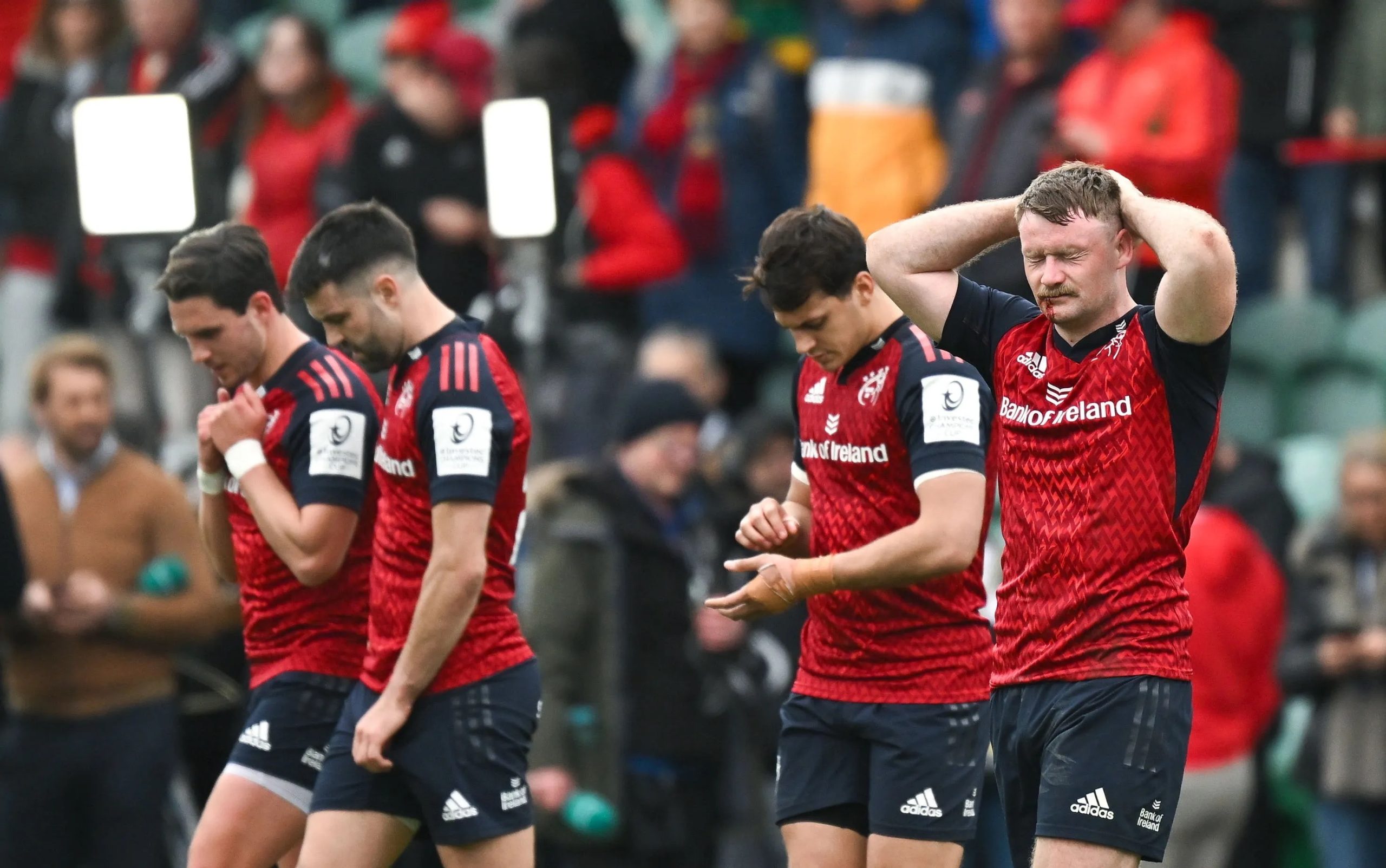
The short version of this article is that Munster were beaten by the better team on the day and exited Europe at the Round of 16 stage for a second year running, with one win out of five games.
That isn’t even close to the whole story, but it’s the only part of the story that really matters. We lost, we’re out, and that’s that. When you look back at this season’s fixtures in a year or two, you’ll 24-14 Northampton. There won’t be an asterisk.
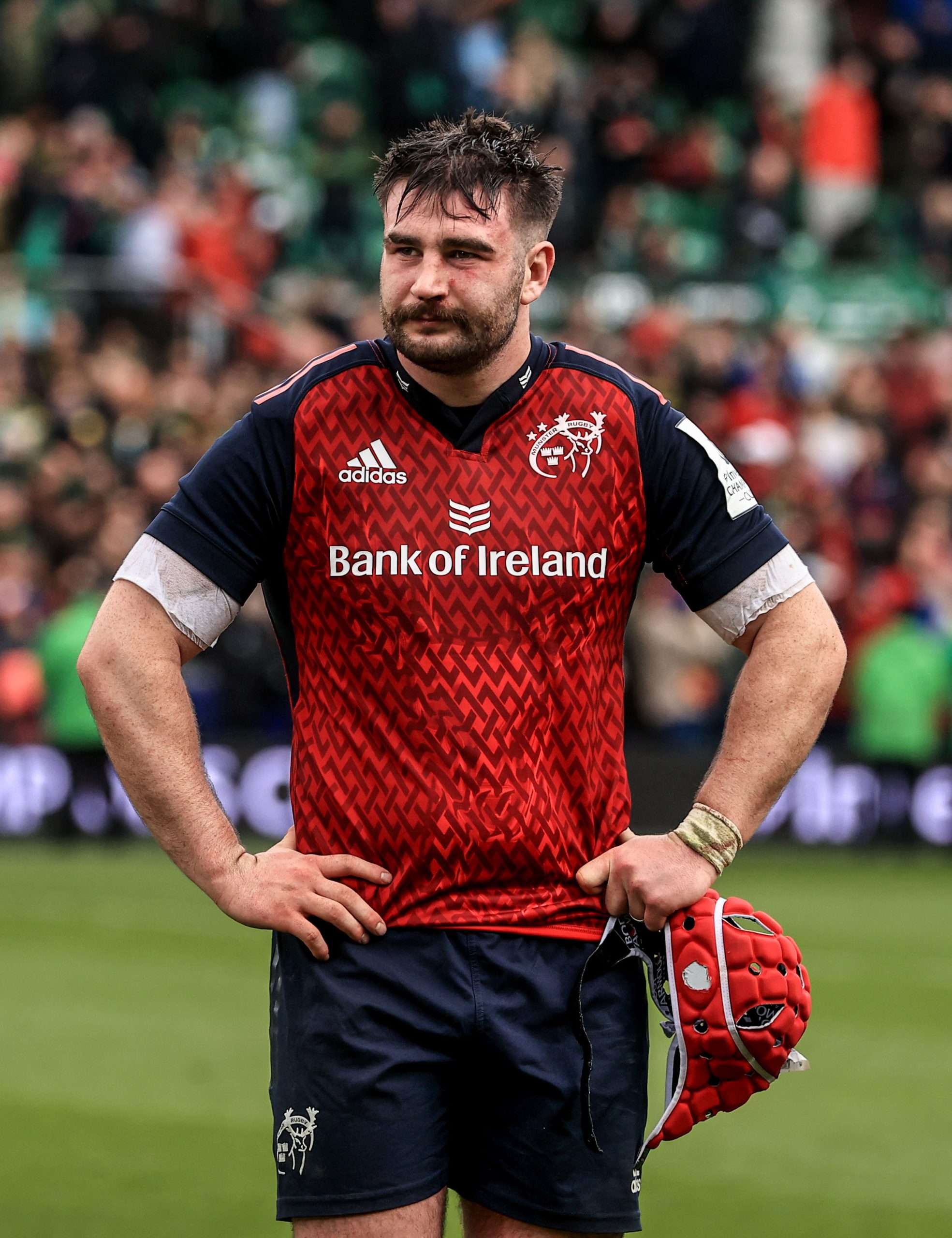
If there were an asterisk, it would tell you that this Munster side went out swinging with several players so sick that they were lucky to take the field, never mind to exert the effort they gave on top of a crippling injury list in the front five coming into the game that would have battered most test sides, never mind a side aspiring to get back to top four level in the European Cup.
Against a big, physical Saints side with a 6/2 split, we did well for about 50/55 minutes but when they started to dip into their bench, we hit a brick wall and lost our grip on the game.
They made their first changes in the forwards around 50 minutes and scored within 10 minutes. They made more changes after that try and scored the killer try in the next 10-minute block. We replaced a visibly ill Peter O’Mahony with Alex Kendellen on 51 minutes and made two changes in the front row on 69 minutes.
Why do we make these changes so late?
To understand that, you first have to understand the outsized importance of the front five in the modern game. I say “modern game” there, but it’s always been the case that your front row and locks have an outsized influence on how you play. Your base style has to be reflected by the build of your pack, and your pack is mostly comprised of your front five so if your style does not suit those players, you will struggle to win games.
There is the obvious scrum and lineout load on both sides of the ball to consider, but the phase play work is as important as it’s ever been.
To boil it down, your front five help advance the ball up the middle of the field – the 40m between the 15m tramlines – where it’s hardest to win ground against the opposition pack either by carrying, using the threat of your carry to form a compression before passing the ball and blasting defenders off the ball at the breakdown to generate quick ball. This area of the field – the zones closest to the previous ruck to help ground you on where exactly I’m talking about – is where you’re most likely to get double tackled and get heavy breakdown contesting given how many forwards are in these zones.
When you’re fresh, you can still get good collisions while being double-tackled, even against bigger men. Look at Jeremy Loughman in this example within the first 15 minutes.
There’s good pop on that carry and he keeps the gainline, even with two men tackling him. Beirne smashes in over the ruck to dominantly win it, while Archer secures.
Loughman is the perfect guy for these tight engagements because he’s one of our most explosive forwards at 118kg. Explosive in this instance equals acceleration + strength + weight. Without Snyman, Kleyn, Jager or Edogbo, Loughman was our most dynamic forward in those tight exchanges for throwing his weight around. Coombes carries in these areas too but he’s a considerably lighter man than Loughman. Niall Scannell carries a fair bit too but he is not very explosive at all – he’s listed at around 110kg but his acceleration and power in the tight exchanges isn’t very high level. Remember, explosivity = acceleration + strength + weight on both sides of the ball.
We left Loughman on for 69 minutes because Josh Wycherley, his loosehead replacement, is a different, lighter profile of loosehead. Josh is listed as 10kg lighter than Jeremy Loughman so whenever we took Loughman off, that immediately scraps one of our heavier carriers for a player more suited to ruck support.
Look at how Loughman is performing right before he goes off – his energy levels and “pop” are almost depleted and he misses easy cleans.
But we left him on because we needed his size and explosivity for as long as we could use it. Without him on the pitch, our ability to advance the ball was almost nil. Beirne and Ahern are good – great, even – players but they don’t have the size profile to be slugging it out off #9 for position against a fresher, bigger team.
This has been the case for most of the season. Without a fresh front five to help you advance the ball and prevent the opposition from advancing the ball, you leak energy collectively. This is why explosivity as I’ve defined it here is so important to winning teams and so expensive in the modern game.
Look at this sequence for an example of how losing collisions off #9 costs you energy and ground.
Archer can’t push off to help Coombes with the two-man tackle, so Coombes gets isolated and driven back. Loughman and Scannell get driven through on the next phase by one lock and Archer can’t make the stop on the scramble. All this is understandable because all three of these front-row forwards had been through a mountain of work at this point and they all had at least another 10+ minutes on the field to get through against a Northampton side who had already made two forward replacements at this point that shifted their size profile heavier – Matevesi and Agustus are more explosive tight carriers than the players they replaced.
We started to suffer almost immediately.
This is why depth matters and why injuries to Kleyn, Jager, Edogno, Salanoa and Snyman pulling out pre-game hurt us so badly. Even John Ryan, who is not as explosive as he once was, was a critical loss because it meant Archer had to conserve his energy for 80 minutes. After all, throwing an academy loosehead prop into a game like this would be borderline irresponsible when it came to the scrum. It’s why whenever I look at a team I look at who their Big Six are, irrespective of jersey numbers. Every top team has that Big Six players who they plant in the middle of the pitch.
For Leinster with everyone fit, it’s Porter, Sheehan, Furlong, Ryan, McCarthy and Doris with Jenkins, Ala’alatoa, Kelleher and Healy to back them up. For La Rochelle, it’s Reda Wardi, Uini Atonio, Pierre Bougaritt, Will Skelton, Gregory Aldritt and Levani Botia, with Sclavi, Colombe, Danty, and Dillane to back them up. For Toulouse, it’s Emmanuel Meafou, Jack Willis, Richie Arnold, Nep Laulala, Peato Mauvaka and Cyrill Baille with ample size in the background.
For Munster, with everyone fit, I think our Big Six is Jean Kleyn, RG Snyman, Oli Jager, Tadhg Beirne, Gavin Coombes and Edwin Edogbo with really good complimentary role sets to back them up throughout the squad. When it comes to exerting size and power on the opposition in the middle of the pitch, they are our best guys.
Without them, everyone has to work that bit harder, get tired that bit faster and slowly leak energy right as the opposition is rebuilding theirs with their backups.
If you want to know why Munster started to look tired and collapse around 55/60 minutes against every physically larger team we’ve played this season from Bayonne to Exeter to Cardiff and Northampton (twice), look at how many of our Big Six we had playing in that game and the answer will become obvious.
***
Nobody can accuse Munster of not fronting up in this game and giving absolutely everything.
It’s far from a secret that a critical number of players were seriously ill for the last two weeks and in particular bad before and during this game. That had an effect that we can’t really quantify and only the deeply stupid would pretend that it doesn’t have an impact on performance. Munster didn’t use it as an “excuse” in the media after the game because what else do you do? You can’t come out with a box of tissues and a duvet and ask for a replay, like, you just have to take it for what it is – another hurdle that we couldn’t quite get over.
So that is a factor in my critique of this game. I’d give everyone four stars just for fronting up in the circumstances, but I’m going to rate the game on what I saw – just remember the context.
The biggest issue for me was how many times we got caught off the set piece.
The first one was this nicely executed scrum launch which, to be fair, is a really good piece of attacking rugby as much as it is errors in defence.
That movement on the blindside – a mass feint – helped to keep O’Mahony, Casey and Crowley quite narrow on the initial launch.
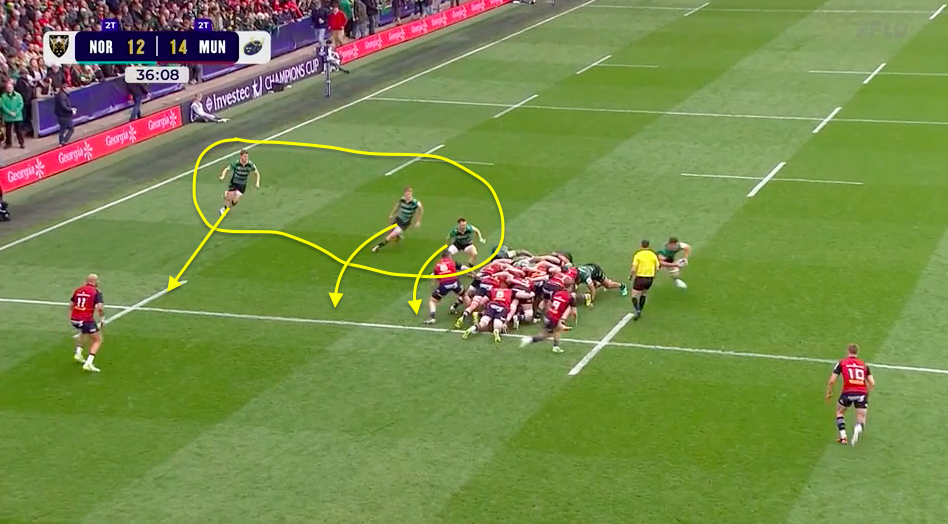
We also got a push going after the ball broke free so that took players out of the ensuing defensive coverage. That core of three Northampton players on the feint came back around the tight carry from Sam Graham – the loop was designed to come around that carry action en masse.
Hodnett was a little unlucky to lose his footing on the scramble because I’d back him to land a poach or a good slow-down otherwise.
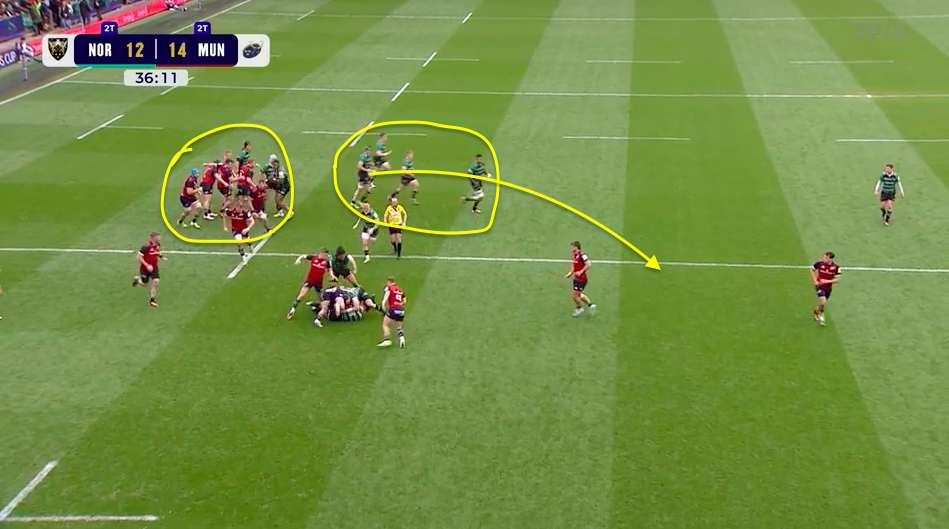
Saints get quick ball and all of a sudden we’re wildly outnumbered on the next phase with a critical mass of our scrum forwards still engaged as the ball comes out of the first ruck. We’re essentially defending the next zone with our midfield against a massive stack of Saints runners.
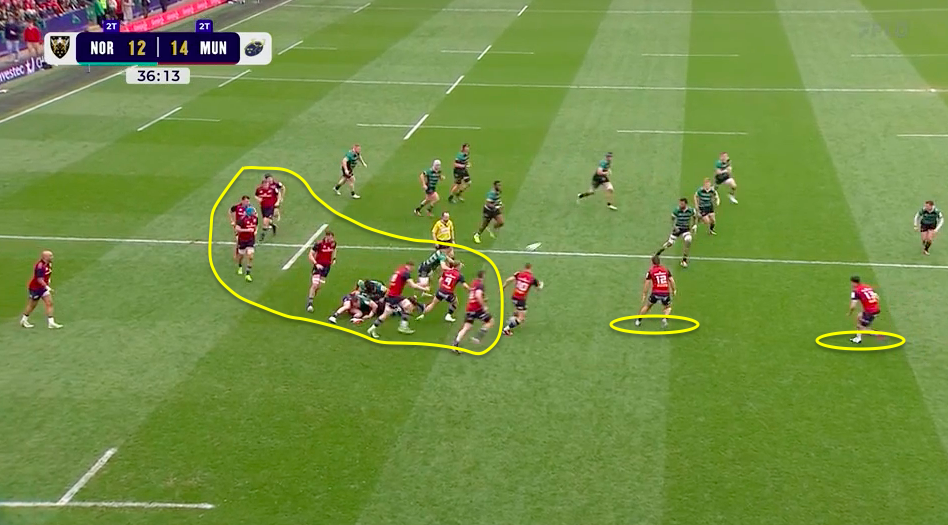
At this point – and it’s easy to say in hindsight – the only play is for Frisch to blitz Smith as the only other option is Courtney Lawes flinging a 3m pass across the face of the defence. I think he’s paying too much respect to Courtney Lawes’s passing game here and that jockey movement takes him out of the game.
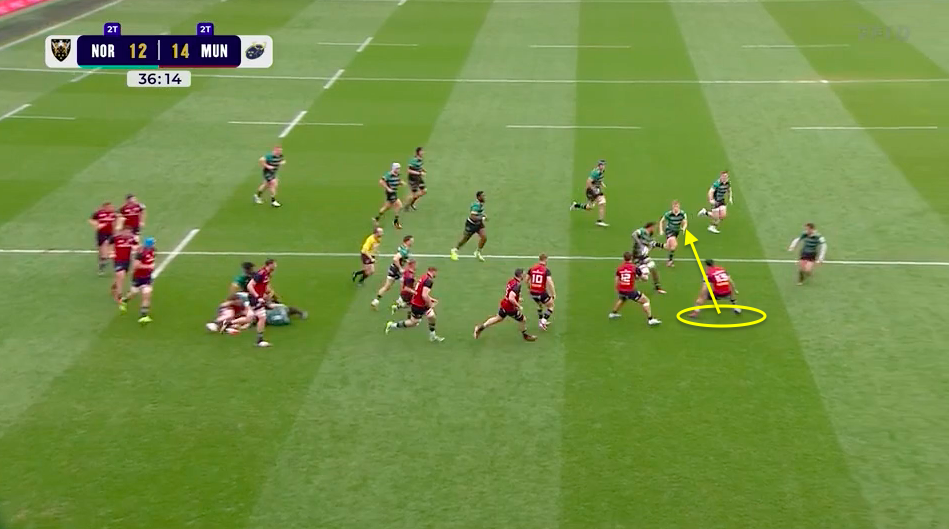
There’s no doubt that this is a good play design by the Saints, though, and it needed two high-quality interventions to potentially stop it – a breakdown stop by Hodnett and a context read and blitz by Frisch.
As it happens, their first try came from a sloppy error by Jack Crowley off a nothing Saints’ box kick and subsequent kick out on the full. We actually defended the close-range lineout that ensued really well up until the last play where Scannell bit in on another Lawes pass option.
A better context read from Scannell here probably has him jockeying and guarding the space outside – we probably snuff out this phase if that happens. Again, easy to say afterwards.
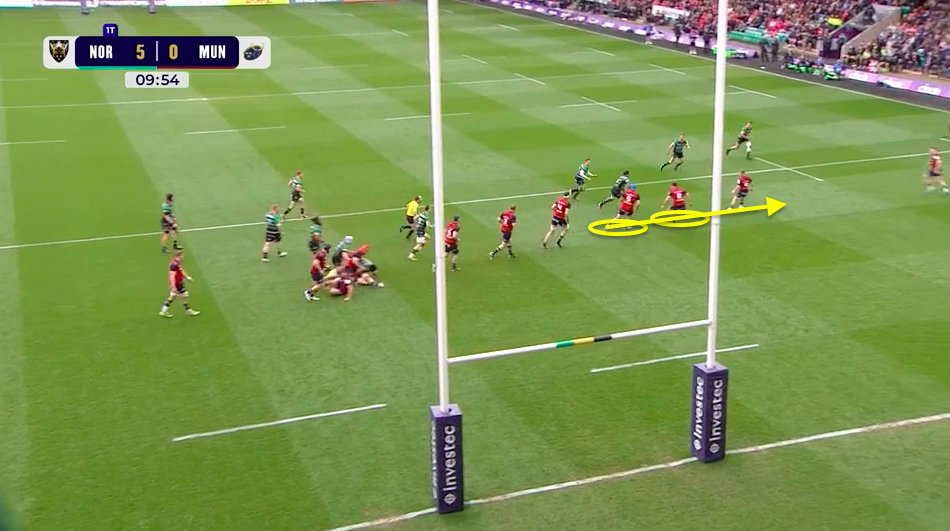
That decision between blitzing and jockeying is always there against Northampton, who really specialise in hurting you with compressions that fan out to width quickly.
Their entire backline is, essentially, strike-runner profile players so when they get a corner to attack, they do so with real pace and power. Their third try came from a deep lineout launch that I feel we could have defended much, much better.
First, that loopy pass from Mitchell should have been our cue to take the space that slow ball afforded us to pressure their backs-only screen action.
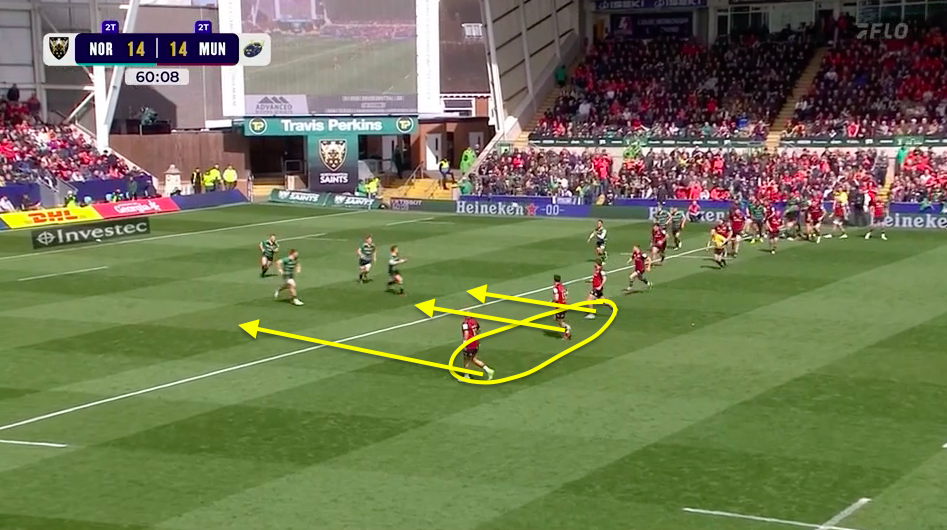
We didn’t – we fanned out and jockeyed – which gave Saints time and space to make their play.
If we sweep behind the play, we can see the next opportunity to kill the play and, for me, it was this potential read by Frisch but, again, it’s low percentage because Saints got a great block line on Nankivell so Frisch is probably caught in two minds.
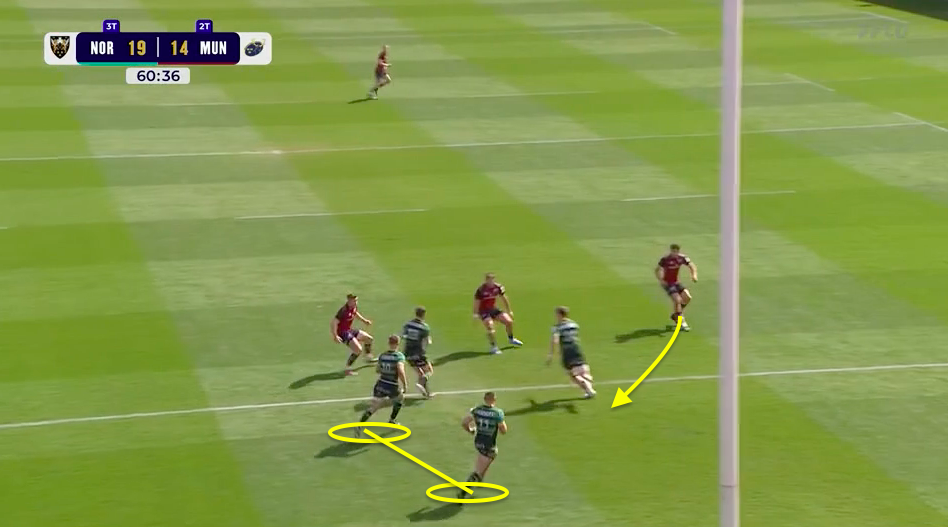
I still think he can cut in here and make life difficult for Smith – force him to make a high-pressure pass, in essence – but when we didn’t advance on the poor pass by Mitchell, this was always a risk against a team like Northampton.
Their killer try doesn’t need much screengrabbing to be honest – two tired, bad missed tackles on the edge of the play after Crowley’s ambitious pass to the edge missed the mark.
First thing first, the actual play call here was to hit the 6’9″ lock who can run like a winger with an overload outside him. This is the lack of composure we’ve shown throughout the season when we’ve hit the end game – not seeing obvious opportunities.
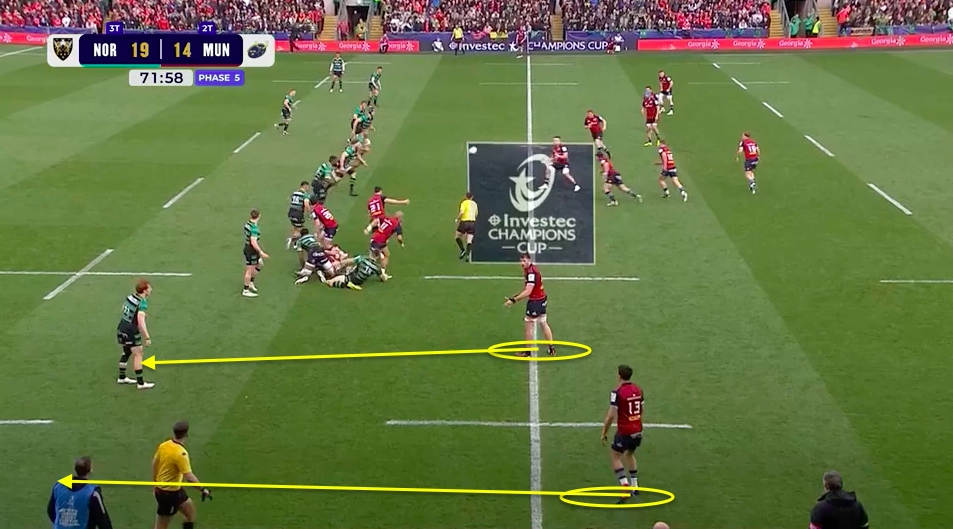
On Crowley’s first look, he sees O’Donoghue calling for the ball at the edge of the midfield three-pod with Hodnett on the edge. If he can hit that pass deep, Beirne and Clarke will compress Saints – who’ll be expecting a pass to one of them – which will open a lane for O’Donoghue to run through.
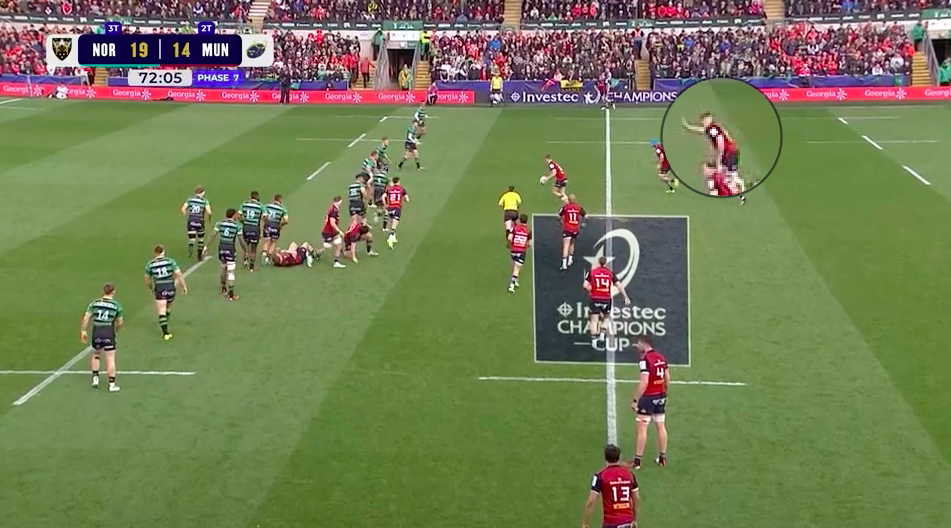
If he can make that pass, he’ll get O’Donoghue into a one on one with Alex Mitchell on the edge of the play so Crowley goes to the line where he can engage the Saints defence and goes for broke on an incredibly difficult pass off his left hand.
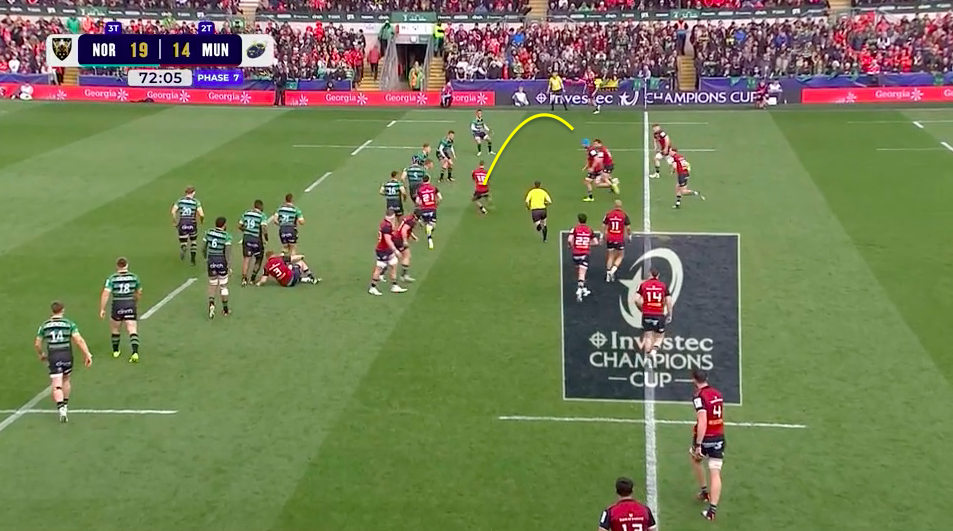
It’s too far behind O’Donoghue – Crowley has to clear Beirne and Clarke and overcompensated – so O’Donoghue can only bat the ball forward and Saints score on the turnover.
Game over.
It’s hard to fault any of these lads though, because they went out scrapping and, if you can’t win, that’s all you can ask of them. It leaves us with the URC to focus on exclusively which we have to view as a positive now, because there’s fuck all that can be done about the injuries and sickness of the last two weeks.
Get healthy, and I think this Munster team can beat anyone. But getting healthy is the thing.
| Players | Rating |
|---|---|
| Jeremy Loughman | ★★★★ |
| Niall Scannell | ★★★ |
| Stephen Archer | ★★★★ |
| Tom Ahern | ★★★ |
| Tadhg Beirne | ★★★★★ |
| Peter O'Mahony | ★★★ |
| John Hodnett | ★★★ |
| Gavin Coombes | ★★★ |
| Craig Casey | ★★★ |
| Jack Crowley | ★★ |
| Simon Zebo | ★★ |
| Alex Nankivell | ★★ |
| Antoine Frisch | ★★ |
| Sean O'Brien | ★★★ |
| Mike Haley | ★★ |
| Eoghan Clarke | N/A |
| Josh Wycherley | N/A |
| Mark Donnelly | DNP |
| Jack O'Donoghue | ★★★ |
| Alex Kendellen | ★★★ |
| Conor Murray | ★★ |
| Joey Carbery | ★★★ |
| Shay McCarthy | N/A |
