



There are two ways to look at this game.
The first is that Ireland aren’t capable of beating New Zealand in Eden Park, just like every other team in the last 32 years and, with that in mind, there are a lot of positives to take from this loss. I watched Virgin Media yesterday and heard them say that, at 35-21 with just 10 minutes to go, we were only 14 points down. Two tries. They seemed to imply that there was a lot of credit in that. You might think the same.
The second is that this was a game Ireland never looked like winning, not even for a five-minute block, despite not playing all that badly, and that, far from a positive, this is a clear sign of regression, given we lost by 19 points to an All Blacks team that played well for around 50 minutes. This is multiplied when you consider that Ireland politicked a logistical advantage with their travel arrangements in the previous week, something that no other team has done. Sure, Scotland and England played Fiji in the UK, but they had to travel across the equator in a week to do it.
It was good enough for France to go from New Zealand to Australia to Japan in back-to-back weeks. Ireland, but I’m getting off topic.
I think it’s indisputable that, in the last two test seasons, Ireland have been treading water, while France, New Zealand and South Africa have been pushing themselves on from a selection and game standpoint. We are still playing the old hits, with mostly the old band members, and seem incapable of discussing this fully at a national level.
How did we go from beating the All Blacks in New Zealand in 2022 to being relatively happy at being within two scores with ten minutes to go? The passage of time. New Zealand have moved on, collectively, and we haven’t, stylistically and with respect to selection.
If we compare the teams from that series in 2022, we can see the difference. I spoke about frogs in a pot of boiling water yesterday — so who’s still in the pot?
Who’s still in the pot?
Where the players who featured in at least two Tests of the 2022 series are now
Ireland — in the squad (10): Keenan, Ringrose, Aki, Gibson-Park, Sheehan, Furlong, Ryan, Beirne, van der Flier, Conan
Ireland — would be named if fit (3): Porter, Doris, Hansen — plus Crowley and Kelleher†
Ireland — still playing, not named (6): Henshaw, Lowe, Carbery, Herring, Bealham, Treadwell
Ireland — retired from Test rugby (5): Sexton, Earls, O’Mahony, Murray, Healy
New Zealand — in the squad (5): J. Barrett, Jordan, Tupaea, Savea, Taylor
New Zealand — would be named if fit/available (3): Taukei’aho, S. Barrett, Fainga’anuku
†Crowley (debuted after the series) and Kelleher (missed the 2022 tour injured) sit outside the 24-player base, so they don’t count towards the bar; counting Kelleher puts Ireland’s fit-adjusted retention at 14 of 25 (56%). New Zealand’s remaining 15 not split by reason. Source: matchday 23s, 2022 series and July 2026 fixture.
Four years ago, winning a series in New Zealand was supposed to announce our permanent ascension into the elite conversation of the game. It made us favourites for the upcoming 2023 World Cup, but it changed how we thought about ourselves in this sport at test level. Who beats New Zealand in New Zealand? Only the very best.
Twenty-four Irish players featured in at least two of those three Tests. Here’s where they are now: ten are in the current matchday squad. Three more — Porter, Doris and Hansen — are only missing through injury and would be named the moment they’re fit. Six are still playing professionally but weren’t picked, either because of their contract status in the case of Lowe and Carbery, or by choice in the case of Bealham, Henshaw, Treadwell or Herring. Just five have retired from Test rugby.
Add it up and 13 of the 24 — 54% — are still in or around this Ireland squad. Adjust for full fitness, including Kelleher, who only missed the 2022 tour through injury, and the figure hits 56%.
Now look at New Zealand. Twenty-three of their players featured in at least two Tests of that series. Eight remain: Jordie Barrett, Savea, Codie Taylor, Tupaea and Will Jordan, with Scott Barrett, Samisoni Tauki’aho and Leicester Fainga’anuku possibly featuring if fit and available. In the four years since losing a home series for the first time in the professional era, they have turned over nearly two-thirds of the group.
The distinction isn’t just the numbers — it’s how the change happened. New Zealand’s turnover was chosen. Sure, there were a few retirements post-2023 World Cup, but they’ve actively looked to refresh the team in several areas since that point. Ask yourself this: could you see Ireland moving on from an Irish equivalent of Beauden Barrett, Rieko Ioane, Ofa Tu’ungafasi, Dalton Papalali or Aaron Smith if they were still capable of lacing up the boots at a decent level, despite their age or recent performances?
Of course not.
Aaron Smith is 37. He last played for the All Blacks in the 2023 World Cup final. Next season, Gibson Park will be 35, and I can easily see Andy Farrell trying to convince him to “get to” the 2031 World Cup.
That’s what we do.
Strip out the players who retired, and Ireland have actively moved on almost nobody. The 2022 pack — Ryan, Beirne, Furlong, Sheehan, van der Flier, Conan — is still, broadly, the 2026 pack, and with Porter and Doris surely starting this game if they were fit, it looks like the only way out of this team is by cashing in your tax cashback when you hang up your boots.
Is it any wonder we’re treading water?

Most people outside of Ireland can see this game for what it was. An All Blacks side putting away a limited and ageing Irish team without necessarily playing all that well as they get to grips with what their new coach, Dave Rennie, is looking for from them.
I’ve been sitting with this performance and the performances of the last 24 months for the last few days, trying to come up with a common thread that might define this decline in clear terms. There are none. Sure, you can look at the lineout malfunctioning and scrum trouble, but these are symptoms — not the illness itself.
I keep coming back to an obsession with second-order thinking.
First-order thinking asks a simple question: what do we do to the opposition? Second-order thinking asks what happens after that — what they do to what we do, and what we do about that. Good teams need both. But somewhere over the last two years, Ireland have inverted the hierarchy. We’ve become a side that starts with the counterfactual. Every decision about how we play seems to begin not with “how do we hurt this team?” but with “how might this team hurt us?” We don’t talk like that internally, I’m sure, but it’s what our system has been designed to mitigate against automatically.
You can see it most clearly in our relationship with transition. We are terrified of being caught in unmanaged chaos — the loose kick, the half-broken ruck, the turnover with our shape scattered. And the fear is rational, as far as it goes; that’s exactly where the best sides have been killing us. But our answer to it has been to play a game designed to make sure the chaos never happens. Patient rugby. Predescribed ruck lines. Phase after phase of low-risk possession where every player knows where he’s supposed to be, because knowing where you’re supposed to be is the whole point. We’re not playing to impose; we’re playing to avoid.
And that choice doesn’t just shape the game plan — it shapes the men picked to run it. A system built on managed possession self-selects for a particular type of player: the hard worker, the ruck-hitter, the man who’s reliably in position. Work rate becomes the currency of selection, and physical impact becomes a luxury, in almost every position on the field. Nobody decided this out loud. It’s just what happens when you optimise for not being hurt.
The end product is a team that is safe, predictable, and — for any analyst worth his salary — trivially easy to game out of existence. When your patterns are pre-described, they can be pre-solved. The opposition doesn’t need to beat what you might do. They only need to beat what you always do.
What do you notice about the All Blacks on this defensive set less than a minute into the game?

They aren’t blitzing.
Why aren’t they blitzing?
Because they realised that Ireland’s relationship with linebreaks when Prendergast plays at #10 depends on the opposition giving him corners to pass around. Ireland play in front of you, generally, so blitzing into passing lanes is a proactive way of shutting that down, but what if you let Ireland play in front of you?
Who’s going to win the collision if the defence sit off you and wait for it?
Furlong? Beirne? Ryan? Conan? Van Der Flier? Maybe three years ago, not now. The only player we had capable of winning a collision was McCarthy, but if you’ve only got one in your pack, you have none.
Here’s a really good example of how the All Blacks completely decoded our attacking concept.
Look at how the All Blacks stay completely out of each ruck — no jackal attempts in the middle of the pitch when Ireland are in that 3-2 shape during phase or 3-3 directly post-scrum. They fan out to make sure they can drift with numbers on Ireland’s shape so there are always two men in the collision, with one adding some extras post contact to draw Ireland off our feet. We love hitting rucks, so give us rucks to hit.

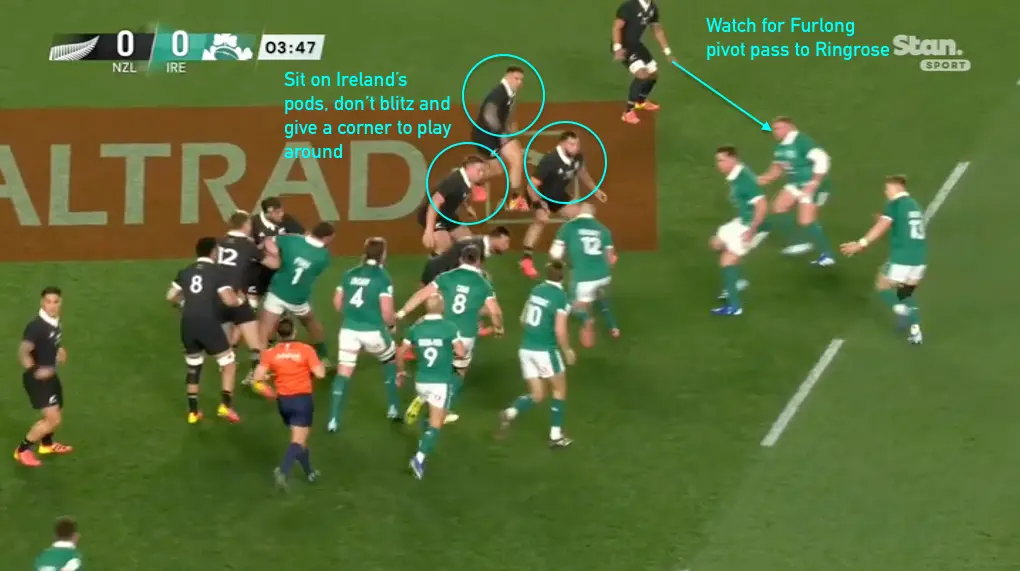
Keep doing that until Ireland look to swing around with the full loop coming in behind Prendergast, and then step up into the second layer if you have cover outside.

Prendergast pops the ball to Ringrose, as he almost always does, and Ringrose gets choked up and turned over.
Of course, the counter to this is with a sequence of heavy pick-and-goes, but we’re not built to play that game outside of the 5m line. We do not select the team to do this. This is where we get into the idea of selecting for hard workers, or guys who excel at winning collisions in certain zones. More on that later.
Let’s have a look at another example using the defensive drift I showed you in the first screenshot.
It ends with a turnover, but you can still see the concept. New Zealand keep don’t give Ireland any easy corners. Tupea steps up on Prendergast again, but only with Moorby covering outside, and Barrett free to push out if Tupea misses the ball or can’t pressure a pass.
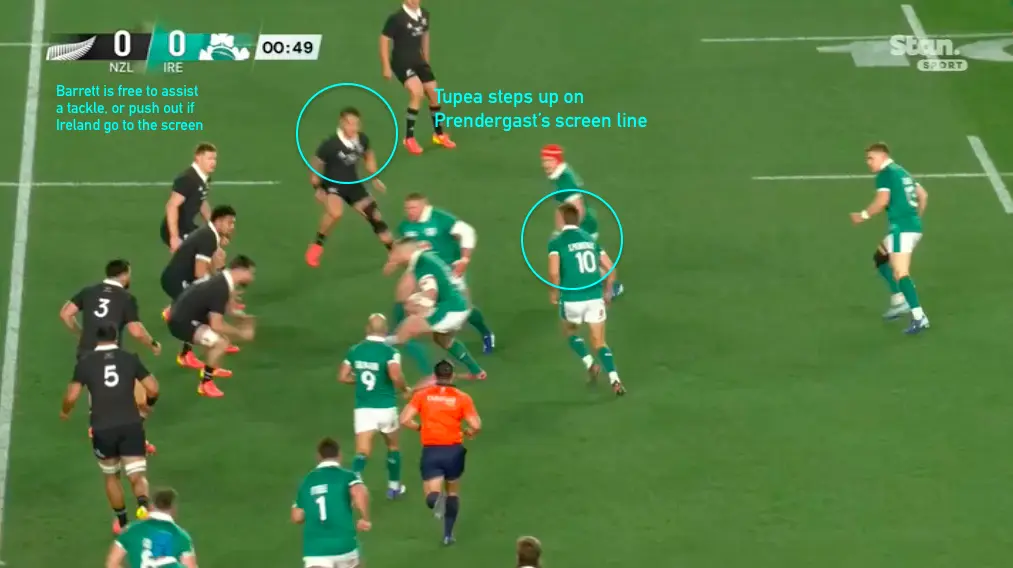
No heavy ruck contest. Give Ireland the quick ball we want, but keep defenders in the line.
When we swing around, Prendergast runs between the split two pod, but New Zealand have seen the deep screen loop around the back. They have numbers to cover it.

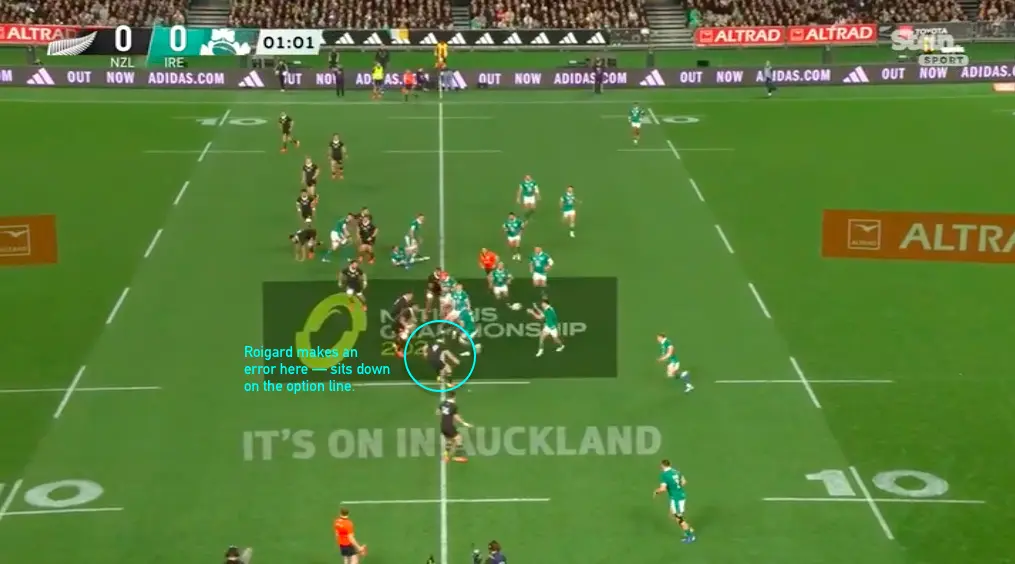
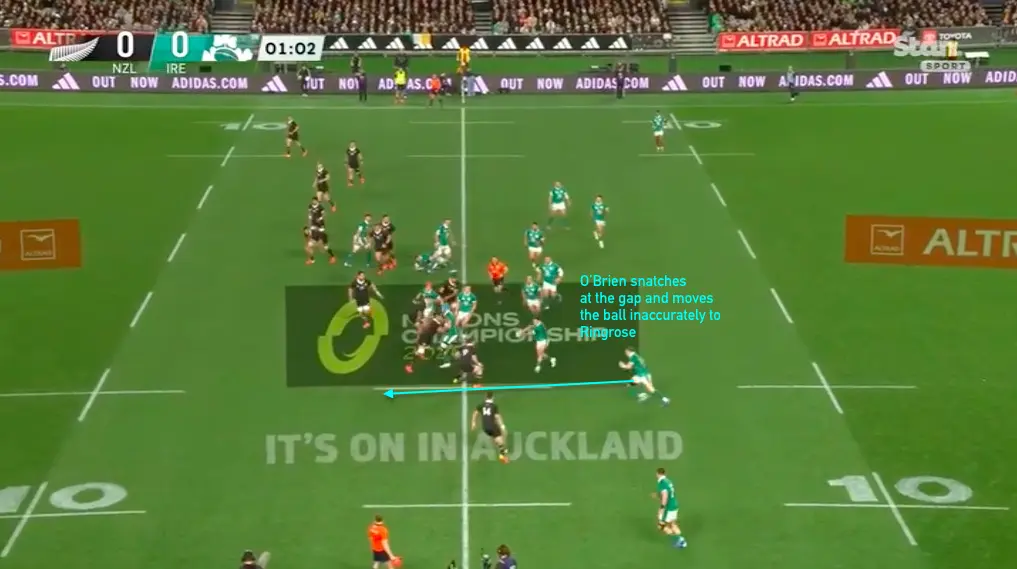
This is classic Ireland. Other teams use pods and screenplays too, of course. We seem to use them by rote: a mitigation layered on a mitigation layered on a third, until the structure exists to manage risk rather than create anything instinctively. And now we select players to fit that purpose.
We use these layers and screens to play around what we see as a power differential that we can’t hope to ever overcome without radically overhauling the team, so we add more and more complexity until we feel we can bamboozle opponents with layered running lines and intricate scripted movements that punish teams who try to beat us up in the way we’ve imagined they will in our worst case scenario. It’s like we’ve decided that our kryptonite is physically bigger teams who blitz us off the park and stuff our forward carriers, so we’ve started with the second-order thought to that — we’ll pick them off when they blitz us with our loop lines and screens — and applied that to our first order of game play.
When they don’t try to beat us up with a blitz, we keep playing like they are.
Here’s another example of the All Blacks comfortably stuffing us on a starter play sequence.
Here’s a good example of a spot where we’d have probably liked for the All Blacks to blitz us. Ireland hit the middle off a lineout. Prendergast sprays it to McCloskey for a central hit up. We flow around the corner with Van Der Flier working really hard to get to the edge, but look at Moorby — he only moves up when the pass comes, not before.

If he tries to cut off Van Der Flier, Keenan pops this over the top to Baloucone for a linebreak, where Ireland can flow forward on the front foot.
When Moorby waits for the pass, he makes Keenan’s decision for him.
We spot the lack of momentum, and go to a high contestable from Prendergast, that New Zealand take and clear from.
Even on turnover, the concept still works. This is a fumbled New Zealand lineout, but look at Tupea reacting to Prendergast on the screen after Ireland get the ball back.
He forces a hurried pass, which puts every subsequent pass under pressure, and New Zealand get the ball back.
Tupea was doing this to Prendergast for the entire game.
If we compare this to New Zealand, who could play at depth because they have both the power up the middle and pace in the layers to make it work, it’s like night and day.
Sure, the tight forwards can pop a pass when needs be, but their primary aim is getting over the fucking gain line, and generating pace on the collision, not just on the ruck.
Look at the depth New Zealand can work with here, knowing well that Ireland’s press will have to come out to meet them vertically — they have the pace to weaponise that against us.
Beirne is the first man to make contact with an All Black player here, and he’s doing it side on after the ball is gone.
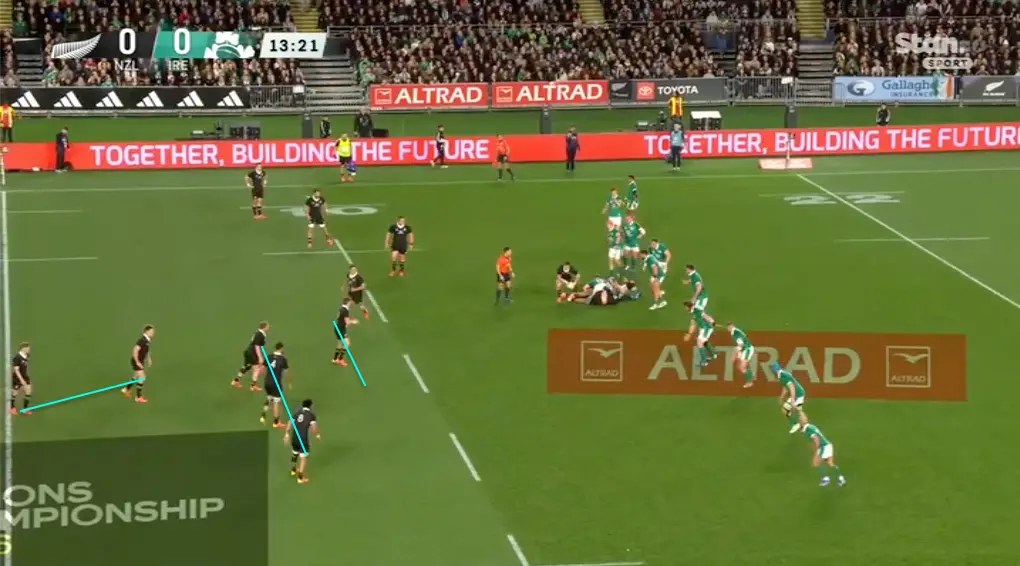
When the tight forwards are lined up, they hit the line, and then pick and go to pull Ireland’s pillars in deeper. We can’t over fold, because they are pinning us in place.
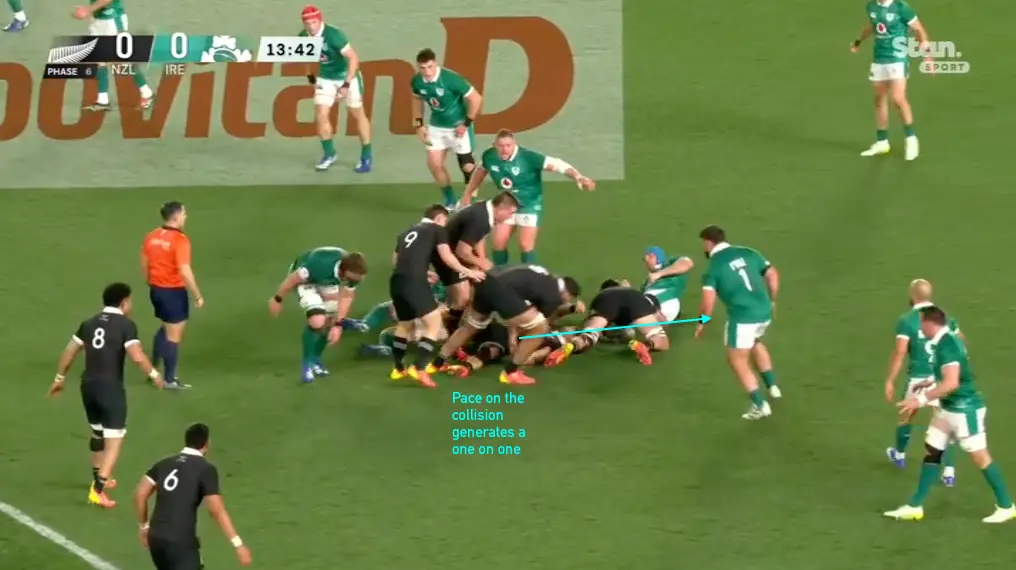
The All Blacks generate quick ball by winning collisions and then doubling down on them. We try to do it with hard work, scripted entry lines and trying (and failing) to bamboozle elite defences with the idea that a tight forward might pass the ball through a screen multiple times per game.
We’re still running the same things as we did at our peak between 2021 and 2023, except with an older team, fewer collision winners and with everyone now understanding what we do and why we do it.
To me, the answer starts simply; if we can’t win collisions directly in a game that now heavily prioritises that, and on which the elite teams have been selecting and developing for the last two years, we need to do the same, but that requires something fundamentally unpalatable to Irish Rugby at large — moving on from the core of this pack, midfield and outside backline immediately. The lineout and scrum are a sideshow. Something that fluctuates from game to game but only affects our perception of the problem; the actual problem is that we have over-intellectualised our game to a point that we have evolved into a team that is so reliant on Jamison Gibson Park to get us over the line that we stand off decent ruck position to allow him to handle almost everything.
Look at this one; two good carries in a row, momentum, and we all have to reset behind Gibson Park, so he can dictate what should be obvious.
Beirne gets milled here because he’s taking the ball from a standing start and high. He had two opportunities to pick and go here, but no — that’s not what we do.
There’s no scope for any of the forwards to play it as they see it. Look at this one — decent hit up, McCarthy arrives in as a ruck guy, but there’s never any idea that he might take the ball and have a cut at compressing the All Blacks and doubling down on the carry.
But why? Well, I can tell you why. He knows that isn’t the system. Leave it for Gibson Park; let him spray it wide to the next pod, and go again. If McCarthy picked here, he’d have been on his own because the other forwards know they have to fan out and get into shape regardless.
What happens if Gibson Park has an off day? We don’t know, and we don’t want to know, because everything runs through him. It’s like we’re built to produce ruck point opportunities for Gibson Park to get us in system. When he sees an opportunity to go, he can do so.
On this occasion it worked out, and we won a penalty up the other end with a somewhat dubious breakdown penalty, but we’ll take it.
Others need that license too, because at the moment we’re obsessed with shape and tip on/screen balls that are fine when you’re playing the weaker nations with weak point defenders, but always — in recent history — falls short against the very best.
We have to ask ourselves what we’re setting up to be, and whether what worked for a team whose best days were four years ago is what will work now against different opponents.
If we aim to give it a rattle against France every Six Nations and hope England don’t get it together, and accept our place below South Africa and New Zealand, we need to keep on the current path. Nothing needs to change.
We’re lucky enough that our World Cup draw means we’ll likely make a semi-final despite all this; all the serious teams are locked on the other side of the draw but as we’re currently playing, I wouldn’t be confident of taking on Argentina, England or Australia — especially in a home World Cup — because on the evidence of the last season or two, they’ll all have evolved, and we’ll still be broadly the same as we are now, just hoping we can get one last hurrah from our ageing core and system.
The choice is ours.
| Players | Rating |
|---|---|
| 1. Tom O’Toole | ★★★ |
| 2. Dan Sheehan | ★★★ |
| 3. Tadhg Furlong | ★★★ |
| 4. Joe McCarthy | ★★★★ |
| 5. James Ryan | ★★★ |
| 6. Tadhg Beirne | ★★ |
| 7. Josh Van Der Flier | ★★ |
| 8. Jack Conan | ★★ |
| 9. Jamison Gibson Park | ★ |
| 10. Sam Prendergast | ★★ |
| 11. Jimmy O’Brien | ★★ |
| 12. Stuart McCloskey | ★★★ |
| 13. Garry Ringrose | ★★★ |
| 14. Robert Baloucone | ★★ |
| 15. Hugo Keenan | ★★★ |
| 16. Ronan Kelleher | ★★★ |
| 17. Jeremy Loughman | ★★★ |
| 18. Tom Clarkson | ★★★ |
| 19. Nick Timoney | ★★★ |
| 20. Sean Jansen | ★★ |
| 21. Craig Casey | N/A |
| 22. Ciaran Frawley | ★★★ |
| 23. Bundee Aki | ★★ |
