


It’s a well-worn track at this point—Flannerys on Shannon Street for two, JJ Bowles for one, and maybe Fitzgeralds for one if we’ve time before kick-off. Then it’s the jacks at the stadium, a burger if you’ve time and then into the seat. Every Stephen’s Day or, as it turns out, the Stephen’s Day+1, the fun ends there in the last few years until the full-time whistle and you can hit JJ Bowles again, have one in Timmy Martins and back up to Flannerys after some Chicken Hut.
Munster are at a low ebb this December, but the craic at the games is good. The best part of watching Munster play Leinster in Thomond Park is Limerick itself. Walking along the river with that two-pint buzz off Flannerys, the string of lights along Clancy’s Strand, the buzz outside the Curragower, bustling into JJ Bowles; that’s the good stuff.
What happened from half-seven until around half-nine was not the good stuff. It was the bad stuff.
It was not enjoyable.
I wrote and spoke before the game about the possible steps Munster might take to win this game against Leinster’s process this season. Give the ball to them and deny them defensive energy, take threes when you have the chance, and deny them easy access to your 22 with conservative scrummaging.
Let’s see how we did.
We tried to off-ball them early on with a longer kicking game from advanced positions but, rather unfortunately, our lineout imploded when Leinster kicked the ball off the field in return. We would have expected this tactic, as we saw it in Croke Park back in October. As a result, we had 14 lineouts and ran at 71% completion – a disaster – losing two crucial lineouts on both 5m lines that stopped us from scoring and gave them a position from where they did score.
This is a good example of Leinster pressuring our jumping core on back-to-back lineouts. Wycherley walks up as the jumper but can’t elevate quickly enough under pressure from McCarthy.
You can see Wycherley drifting towards the Leinster side in the air, which is a sure sign of the launch being off. Clarke’s throw was a little high anyway. On the next one, we run a nice walk-up position swap but it looks like the front lift on Beirne is off because the Munster captain barely gets off the ground.
Add it up and those are two positions lost from which we could pressure Leinster territorially. They did not make the same mistakes.
This was compounded by a disastrous defensive scrummaging performance in line with our off-ball plan. We had 5 scrums and lost 50% of them – bad. Leinster had 13 scrums but won multiple penalties from those put-ins as Slimani did a proper number on Blueler for most of the game – worse again.
This was against the head and lead to the position that Leinster would use to score the first try of the game. Slimani pivots into the space inside Blueler’s head, gets onto Scannell and gets around the corner with Bleuler’s elbow in a weak position on the other side.
Munster started high and finished popping up as Slimani got just enough freedom to get after Scannell. It happened all game long and it’s exactly what Slimani is capable of against shorter looseheads.
That, and multiple others, meant our turnovers were punished in about the only way that gives Leinster 22 access when they aren’t winning defensive penalties and when they got that access, they scored pretty much whenever it counted.
When we got it, we looked broadly underpowered. We have a bad habit of following up something good with two or three bad things. Here’s a good thing; Beirne steps inside the Leinster linespeed and gets us up to the 5m line. If we’re accurate on the next phase, we can get Gavin Coombes one-on-one with Sam Prendergast right on the tryline. Coughlan’s pass is awful.
Behind the head of Farrell, bad shape, bad height. The chance is gone and we’re into trench warfare from then on in. We win a penalty on the next ruck and opt to go for a tap-and-go after a previous lineout at this range was turned over.
Here’s how it played out.
The first part you notice is how slow Scannell’s pick-up is after the tap. By the time he has the ball in his hands after bending down, Van Der Flier is already 2m off the line.
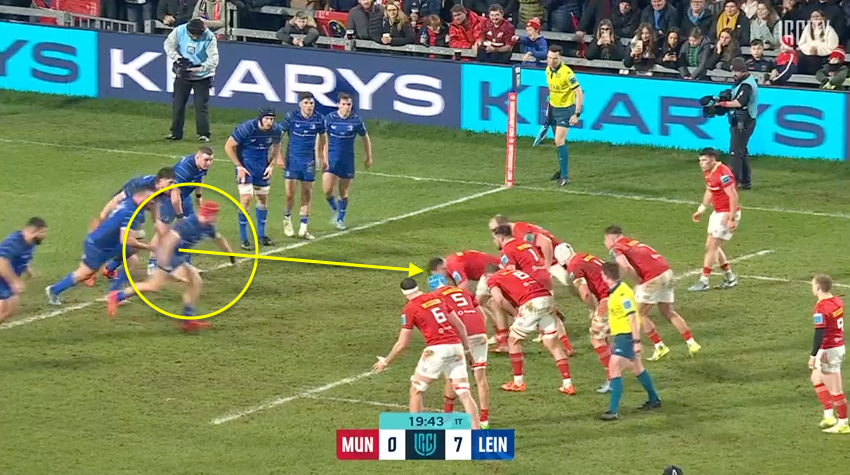
We use Scannell in this spot because he rarely goes backwards – or forwards beyond the first tackle – but he normally draws defenders and gets the ball back. We use our front row to latch and hit, with #7 protecting the back and hitting the second three-pod that normally has Coombes in the middle of it.
On that one, Beirne cracks off the outside of the latch and falls over, so we don’t make gainline. Wycherley also dislodges from Coombes and shoots forward without him, essentially making this Coombes vs two Leinster defenders. Doris does the usual Leinster tactic here of rolling on top of the ball to slow the clean enough for the other defenders to get back on their feet and fill space. How do you fix this? Win the collision so he’s rolling into empty space. How do you win the collision? Get your latches right.
Watch us in the 5m space for long enough and you’ll see missed latches and missed opportunities to be a force multiplier. As a result, we’re often losing collisions by default because it’s two heavy defenders against one carrier. Our Three Man Game is one of the worst things we do right now. This is a great example – I’ll get back to the previous example in a minute – where we get to the tryline from a tap-and-go but go for an option that runs Coombes into three heavy defenders before a single Munster player gets a hand on him.
We almost turn the ball over. Why is this even in our playbook from this range?
But the problems extended on the “release” play too. When you get enough compression on 5m plays, you’ve got to have option plays to take advantage of the massive space that usually lies on one side of the previous ruck. Against Leinster, we consistently took the wrong option.
Scannell had to pop this back for Burns.
I can’t work out what Scannell was seeing during this play. A simple pop back to Burns running the screen exposed Prendergast with a two-man overlap.
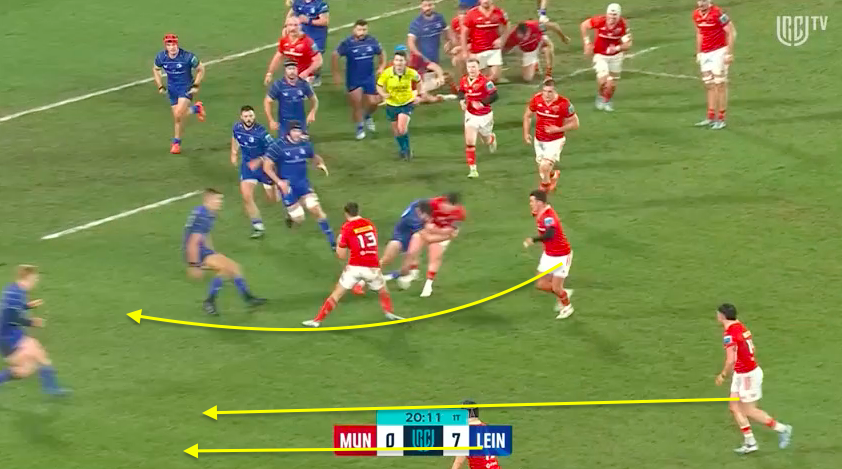
Either Burns, Nash or Haley convert this under the post. Instead, Scannell hits Farrell and the chance is gone. This ends with the ball getting held up over the line from our final tap-and-go on this sequence. It’s the usual. Front row does the first ruck, #7 secures, and our next unit – Coombes with Wycherley inside and Beirne outside – goes for a variant play.
Coombes pops to Beirne across the face of the defence. The pass sticks!
But Beirne has to turn in the tackle under pressure from Doris and Henshaw, which takes Ahern out as a latcher and gives Ringose room to make a play.
Held up. And that was game over.
Genuinely.
At 7-7, I think we could have gone back to kicking it long, pressuring Leinster and mopping up lineouts or long exits. But because we were 0-7 down, we didn’t have the patience – or the confidence – that we would get three kickable penalties while also holding Leinster out at the other end with that hands-off approach.
By losing the first score, we were forced to chase the game against a team that specialises in suffocating defensive sequences against under-powered phase play teams. And it played out almost exactly like that until the game was gone.
***
We haven’t turned into a bad team overnight. We just needed to hit every checkmark on the Beat Leinster List to have a chance here and failed on the second one – don’t give up scrum penalties that give them 22 access. If you add in Edogbo, peak Jean Kleyn, the platonic ideal of Roman Salanoa, Barron, Nankivell, Murray, O’Mahony, Abrahams, Casey and Crowley to this team, it’s probably much closer than it finished on the night but we’re still two or three top players away from competing with Leinster like-for-like.
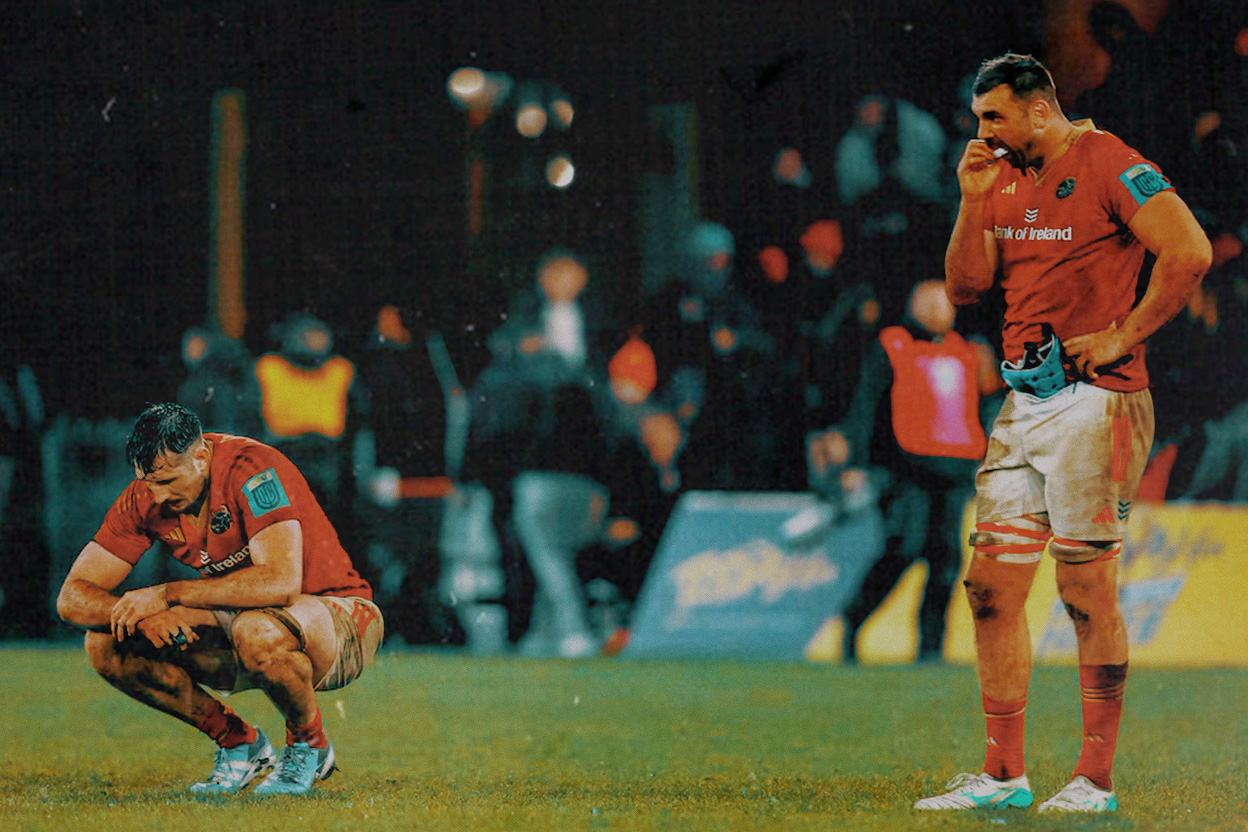
Watching this game back, you get a pretty good idea of the guys we probably need to move on from if budget/dispensation to sign better players to replace them allows or if we have a young player ready to step up ahead of them. Guys like Brian Gleeson, Evan O’Connell, Ben O’Connor and others are almost at a point where they’ll start getting back-to-back URC minutes to scale them up but they need time, space and patience to become who they can be.
Until that point, we need to get healthy – Edogbo’s recovery is now of huge importance to the rest of our pre-Six Nations season and beyond – and get through these next two games. Thankfully, neither Saracens nor Northampton are as dominant as this Leinster team. It doesn’t mean we’ll beat them, but it won’t be as difficult by default if we can at least get our lineout working i.e. getting O’Mahony back fit.
These losses still hurt, still sting, but we need perspective too. We aren’t a rival for Leinster at the moment in general, we’re certainly not with our current injury list specifically and our best chance at getting our own back is getting healthy, dominating the back half of the season and maybe catching them on the hop later in the year.
We live in hope.
| Players | Rating |
|---|---|
| 1. Dian Blueler | ★ |
| 2. Niall Scannell | ★ |
| 3. Oli Jager | ★★ |
| 4. Fineen Wycherley | ★ |
| 5. Tadhg Beirne | ★ |
| 6. Tom Ahern | ★★★ |
| 7. Alex Kendellen | ★★ |
| 8. Gavin Coombes | ★★★ |
| 9. Ethan Coughlan | ★★ |
| 10. Billy Burns | ★★ |
| 11. Shane Daly | ★★★ |
| 12. Rory Scannell | ★★ |
| 13. Tom Farrell | ★★★ |
| 14. Calvin Nash | ★★★ |
| 15. Mike Haley | ★★ |
| 16. Eoghan Clarke | ★★ |
| 17. Kieran Ryan | N/A |
| 18. John Ryan | ★★ |
| 19. Brian Gleeson | ★★★ |
| 20. John Hodnett | ★★★ |
| 21. Paddy Patterson | ★★ |
| 22. Tony Butler | ★★ |
| 23. Ben O'Connor | N/A |
