


For a while, I used to amuse myself by imagining the worst possible superpower you could have that would still count as a superpower.
I settled on the ability to detect dog shit as you were walking along a street without looking at the ground, but only when you were within a metre of the dog turd in question. I think it’s a mostly useless power but, at the same time, it would still count as a superpower of sorts.
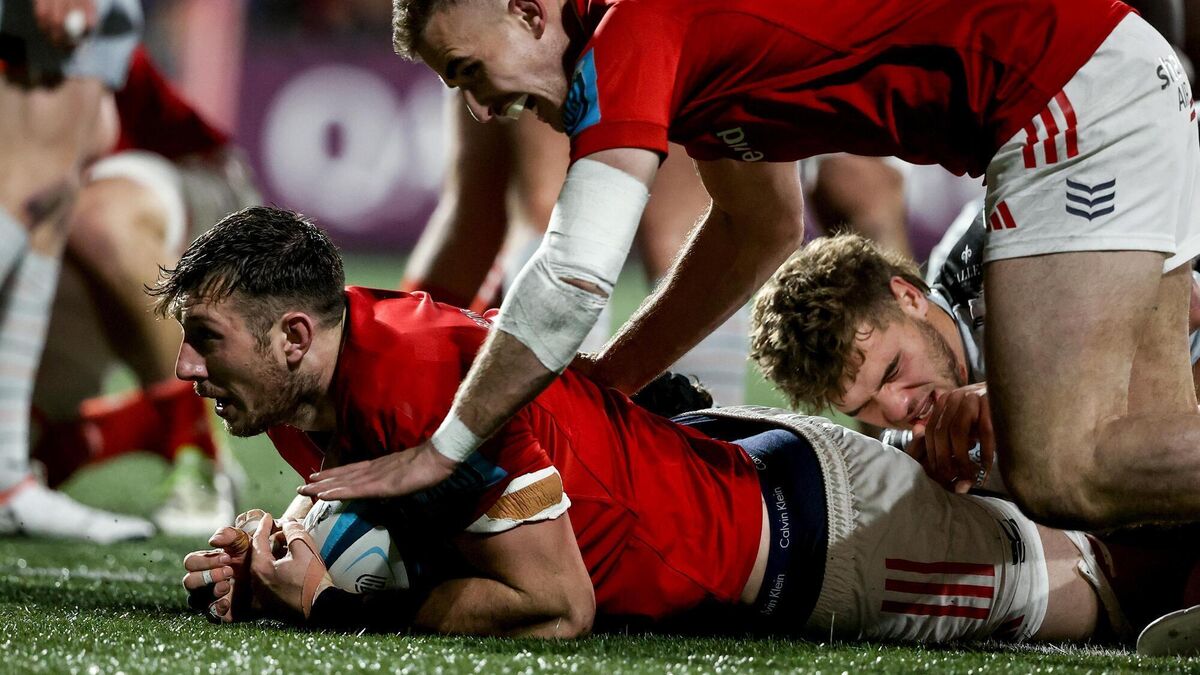
If I had that superpower, my dog shit senses would be tingling between the 35th minute and 40th minute of this game against the Dragons’ where we conceded a try to make it 17-7, only to concede a penalty straight from the restart and then another for offside at the ruck a few phases later before just about escaping without conceding any more.
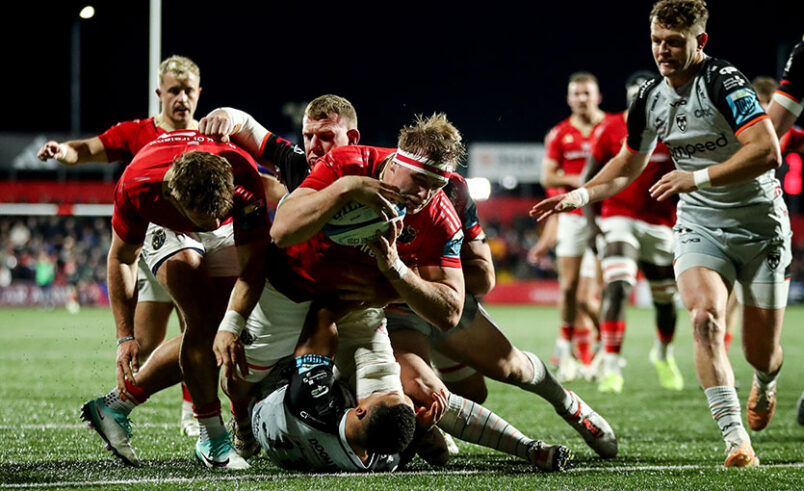
17-14 at halftime against a team we’d dominated for almost the entire first half? Against a team that we were expected to put away nice and handy? That’s the kind of turd that you’d want to avoid at all costs.
In truth, we should have already been out of sight – and soon would be – but for a while across the second and third quarters, this had the feel of a game that could squirm away from us if a few more decisions went the Dragons way or a few more errors crept into our play at key times.
But then we found the score that quenched what was left of Dragons’ fire and the win came easily enough thereafter. Those wobbly moments aren’t a concern in a broader sense – they happen, especially with brand-new combinations at 9/10/12/13 – but they reflect why I think Graham Rowntree and his staff won’t be doing cartwheels after this game, even with the bonus point and the seven tries. I think we’re a better side than we were last season with a more advanced, varied way of playing but there are still a few bugs to be worked out of the system, and this game is a good illustration of that.
One good thing about our game so far this season is that we don’t seem to be boiling down any one aspect of our game. Success often breeds a need to double down on what works to the point where you evolve into a team that can only win big, tight games in very specific conditions in a very prescribed sequence of steps from start to finish. There is power in not being fully optimized and sometimes the inefficiencies in your game are vital to the overall strength of your game.
That said, we could certainly do with some of the passing errors and blown lines we saw here from growing into something more systemic. We play a lot of phases, so that means a lot of opportunities for errors to creep in, but we can’t stop pushing the limits on that phase play.
Two wide, lightning-quick passes from the halfbacks to that second pod with multiple options behind it and alongside it.
The pass goes to the ground here but look at what we’re trying – a late-arriving screen option running a straight line through the side of the pod while the initial screen runner slides out as a pass option.
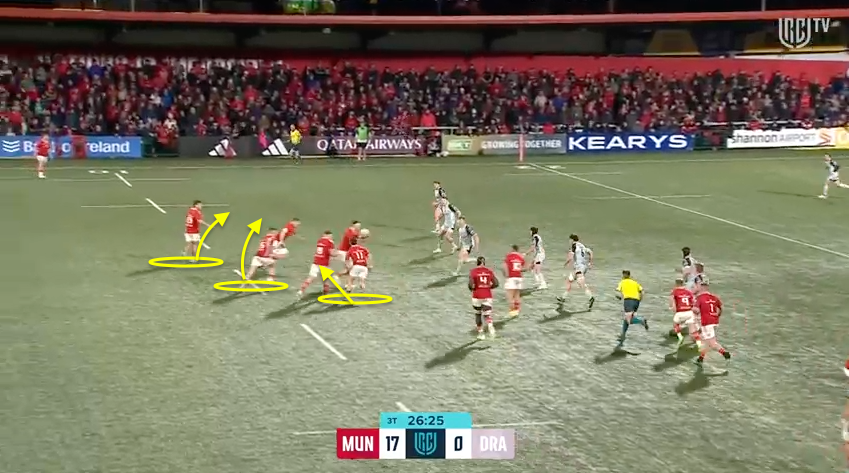
This “Y” line where players drift out on the pass from behind the screen is the kind of new stuff we’ve been building into our game this season. You can see another example of the same principle here;
Casey hits Butler on the link, the three pod takes the ball, Ahern passes super late with a power forward outside him to force a compression, before passing late enough to the same power forward and straight through the hole left by the defender blitzing on the screen runner.
The delay in the pass draws out the edge defender onto Daly, which in turn creates the offload lane for Daly – which was the line he was always looking to run on this sequence.
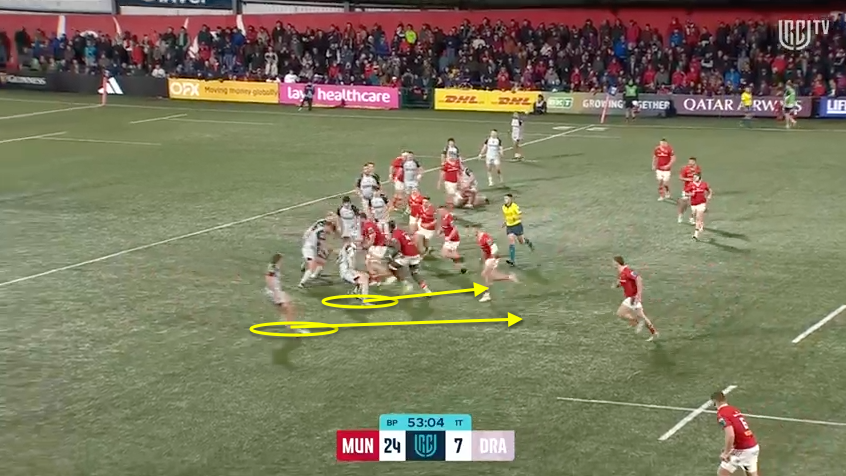
This, again, is new stuff that we’ve layered onto our base game from last season. When we run these Y lines on phase play and the set piece, we open up opportunities that just weren’t there from last season. Look at Alex Nankivell right before the pass to Calvin Nash.
Butler even throws the pass with the extra width it’d need to find Nankivell in the spot he’s going to be after he runs his Y line with Nash running a pocket route behind Nankivell and through Coombes’ carry lines.
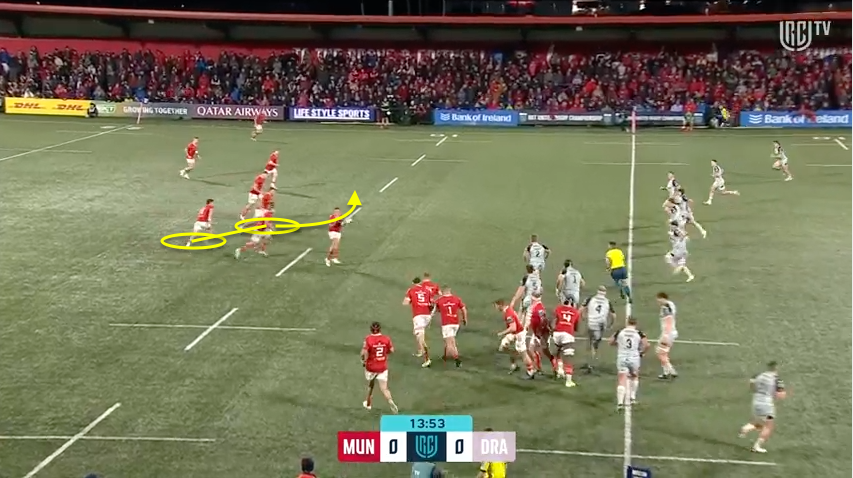
That means that the defenders who were compressing to guard Coombes when the play began had to make the extra steps across to try and cover Nankivell who started the play at “#12” lined up between Kendellen and Coombes but finished it outside the edge of the defence.
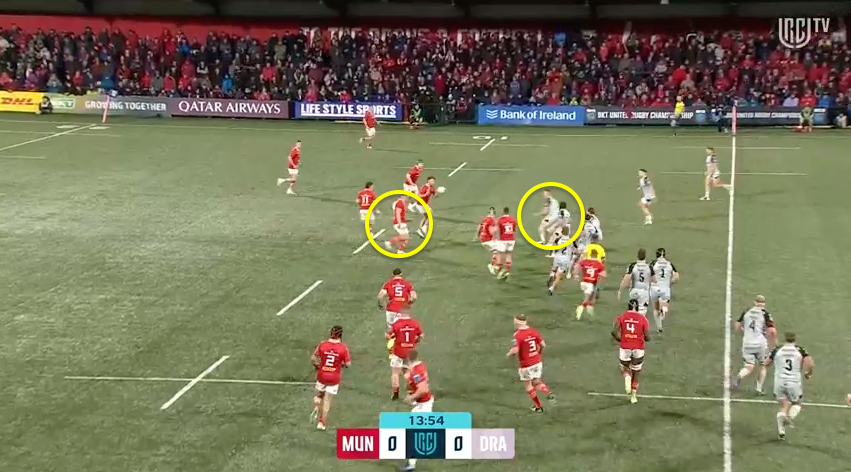
When Nankivell passes, he does so under zero pressure to Nash who breaks out of the pocket route to swing around for a first-phase overlap on the edge with Scannell running a blocker line to complete the trap.
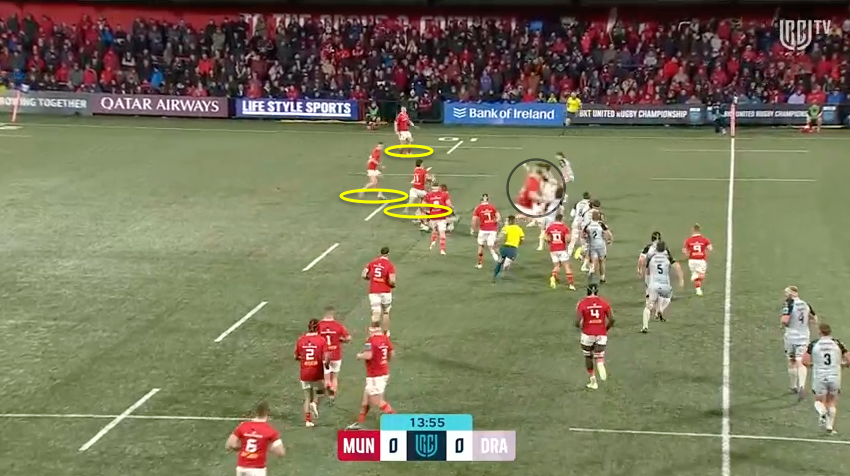
Nash flies through the gap, Scannell tracks along with the break and is there to take the scoring pass.
This is lovely stuff and it’s almost uniquely possible due to the build of the midfielders we’ve chosen this season. Nankivell did the Y line here for the killer pass – Butler did well to find him too – but Frisch is equally capable of this kind of route. And the best thing? That route is the perfect disguise for a hit up to Coombes with the Y line exposing the middle line of their defence to a possible isolation in the carry.
When you combine this with our super-stacks off the scrum, we’re providing an awful lot of questions for teams on every phase. As an example, all of our outside backs are on the openside of the ruck here;
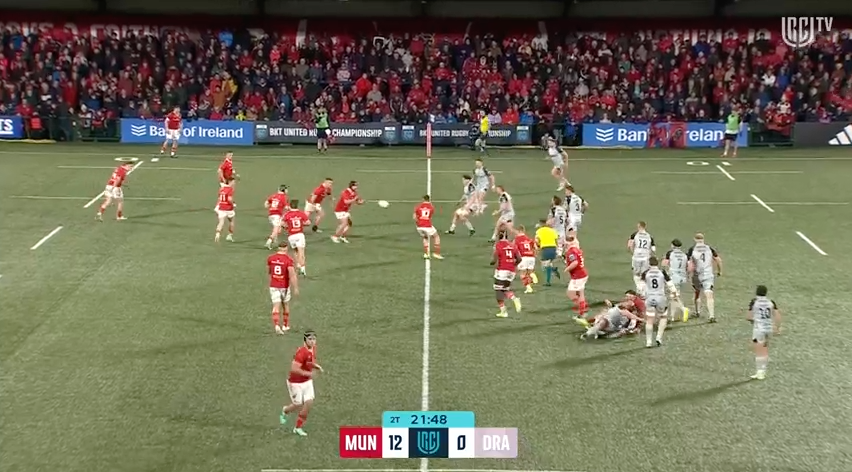
We don’t leave wingers to “hold width” on most of our plays – we loop them and ram them into cluttered spaces where the opposition struggles to keep track of them. The actual play itself runs like a stack with Butler hitting Barron, Barron hitting Scannell in the screen and then Scannell popping to Nash who scorches around a block line from Daly.
It’s complicated, and it runs the risk of passes bouncing off a bad line but you can see the power of it. When this team settles into regular games when all the internationals are back – Crowley in particular – then you can see how these plays and line changes will start to increase their fluency and power.
From a numbers perspective, we played a more reigned-in game than the last two weeks. We kicked more conservatively – we went after the space I spoke about in the Red Eye on transition a few times;
That brought our overall kicking game back to 1:5 but a lot of those kicks were more targeted than playing long counter-transition sequences – even then, I felt some of the kicking sequences we did engage in were errors, rather than a grand plan.
Dragons played around a similar rate and we played a tighter phase game than against Benetton with a ratio of 1.26. We were better for it, in this instance, but I feel we can adjust this if needs be.
The important thing to remember is this; five points while scoring some tries we weren’t scoring last year while also appreciating we’ve a lot to work on ahead of the next four games is a decent place to be.
Now it’s time to go up the gears.
| Name | Rating |
|---|---|
| Kieran Ryan | ★★★ |
| Diarmuid Barron | ★★★ |
| John Ryan | ★★★ |
| Edwin Edogbo | ★★★★ |
| Tom Ahern | ★★★★ |
| Jack O'Donoghue | ★★★ |
| Alex Kendellen | ★★★ |
| Gavin Coombes | ★★★★ |
| Craig Casey | ★★★ |
| Tony Butler | ★★★ |
| Calvin Nash | ★★★★★ |
| Rory Scannell | ★★★ |
| Alex Nankivell | ★★★★ |
| Sean O'Brien | ★★★ |
| Shane Daly | ★★★★ |
| Scott Buckley | ★★★ |
| Mark Donnelly | ★★★ |
| Stephen Archer | ★★★ |
| Ruadhan Quinn | ★★★ |
| Brian Gleeson | ★★★★ |
| Paddy Patterson | ★★★ |
| Jack Crowley | ★★★ |
| Ben O'Connor | ★★★ |
