


This game was a great illustration of what works in this sport — what always works.
Munster should have won this game by more than the 20 points we ultimately won by, but that was due to a few missed conversions and a few missed opportunities; the point is that we never once looked like losing it. Why? Set-piece dominance and collision dominance on both sides of the ball. Sure, Leinster had their moments and looked threatening when they managed to string some passes together to the 3/4 space, but make no mistake; Munster hammered Leinster in the core areas that decide every single game of consequence.
Two moments in the first five minutes showed this pretty clearly, for me.
One: Munster won a penalty from the kick-off after a Leinster spill in contact after some heavy collision pressure. The ball went to the 5m line, and from there, Munster’s maul split them open.
When you see Eilís Cahill in this body position relative to the woman guarding that side of the maul, you know it’s only going one direction — over the try line and with a bit to spare. Look at how strong Munster’s body positioning is on this shove.
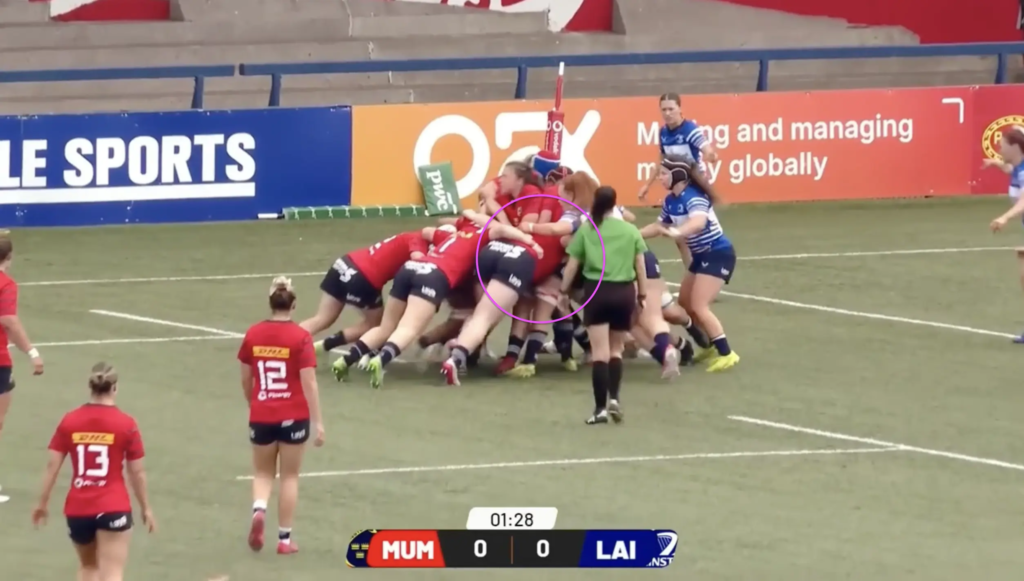
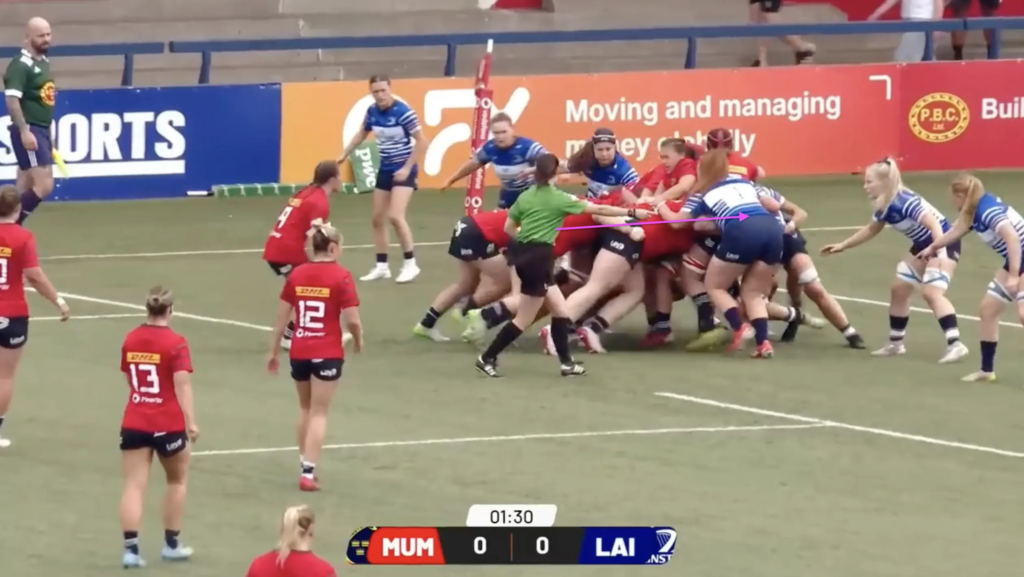
Grace Moore got a strong rip off Maeve Óg O’Leary, the secondary unit got immediate go-forward, and with Buttimer in the boot, Leinster had no means to defend this in any meaningful way.
Too much power, too much momentum, and all the key battles won right after the drop. When the maul works like this, everything is infinitely easier.
Second: After a Munster knock-on in midfield, Leinster had a strong scrummaging position that, if they could launch from it, would give their star-studded backline the kind of positioning that you know they can threaten from.
Bang.
Scrum penalty against the head.
First, you can tell early on that Munster are the better-drilled unit here — all of the back five are locked and low before they engage, while Leinster start high and loose. Look at the Leinster #8 as the hit comes in, for example; she starts too low, so the only place to go after the hit is to bump up once the hit comes in. She’s not bracing the second row’s here, and that’s made worse by Cahill monstering the hit.
Look at how she “lands the plane” here by crushing the loosehead down on the hit; she feels all the weight and power immediately, and can’t respond. Elbow goes down, arse goes up — there’s only one way this scrum is going, unless the hooker gets an incredible strike of the ball, which she doesn’t.
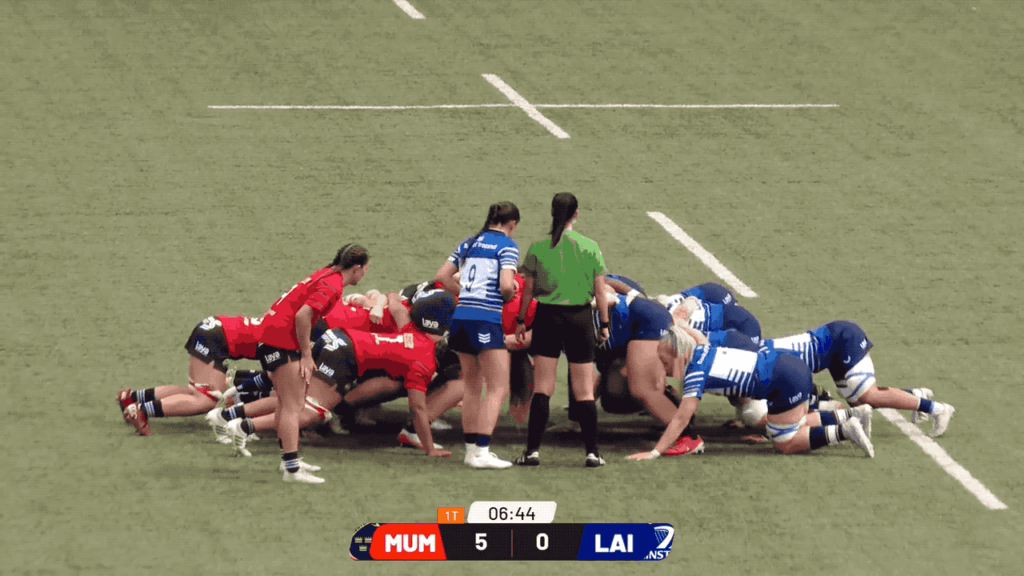
The ball goes straight into the locks, gets tangled, and Cahill powers through into the seam for a full penalty.
The penalty didn’t make touch — our kicking was an issue for most of the game — but soon we had another opportunity after Leinster were pinged for an offside. The ball went to the 5m line, and we had another maul.
Slightly different build this time; O’Leary jumped at the back, but this time with Cahill as the back lifter. The end result was the same — complete physical dominance.
We got a really strong punch on the infield side here, but watch Cahill again. She’s mauling two defenders backwards here so the initial momentum isn’t sideways; it’s forward.
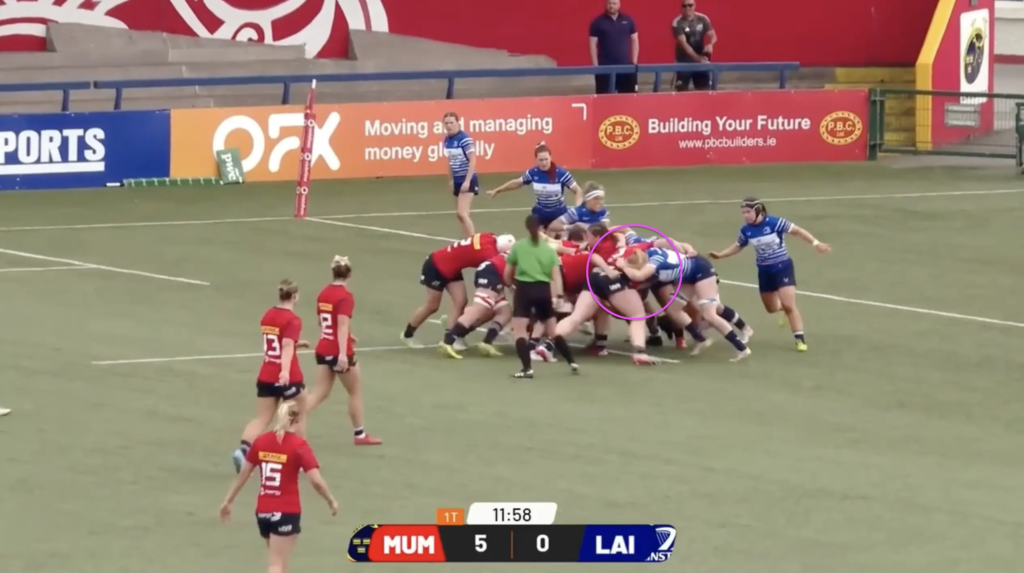
This one doesn’t go straight over, but our close contact collision work was really strong, and Breen eventually executed a pinch to put McInerney over for our second try. So many options here, all forced by the compressions made on the tryline.
Breen takes it right to the tackle line and picks between McInerney and Corey, but there were no bad options here; she could have gone herself, gone out the back to Corey, or picked the option she went with.
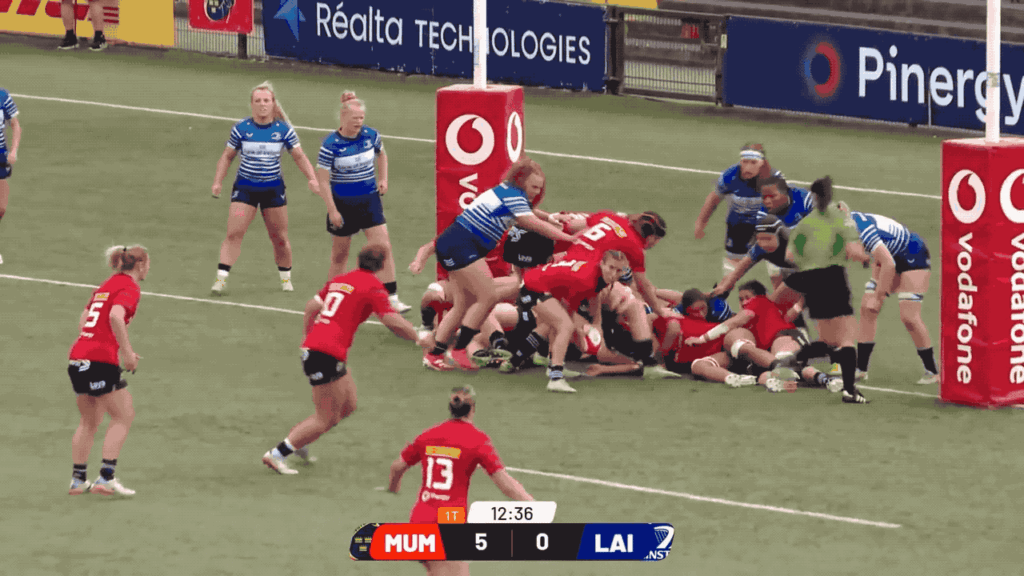
That’s what physical dominance brings you — options. And good players make hay when they get options like this to work with.
Even then, we left four points on the tee after these tries, and you’ll have an easy memory of how two unconverted tries can lead to a sweaty ten-minute block if the opposition pick something off up the other end for seven.
10-7 is nothing.
Leinster pressed back from the restart, but they weren’t able to gain ground up the middle of the pitch with any ease.
High, impactful defence meant there was no quick recycling for Leinster, and when that forced a knock-on, the scrum was a force multiplier, even when our handling post-transition wasn’t the sharpest.
At a fundamental level, Leinster didn’t want to scrummage against us. They were slipping binds, trying to pull and drag through Djougang to win technical penalties that they were only sometimes successful in selling. Djougang, in particular, was trying every crafty veteran trick in the book to keep Siobhan McCarthy under her, but all the dominance was with Munster as Molloy and Delaney struggled with their direct opposition.
That kind of set piece and lineout dominance gives you the kind of platform that only diabolical handling or kicking can overturn, and our backline didn’t oblige.
When we had to exit or move up through the edges, we were accurate, which, quite directly, meant Leinster were always playing at range.
Even then, they pulled it back to 10-7 after a scrum penalty of their own — Djougang’s craftiness bought a sloppy wheel penalty from the Munster loosehead side — before running over a maul of their own. The kind of sweat we didn’t really need after such a positive opening half hour, but that physical dominance was going to be the thing that provided true scoreboard separation.
Right after Leinster scored, we controlled the next few sequences. After another offside penalty, we had a decent maul before launching into some seriously physical and direct ball carrying. This is 42 seconds long, but look at how strong we are in contact here.
That is impressive, blunt-force trauma rugby that empowers everything you play through it. Win the gainline, win the set piece, win the game.
15-7 wasn’t much of a lead at halftime — barely one score in it — but I never felt, watching live, that Leinster had the wherewithal for back-to-back scores. They weren’t progressing the ball easily, and the physicality Munster showed in possession was mirrored out of possession.
Leinster couldn’t get any kind of consistent platform to play through Munster without a mistake, and when they did threaten, Munster were able to get back to the winning formula — dominant collisions, big scrum, big maul — and everything flowed from there.
On the strength of this performance, it’s hard to see who can stop Munster in this interpro series.
What I liked about this performance was how scalable it was. This wasn’t a game where Munster shot the lights out with the kind of complex, intricate rugby that either hits or it doesn’t. When you’re on, you’re great; when you’re not, you’re not, and individual form can sometimes dictate that.
The fundamentals of this win were deeply repeatable. That scrum and maul should hold up for the rest of the series, injury allowing, and if it does, that platform will be an incredible challenge for whoever we play from here on out.
For now, it’s just making sure that it’s consistent. If it is, I think this team will go back-to-back.
| Players | Rating |
|---|---|
| 1. Siobhan McCarthy | ★★★★ |
| 2. Beth Buttimer | ★★★★ |
| 3. Eilís Cahill | ★★★★★ |
| 4. Clodagh O’Halloran | ★★★★ |
| 5. Jane Clohessy | ★★★★★ |
| 6. Sally Kelly | ★★★★ |
| 7. Grace Moore | ★★★★★ |
| 8. Maeve Og O’Leary | ★★★★ |
| 9. Emily Lane | ★★★★ |
| 10. Enya Breen | ★★ |
| 11. Chisom Ugwueru | ★★★ |
| 12. Lucia Linn | ★★★ |
| 13. Alana McInerney | ★★★ |
| 14. Katie Corrigan | ★★★ |
| 15. Aoife Corey | ★★★★ |
| 16. Emma Dunican | ★★★ |
| 17. Tuathla Ryan | ★★★ |
| 18. Alisha Flynn | ★★★ |
| 19. Aoibhe O’Flynn | ★★★★ |
| 20. Annakate Cournane | ★★★ |
| 21. Abbie Salter-Townshend | ★★★ |
| 22. Caitríona Finn | ★★★★ |
| 23. Ellen Boylan | ★★★ |
