


One thing you learn about this game when you get anyway deep into it is that the more phase play is involved in your best game, the more time off hurts you.
Off-ball, kick pressure styles are the easiest to bed in over a short period and the quickest to be picked back up after some downtime. Your main focus with that style is its most easily drilled facets; kick chase, defensive transition, set piece, set piece strike plays, and close-range finishing work.
You’ll also find that teams with styles in that ballpark tend to have excellent system cohesion throughout their squad because a “simpler” game plan easily propagates in a wider group of players. It’s a classic high-floor, low-ceiling game plan that relies heavily on structure to succeed. The structure is your map.
Munster’s very deliberate style choice over the last few seasons has been to move away from this style of game, which was the one we most often seemed to settle into in big games during Van Graan’s chimaeric last two seasons in charge. We found that, yes, being heavily reliant on structure made navigating through the regular season pretty easy but left us badly wanting when the levels went up in the semi-finals and finals. Are we trying to do well in the regular season or win trophies?
For Munster back then, those two things seemed to be mutually exclusive. So we focused on unstructured rugby.
With that change in style, Munster have gone for something that is not easy to embed in a wide group of players. It is also not easy to effortlessly pick back up after a down period, something we’ve seen repeatedly in the last three seasons. So why do it? Why make a heavy course correction earlier this season when, amongst other things, the previous head coach was trying to change the focus back to more structure-based?
Because a primarily unstructured team won’t beat structure-based teams by adding in a dollop of more structure. All you do is take away more of what structured teams dislike, making yourself easier to beat in the process.
Why was the first 40 minutes of this game so scrappy? Because the game Munster want to play can take time to kick back into gear. Running lines need to be dialled in. Passes need to be accurate because we’ll be throwing almost 40 more per game on average than the Bristol Bears, the highest passing team in Europe by volume on average per game this season. Every pass needs layers of runners and subsequent ruck support to support the next phase, which requires a variant of those lines, players to run them and more accurate passing and ruck support.
When a few of these are off, you get turnovers. Knock-ons. Breakdown turnovers too.
But even when you’re suffering these errors, the style itself is built to up the ball in play time, create defensive overloading in the opposition, weaponise their defensive actions against them through fatigue and then take advantage. Want to know why Munster don’t kick for three points? It’s to build up the ball in playtime and maximise our return for the time we spend investing in achieving it.
Why? When the ball in play time goes above the 38-minute mark, Munster’s win record goes through the roof.
It just doesn’t always look as obvious as it did in this game.
Here’s an example of what I’m talking about in the first half.
Kendellen starts his run onto this ball in the second layer a little too soon, so he takes the pass from Daly a little static. It’s a timing issue that gives the defence the momentum to swarm him backwards, which means they have more momentum on the next phase where O’Donoghue gets smashed.
We don’t lose the ball and keep playing but if you’re conditioned to see “smart” rugby as kicking the minute you lose momentum, this looks like the kind of stuff that gets described as “lateral” by pundits who don’t know what they’re looking at.
Here’s another example – this time off a strike play from a lineout that uses multiple pinch runners and the final play on the first sequence across the pitch sees Jack O’Donoghue being used as a loop runner to send the ball to Daly, who cuts back inside. This play is designed to be particularly effective when the opposition is down an outside back.
The pass, in the end, is right at O’Connor’s eyeline and that, combined with the outside-to-inside pressure from the Scarlets’ defender, spooks him into a knock-on.
But look at what we were trying to do.
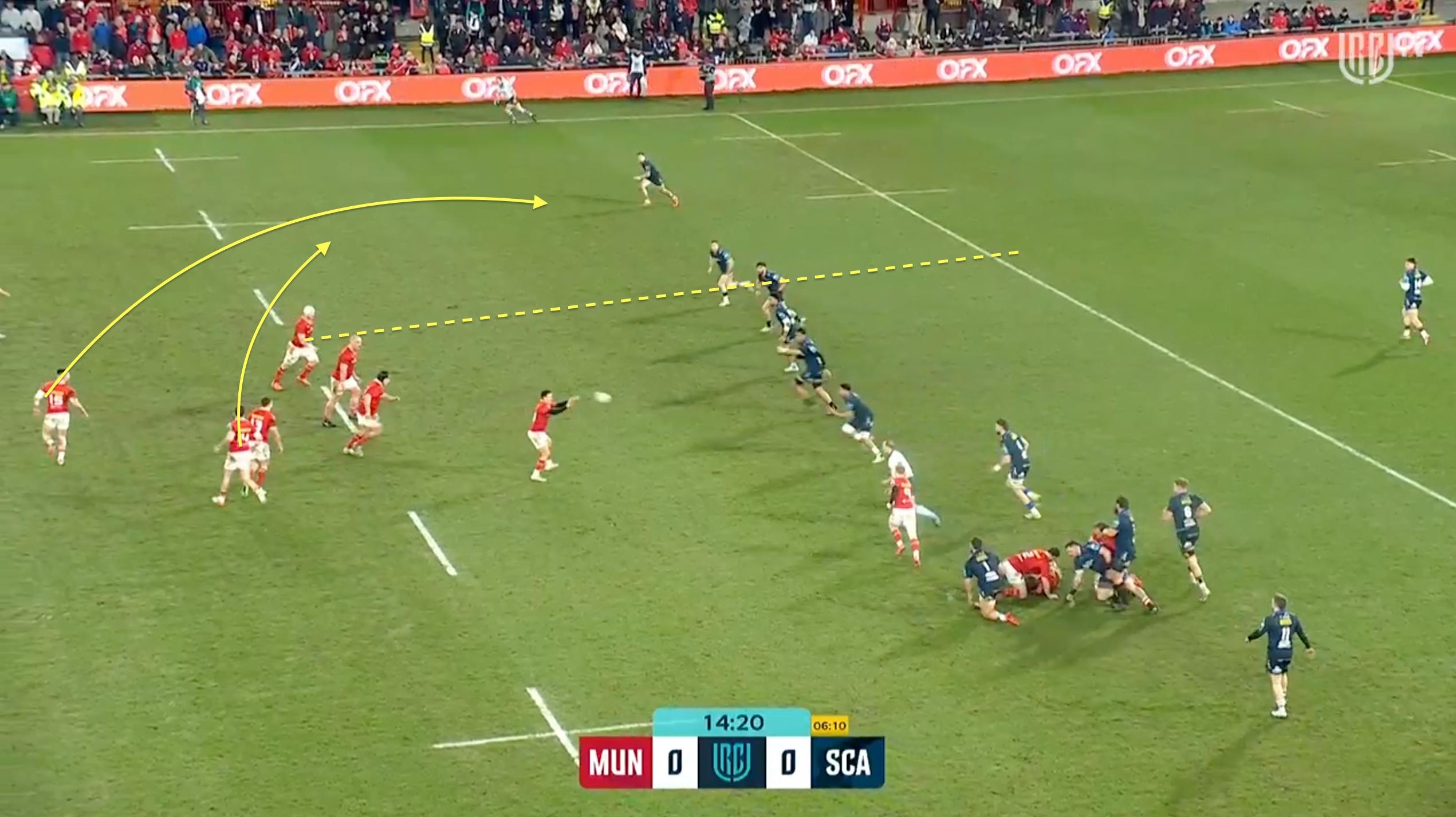
The movement across the pitch has dragged most of the Scarlets centre-field defence to one-half of the field. Jager is right on the central hash and the Munster pod arrays around him. Fineen Wycherley has influence over the edge of Scarlets’ main defensive line and just one free defender lies outside this. That’s who we’re going after.
When the pass comes from Farrell, the intent is to release Kilgallen and Ahern – two massive runners – down the tramlines.
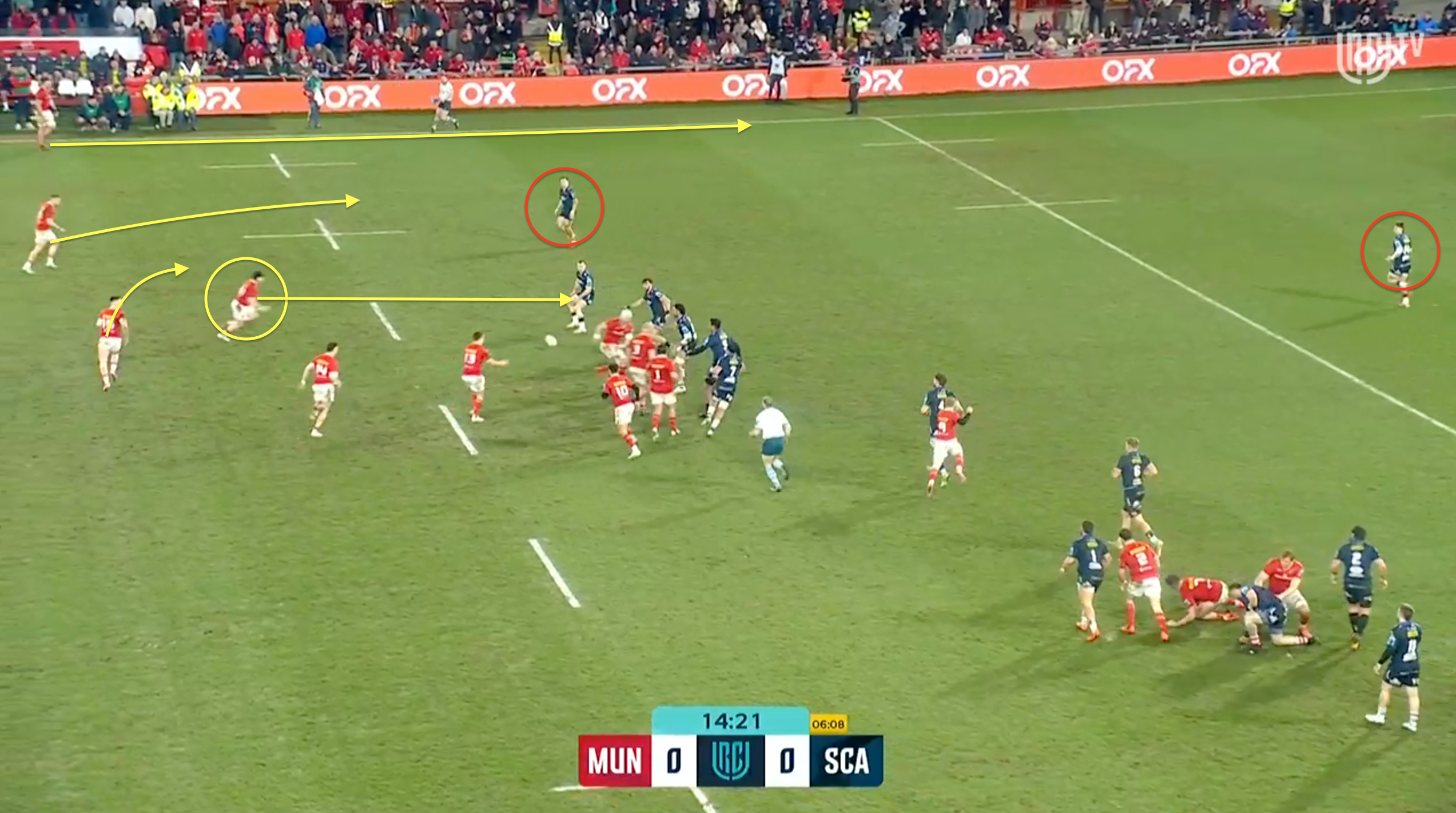
Farrell and O’Connor can’t connect properly here but you can see the intent and the design of the play is very good. If the intent was to run two phases and drop back for a contestable kick to the edge, it would be much simpler to execute but that’s not the game we want to play.
We had another few opportunities that were spoiled by marginal refereeing decisions. For instance, this rip by Evans should have been a Munster penalty – in my opinion – because the rip happened when Wycherley had his knee on the floor.
But the action to that point had been good – great flow passing from Coughlan, Coombes winning collisions and tight work at the breakdown. Small margins. On another day, I think we probably score two or more tries in that first half but the fatigue we banked in the Scarlets was just as important.
In the second half, the third quarter in particular we started to run all over the Scarlets. Our 1-3-3-1 shape really came to the fore here and we began to use the full scope of it.
Even some of the small bits from this clip show how the cumulative effect was impacting Scarlets. This kind of impact, even on unsuccessful possessions, shows that you are building in exploitable reactions to your ball work and creating fatigue.
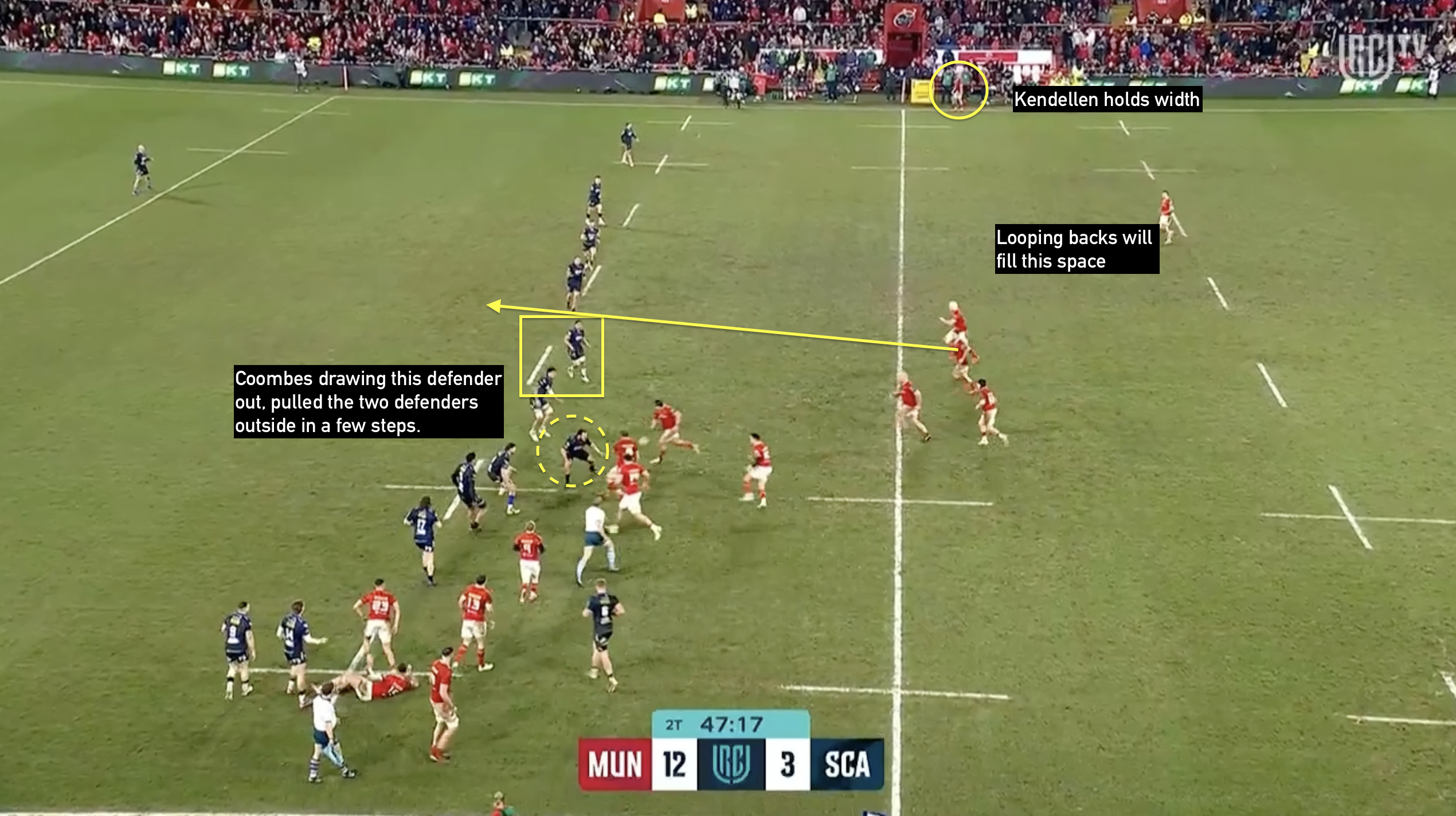
Coming into this game, Scarlets had the third-best red zone defence in the league. They concede an average of 8.9 entries per game but only concede a try on 29.9% of those entries. By the time this game was done, they had conceded a try on 38% of Munster’s 22 entries – that is off the back of Munster’s punishing attacking work wearing them down over time.
It wasn’t perfect – this style of rugby will never be machine efficient – but what this game showed is that Munster’s unstructured game can live with a heavy off-ball game from a turnover machine opponent. Scarlets’ kick-to-pass ratio was 1:3.4 – the exact type of game that we’ve lost to at home against teams with that very game state in the last year.
This game shows that maybe we have the tools to handle off-ball rugby better than before. As the ground hardens up even more, that makes the seasonal run-in even more interesting, especially as we head into the next block of games sitting in fifth.
| Players | Rating |
|---|---|
| 1. Josh Wycherley | ★★★★★ |
| 2. Diarmuid Barron | ★★★★ |
| 3. Oli Jager | ★★★★ |
| 4. Fineen Wycherley | ★★★★ |
| 5. Tom Ahern | ★★★★ |
| 6. Jack O'Donoghue | ★★★ |
| 7. Alex Kendellen | ★★★★ |
| 8. Gavin Coombes | ★★★★★ |
| 9. Ethan Coughlan | ★★★ |
| 10. Billy Burns | ★★★ |
| 11. Diamuid Kilgallen | N/A |
| 12. Rory Scannell | ★★★★ |
| 13. Tom Farrell | ★★★★ |
| 14. Shane Daly | ★★★★ |
| 15. Ben O'Connor | ★★★★ |
| 16. Niall Scannell | ★★★ |
| 17. Kieran Ryan | ★★★ |
| 18. John Ryan | ★★★ |
| 19. Brian Gleeson | ★★★★ |
| 20. John Hodnett | ★★★★ |
| 21. Paddy Patterson | ★★★ |
| 22. Tony Butler | ★★★ |
| 23. Shay McCarthy | ★★★★ |
