



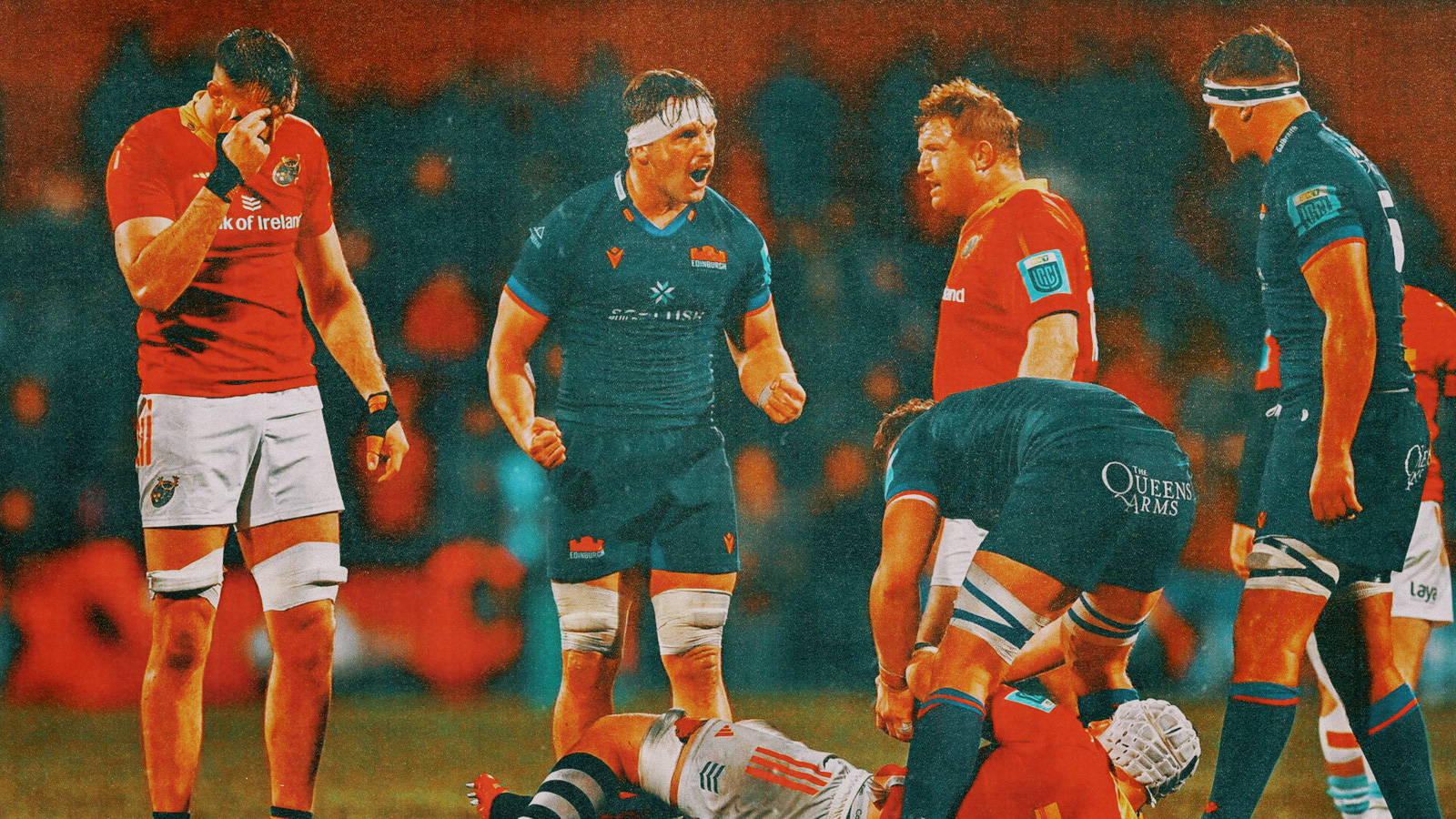
The annoying thing about this game watching it back was that even though we got annihilated at the scrum and bullied in contact for most of the game, we still would have won if we conceded one fewer daft try.
Just one. We conceded four daft tries overall but, even then, just one less would have been enough, especially in a second half where Edinburgh ran out of steam quite a bit.
I spoke beforehand about how Edinburgh were better than their last two losses suggested and that, if anything, they were underperforming what were quite solid statistical fundamentals overall, at least up to this point in the season. Even with that, they had picked a front five that was significantly bigger and heavier than ours, both starting and off the bench. We’ve seen already this season that, with our few power profile props and locks in the physio room for most of the season, the grafters, ageing veterans and young lads we’re left with can struggle against a side with good tackle execution and a big set piece, as Edinburgh certainly do.
With Craig Casey, Conor Murray and Jack Crowley, we have generational halfbacks who can play around these obstacles but when those guys aren’t available, the drop-off is precipitous.
Let’s do the “Will This Be A Sticky Game For Munster” checklist.
- Losing collisions in the middle of the field. ✅
- The usual quality isn’t there at halfback. ✅
- The set piece goes wrong. ✅
You can see the issues straight away.
***
Firstly, we can’t talk about this game without mentioning the absolute disaster that was our scrummaging performance. When judging a scrum across the full 80 minutes, we’re almost exclusively talking about what the referee sees. It’s a generally held rule that what a referee sees in the first five scrums will tell them all they need to know about who is dominant.
In the first scrum, Edinburgh showed the referee and the assistant referee on their tighthead side a very positive picture.
Look at what the referee saw on his side; Venter sinking in and holding John Ryan’s attack with his elbow up. Elbow up is the first picture that referees are trained to look for when it comes to loosehead vs tighthead in the scrum. If the loosehead, in particular, has their elbow pointing downwards, it tells the referee that they’re trying to pull the tighthead down and out of the scrum so they can get under them, get both shoulders on and then drive across. Illegal. Penalty. The whole point of a fully legal scrum is that it’s the tighthead scrummaging against two shoulders – the loosehead’s inside shoulder and the hooker’s outside shoulder – in a two-on-one contest, with close to 600kg of force coming behind him.
Everything being equal, the tighthead usually can’t go anywhere except forward. When you see a loosehead’s elbow going down, it can also mean they are trying to force a collapse which can look like the tighthead collapsing

When Andrew Porter is getting pinged for this – I use him because he’s the most relevant example – I think it’s because he’s trying to unbalance the tighthead, tilt him out, encourage something of a bore and then literally squat him with both shoulders on so you break his bore with your own.
On the other side, you can see the Edinburgh tighthead slipping across into Niall Scannell and popping him. That’s another good picture for the Assistant Referee to look at.
This is the same scrum from the reverse angle, which isn’t ideal, but you can see what the assistant referee sees here. Wycherley’s elbow is down and he also looks like he’s boring across with the Munster scrum wheeling around him to give the impression of forward movement.
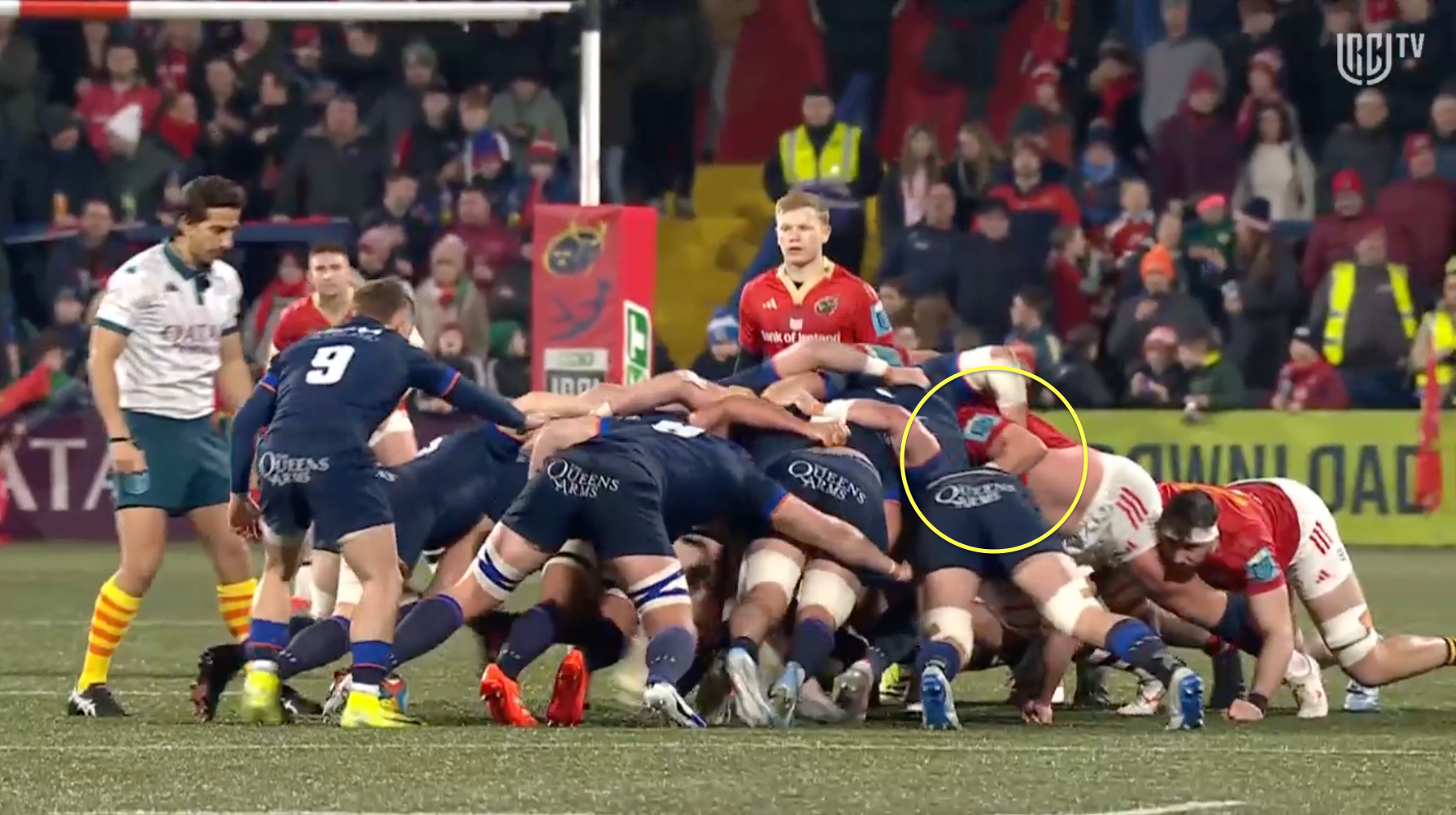
In the second half, we can see this on the Munster loosehead side directly. Again, look at what the assistant referee is seeing; Munster loosehead elbow down, back five stepping across.
As this scrum engages, Wycherley’s elbow goes down and the step across looks pretty obvious, especially in the context of Munster conceding five or six scrum penalties in the first half alone.
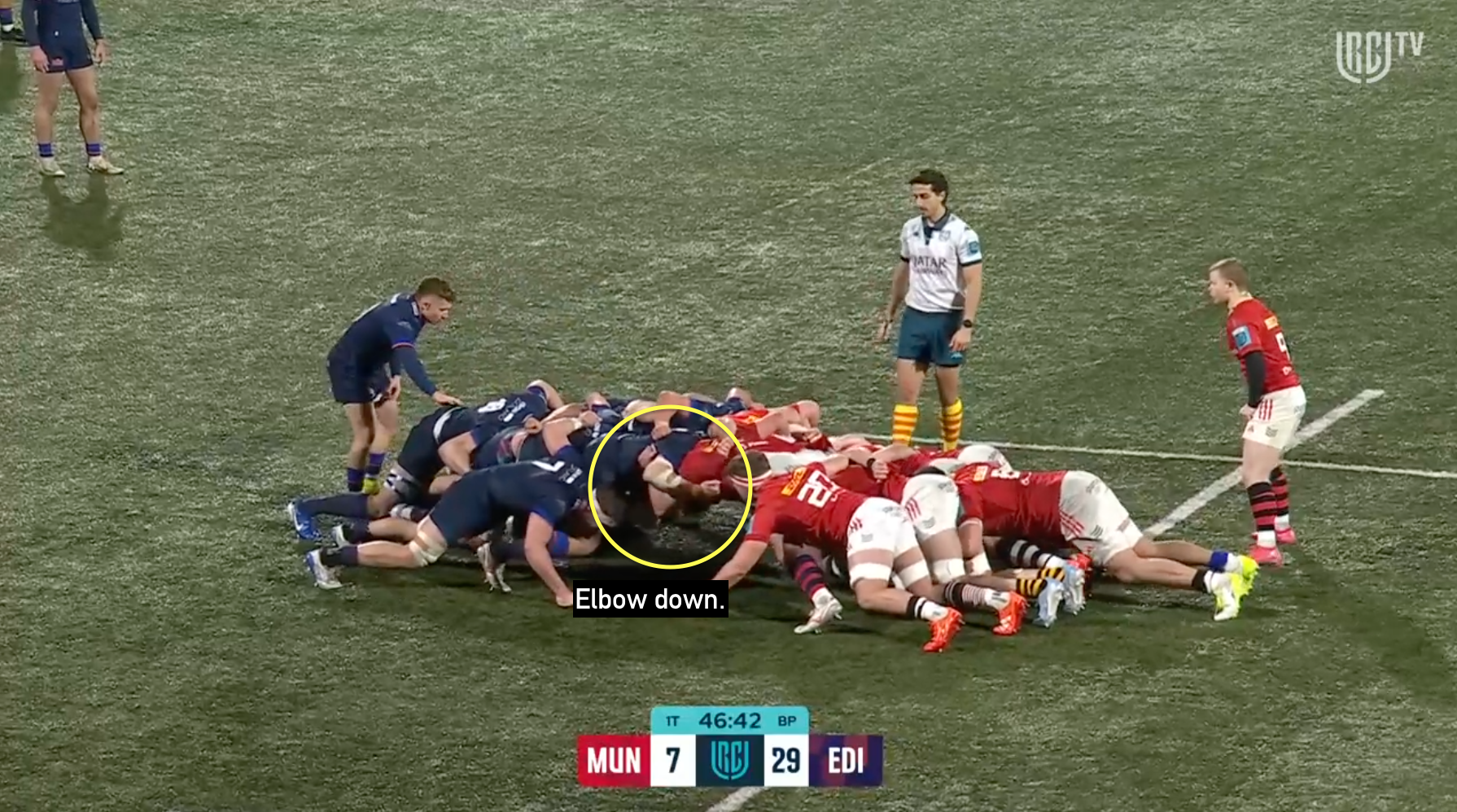
Now, you could equally say that Edinburgh’s tighthead is quite visibly boring during both of these scrums and that alone accounts for a lot of the shearing movement across the scrum that seems to pop up our hooker. This one, in the build-up to Edinburgh’s second try, was the most decisive in setting the tone for the officials, in my opinion. Munster were carted backwards and you can see the pressure surging through from the Edinburgh tighthead side at an angle with Paul Hill popping up in between Wycherley and Scannell – splitting them like a log.
Was he boring in? Probably. Did he drive straight through whatever attack Wycherley levelled on him? Absolutely. Did Venter have his elbow up for most of what the referee saw? Yep.
Scrums like this set the tone for the officials for the rest of the game.
***
Yet, even with our scrum evaporating we still should and could have won this game with a bonus point.
Being dominated like this is painful, yes, but it needn’t cost the game. We’ve seen over and over that getting pumped in the scrum is only as meaningful if you allow it to be.
For me the biggest issue was a serious lack of composure in the backfield and on edge defence that saw tries conceded that would be closer to something you’d see in the Munster Junior Cup than the URC.
Edinburgh’s first try came from two defensive errors on a nothing-attacking sequence from Edinburgh. There’s nothing remarkable here. Average pass quality. All of their threats lying deep enough that a lateral scramble should deal with them.
Coughlan’s defensive misread here is obvious – he overcommits on the screen pass option and can’t readjust to scrag the tip on runner. This is where your line cover comes in and has to make a cover tackle. In this instance, it was Niall Scannell covering across the inside and simply had to make the tackle here to cover for Coughlan’s initial error.

You can see here that Scannell plants his lead foot, gets stuck in the 4G and gets nowhere near.
Nankivell does a decent job covering but Coughlan loses sight of Thompson on the break inside so there’s very little else that can be done. Seven points.
I showed this scrum earlier but this is the aftermath. Vellacott drops a nicely judged kick in behind. Shay McCarthy turns his back on the ball and, as a result, loses a few steps of acceleration on his chase back.

He gets screwed over by the bouncing rugby ball – not the first guy, won’t be the last – but he’ll probably take away that he probably should have booted this one out and taken the chance of a 5m scrum.
Even then, I think Edinburgh probably kick this one for three points. In a game we lost by six points, that four-point differential adds up. Fourteen points given up completely avoidable.
Their bonus point try right on the stroke of halftime was particularly disappointing. After another scrum penalty, Edinburgh had a decent lineout position but it was far from undefendable.
They took the ball around the middle and built a maul that we bit in on. That exposed Scannell at the back of the lineout, in a similar position to the one that cost us so dearly against Northampton in January.

This is the weakest part of Scannell’s game – set defence moving from a standing start against deep-lying attackers moving at speed. He can’t seem to shift his feet in time or adjust to an inside ball.
O’Connell can’t make the scramble across after Scannell gets drawn out but Sykes does a great job of swinging across on this maul to make any scrambling defender do so at a disadvantage.

Even with that good play design and hard-line running, this felt way too easy to concede and, worse again, that it was one we’ve conceded before for exactly the same reasons. Twenty-one points.
Three of the four tries we conceded in the first half were completely avoidable.
The start of the second half brought us back to within three scores of Edinburgh and most of the second half to play. 14-29 is far from a gimme but Edinburgh were significantly weaker on the bench than we were, plus they’d used a backrow replacement after just 30 seconds.
There would be opportunities to make this less than a one-score game, but only if we could avoid any more self-inflicted wounds. Unfortunately, that wasn’t the case.
What you’re looking at here is a positional error in the backfield pendulum defence. What is a pendulum defence? It’s when three (sometimes four) players – your back three and your flyhalf usually – rotate around in the backfield to cover when one player has to step up into the primary defensive line to make a tackle. This allows you to cover large areas of the backfield while also making sure that players can make their tackles in the moment. It requires a lot of visual communication and game IQ to make it work. It’s not always possible for players to call players into the spots they should be. You’ve got to constantly be scanning the field to see if you’re in the right spot.
In this instance, Ben O’Connor had been involved in two tight defensive phases in the moments before and had started his step back into the backfield.
This should have been the trigger for Billy Burns to start his transit across to a more central area but he either didn’t see O’Connor dropping back or trust him to take what would have been a very difficult, tight-angled kick for a left-footed kicker.
You can see Burns step three times posts-right, which is particularly costly as the centre of your pendulum normally lines up more or less on the same line as the opposition’s primary kicker.

That means Burns is essentially out of the contest for this kick the minute it leaves his boot. That would be survivable if McCarthy wasn’t trying to cover back inside from the 5m line, where he had been lining up to guard against a possible crossfield kick.

This means Thompson has a deeply obvious place to target that would have been visible for a few seconds before he kicked the ball. Nankivell is always behind the eight ball here trying to catch a ball coming over the top of his head so it falls on Burns and McCarthy to be in the right place to stop this fairly speculative kick from bouncing just outside our 22.

Of all the tries we conceded, this was probably the worst because it showed a lack of composure and understanding in a basic area of backfield defence. This try concession looked so weird because you don’t really see tries conceded like this at this level. That’s 26 points.
Edinburgh didn’t convert this try but it made any chance of a win incredibly remote. We’d need to score from pretty much every possible entry at that point and, once again, our composure deserted us. With around 15 minutes left, two converted tries isn’t completely outlandish but it just won’t happen with moments like this where your scrumhalf gives away possession because he hasn’t put the ball into the scrum.
That’s just headless. Were the eight scrum penalties before that weighing on his mind? Absolutely. But that can’t happen at this level.
When Edinburgh conceded a yellow card in the last 10 minutes, the chance of robbing this game was very much on but weak ball-carrying let us down when it counted. For me, Barron has to get beyond the first tackler here but he’s taken down way, way too easily and we don’t have the numbers to stop the ball being stolen and another penalty being awarded.
The chance of a win evaporated with that penalty. We did well to fight our way back downfield after this – despite a lost lineout in their 22 – to secure two losing bonus points in the last few minutes.
This try is worth watching purely for the quality of Quinn’s rip pass in the screen – it forced three defenders to sit on their heels for a second – and Nankivell’s outstanding kick assist to O’Brien. Burns conversion did the rest.
There’s no hiding from the fact that this loss was deeply damaging. Edinburgh are a side that you can shut out with even average defensive composure but they are impossible to beat without a functioning scrum and while we were intent on handing them 26 points with some of the most headless defensive efforts you’ll see at this level.
The truth is that a lot of our front five in this game are good players but only when supported by proper size and quality around them. Niall Scannell had a very poor game here but that isn’t reflective of his quality as a player. Put him in a front five next to Jager and Loughman with a fully firing Kleyn and perhaps Edwin Edogbo behind him and you get a far better performance. I don’t think that is outlandish to say.
A front five of Josh Wycherley, Niall Scannell, John Ryan, Evan O’Connell and Fineen Wycherley are all reliant on others to go up a level at this point of their careers. Fineen Wycherley, with a big pack built around him, can demonstrate what a well-rounded grafter he is. But when it falls on him to lead that size from the second row all on his own, he looks lost. O’Connell has all the qualities to be a top-class lock in the next two to three years but as of now, he’s undersized by just enough to need a heavy tighthead lock and power forward prop to be able to get the most out of games like this. Without them, he can look undersized and under pressure.
It’s not about one player. It’s about the overall quality of the unit itself and the power they project.
Combine that with a deeply skittish and paint-by-numbers performance at halfback and a less-than-composed performance in the backfield and a game like this can happen. Objectively, that first 40 minutes is the worst I’ve seen of Munster this season. Worse than Zebre.
I genuinely feel that with an injury list of fewer than six senior pros, this Munster side can be a nightmare for any team in Europe. We have a high ceiling. When we go deeper into the squad, however, there isn’t a side in the URC, TOP14 or Gallagher Premiership that we couldn’t lose to in the right conditions.
High ceiling. Low floor.
| Players | Rating |
|---|---|
| 1. Josh Wycherley | ★★ |
| 2. Niall Scannell | ★ |
| 3. John Ryan | ★ |
| 4. Evan O'Connell | ★★ |
| 5. Fineen Wycherley | ★★ |
| 6. Tom Ahern | ★★ |
| 7. John Hodnett | ★★ |
| 8. Brian Gleeson | ★★★ |
| 9. Ethan Coughlan | ★★ |
| 10. Billy Burns | ★★ |
| 11. Shay McCarthy | ★ |
| 12. Alex Nankivell | ★★★★ |
| 13. Tom Farrell | ★★★ |
| 14. Calvin Nash | ★ |
| 15. Ben O'Connor | ★★★ |
| 16. Diarmuid Barron | ★★ |
| 17. Mark Donnolly | ★★ |
| 18. Stephen Archer | ★★ |
| 19. Ruadhan Quinn | ★★★★ |
| 20. Alex Kendellen | ★★★★ |
| 21. Paddy Patterson | ★ |
| 22. Tony Butler | ★★★ |
| 23. Sean O'Brien | ★★★ |
