



This game finished three and a bit days ago now, so going back to review it this morning – stupid o’clock on Tuesday morning, half a day removed from wrangling a very active sixteen-month-old for four hours on a plane – felt like I was watching it with new eyes.
I saw this game live in Lanzarote last Friday night with six or seven Tropicals on board in a bar called Shenanigans on the main commercial strip of Porto Del Carmen’s new town. I enjoyed it. I was chatting industrial amounts of racket with some Welsh boys who were in watching the rugby too, in the way you can only do while on a sun holiday where you’re lumped in with all the other purple, sweat-glistened inhabitants of These Islands. You hate each other really, but you’ve got to make it work for decorum’s sake when you’re out foreign; just like a Lions tour.
The Welsh lads were from Cardiff and had no love for the Ospreys but even less love for the Bad Guys. If the maxim of “they don’t rate you until they hate you” is true, they rate Munster very highly. Having people openly hate Munster has never been an issue for me. This idea of being beloved by “the neutral” is an alien concept to me. Why would you care if people who aren’t Munster to down to an atomic level want Munster to win? Or lose? It’s like trying to imagine a completely new colour; I just can’t do it. It also doesn’t mean that I can’t have the craic with lads either, and we had a lot of that.
When they saw Munster taking threes, they knew the Ospreys were done. “Fucking Munster man, when they start taking their penalties you’ve got fuck all chance in Thomond Park”. Fire whatever Welsh accent you want onto that sentence. After the match, I saw some media wonks talking about how some Munster fans were unhappy with the manner of this win. That certainly scans. There’s nothing Munster fans hate more than a relatively stress-free knockout win at home against a dogged opponent, after all. I saw a few clips on my phone of Eddie O’Sullivan smurfing away about Munster’s performance and I just couldn’t understand it. This was a quarter-final; there to be won and forgotten about. The only people who remember the quarter-finals of any tournament any longer than two years after it happened are people who lost quarter-finals or blew the semi-final that came after it.
Remember Munster’s dour 19-10 win over Perpignan in Lansdowne Road 2006? I only remember Paul O’Connell’s try and that’s it. I couldn’t tell you a single other thing about it. Do you remember Munster’s 16-3 win over Gloucester in Kingsholm in 2008? I don’t. Couldn’t tell you a single thing about it, and I had to Google to find the opposition and the scoreline.
I do remember Munster’s big win over the Ospreys in 2009, of course, but only because… we blew the semi-final that came after it.
Do you remember Ireland’s quarter-final loss to Argentina in 2015? Do you remember the same quarter-final loss to New Zealand in 2019? I bet you do. Just like I remember Munster losing to Scarlets in the quarter-finals of the 2007 Heineken Cup. And Toulouse in the Aviva.
You don’t want to remember quarter-finals, so a home win with zero fear of losing outside the 50th minute is the right kind of forgettable. I hope I never have to think about this game ever again because it’ll mean we beat Glasgow and play a final here in two weekends.
Walking back from Shenanigans in the lovely warm sea air with the pleasant buzz of Tropicals pulsing through my renal system, I was already beginning to forget the game I just watched. Bliss.
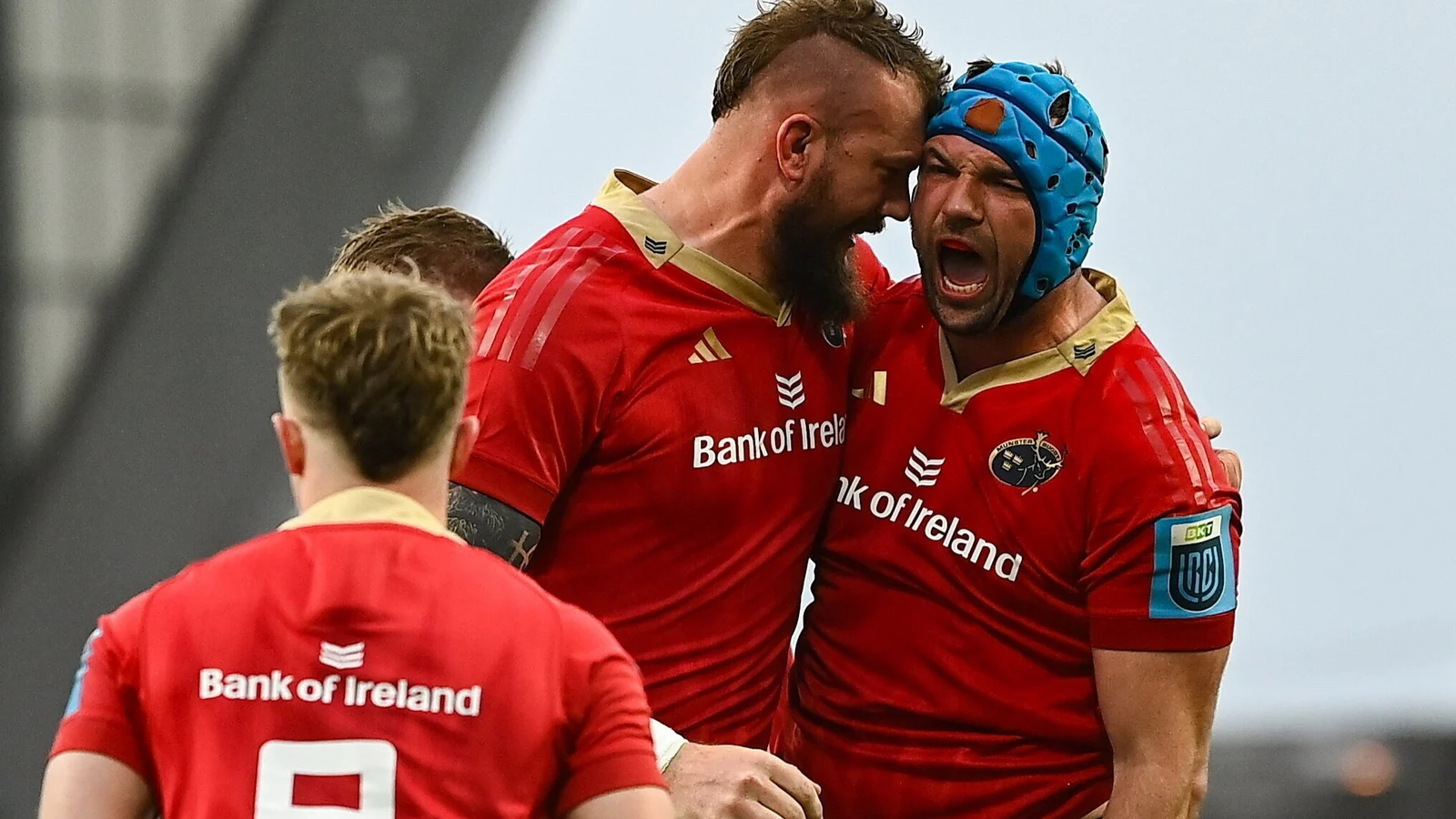
Watching it back this morning, I saw some of the core fundamentals in this gritty win that I associate with lifting trophies and some things I don’t. It’s shorter to list the things that need improving.
- Execute 5m opportunities when you get them.
There were two close-range sequences that we made real heavy weather of, even accounting for some rock-solid Ospreys defence. I’ve sped up the sequence here but we’re not connected, we’re sealing off our own ball with our downward cleans – itself a reaction to Ospreys sweeping across and spoiling – so our recycle rate is too slow.
The Ospreys are committed and great in defensive contact – that, along with their scrum, has been their biggest positive this season by far – but we need to be higher on our entries here to maximise speed around the corner. There was a lot of focus on the breakdown post-game but so much of that was down to the Ospreys work spoiling. Just 39% of our rucks were less than three seconds, which is our lowest return at the breakdown since the Leinster game in Thomond Park back in December during a yellow weather warning. The next slowest game was… against the Ospreys back in February.
When it comes to the positives, I saw;
Suffocating Blanket Defence
Without a superb try off a low-percentage kick play, I think Munster could easily have nilled the Ospreys here and it wouldn’t have been desperately unfair. Our defensive system is really flexible and doesn’t hinge on forcing decisions. Other systems – high edge blitzes in particular – take a lot of thought away from defenders in favour of pressuring actions but ours relies on players on the edges making reads and players on the inside making decisions after the contact.
Here you’ll see Crowley advance up to the edge of the forward pod, within the radius of the screen runner. Ospreys make the carry and get decent gainline but we only lose two defenders. Everyone else is staying active behind the ruck and spreading out.
We don’t blitz on the next phase – we just jockey on the edge – and let Ospreys carry into us with Beirne’s jackal threat drawing their cleaners off their feet. We have no issue giving a little bit of ground when required to help us win the next phase. This is a less aggressive form of defence when it comes to the intensity of the decisions being made, but it gives players opportunities to read the carry and give experienced, prominent tackle and jackal threats like O’Mahony and Beirne scope to work.
A Rock Solid Scrum
The Ospreys are second in the league for penalties won at the scrum and while they caught us on three or four here – two in penalties, two in scrappy scrum plays – we won the big moments when they were there to be won, primarily off the back of a superb performance by Jeremy Loughman.
Loughman got caught once by Tom Botha – himself an excellent scrummager – but the Munster loosehead recovered to put in a five-star scrummaging performance, with this one right before half-time being the pick of the bunch.
The Ospreys had chosen to take a penalty earned on the previous play as a scrum. It was a big play decision but they fancied their chances of catching Munster into a scrum penalty doom spiral that would, ideally in their eyes, end with a penalty try and a yellow card. It was an ambitious play given the scrum to that point – 50/50 with Munster arguably ahead – but with Smith, Lake and Botha in the front row, I get their idea.
Loughman won the penalty for Munster when he kept Botha straight for just long enough to show the excellent Hollie Davidson that the Ospreys were trying to walk around the corner.
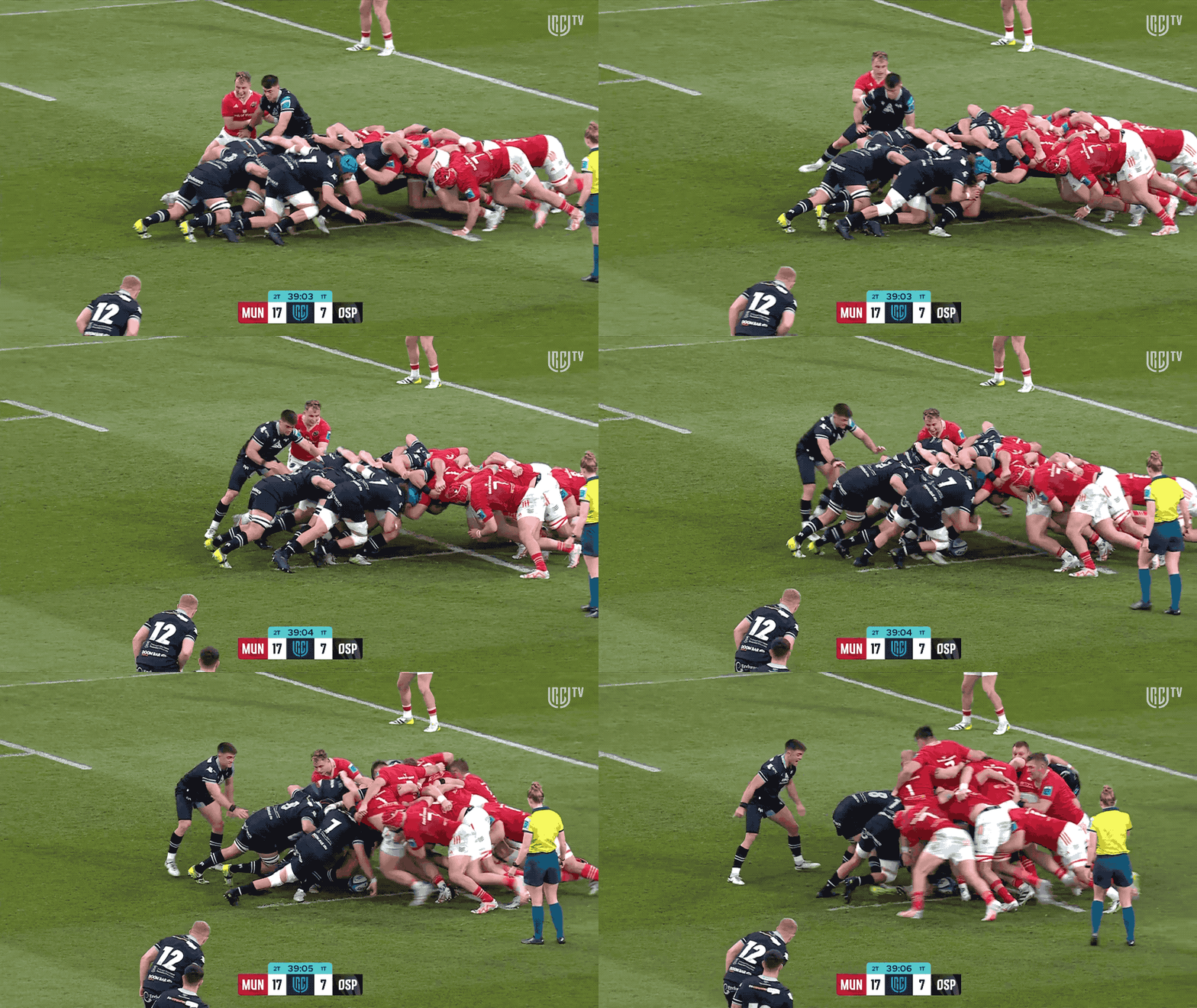
You can see the Ospreys’ back-five wheeling pretty clearly here but if Loughman doesn’t keep his drive going forward, it would look like Munster couldn’t take the pressure and collapsed inwards. A huge penalty against the head on our tryline and it likely won the game for us – that 10-point lead at halftime allowed us to take our threes and build the lead out to north of two scores.
We switched out Scannell and Archer for Barron and Jager in the 45th minute to keep the pressure on and force Ospreys into an early bench transition of their own – that was the end of their scrummaging threat. Watch Jager manhandling Gareth Thomas here. He has him clamped so tightly that the Ospreys backfive walking around looks even more obvious.
Having a scrum this adaptable – along with the power boost of Oli Jager and John Ryan off the bench – is the hallmark of a winning team.
A Penalty Generating Maul
When we needed to get back into the lead in the face of massive Ospreys breakdown contesting, our maul hit its stride at exactly the right time. Our 6+1 lineout build with three legit jumping targets allowed us to build a rock-solid square maul with two banks of three maulers locked out by Coombes and piloted by Scannell at the tail.
This sequence of three mauls* got us back into the lead and it was built off a simple, repeatable build that we could put up at the front and use its base stability to feel for weaknesses.
*O’Mahony is the outside lock in the first maul, not Loughman, but the premise is the same.
Later in the half, we drove from around 12 metres out with a simple variation to that build that had a lineout feint built into it to throw off the opposition.
Maul one had O’Mahony transit from the back of the maul to the touchline side lock point. Maul two had Loughman as the touchline side lock point. Maul three was the same. In those last two mauls, there was no deception on the jump.
In this maul, Beirne feinted out of the jump to allow Loughman to lift Snyman, before snapping in as the touchline side lock point.
We won a penalty from this position but the variation here allowed us to use Coombes as a focal point for the drive direction as a variant. Coombes doesn’t bind on the back three in this maul. Instead, he locks onto the outside two and drives infield around Archer and O’Mahony’s power hinge.
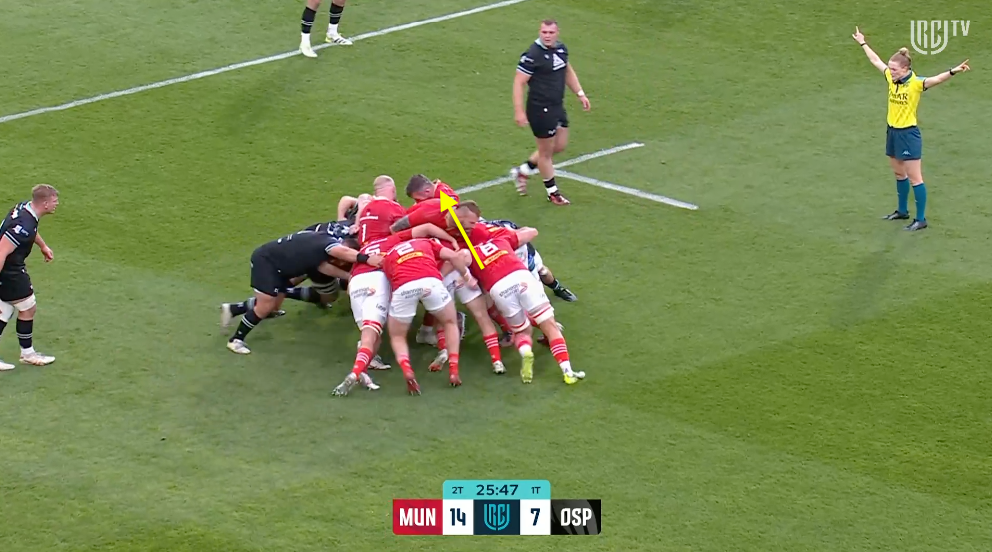
Again, the 3-3 build is super stable but allows so much scope for variation when it feels like the opposition is going to contest and we can build it from the front of the middle so it’s repeatable against everyone.
It got us a 10-point lead that would allow us to kick our threes for the second half and slowly suffocate the Ospreys with our 0ff-ball game. It allowed us to conserve energy and live to fight another day.
In knockout rugby, that’s all that counts. Win, onto the next, win onto the next, and keep doing that until you run out of games.
| Players | Rating |
|---|---|
| Jeremy Loughman | ★★★★★ |
| Niall Scannell | ★★★★ |
| Stephen Archer | ★★★★ |
| RG Snyman | ★★★ |
| Tadhg Beirne | ★★★★ |
| Peter O'Mahony | ★★★ |
| John Hodnett | ★★★★ |
| Gavin Coombes | ★★★★ |
| Craig Casey | ★★★★ |
| Jack Crowley | ★★★★★ |
| Shane Daly | ★★★ |
| Sean O'Brien | ★★★ |
| Antoine Frisch | ★★★ |
| Calvin Nash | ★★★★ |
| Simon Zebo | ★★★ |
| Diarmuid Barron | ★★★ |
| John Ryan | ★★★★ |
| Oli Jager | ★★★★ |
| Jack O'Donoghue | ★★★ |
| Alex Kendellen | ★★★ |
| Conor Murray | ★★★ |
| Tony Butler | ★★★ |
| Mike Haley | ★★★ |
