


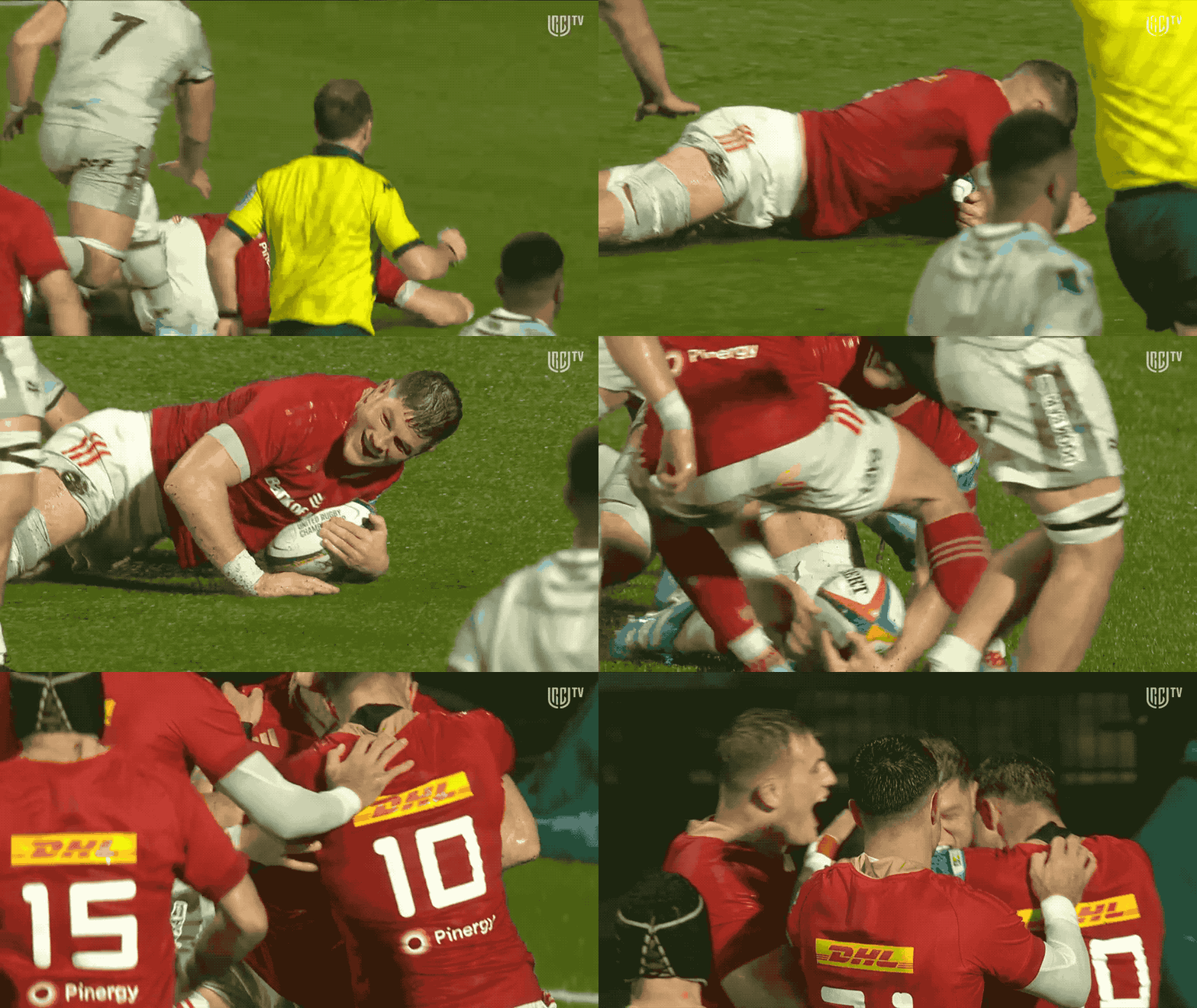
This was a game that you would win or lose on your ability to execute the fundamentals of the sport.
Can you make your tackles? Can you control territory? Can you execute your scrum and lineout? Can you dog it out when it gets tough, especially when it gets tough the minute you walk off the bus and see billowing sheets of rain blowing sideways faster than you thought rain could go?
If you can do all of those things, you’ll probably win. I say “probably” there because sometimes you can do nothing about the Random Bullshit that rolls your way while playing in the kind of weather that makes you regret buying a trampoline.
I present Exhibit A;
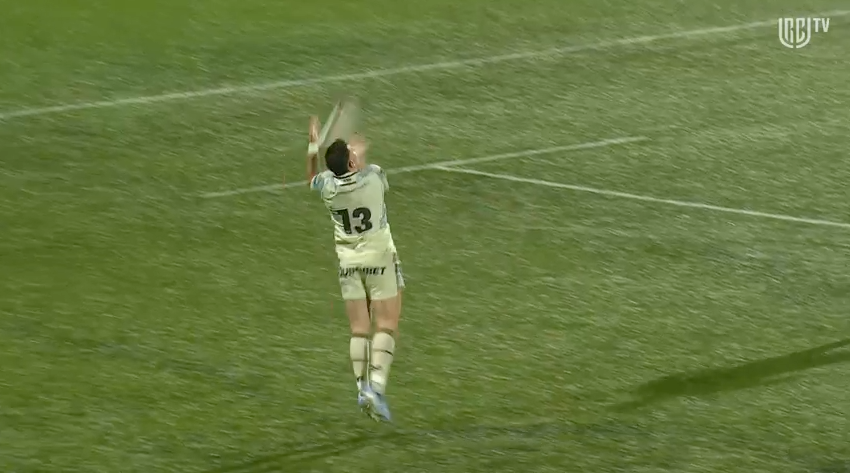
This is Random Bullshit. It’s a great kick from Crowley with a stiff wind behind him. It’s not so far that it’s in danger of blowing into touch, and it’s just at the right height that Watkin has to catch it, or at least try. Normally Watkin – or any midfielder in this back pin receipt position – wants to take the ball front on, but I can guarantee the ball’s trajectory changed in the air.
It’s almost impossible to catch this (wet) ball over your shoulder at the pace it was travelling.
Shay McCarthy had the pace and the luck to be in the right place at the right time – it often happens when you’re working your nads off. That five-point concession after just 10 seconds put Ospreys on the backfoot on a night when playing on the backfoot was almost impossible. I don’t know who won or lost the coin toss, but if I was to guess I’d say it was the Ospreys; I think they chose to play with the wind in the second half. This wasn’t any ordinary wind, though. When you combine it with the rain and the 4G pitch – this meant that catching the ball was incredibly difficult and managing bounces from skidding kicks even more so – attacking with the ball in hand was every bit as difficult as defending would be.
With that lead established, Munster could afford to play stand-off rugby. We defended really tightly because we knew any pass to the edges of the field would require the kind of passing and handling that would be almost impossible in the conditions. So this meant handling Ospreys kicks that would drop vertically in the first half, and fly longer in the second.
It also meant managing the kicking battles with a bit of cuteness. I really liked this one in the first half with Jack Crowley and Craig Casey. Crowley had already kicked a long, awkwardly skidding ball up field on the previous play, and this had been returned by Ospreys.
They had great backfield coverage though, so Crowley made the correct decision to attack with the ball in hand. He wins a collision with Jac Morgan (!) before Casey attacks with the low kick to touch that was almost a 50/22 a phase later.
This takes real patience and skill on transition to execute. Crowley had to be strong and athletic with the ball in hand – and he was – and Casey had to be able to attack a very small window of space in the backfield.
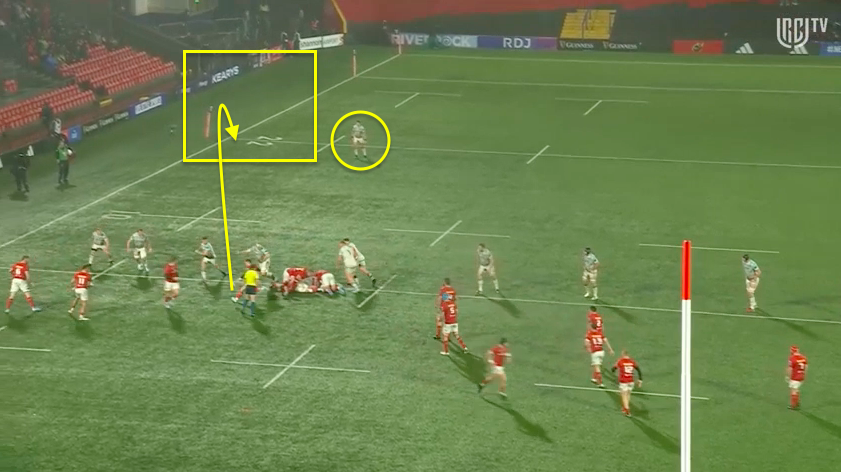
At the start of the first ruck, Nagy had the 5m channel covered. By the next ruck, he’d moved infield to cover the potential kick down the middle.
That opened up a window for Casey to attack. He kept the trajectory low to make sure it had a bounce – no blowing this one out on the full with an errant gust – and got the ball skittering on the 4G pitch in the kind of way that always tends to have a nasty high bounce at the end.
That kind of work on transition wins you the game, inch by inch.
Last week, we were defined by throwing tip-ons and screen passes with a kind of disrespect for Zebre. It’s not open disrespect, but it’s the kind of thing you do when you think you’ll always get another possession. In this game, we carried with the kind of directness and pragmatism that you do when you worry about every pass and every ruck.
Our typical worry about the Ospreys is that they’ll screw at the breakdown with their defensive breakdown threat but they didn’t engage in that here. They – rightly – decided that filling the field was the right call in almost every instance. Munster had to adjust and, again, kick smartly and accurately. This is a great example.
It’s just smart rugby. In that weather, dumb rugby hurts you over and over again.
On the defensive side of the ball, Munster consistently attempted to poach or counter-ruck, which was the exact opposite of the Ospreys approach. The Ospreys decided pre-game that they wanted to stuff us defensively, stay out of the rucks and force us to pass into layers on a day when that would be incredibly difficult. We decided to counter almost every ruck and aggressively poach when the window opened.
This won a few key turnovers but also forced the Ospreys into entries like this, which earned a crucial penalty that we would later score from. Archer’s tackle and second action at the ruck – one of many throughout the game – sell the need for Ospreys to resource this ruck in a hurry and they cough up a sloppy penalty.
That gave us an 18-point lead at halftime with the burning question being this; were we playing into a 20-point wind?
***
Regardless of what else was going to happen, the second half would be defined by Munster’s defence.
In the last two games, we had conceded 75 points – an average of 37 points per game. Last season, we only conceded an average of 17 points per game. Through the power of maths, we can see that the average so far this season is wildly inflated on last year; it’s been the biggest killer in the last few games. At the same time, you’d back the team to sort it. Generally, fixing your defence that is leaking tries is far easier than fixing an attack that isn’t scoring them.
There’s no doubt that the weather made defence “easier”. I’m not sure if “easier” is the right word there. Maybe, “more straightforward” would be more correct. Either way, the Ospreys couldn’t play with any real tempo so the pillar issues of the last two weeks didn’t present themselves. What we did see, however, was Munster smothering the Ospreys off #9 with a series of withering stops from Archer, Kleyn, Hodnett, Beirne and a good few others.
We stopped them behind the gainline regularly and won more than our fair share of clean turnovers. It isn’t a full turnaround from the first two weeks – this coming weekend will be the big test of that – but any night where you nil an opponent as tricky as the Ospreys is a good night for the defence whatever way you slice it.
And, after back-to-back ropey performances, the Munster lineout fired at a 100% completion on 12 throws; a badly needed stat.
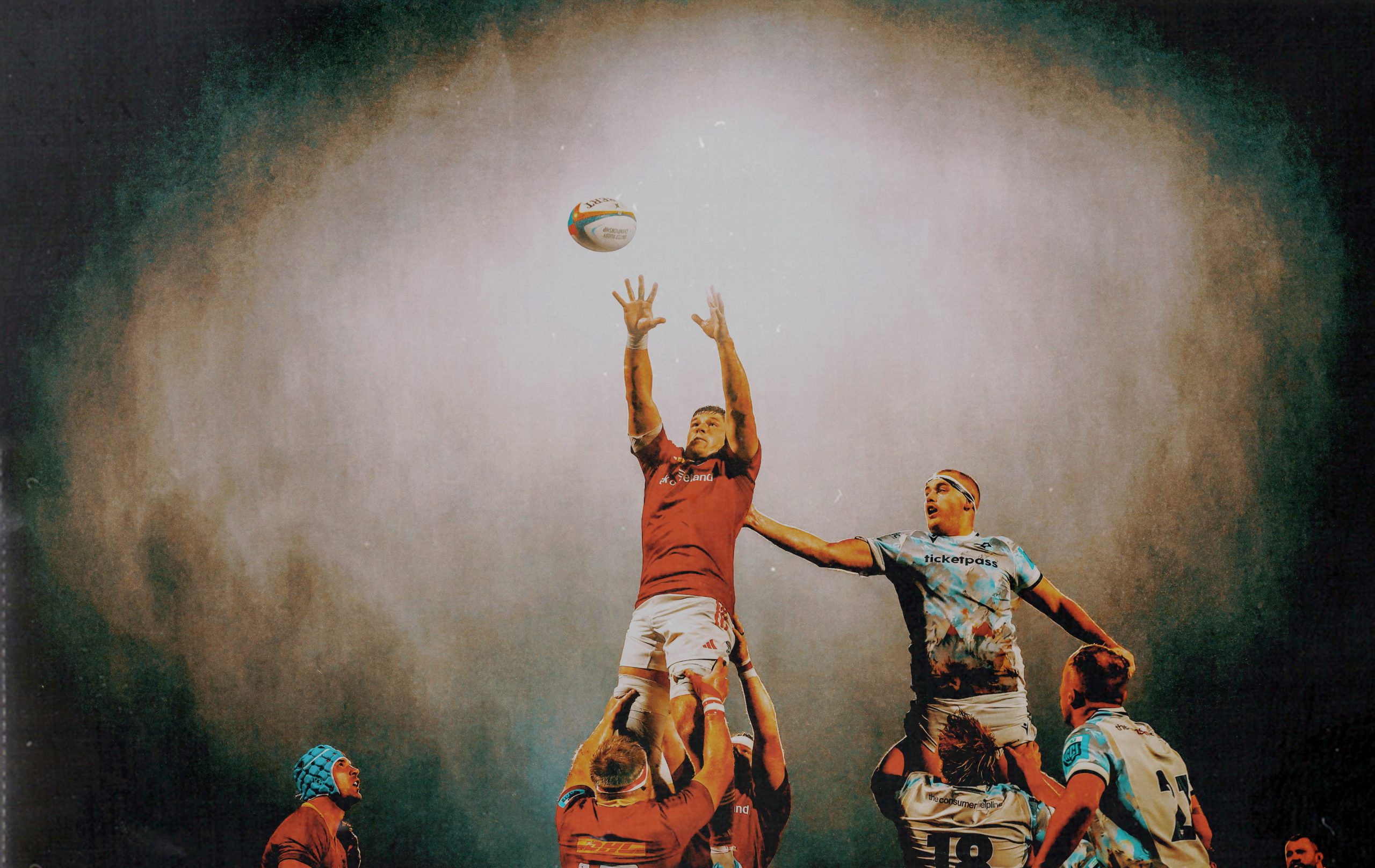
The weather called for simplicity in both call and targeting and, lo and behold, the Ospreys didn’t get near our throw all night, even when they began to compete in the air later in the game to try and pull back momentum. Jack O’Donoghue’s reliability as a springy primary target seemed to take a bit of heat off our throw, both from the throw itself to the lifting schemes.
Minimal movement, Beirne using himself as the bait at the front on a five-man build, a simple lift in the middle taken cleanly even with a contest. That’s just nice to see.
That particular lineout led to the bonus point try, the most well-crafted play of the night. It’s often credited as a Joe Schmidt special, but this particular use of the strike play was different in a few key ways. First of all, it was on the third phase of a five-man lineout.
The most recent Schmidt special came via Hugo Keenan against France earlier this year.
If you watch this one, the principle is the same but Munster’s structure adds another wrinkle to it. First of all, the five-man lineout gave us Coombes and Hodnett in midfield. We drew the play wide to make sure Fitzgerald got a good look at that three-man defensive pod you always see with the Ospreys. Edwards in the middle, Cokinasinga outside him, Deaves inside.
We didn’t have to get the gainline, but we had to dominantly clear the ruck.
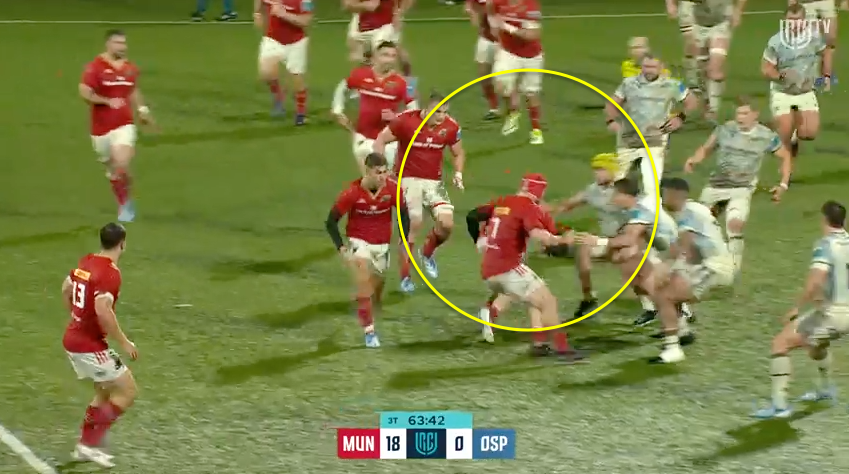
The next phase was to set the Ospreys in the middle of the field. Beirne and Wycherley ran tight around the corner with Barron and Archer arriving to secure the ruck.
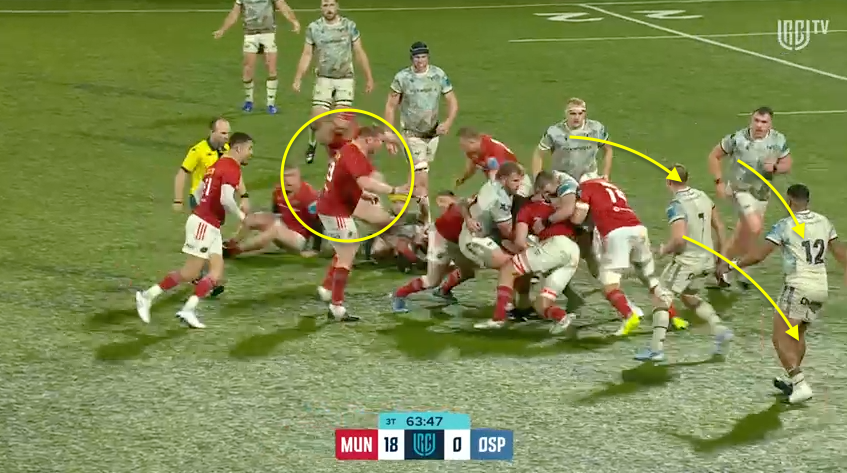
Watch how the Ospreys flood around the back to stack the openside – working hard. Munster used that hard work against them. Archer’s main role here was to act as a blocker for any defender who tried to come back across the face of the ruck on the next play. He’s really, really good at this type of blocking play. Always looking like he’s just standing there, loping around.
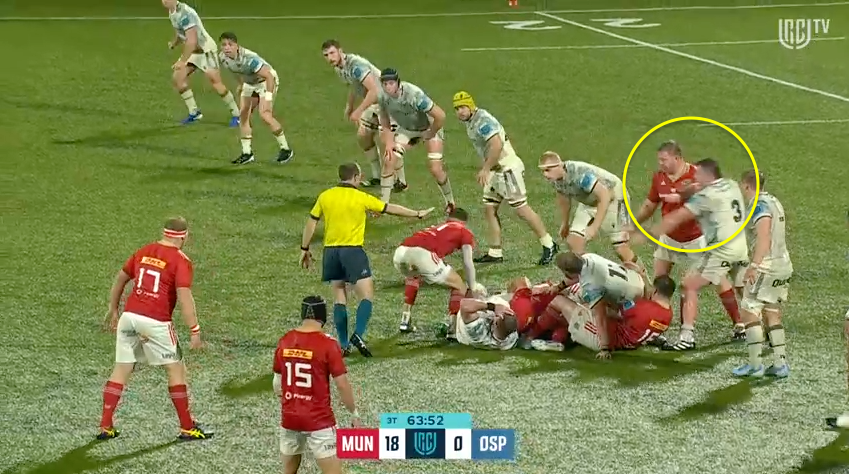
Munster run a full three-pod with a screen runner coming back against the grain. The ruck point is in the centre of the field so it’s not obvious that a strike play has already been called. Crowley’s gravity behind the screen draws the defenders on the edge up – it even draws up the backfield defender as you’ll see on the next still.
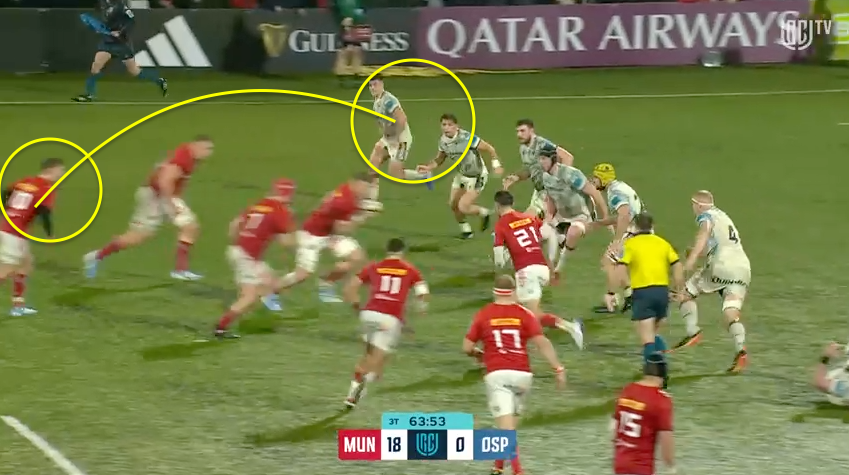
Meanwhile, the Ospreys primary line is looking at a three-pod running straight at Deaves, Hodnett running a dangerous inside line. You’ll see Murray wipe right across McCarthy’s line too – this is deliberate to unsight the defenders on McCarthy’s run until the last second. It adds jeopardy to the pass in that it shortens the window O’Donoghue has to aim at, but when it works it’s devastating.
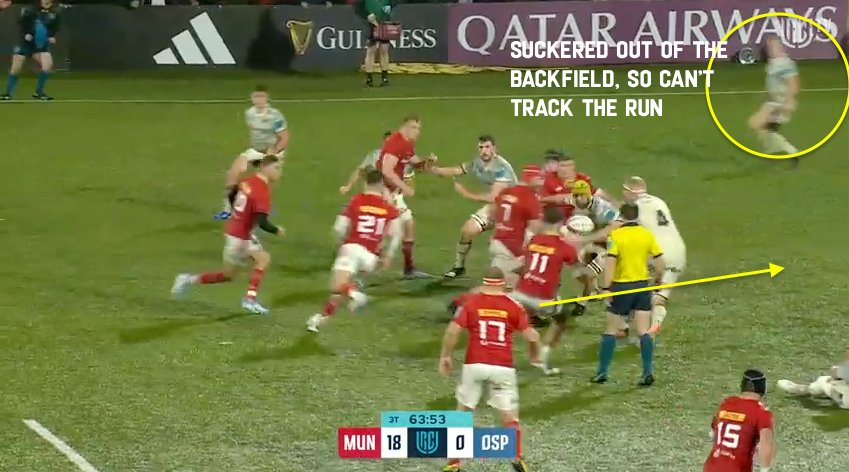
It all clicks perfectly and gives McCarthy an excellent linebreak that he executes perfectly. It’s fitting that O’Donoghue got the try given how good his pass was at a key point of the whole thing. You can see it all moving here.
It put the exclamation mark on a great night’s work at the office. It was a badly needed reset after the wild gunslinging of the previous two rounds. More will be needed this coming weekend, a lot more, but the bonus point win on a night when not many would have gotten it turned the opening of the season around for us.
A lot of vibes ride on next week but this result was far closer to this squad’s baseline. Establishing that was good to see.
| Players | Rating |
|---|---|
| 1. Jeremy Loughman | ★★★★ |
| 2. Niall Scannell | ★★★★ |
| 3. Oli Jager | N/A |
| 4. Jean Kleyn | ★★★★ |
| 5. Tadhg Beirne | ★★★★★ |
| 6. Peter O'Mahony | N/A |
| 7. John Hodnett | ★★★★ |
| 8. Jack O'Donoghue | ★★★★ |
| 9. Craig Casey | ★★★★ |
| 10. Jack Crowley | ★★★★★ |
| 11. Shay McCarthy | ★★★★ |
| 12. Bryan Fitzgerald | ★★★★ |
| 13. Tom Farrell | ★★★★ |
| 14. Calvin Nash | ★★★ |
| 15. Mike Haley | ★★★ |
| 16. Diarmuid Barron | ★★★ |
| 17. John Ryan | ★★★ |
| 18. Stephen Archer | ★★★★★ |
| 19. Fineen Wycherley | ★★★ |
| 20. Gavin Coombes | ★★★★ |
| 21. Conor Murray | ★★★ |
| 22. Tony Butler | N/A |
| 23. Jack Daly | N/A |
