



When I sat back into my car in the Black Ash Park and Ride, I was literally shaking. The Instagram reel I’d made while I waited for the car to warm up looked like it was being made in a shed in Antarctica. It might as well have been. I’d managed to contain the shudders for most of the game, but, as the last ten minutes rolled around, the cold, wind and rain managed to wriggle its way through my coat, through my jumper, and deep inside.
Walking back to the car, I tried to leave a voice note for my fiancé to tell her I was about to hit the road home to Limerick, but my teeth were chattering. I sounded like someone just tried to mug me. Sounds a lot like the game, actually, but it was the weather that tried to snatch me. It didn’t want my wallet; it just wanted whatever warmth was left in me, and it got it.
Welcome to rugby in Cork during the winter. I met Ronan O’Mahony before the game — he was doing radio for Live 95 — and he said “jeez, the weather is rotten”, and I replied that Munster were playing in Cork in winter, it was always going to be miserable, because it always, always is. It doesn’t even have to be technically winter.
In October 2024, we played the Ospreys in Cork, and it looked just like Friday night.
When you’re playing in weather like this, things like territorial control are hugely important. When you’re playing with the wind and rain, your kicking game gets an extra 15/20 metres by default. As a result, the backfield playing into the wind has to stand ten metres back, by default, knowing that any kick coming their way could easily get blown over their head without it.
That creates a texture to the game that defines how you play, with the wind, and against it.
In the first half, into the wind, we struggled to get out of our own half. There are three ways to do that: kick really well, carry really well until a kick opportunity opens up, where you have to kick really well, or via penalty, where you have to kick well to gain the ground you need to make the wind a non-factor.
In contact, the rain becomes a factor too, so you have to narrow your carrying lanes, which the defence will match in turn. The pitch gets infinitely smaller going across the field, but also longer vertically.
So you can’t risk kicking too long, because the opposition can kick way further than you in return. When you kick short, the wind turns everything into a lottery.
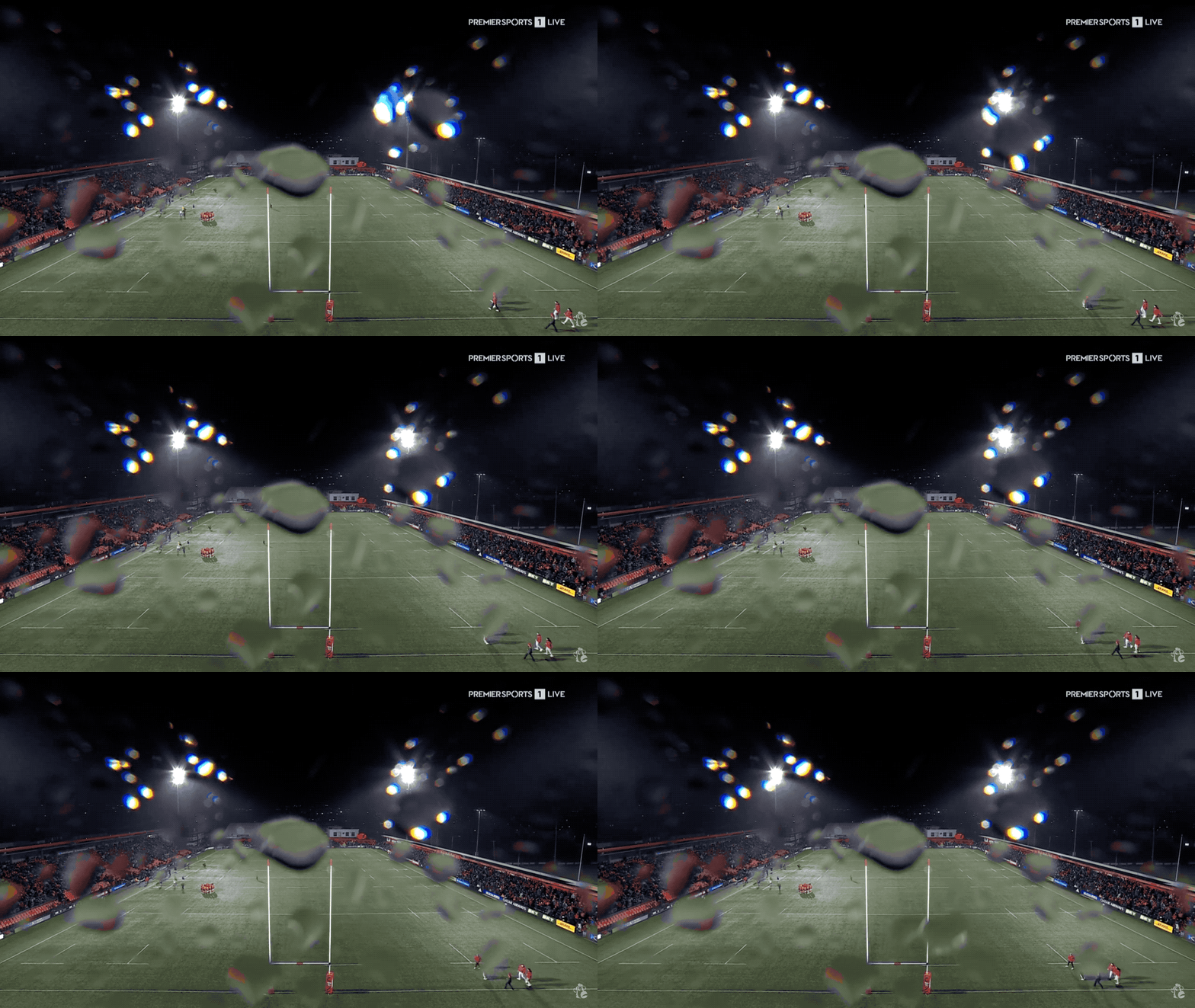
This kick travelled eight metres with four seconds of hangtime because the wind pushed it backwards at the apex. It worked out, this time.
A few minutes later, we exited from the other side of the field. The ball travelled around 10 metres this time, with 3.95 seconds of hang time, but it came back on the Dragons’ side.
They earned a cheap penalty at a ruck a few phases later, and it was 3-0.
A few minutes later, another wind-assisted kick bamboozled Tony Butler in the backfield, enough to bizarrely decide to kick the ball back into the 22 before kicking the ball out on the full; a cheap 22 entry for the Dragons on a night when they only got four, total.
That gave the Dragons the maul platform that I spoke about in the Red Eye. One side entry, early shove, 5m drive, another side entry — try. Now it was 10-0.
That’s a problem.
Being 10-0 down on a night like this is significant, but it’s especially significant for this Munster squad, who have lost the race to 10 points in all five of their last five games.
On a regular, miserable night in Cork, all things being equal, you’d back yourself to make up what was probably a ten-point wind in the second half without much hassle. Dragons would tire — and they did — and playing with that wind at your back lets you stretch the field and defend in depth against a team that can’t really do much to move up the field without an error or a penalty.
With Munster, though, it seems as though we’re increasingly incapable of starting games with any momentum. Last weekend, Castres started with a deliberate ploy to retain possession off the kick off to run us through phase play immediately because they, rightly, figured that at home we’re very likely to give away an enthusiastic penalty. These are the kind of daft moments you get when players are forcing it, which is shorthand for not trusting the system, or components of the system, or feeling individual pressure in the moment. That’s especially meaningful at home, where it feels like the players experience a level of pressure and expectation that isn’t present away from home.
Go back to the opening ten minutes against Leinster in Thomond Park at Christmas. It was the same thing; nervous penalties, pressure forcing guys into daft decisions back-to-back, and each one marching Leinster up the field in a way they couldn’t do without those same penalties.
I think it comes back to a lack of confidence in the reality of our game at this point in the season, magnified by an awareness of how many inconsistent players we have in the squad. When we go 10-0 down, something we often encounter on the road we take to avoid it (weirdly enough), I think we start to panic because we have very little of anything we know works to fall back on, especially when we’re without our internationals.
When you’re under pressure in any given game, every team likes to fall back on what they know works.
We’ll kick well, get up the field and pressure from there.
When they kick, we’ll pressure them in possession, they’ll crack, we’ll get a penalty, lineout and march on from there.
We’ll generate a penalty at this scrum and go down the field.
They’ll kick to us, and we’ll tear into them in post-transition.
3-0? 10-0? No problem. These are the big rocks of your game.
My theory is that not only do we concede early because we worry about our “big rocks” being effective when we need them, but that then complicates how we try to attack those deficits.
Our scrum? Up and down. The last few weeks, it’s been up; a few weeks before that, it was a liability. At the moment, it’s a stable platform, not a penalty machine. Our lineout? This week it was good, last week it was bad, the week before it was good, but whatever changes we’ve made there to turn it around, our maul stopped working on a night you’d really want it to — more on that in the GIF Room.
Our possession game? We view it as a strength — and from a data perspective, it has been, mostly — but it’s very hard to execute on a night like this, so it comes down to winning collisions in the middle of the field, especially when playing into the wind.
Our defence? It’s been a strength too, but we have a tendency to chase defensive rucks a little, which can lead to spoiler penalties.
Most of it comes down to personnel, ultimately. You look through the team, especially with Hanrahan’s injury in the warm-up, and think, where is going to drive us up the field here?
In the first half, in particular, we needed territory and solidity in possession.
Here’s an example of not doing that. First, the pass from Coughlan hits the outside runner against a packed defence, which narrows our line for the next phase.
The carry was stopped pretty quickly by the Dragons, who were standing off our rucks in the first half, so the next phase was being played into a packed area of the field, where we were outnumbered and without adequate forward support, who were still getting up from the previous ruck.
Butler should probably have cut back inside here and looked for support before setting up for a box-kick exit, but he chose to try and stab the ball through a packed line of defenders.
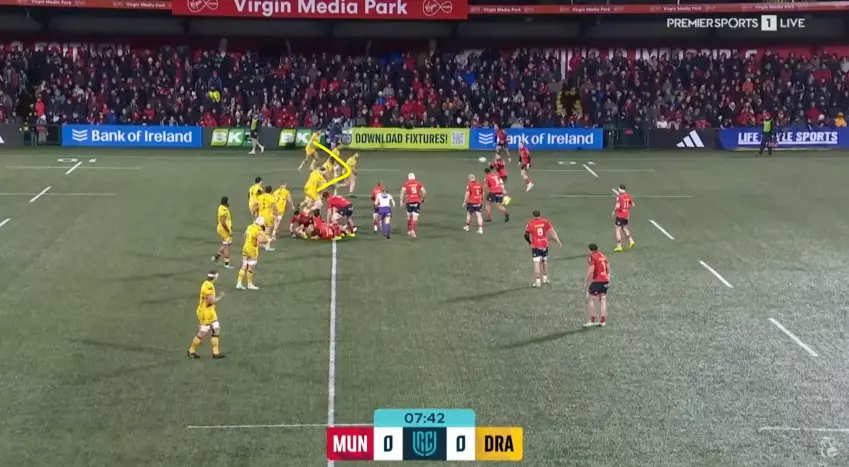
It bounced back, because of course it did, it was the thing most likely to happen, and we were lucky it wasn’t hacked through to our goal line.
This is our post-transition shape — this phase was right after the first kick I showed you — where we often have a split pod of two forwards and a midfielder.
In this instance, Coughlan went for the more difficult pass to Nankivell, but that drew in three other Munster players to the ensuing ruck.
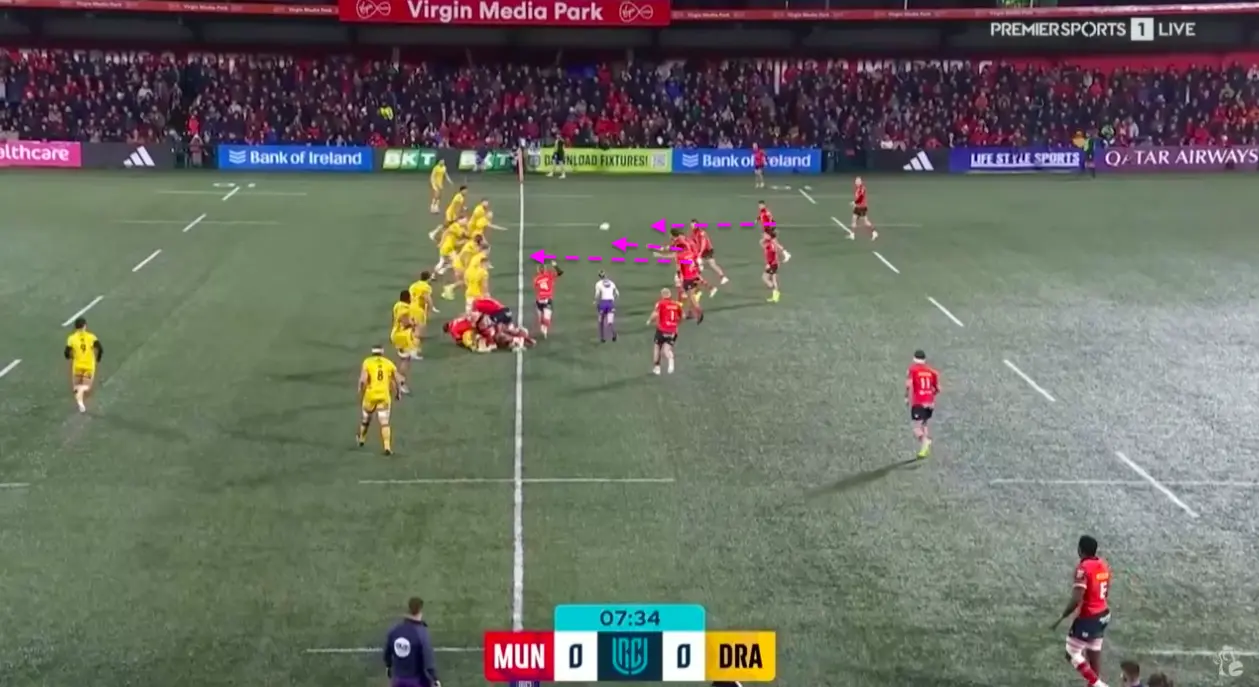
If we’d hit Barron or Kleyn here, we’d have kept Kelly on the outside for the next phase, but the pass selection on this phase determined the gravity on the one afterwards. One decision knocks into the other.
A few minutes later, we worked our way to a decent position after getting through the Dragons on post-transition. We’re in a decent spot here, but our work is cluttered and lacks clarity.
Kelly and Daly go for the same screen pass, which means there’s one less looping runner. I think Daly should probably continue his outside line here, rather than showing for the ball, but he didn’t see Kelly’s transit until late.
That isn’t a massive issue, but it knocks into the next sequence where, thinking ahead, Butler probably needs to hit Abrahams here. He has an angled isolation on Tinus De Beer – a weak defender — and it’s about the only time Abrahams had this kind of open ground, with Sean Edogbo waiting outside him.
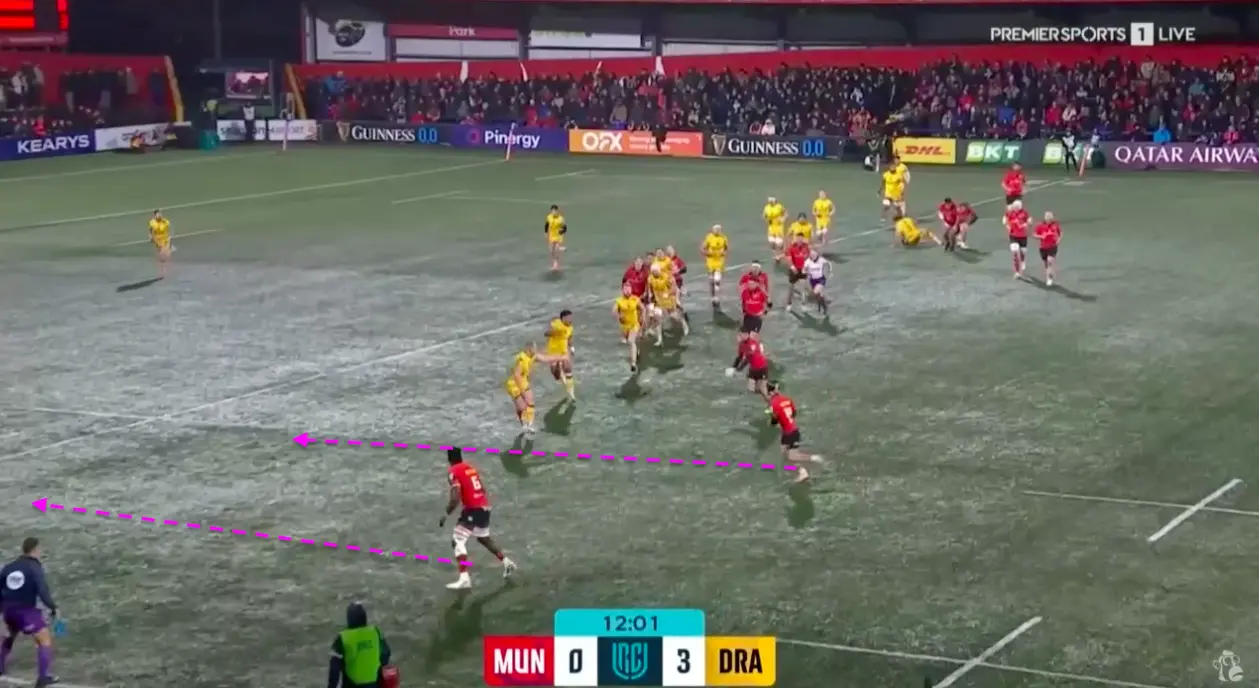
Butler kicked through for a decent touch finder, and, in context, it’s not a bad decision, but remember the wind?
Unless we turn over the lineout or the setup carry, the Dragons can exit with a huge wind at their back. They made 90m off the relieving kick.
Not a bad decision in isolation, but one that had a massive territorial downside. Small margins when you’re playing in a washing machine.
On the next sequence, we ran it back, box kicked, lost the contest, and the Dragons kicked into our half, Butler missed the ball, kicked it back into the 22 and then exited on the full. Dragons maul soaked three penalties out of us — 10-0.
On the next sequence, we won a scrum free kick and, again, cluttered thinking. Coughlan tosses it to Gleeson who’s coming up off the scrum, and he botches the freekick, knocking it on. The Dragons get the scrum, and kick cross field — a tactical error — and Haley has a clear run if he can take this kick uncontested. He loses it in the wind and rain.
Dragons get the scrum, and win a penalty on the next set when Wainwright jogs through a non-tackle from Butler, who falls on the wrong side of the next ruck.
13-0. Keep in mind, Dragons were down to 14 men at this point, also.
Now we had a big problem.
Dragons were beginning to tire at this point, as they always would. They have decent, heavy defenders who were well able to win tight collisions in isolation, but the defensive workload was beginning to tell by the 30th minute, right after they had a try ruled out — rightly — for an illegal strip in contact. They started conceding tired penalties, and that eventually gave us the position to drag a score back late in the half after finally getting some momentum at close range.
Earlier in the half, we’d been too easily stopped coming around the corner. Again, this is a big rock of the game we can’t truly rely on without Jager and Edogbo on the field.
Kleyn, who was struggling all night after some early knocks, was stopped way too easily by the Dragons here, but our set up was very static and flat.
Eventually, we squeezed a 5m tap-and-go out of the Dragons, and Brian Gleeson finished strongly after a good initial latch and drive from Kleyn and Barron.
There’s good work from Ala’alatoa and Loughman as latchers and disrupters there too.
13-7. Halftime.
I was certain that we were going to win the second half.
We did, but it wasn’t as straightforward as that.
***
Data Read Out
In conditions that should have reduced this to a pure territory/discipline arm-wrestle, we lost the scoreboard for 65 minutes, but won the match by doing the unglamorous thing well in the second half: we manufactured far more 22 access (8–4), stayed cleaner (6 pens conceded vs 12), and closed it out when the wind finally flipped in our favour.
Game-state story: we trailed almost all night, then squeezed the finish
- Time in lead: Munster 7 mins (9%); Dragons 65 mins (81%).
- Last 10 mins: Munster 63% possession and 3 points, Dragons 0.
That’s the clearest indicator of how this was won: we didn’t “win” the first hour, we won the last quarter’s territory and control thanks to the bench impact, which is exactly what you want when you’ve got the wind at your back, and the rain is turning everything into handling and discipline.
The decisive KPI: 22 entries and what we did with them
- 22m entries: Munster 8, Dragons 4 (net +4).
- Points per entry: Munster 2.7, Dragons 4.2.
This is the match in a sentence: we created the opportunities; they finished theirs better. On a dry night, that’s a red flag. In driving rain, it’s a reminder that entry volume often beats entry quality — especially if you’re the side that can stay on-task long enough to earn penalties and keep the ball down the right end.
Practical takeaway: holding Dragons to 4 entries is excellent (it’s the platform denial I spoke about pre-game). But conceding 4.2 points per entry tells you those entries were high-value — the kind that come from short fields, set-piece launches, or avoidable mistakes.
This is one of their converted entries, for example, which I’ll wager you won’t see in another professional game this season.
Possession and territory: we lived in their half (eventually)
- Overall possession: Munster 64%, Dragons 36%.
- Territory-by-possession zones: we spent 33% + 41% = 74% of our possession in the Dragons’ half / Dragons 22, with most of that in the second half; they spent 17% + 37% = 54% of theirs in their own 22 / own half.
That’s what the wind shift looks like in numbers. First half (into it), Dragons can sit on you, stand off your rucks and make you feel the elements. Second half (with it), you can keep the ball in their end and force them to defend for long spells, which we eventually did well.
Ruck speed and workload: we played a long, wet game and made them defend it
- Rucks won: Munster 132, Dragons 53.
- Ruck speed: Munster 54% of rucks at 0–3s (Dragons 49%).
- But we also had 16% at 6s+ (Dragons 10%) — that’s a lot of sticky ball.
This is the pressure pattern: we had enough quick ball to keep them working, but too much slow ball to turn pressure into clean scores.
“Width” of our game: pass/carry rate + post-contact + defensive load
Pass-per-carry (shape)
- Munster: 150 passes / 141 carries = 1.06 passes per carry
- Dragons: 79 / 78 = 1.01
That’s not “slinging it” or the multiple-screen ball game that we saw malfunction at times over the last few weeks. That’s a one-pass, pod-to-pod game — exactly what you’d expect in rain and wind. We weren’t trying to play width as in “touchline-to-touchline”; we were trying to play width by shifting the point of contact one channel at a time and making their line reset.
Post-contact metres (collision sustainability)
- Munster: 239m post-contact (≈ 1.70m per carry)
- Dragons: 183m post-contact (≈ 2.35m per carry, on far fewer carries)
We generated more total post-contact because we had far more ball-in-hand volume. In this weather, that matters: it’s the difference between “one-and-done” and being able to keep building phases until the defence blinks. They did, eventually, but we struggled phase by phase when they were fresh.
Defensive workload (what that “width” did to them)
- Dragons tackles: 214 made at 96% completion.
- Munster tackles: 80 made at 84% completion.
That’s the real “width” output: not linebreaks (we had 0), but fatigue and discipline stress. When a team has to make 214 tackles in those conditions, the strain shows up somewhere else — which brings us to the key swing.
Discipline and set piece: the winning margin lives here
- Penalties conceded: Munster 6, Dragons 12 (plus 1 yellow).
- Lineouts: Munster 17 and 100%; Dragons 11 and 91%.
- Scrums: 100% win rate for both sides.
In weather like this, penalties are entries, and entries are points. We didn’t carve them open, but we kept them defending, kept the set piece stable, and their discipline cracked first. That is how you win these games when the weather makes it difficult.
The uncomfortable bits (because they’ll matter against Glasgow)
- Tackle completion at 84% is low, even allowing for a slippery night. We didn’t defend much, but when we did, we leaked too many finishes and/or metres after contact.
- 11 turnovers lost is still a lot of free ball to hand a side that was playing with the wind for 40 minutes, especially considering how narrowly we played.
- 0 linebreaks is not a problem in itself in this weather — but it reinforces that our attack was almost entirely pressure-based. When the pressure doesn’t convert, you can lose these 3/5 points very easily, and we almost did.
TL; DR
This wasn’t pretty, but it was mature in the end. We didn’t beat Dragons by “being better at rugby”; we beat them by owning the match’s operating system on the night: possession, territory, set piece security, and discipline. The stats are blunt: we created double the entries, played almost the entire second half in their half, and forced them into the kind of defensive workload that turns into penalties late. In dishwasher conditions, that’s what winning rugby looks like, on top of finishing well with a strong impact off the bench.
If you forget about this being the Dragons, and everything you might associate with them over the last few seasons, you’ll see this for what it is. A side that’s playing really well over the last three months that loaded up for this game in game-altering conditions, playing against a side that has lost its way a little in the same period.
We’ll regret not getting the bonus point in the last 15 minutes.
I’ll cover it more in the GIF Room, but this is a good example of our maul being too high, badly built and badly timed.
It’s a fairly simple build. Edogbo takes in the middle, lifted by Coombes and Loughman, but our secondary build looks a little muddled.
Quinn is the “rip” in the middle of the second layer, with Ala’atatoa and Wycherley as the drivers on the infield and touchline side, respectively.
Kleyn — our biggest mauler and most powerful tight forward — steps in as the “lock” on the back end, where his power is least effective on this set.
Compounding this, the Dragons beat us to the shove on the drop. Our timing is off.
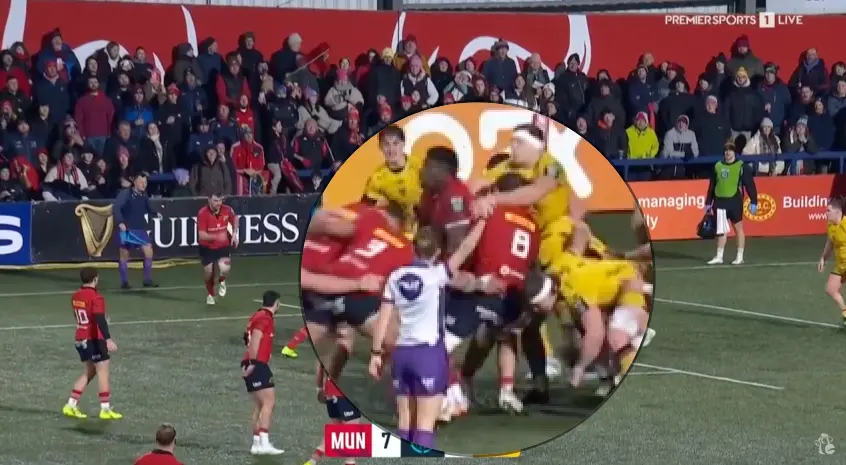
We threw Daly and Kelly into this to add back some momentum, but that cluttered the back end of the maul, and strong infield pressure from Martinez and Coghlan crumpled that side, which collapsed the infield and sent the ball sprawling out on the floor as boots and hands flew.
Dragons broke up the field and should have scored another try.
We were lucky to get away with it, but that’s an allegory for the game itself. We were lucky to get out with a win and, at the same time, disappointed that we didn’t get a bonus point that our second half deserved on the balance of play.
This game showed us what we already know; we’re a side wracked with conflicting system issues, and very little we do to a high level at the moment, while also being almost uniquely vulnerable to individual errors, both in discipline and in execution of the basics. Our starting halfbacks are a good example of this. Good players, capable of great things — Coughlan against Leinster, Butler against Argentina XV — but also capable of dipping wildly moment to moment, phase for phase. They had good moments in the game, Coughlan in particular with his 50/22, but they seem to bring the worst out of each other in a game that turns into a pressure one as it develops, partly due to their mistakes and decision-making. They aren’t alone in that, though, either on Friday night or in general.
Playing in weather like this enhances those issues and exposes us even more to our vulnerability to momentum swings, where we can flap one way or another, like the flags that almost came off their grommets at the Dolphin End of Virgin Media Park.
There is a seam of inconsistency that runs through the squad at the moment like a fissure, in both core systems and individuals, that needs to be chiselled out, one way or another.
Until that inconsistency is addressed, we will continue to flap in strong winds, both of our making and those of our opponents.
| Players | Rating |
|---|---|
| 1. Jeremy Loughman | ★★★ |
| 2. Diarmuid Barron | ★★★★ |
| 3. Michael Ala'alatoa | ★★★ |
| 4. Jean Kleyn | ★★ |
| 5. Fineen Wycherley | ★★★ |
| 6. Sean Edogbo | ★★★★ |
| 7. Ruadhan Quinn | ★★★ |
| 8. Brian Gleeson | ★★★ |
| 9. Ethan Coughlan | ★★ |
| 10. Tony Butler | ★ |
| 11. Shane Daly | ★★★ |
| 12. Alex Nankivell | ★★★ |
| 13. Dan Kelly | ★★★ |
| 14. Thaakir Abrahams | ★★ |
| 15. Mike Haley | ★★★ |
| 16. Lee Barron | N/A |
| 17. Josh Wycherley | ★★★ |
| 18. Oli Jager | ★★★★ |
| 19. Evan O'Connell | ★★★★ |
| 20. Gavin Coombes | ★★★★ |
| 21. Paddy Patterson | ★★★ |
| 22. Jack O'Donoghue | ★★★ |
| 23. Diarmuid Killgallen | ★★★ |
