



Ultimately, these games are for winning, and we didn’t. That’s the long and short of it.
I suppose my job is to work out why we lost and then peel through the context.
To start, let’s look at last season. Barring the Leinster game, Munster’s opening run of wins up to the Stormers in November, as I wrote on the €10 tier around the Six Nations block, was defined by narrow wins that overcame worrying underlying trends. By the second half of the season, those narrow wins became varying degrees of narrow losses, as the underlying problems became more profound. Boiled down to the basics, we were underscoring our own 22 entries and conceding too regularly on the opposite end. Sooner or later, that comes back to bite you, and it did.
After watching this game back, it’s almost the opposite. So much of what we did in this game for 50 minutes was good — and transferable — only to be undercut by the same things that cost us last season. Killer penalty concessions against an efficient team, scrum trouble and running out of gas as we struggled to live with the shape of the game as it transpired.
The challenge will be promoting the first 50 minutes and squeezing the weakness out of our game as soon as possible.
Before the game, it was fair to say that Glasgow dominating the ball was broadly predictable, and was pretty accurate. This is what Glasgow do, home or away — they hang onto possession, go through the phases and challenge your discipline and centre-field defence. If you can repel them in the middle of the field without conceding easy offside or not-rolling-away penalties, as we did, they start to pull the ball back and chase the edges and, if you hold them there, you have a high percentage chance of forcing a knock-on or other error, which can get you up the field. They carry, hit rucks, go again. That’s the challenge. In the first half, our tackle pressure and wide coverage were really good, so Glasgow, for the most part, popped back and forth across the field to no real advantage. Even off their set piece, which is a key part of their starter sequences, we scrambled well even when we got our fold wrong, and that allowed us to soak up pressure and then, through our scrum, move the ball up the field.
This is a good example: a great tackle and pressure on first phase, Glasgow run a decoy play, we get caught, but scramble well to cover across.
From the resulting scrum, Glasgow try to walk around the corner — as they did all game — but because we’re so solid at loosehead first, and then tighthead, the walk around is obvious. Penalty Munster.
This is what you need to do against Glasgow — turn their phase count into dead calories.
Up to that point, we had shown a real efficiency in moving up the field through our own strike plays.
This one — a nice scrumhalf bounce loop — pressured an offside penalty from Glasgow on the subsequent phase play. 3-0.
We defended their follow up pressure well after an obstruction penalty, forced a mistake and then pressured them down the field, earning a yellow card for a deliberate knock-on.
Then we did something we rarely managed last season — hit two back to back strike plays to generate an easy score from set piece. This is incredibly efficient rugby.
Two strike plays, one to gain 40m, and then another to generate a score in the corner, all without a single ruck.
10-0.
A great start.
Glasgow were always going to fight back — they’re a good, settled side — but winning the race to 10 points is as good an indicator as you can get.
We got caught out with another post-lineout strike play to give them their first proper go at the 5m line later in the half. Scrambled well, but got caught at the breakdown.
That came from a poor exit — after Ben O’Connor had done everything right up until the kick — something that hurt us on a few occasions, as the game wore on.
But we didn’t get bogged down on it.
We used another strike play to get up the field soon after and, despite a forward pass, had a very defensible position deep in the Glasgow half. Glasgow’s scrum on their own put-in is a real strength of theirs, as I mentioned before the game. They don’t tend to concede penalties on their own put-in, in part because their hooker never has to strike for the ball. Horne, or whoever is the scrumhalf, rolls the ball through their loosehead’s legs, straight into the second row, so their front row never has to account for the pressure change of their hooker lifting his leg to strike.
That allows their front five to go immediately on the put-in and try to generate that walk-around pressure, but because Brookes and Milne were so dominant, they never got a settled platform to disguise the walk-around for what it is.
On this instance, their tighthead was so keen to generate that impression that he got caught and pumped by Milne. Scrum penalty against the head.
Kick to the corner. Maul. Try.
17-7.
Good defensive pressure. Efficient strike plays. Efficient conversion of 22 entries and good energy management. Had that continued in the second half, we’d have won, but it’s an 80-minute game.
Glasgow were never just going to fold up their tent and go home, and before long, the pressure began to tell. The key point was this moment, around 46 minutes in. We’d done the hard part, repelling Glasgow on our 5m line, but overplayed this one slightly — albeit for the right reasons.
We got isolated and turned over.
I’d argue there’s a bit of rolling into the cleaning lane here from the Glasgow tackler, which creates the space for the turnover, but they’d been getting the reward for that most of the game and, at this point, a lot of our starting front five were beginning to flag under pressure. O’Connell, for example, finished the game with 20 tackles. At this point, he was close to 12/13. Wycherley was the same. Glasgow scored off the back of this penalty, and it was back to a three-point game. Nothing at all.
Milne and Brooks had given everything for 50 minutes, so we needed a strong kick-off from the bench to see out the game.
We didn’t get it.
We couldn’t afford — energy-wise — to soak up another 30 minutes of Glasgow pressure, so when we got the ball, we needed to keep it and reverse Glasgow’s carrying calories back into defence. They carry more than anyone, hit more rucks than anyone, so if you can hold the ball after they’ve spent a ton of energy on-ball, you can flush them out. The long and short of it is that Glasgow went to their 6/2 bench en masse between the 45th and 60th minutes, and it won them the game. That pressure in the front five did the damage.
We know what Glasgow uses their energy on. Phase play, ruck entries, maul pressure, counter-jumping in the lineout. It’s why they almost always use a 6/2 bench.
It’s why being down to only two senior locks for this game was so costly — Ryan, Beirne, Ahern and Edogbo were all unavailable. The areas where we were redlining around 50 minutes in were vitally important when it came to winning the individual and unit battles that would define the endgame.
We won a penalty after Glasgow’s try with an excellent series of tight carrying that eventually forced them offside around the 60-minute mark.
We chose to kick for three points, but, to be honest, I felt that was the time when we needed to go down the line to hunt for seven. That said, I get the logic. Glasgow were having to work incredibly hard for their points, even with their possession and territory advantage. So a six-point lead at the point would have been defendable if we’d held out for the next 10 minutes. We didn’t. Hodnett was pinged for a marginal enough seat belt tackle that even Glasgow didn’t shout for, and even though the penalty didn’t go deep into our 22, a mistake off the lineout gave them an in.
Nankivell sat down on the pinch line here, which opened up the isolation on the edge. Glasgow scored from the linebreak. A cheap concession at a bad time.
A killer call on a marginal forward pass gave them another scrum penalty entry on our next possession; they converted it off the back of a strong maul, and that was that.
Six points down on the last play, more or less, and we needed to be accurate, but the restart wasn’t what it needed to be, and that was that.
The big talking point here is penalty count — we conceded 15 — which makes it very difficult to win a game against a team that ostensibly runs on penalties.
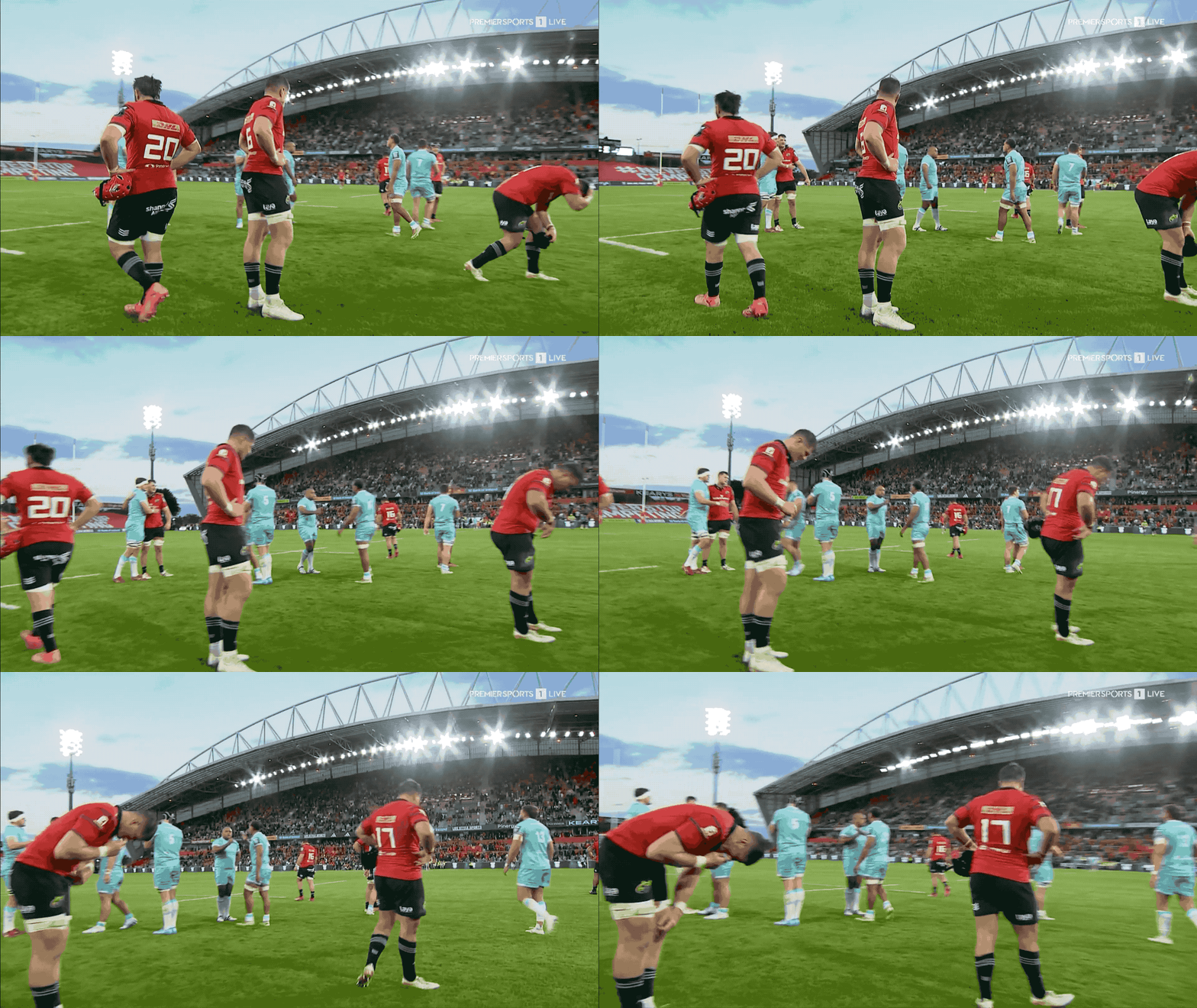
Why we conceded those penalties comes back to territory pressure and energy management. Three of those penalties were second-half scrum penalties, which is a bad reminder of last season’s core weakness. Wycherley and Ala’alatoa had a rough time off the bench, but how wiped our second row was after 40+ tackles between them had a fair bit to do with that.
This is a tired scrum in almost every facet.
But our exits weren’t good enough, either. When we forced turnovers or won penalties, we didn’t gain enough ground, so our improved gain-line winning and dominant tackles were all a little too close to our 22 for comfort. Glasgow will keep going until they get that penalty or they lose the ball, and too often they got a cheap penalty that gave them all the invitation they needed.
That said, our 22 efficiency and the quality of our strike plays — along with wildly improved ball carrying — suggest that there’s more in this defeat than meets the eye, albeit with another witheringly difficult opponent up next week in the Bulls.
With an 80-minute performance in the scrum and more depth in the front five, it’s arguable that we’d have had enough to win this one given how it played out, but wanting it and getting it are two different things.
What this game showed us is that, at this point in the season, we’re mostly better in the areas that cost us last season, but not for 80 minutes.
Our attacking depth and strike plays — much better, albeit with a few glitches when it comes to ruck entries as players get used to what’s required and where.
But we’ll need a stronger 23, especially against top-tier opposition, or, failing that, better discipline and winning more critical moments.
| Players | Rating |
|---|---|
| 1. Michael Milne | ★★★★ |
| 2. Diarmuid Barron | ★★★ |
| 3. Kieran Brookes | ★★★★ |
| 4. Evan O’Connell | ★★★ |
| 5. Fineen Wycherley | ★★★ |
| 6. Jack O’Donoghue | ★★★ |
| 7. Alex Kendellen | ★★★★ |
| 8. Gavin Coombes | ★★★★ |
| 9. Ben O’Donovan | ★★★★ |
| 10. JJ Hanrahan | ★★★ |
| 11. Ben O’Connor | ★★★ |
| 12. Sean O’Brien | ★★★ |
| 13. Alex Nankivell | ★★★ |
| 14. Diarmuid Kilgallen | ★★★ |
| 15. Mike Haley | N/A |
| 16. Marnus Van Der Merwe | ★★★ |
| 17. Josh Wycherley | ★ |
| 18. Michael Ala’alatoa | ★★ |
| 19. Brian Gleeson | ★★ |
| 20. John Hodnett | ★★ |
| 21. Jake O’Riordan | ★★★ |
| 22. Charlie O’Shea | N/A |
| 23. Dan Kelly | ★★★ |
