


I pulled into the Clonakilty Park Hotel around 4 pm on Sunday. I had been working until 1 am that evening, getting my Schedule article out after doing live comms for the game on Live 95.
I was tired. I am tired. But the energy was good.
One thing I noticed driving through Charleville, Buttevant, Blarney, Bandon and then through Clonakilty was how much Munster gear I saw walking around the streets; a lot of it brand new.
Something is building.
Call it buzz, expectation, hype, a bandwagon, whatever you like. Something is there.
I was sitting in the soft play centre in the hotel after arriving, and plopped down next to a guy in one of those new Munster jerseys. Soft play centres are fundamentally liminal spaces. You can hear (and hopefully see) your kids running around or getting stuck in a ball pit. An hour goes like ten minutes, but those ten minutes take an hour and a half to pass.
We were doing the usual — scrolling on the phones, looking up every few minutes, back to scrolling. I had had enough of the phone, so I turned to him and said “good result at the weekend”, pointing at the jersey.
What if he were a subscriber, I thought for a second. That would be even better; a little bit of an ego boost after I took three attempts to parallel park when we arrived. If he were a subscriber, he hid it well.
He said the usual stuff. Good win. Tough game. What was that ref at? But then he said something else.
“You’d trust this team with the drive up”
I hadn’t thought about it like that. The guy was from outside Rosscarbery, which, as I know well, is around 2.5 hours away from Limerick — and that’s up and down. Coming back down from Limerick to Rosscarbery after a loss leaves a lot of time to start rueing things; too much time.
By the time you turn the engine off, nobody would blame you for deciding that you’ll be more discerning with your time.
But trust is building with this team. Every win of these five in a row has served as something of a parable to the past.
Not just “we’d have lost this last season”, but something a little deeper than that.
Sure, beating a loaded Leinster side in Croke Park — with all the symbolism that comes with that — helps build excitement, but so many of these last five games, including this one, have had echoes of the long drive home in them that digging in to turn losses into wins resonates even harder.
Munster’s golden age wasn’t really about playing scintillating rugby every single week, and it certainly wasn’t built on being a relentless winning machine; for seven seasons before 2006, Munster were seen as heartbreak specialists who always found a way to lose semi-finals or finals.
It was about trust. You trusted that when you pitched up at a game, the team would pitch up too.
When we’ve been losing at points during all three home games in the last five weeks — quick stat: we’ve spent longer losing on the scoreboard in all three games than we have in the lead — we’ve bit down on the mouthguard, and started carrying hard, rucking with venom and dragging ourselves back into the lead by hook or by crook. We’ve fought for the lead, and then fought to keep it.
Plenty of Munster teams have done that in the past, but it felt in the last few years that fight showed itself in trying to fling offloads to nowhere or stringing five or six chaotic phases backwards.
This win over Connacht wasn’t glamorous, or even all that enjoyable to watch as a spectacle, but it showed that, whatever about anything else, this team doesn’t baulk when the scoreboard is against them.
They bite down on the mouth guard, and they keep going in a way that Munster fans can instinctively.
So you’d trust them with the drive to Limerick.
***
All that matters here, really, is that Munster found a way to win in achingly difficult circumstances.
Connacht, as we fully expected, were as scrappy and comfortable playing on the back foot as they almost always are in Thomond Park, and it took a monstrous effort in the second half to overcome a game plan designed to frustrate Munster’s tight game, and empowered through one of the worst officiating performances you’ll see at this, or any, level. But again, that was also fully expected.
It can be withering to hear coaching talking points repeated throughout the season here, but I promise that after this time, and the headline, it’ll be the last you’ll read of me saying this: as Clayton McMillan has spoken about this season repeatedly, Munster found a way.
There. No more.
***
At a fundamental level, this game played out as it did because we struggled to impose a kicking strategy that would allow us to pressurise Connacht. Even then, our lineout malfunctioned under constant counter-pod pressure, so how well kicking execution would have played out in practice is anyone’s guess.
That’s why it seemed like the first half was played over way too much ground for Munster’s liking. This is a good illustration of what I’m trying to talk about; Coughlan and Hanrahan being ever so slightly out of sync on this contestable, combined with Connacht knowing exactly where and how to pressure Hanrahan, who was slow on his kicking action all night.
Hanrahan has to adjust before the catch here, and that slows his shape even more, which leads directly to that leisurely lob into the middle of the field.
From the data I’m looking at, Connacht produced two linebreaks all night and scored from one of them — a magical offload by Josh Ioane.
Every other try and they scored came off the back of a weird Munster penalty concession in possession. Without those ladders up the field, they found it really difficult to get any access. Again, our kicking game helped them here.
Coughlan skews his pass to Hanrahan’s inside shoulder. Hanrahan has to adjust and kick to his left when Connacht’s forward line presses his right. We have to chase on the “wrong” side of the field, leaving a huge gap behind our left side, and Ioane did really well to force a hasty exit to the 5m line. We turned the subsequent lineout drive over, and then forced a scrum penalty, but were punished again for a penalty in possession when Dan Kelly was adjudged to have sealed off a breakdown with the clock almost in the red.
Andrea Piardi and his TMO somehow conspired to find a clear grounding from this angle alone.
I was on the radio for this, so my live reaction to this decision needed to be shouted into the crook of my elbow, but it’s safe to say that after last season’s Piardi Debacle at Thomond Park, not many around us were all that surprised.
15-12 at the half, and it felt like the first 40 minutes had completely slipped away from us. That mostly came back on a low-energy Munster performance, combined with excellent Connacht defence for the most part. Like Cardiff in the same stadium a few weeks before, Connacht knew well that if you commit to defending on the back foot, with the right referee, you can frustrate the life out of an opponent.
The second half was, essentially, Munster attack versus dug-in Connacht defence. At halftime, we seemed to really commit to narrowing up our forward carrying platform to force compressions in the Connacht defence or, just as good, make what we believed were pretty obvious not rolling away penalties really visible.
It worked — eventually — but it was far from free-flowing.
The main battle came down to this: Munster carrying tight off #9 trying to generate tempo up against Connacht using that old Lancaster gimmick of rolling into the ball placement as the second action after a tackle.
Go back to Leinster in 2018/19, and you’ll see the same defensive principles. On another day, Connacht would have ended up conceding another five penalties, but they rolled the dice and almost got the reward. It made every single ruck, every single collision point, an absolute mess, and it meant the game was mostly played out in a shoebox.
During the half-time break, it seems pretty clear to me that the Munster coaching staff realised that the only way around this Connacht team was actually through them. For the second third home game in a row, we went in at halftime without a lead, so what worked against Cardiff and Edinburgh would have to work here, too.
It changed the context of the approach.
Connacht, with a three-point cushion, plus a lot of their bench depleted already, took to a heavy volume kicking game to keep us pinned back in our half, trusting their ability to defend us from deep.
They knew going deep with most of their bench used up, so they wanted to keep us at arm’s length. That, combined with their ability to throw gum in the gears of our tight carrying game and a scrappy, gimmicky scrum, was enough to make this incredibly tense.
The opening four minutes of the second half were, essentially, a cagey kick battle looking for position. At 15-12, the next score was absolutely vital, so whoever had position had the advantage.
It was this kick by JJ Hanrahan that started what seemed like a never-ending encampment in the Connacht half.
It’s nothing remarkable, but it finds grass and two loopy bounces to put the Connacht kicker off just enough to scuff his exit.
And that was it. Breaking Connacht down around the edges was becoming more and more difficult, so when they kicked to relieve pressure, we swarmed right back to the 22 and beat them with volume, put them under the blowtorch and waited for the scorch marks to show.
***
It was the impact off the bench that swung it for us. Quinn, McCarthy, O’Connell, Foxe, Butler, and Jake O’Riordan, on for his debut, gave us the impetus we needed to do the business.
Ruadhan Quinn won key collisions for us in the edge spaces. O’Connell stabilised our lineout — as a caller and a primary jumper, which was great — as well as hitting a few rucks like they owed him €500.
Foxe battered through tight collisions and latched onto O’Donoghue to the winning try, and Shay McCarthy smashed everything that moved in a white shirt.
Butler provided a bit of solidity and running threat, while Jake O’Riordan looked like a zippy, composed veteran, and not a young lad playing in the biggest game of his life to that point.
They were trusted to earn us the win — they all came on the field when we were losing — and paid that trust back in spades.
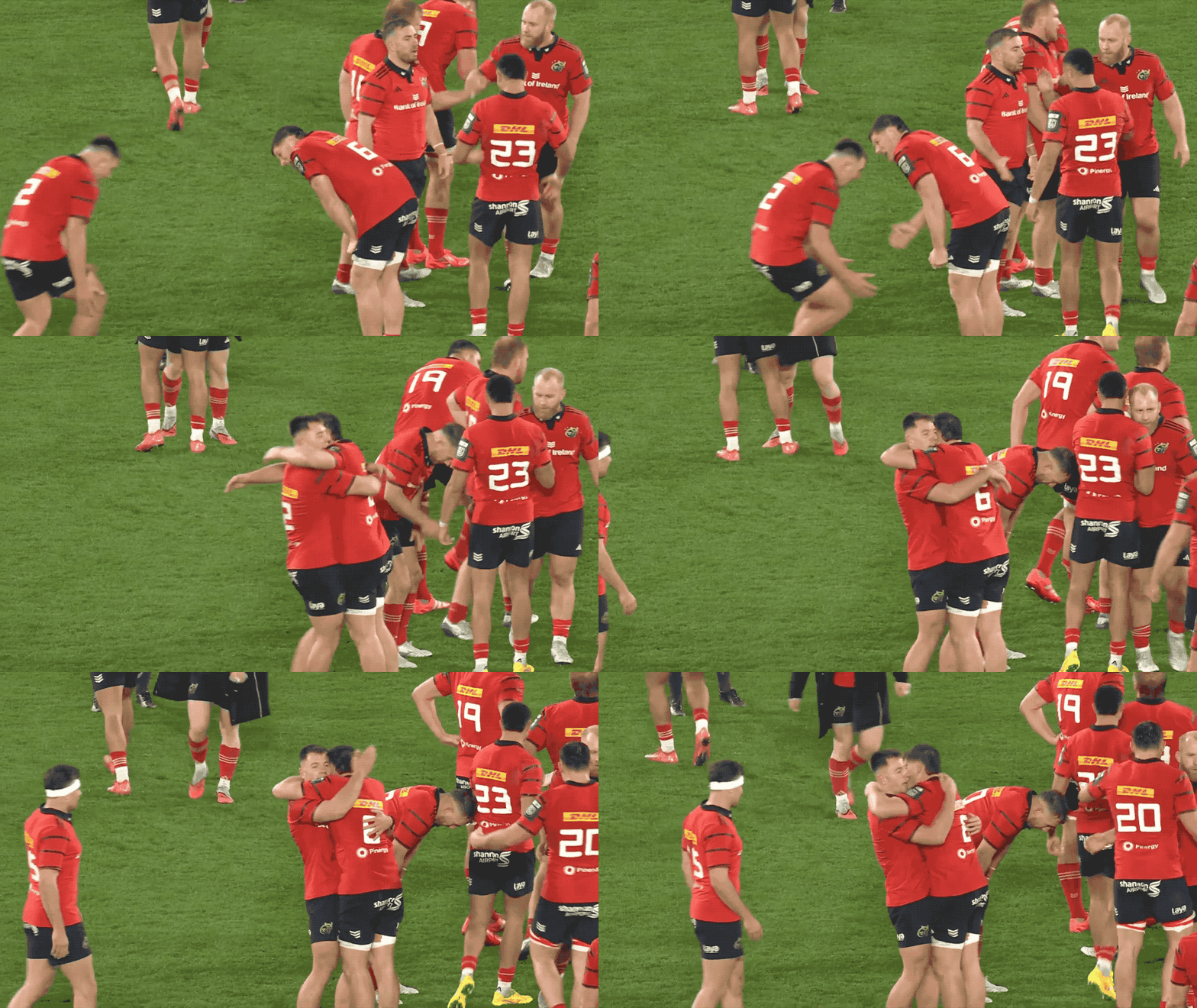
Look at O’Connell and Foxe here; that’s desire, that’s impact, and that’s taking your opportunity.
O’Riordan found a great pass to Nankivell, who drove through two or three defenders to get us inside the 5m line and Connacht eventually broke down.
Look at this latch and drive from Foxe and O’Donoghue.
A small thing, but an important one. In a two-point game, it counts for a lot.
After a nervy defensive set, a knock-on was forced, the game ended, and Connacht fell to their feet in unison. Relief. Five wins from five. Munster didn’t play well here. In fact, I’d say we played fairly poorly overall, but after the catharsis of last week, the onus was on making sure that whatever happened, we came away with the W here to cauterise the gains of Croke Park. It hurt, but cauterising always does.
| Players | Rating |
|---|---|
| 1. Mikey Milne | ★★★ |
| 2. Lee Barron | ★★★★ |
| 3. John Ryan | ★★★ |
| 4. Jean Kleyn | ★★★ |
| 5. Fineen Wycherley | ★★★ |
| 6. Jack O'Donoghue | ★★★★★ |
| 7. John Hodnett | ★★★ |
| 8. Gavin Coombes | ★★★★ |
| 9. Ethan Coughlan | ★★ |
| 10. JJ Hanrahan | ★★ |
| 11. Thaakir Abrahams | N/A |
| 12. Alex Nankivell | ★★★★★ |
| 13. Dan Kelly | ★★★★ |
| 14. Diarmuid Kilgallen | ★★★★ |
| 15. Shane Daly | ★★★★ |
| 16. Niall Scannell | N/A |
| 17. Jeremy Loughman | ★★★ |
| 18. Ronan Foxe | ★★★★ |
| 19. Evan O'Connell | ★★★★ |
| 20. Ruadhan Quinn | ★★★★ |
| 21. Jake O'Riordan | ★★★★ |
| 22. Tony Butler | ★★★ |
| 23. Shay McCarthy | ★★★★ |
This was a standout performance by Jack O’Donoghue, who seems to have grown with every game this season. Is it the extra size? Is it the tweaked role in the #6 jersey? Or is it stepping out from the shadow of Peter O’Mahony and embracing a true leadership role, off and on the field?
Whatever it is, he is playing the rugby of his life. ★★★★★
Alex Nankivell won almost every collision he took on here and dragged us into good positions almost constantly. He smashed through Hugh Gavin in the build-up to the winning try, delayed a beautiful pass to the excellent Dan Kelly right before O’Donoghue’s first and generally looked like the best back on the field for almost all of this. ★★★★★
Digestible Stats to Repeat to your Friends
Volume beat Efficiency. Munster had ~11 entries to Connacht’s ~5, but returned only ~1.5 points/entry versus Connacht’s ~3.0. The game was won on the basis of volume of visits and possession, rather than red-zone conversion. In the second half, we kept getting the ball back into the red zone, and eventually got the reward.
Ruck Tempo Edge. Munster produced 64% sub-3s ruck ball (Connacht 41%) and won 138 rucks to 96 — clear multi-phase control that stressed Connacht when it counted.
Carry Dominance. 190 carries to 112 and a huge 378m post-contact to 200m. That, plus 5–2 line breaks, explains the tackle load Munster forced on Connacht and why the dam eventually broke.
What swung it. Tempo + carry dominance + territory eventually told, and one kick separated the sides. The performance baseline is strong; the conversion layer (lineout accuracy, decision-making after the break, finishing on advantage) is where the easy extra BP lives.
Fix-list for Argentina. (1) Clean the lineout in the 22 (timing/lifts vs Connacht’s reads). (2) Tighten red-zone D—first-phase maul/starter moments cost ~3.0 p/entry. (3) Keep the ruck speed; it created 30+ missed/ineffective tackles; the points will follow.
