


The modern game is a battle between possession rugby and out-of-possession rugby — your game state. The very best teams will be comfortable in all facets of the game, but this is usually out of reach for most sides, be they club or test teams. For most clubs, you will assess the players at your disposal — usually your best players — and find a game state that best highlights what they’re good at and hides what they’re not.
This is, arguably, the hardest part of coaching.
You might have halfbacks and midfielders, for example, who are really good in possession. This will, naturally, lead you to building a more “in-possession” style, especially if you have a roster of good forward ball carriers.
On the other hand, you might have halfbacks who are really accurate kickers, good aerial duelists and strong kickers, with a mobile forward pack — this would naturally lead you to a longer kicking game, where you can break a team down on counter-transition.
Then you might have a really strong, heavy pack of forwards with a great scrum and maul game — you might choose to enhance that with a shorter contestable game that cuts down on their movement without the ball, increases their scrum involvements, and then play a tighter, narrower in-possession game closer to the opposition 22 where you can make your weight count for more. Your backs need to be very comfortable retaining possession outside the general “lane” of your forwards in this style, but that’s the challenge of putting a team together.
You have to know where you’re strong — and need to double down on — and where you’re weak. But the question then becomes something more complex — whether you’re strong enough in those areas you’re good at to win rugby games at the level you need to be successful.
That’s where the complexity comes in.
There’s no point in being a decent “in possession” side when you aim to win trophies. The teams that stand in your way at that level are great at their particular game state, so if they’re better at heavy rugby, or defensive counter-transition, or offensive counter-transition, you’re off to a loser on the first day of preseason. Specialists will always beat generalists when it comes right down to it, because specialists specialise in making you play their game on their terms.
This is where the top coaches earn their money.
In a general sense, the roots of style boil down to kicking tendencies and set piece.
Every style ultimately comes down to these things.
If you’re an in-possession team, your identity is based on the concept that, when teams kick the ball to you, they don’t get it back on their terms.
If you’re an out-of-possession team, your identity is based on the concept that, when you kick the ball to the opposition, they will lose it on your terms.
The set piece decides the volume of that discussion on both sides.
This is a short way of saying that you can choose whatever game-state you want, but if you don’t have a functioning offensive and defensive lineout, maul or scrum, you won’t get to dictate your concept to the opponent effectively.
This is the beauty of this sport.
The more you kick, the more likely you are to rely on your scrum and lineout. If they don’t work, your out-of-possession game won’t work either. There’s no point in “playing the percentages” when that can be hacked by the opposition simply kicking the ball off the field, or by you forcing a knock-on in the tackle.
If you choose to keep the ball in hand more often than others, you’d better have a good scrum and maul that’s capable of keeping the pressure on the opponents you’re trying to wear down. If you’ve decided that you want to be a high-tempo, high-possession team, then your kryptonite simply can’t be knocking the ball on.
You don’t need a dominant scrum or lineout — although that would be nice — to make either style work, or the transition derivatives of it, but it has to be good at the very least.
At Munster last season, there wasn’t a whole lot that we did well.
That’s bad — obviously — but it does give Clayton McMillan something of a blank slate to work with. If I were to describe Munster in the last few seasons, I would classify us as an “in-possession” team. We were more comfortable, or felt we were at least, with the ball in hand, pressuring the opposition.
I have written before on these pages about how I felt our particular setup was a holdover from a previous iteration of this team. The players that drove the system then — RG Snyman, Peak Jean Kleyn, Antoine Frisch, Malakai Fekitoa, Late Prime Peter O’Mahony, Prime Tadhg Beirne, Late Prime Conor Murray and ascending Craig Casey and Jack Crowley — were either not at the club, greatly reduced from their peak or struggling in the absence of the others in a system designed to maximise qualities that were no longer there.
Our squad changed, but our system stayed broadly the same despite the best efforts of everyone involved.
Now, we have a chance to change it this summer, with a whole book on what worked and didn’t work from the last two seasons, in reality, to drive it.
In a general sense, I don’t think there’s much sense in ripping everything we did over the last few years up and moving to an off-ball, out-of-possession game, or even a defensive counter-transition game.
That would be tempting, given how last season went, and while we could certainly kick the ball more than we did in a general sense, I don’t think we’re set up to play a game that primarily chooses to do its best work out of possession.
We’re a decent defensive team that won a lot of turnovers last season, but I think moving fully to a structure that focuses on that as a point of difference is a losing strategy.
I think the biggest example of what we could move towards requires a change in forward shape and depth, combined with a radical overhaul of our set piece.
The best example of that, unfortunately, is Glasgow.
Last season, Munster were firmly in the group of teams that kicked less frequently and held the ball more often per possession along with Glasgow and Connacht, but were the worst of the three when it came to errors.
I think there are three things to note here;
- Of those three, Connacht were the team that teams felt most comfortable kicking to and defending, but were caught by surprise by their effectiveness in possession. This will be tested next season. If I were to grade them, I would list them as “ascending” in this style, with tests of it to come as teams get to grips with them.
- Munster were the team kicked to most often because of the opposition’s general level of comfort with our possession game, after three and a half seasons of data. I would list us as “past prime” in this style.
- Glasgow were the most “prime” team in this style, where teams kick to them to relieve pressure and then find themselves getting torn up with their possession game, unless a firm set piece advantage could be gleaned.
One of the things we can take from Glasgow is that they have several key weapons that they can lean on constantly;
- A very reliable scrum that only really comes under pressure from super heavyweight teams.
- A high-possession style ingrained for the guts of ten years, with a ton of cohesion and strike plays built off their generally very solid set piece.
- A high-energy, high-pressure defensive style built to get the ball back as quickly as possible when they lose it.
- Core players that the style is built around — Horne, Cummings, Tuipulotu, Steyn, McKay, Darge, the Fagersons and now Jamie Ritchie. You’ll notice that the #10 isn’t one of them here, as it’s purely a facilitatory role.
- An outstanding maul that acts as a finishing tool and penalty generator
It’s a self-sustaining system, with each element playing into the other. That isn’t to say that Glasgow are unbeatable — they won nothing last season, or the year before — but they are the clearest example I can find of a team with a distinct playing identity that is so closely tailored to their playing group’s strengths that it allows them to punch above their weight and budget.
One thing you’ll always spot with Glasgow is how deep they attack the pass from.
Look at how deep Glasgow are from this wide ruck reset.
All of the Glasgow players are 10m back from the ruck and get up to close to a full clip when he takes the ball.
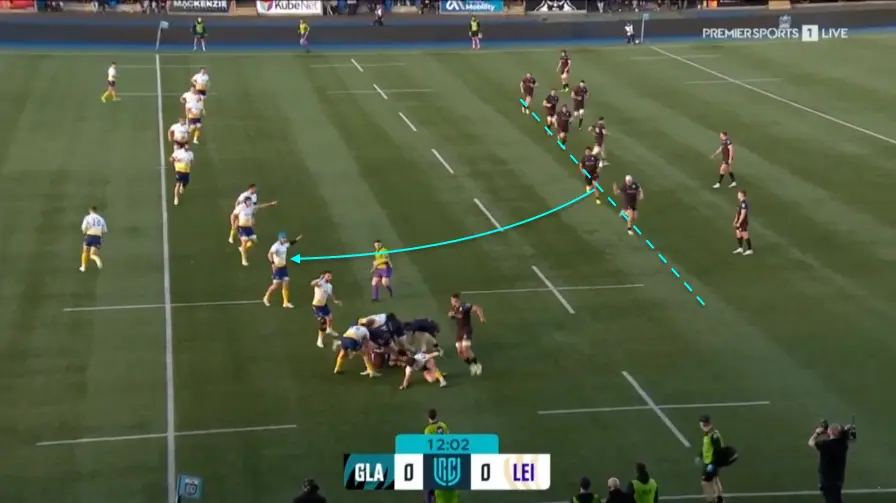
Leinster do well to get a stop, but it costs them on this phase — it’s not an easy tackle.
It’s their depth to the gain line when they take the ball that informs their in-possession game.
There’s something there for Munster to look at this preseason. If you look at Glasgow, their game is based on bouncing through their midfield to get those deep runners attacking the line, turning blitz defence into a high-risk strategy. Sure, they knock on the ball and lose possession in one form or another, but they have the second-lowest error count per possession in the club game — behind Connacht, and structurally similar to them — because their handlers are given every possible chance to handle it cleanly. Time on the ball, taken at pace, improves the chance that a high-possession team keeps the ball.
With the young players we have growing into the team this season, this is a way to keep on the possession tendencies that we’ve been building since the summer of 2022, but in a way that enhances our strengths as they are right now.
