


The really interesting thing about tracking individual Offensive Ruck Work and Collective Offensive Ruck Work metrics, to me anyway, is that if you do it for long enough, you begin to see patterns emerging.
For example, you can see that Josh Van Der Flier’s ruck tracker role in the last year has completely overtaken his Much Improved Ball Carrying Game™ that came to the fore in 2021/22, mainly since the emergence of Dan Sheehan as a starter. Sheehan has taken up a lot of Van Der Flier’s carrying output but that has freed Van Der Flier to become one of the best and most reliable ruck guards in the game. When Van Der Flier is having a big game, you can tell by the sheer number of guard actions in his ORW score. He doesn’t need to fly off his feet to create the ruck and ensuing offside line, because he’s right where he needs to be when he needs to be. Van Der Flier is so rarely out of position that marking him for more than one inefficient entry per game is a genuine oddity. That’s the personality of his game at the offensive ruck and you only see it when you classify his entries beyond the usual “first arrivals” or “ruck attendances”.
Collectively, you can also get a good idea of how Ireland or Munster stack up against certain opposition. Against South Africa, for example, the fabric of the game was reflected in the CORW numbers. Ireland had a CORW score of less than 350, which is exactly what you’d expect in a game as tense as that one, played out as it was in a really narrow space over just 27 minutes of ball-in-play time. The low score didn’t mean Ireland played badly – far from it – it just reflected what we saw on the field as it ebbed and flowed in Ireland’s favour and then the Springboks’.
Ireland’s dominant win over Scotland showcased a different type of game though, to the point that we can actually see how the scoring differed from our previous games. Why did we look so dominant? Let’s have a look at the ORW scoring.
IRELAND’S OFFENSIVE RUCK WORK SCORE vs SCOTLAND
- A Dominant Clean is an action that decisively secures possession when the ball carrier takes contact. A Dominant Clean does not have to be the first arrival at the breakdown but it is rewarded in the context of effectiveness. We will assign this action 3 points.
- A Guard Action is where a player plays a role in helping to retain possession after we have “re-won” the ball on the floor. Sometimes this can happen on a carry/ruck point where there is no active contention by the opposition. Let’s assign this action 2 points.
- An Attendance can be anything from standing as a “kick shield” on a ruck to adding a bit of bulk to ward against a counter-ruck. I’m marking this down as being worth 1 point.
- An Ineffective Action is a blown cleanout, a lean, a breakdown penalty or an action that I couldn’t see any direct benefit for. This will be worth -2 points.
| Dominant Clean | Guard Action | Attendance | Ineffective | Ruck Work Score | |
|---|---|---|---|---|---|
| Porter | 1 | 3 | 2 | 11 | |
| Sheehan | 8 | 2 | 18 | ||
| Furlong | 2 | 11 | 3 | 1 | 29 |
| Beirne | 2 | 9 | 2 | 1 | 24 |
| Henderson | 4 | 24 | 2 | 1 | 60 |
| O'Mahony | 4 | 7 | 26 | ||
| Van Der Flier | 1 | 26 | 5 | 1 | 58 |
| Doris | 2 | 10 | 26 | ||
| Gibson-Park | 1 | 3 | |||
| Sexton | 1 | 2 | |||
| Lowe | 3 | 6 | |||
| Aki | 2 | 3 | 12 | ||
| Ringrose | 1 | 6 | 1 | 13 | |
| Hansen | 0 | ||||
| Keenan | 1 | 7 | 17 | ||
| Kelleher | 8 | 1 | 17 | ||
| Kilcoyne | 2 | 5 | 1 | 14 | |
| Bealham | 1 | 4 | 1 | 12 | |
| Ryan | 2 | 7 | 2 | 16 | |
| Conan | 4 | 8 | |||
| Murray | 0 | ||||
| Crowley | 3 | 6 | |||
| McCloskey | 1 | 11 | 1 | 1 | 24 |
Top Five ORW Scorers
- Iain Henderson – 60 points
- Josh Van Der Flier – 58 points
- Tadhg Furlong – 29 points
- Peter O’Mahony/Caelan Doris – 26 points
- Tadhg Beirne/Stuart McCloskey – 24 points
The first thing to point out here is how we preserved the energy of Andrew Porter with our usage of him in a defensive and set-piece role primarily. I had assumed we’d go the opposite way, with Tadhg Furlong cycling out of that central role, but Ireland stayed with the same load balance as against South Africa. Furlong’s breakdown work was really, really good, especially with how well he screens the transit of defenders behind the ruck when he’s “attending” the breakdown as a third-arriving player.
Peter O’Mahony and Tadhg Beirne have excellent numbers considering they were only on the field for less than 50 minutes and, if we extrapolate their scoring out over the full 80, they were both good for 40+ points each which reflects the accuracy and physicality they played with – O’Mahony in particular.
The big standouts for me, however, were Iain Henderson and Josh Van Der Flier. Van Der Flier produced the same kind of robotic, hyper-accurate game he produced back in the Six Nations against Scotland. He was only four points off the 62 points he scored that day and only two guard actions away from matching his yearly high of twenty-eight. Everywhere you looked in this game, Josh Van Der Flier was either making a tackle or guarding a ruck.
Iain Henderson produced a really slick, personal year-best performance at the offensive breakdown. He was a constant in the flow of possession in the middle of the field and produced some excellent penalty savers at pace when required. This was the kind of consistent, accurate and complete performance I’ve been waiting for from Henderson and it couldn’t have been better timed. James Ryan, who I criticised quite heavily last week, did well off the bench and showed his toughness by essentially playing with one working arm in his half an hour on the field. When he wasn’t able to carry with any regularity due to the wrist injury, he focused his energy on the breakdown and played with real grit.
When we look at the Collective Offensive Ruck Work chart, we see a very interesting deviation from the Tier 1/Difficult games we’ve played so far. You’ll see it in the orange line immediately.
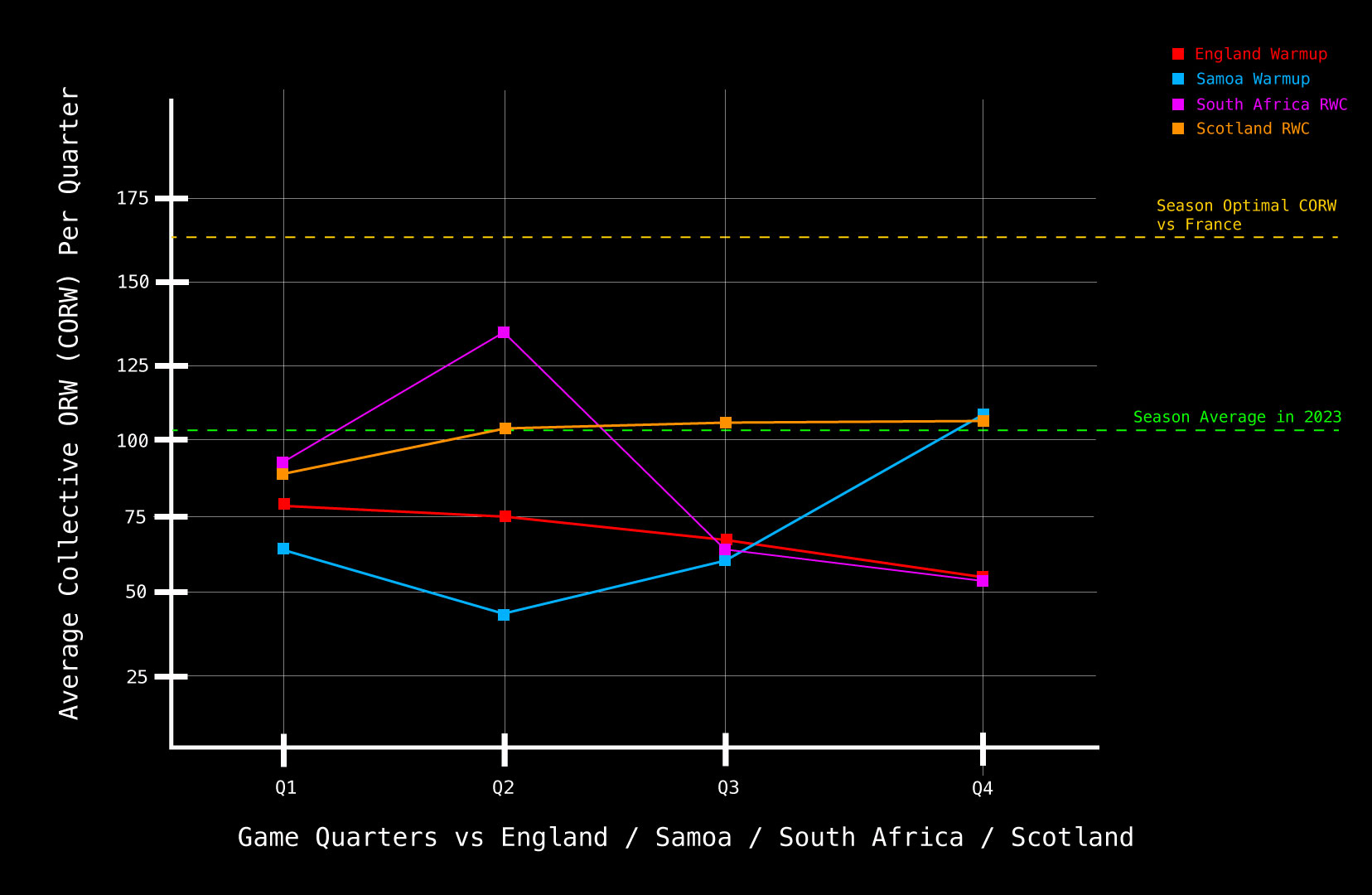
This was the first time we played above our Six Nations average for three consecutive quarters and without a large drop-off in output in the third quarter, as we’d seen in every other game to this point. That consistency produced a reliable, consistent platform that we had the accuracy to capitalise on over and over again. If anything, we underscored the last quarter – even accounting for the try chalked off for a knock-on at the ruck.
Even more interesting was that our CORW score was 402 which is notable because if you go back to the 2023 Six Nations for our game in Murrayfield, our CORW score in that game with broadly the same team was… 401.
The patterns show up again and again, and so far they’re looking good for Ireland across the board.
