


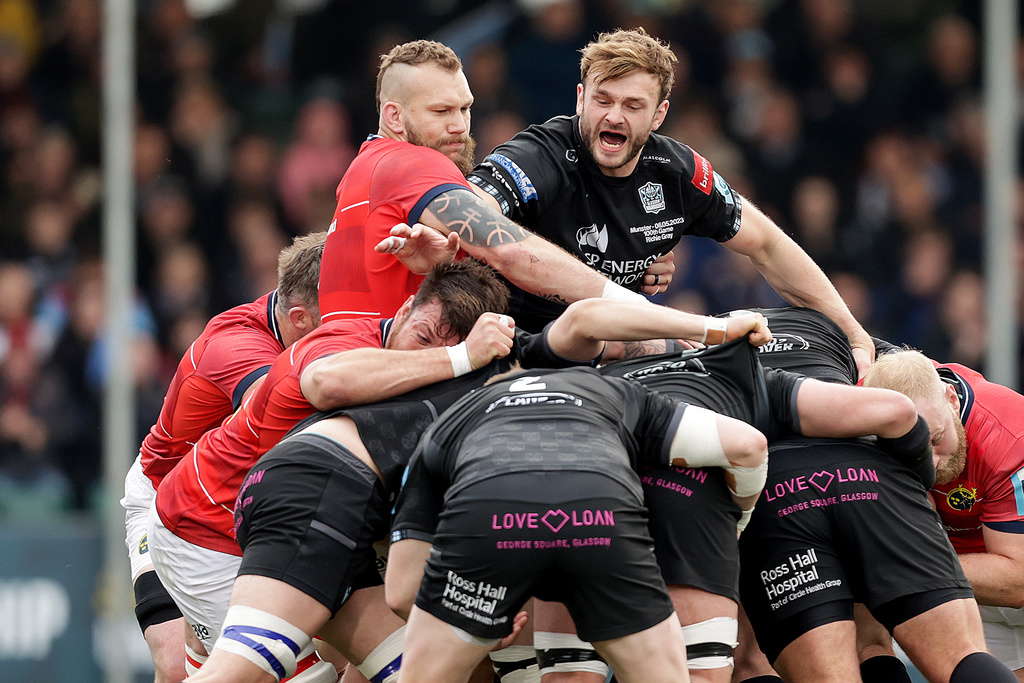
Part of stopping a team like Glasgow – and Leinster – is preventing them from getting killer momentum off the back of close-range mauls.
Glasgow, in particular, put a huge focus on their lineout maul as a game-winner for them to the point that they actively throw away three-point opportunities to kick down the line. Glasgow uses their maul to score tries, obviously, but it’s part of a wider strategy of exhausting their opponent with relentless close-range activity.
I think at a bare minimum, Glasgow understands that they won’t score off every single maul they build in the opponent’s 22 but that doesn’t matter – they hope the effort it takes to stop their constant mauling helps them later in the game.
In the URC 2 Quarter-Final last weekend, their maul really added to the bloated Ball In Play for this game, which was 43 minutes total. That’s reall high and reflects the game that Glasgow wants to play. To them, the maul is a vice that ups the blood pressure of the opponent. One way or another, that squeeze is useful.
For Munster, the key to winning this game was to keep the Glasgow maul out of the contest as much as possible. Do that – and a few other things – and a win would follow. Easier written than done, that’s for sure.
Back in March, Munster couldn’t handle the Glasgow maul with any kind of reliability or structure. We struggled to get any solid stops on their drives and, as a result, we were in trouble all game when they brought the ball down off the top of the lineout.
Before the game, I wrote quite a bit about Glasgow’s lineout builds into their maul build in the Red Eye.
From a system perspective, attacking Glasgow’s lineout is a key part of beating them home or away. We have first-hand experience of this when we were unable to affect them in the lineout and, as a result, we suffered in the maul.

This maul opened the scoring for Glasgow and you can see the strength of their maul build here, especially when they surge in behind a failed counter-launch. Glasgow’s maul is really dangerous this season and you can see why here – a middle lift with a swing “punch” from the front and the back of the lineout. Nice and low with a unified “punch” to win the first shove.
You can see it here – the flanker lifts on the inside, and the other lock lifts the back with the props swinging from the tail and the front to add the weight.

Vailanu, in particular, adds a particularly strong “rip” as the +1 receiver. So much of what Glasgow does really well comes from the lineout as a core starter platform.
The first GIF above is a really good example of their “punch” maul where a simple starter build transitions into a high momentum maul where the entry of the “engine” of the maul happens with, essentially, four players entering at once.
If we play it out, you’ll see us really struggle to stop it. We left three forwards out of this counter-shove initially because, I think, we wanted to guard against the break off the back but by the time we realised what was happening, it was too late to stop it.

You’ll see Stafford McDowall (Black #13) shoot in once the maul gets going – a common enough trend for Glasgow – and we just couldn’t handle the numbers. We tried to stuff this maul five on eight but when we lost the initial “punch” on the maul, it was impossible to stop their progression up the field.
By the time Fraser Brown joins the maul, the ball is too far away for us to work in a strip or effect any kind of stress on their progress so once they turned back infield at the end, a try was always incredibly likely. They punch with a shallow 3+1 build but then that extends out to a 3-3-1-1 with a back or two adding their numbers in to elongate it even further. When they win the initial engagement, it’s impossible to get your hands on the ball because you’ll be penalised for swimming up the side or entering from the side. When you’re defending in your own 22 or around your 5m line, that can lead to more penalties, yellow cards and penalty tries.
So how do you stop it?
You have to do two things – deal with the initial punch of the Glasgow maul but also get set up the side of their maul early to deal with the length of their maul in the later stage before they can set the terms of engagement.
We got a good look at this early on in the game, inside the first five minutes.
We used O’Mahony and Archer as a counter-launch unit in the front. This guarantees a slower, floatier throw and it’s exactly what happens as Glasgow targets the back end of the lineout. Look at how Snyman throws a long arm right over the top of the Glasgow lift unit.

This is a fairly standard 3-3 build with a decent punch from the front of the lineout on the turn.
Munster, though, have a plan.
Our initial counter-shove looks to brace for the “punch” without necessarily adding a whole tonne of counter-momentum while our second arriving unit – O’Mahony and Archer – looks to “pull” the maul to the touchline side.
On the initial counter-shove, Snyman and Kleyn have positioned themselves long up the touchline side of the maul.
As Glasgow punch through the initial braced maul defence, Loughman and Barron add their weight to the effort to turn the front of the maul infield. In Thomond Park, Glasgow would have just launched into the open in-field space but they can’t because their initial punch movement has brought Kleyn to the back of the maul within grabbing distance of the ball.
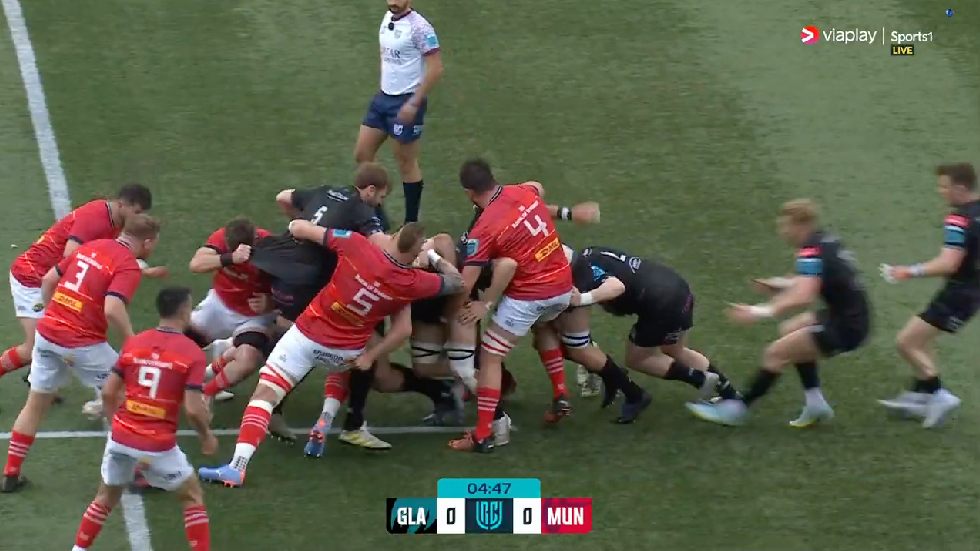
Kleyn isn’t illegal here – he hasn’t changed his initial bind – but Glasgow have been turned at the front of the maul so their initial punch movement has only brought Kleyn closer to the ball carrier. Look at O’Mahony’s positioning here. Yes, he’s counter-mauling one-handed but he’s pushing Richie Gray to the touchline, not looking to flat-out brace against him.
That subtle shift to the touchline has meant we can essentially wrap up Glasgow’s maul from both sides and force them to play it early, even when their backs come in to add their weight.
This “L” defence even worked at close range – albeit with a stronger initial counter-push against the Glasgow punch. If we look at this maul set on our five-metre line, we can see Glasgow trying to react to our previous stop. They have lifted Stafford McDowall – their #12 – at the front of the lineout to make sure they have an extra forward to lengthen the “train” of the maul, with Kyle Steyn, a winger, adding even more length at the back.

What’s the purpose of this? They want to have enough length that they can essentially just win 3 metres of ground off the shove to launch one of the tail maulers to the line.
You can see Archer, Beirne and Kleyn already shunting Glasgow hard to the touchline side to divert their initial energy where we want them while Barron holds the touchline side like a pivot.
Watch how Snyman and Kleyn move up the side of the maul to make the L shape.

Snyman even goes one further by using his freakish wingspan to keep Richie Gray from adding his weight to the back of the maul. At this stage, Glasgow can only go one way – right for the corner flag.
The length of their maul is now working against them as Kleyn, Snyman and Archer are now pushing directly onto side-on Glasgow maulers. They can’t drive through, they can’t break out the side so they get stuffed dead despite having a multi-man advantage.

But this is chess, not checkers. Glasgow were always going to respond so our maul defence would have to adapt too. One of our best gimmicks for this was to reverse the L – essentially use Kleyn to slide up the opposite side of the maul depending on the context and the position.
This lineout, for example, was a little further out so the touchline wasn’t our friend as much as it was on the 5m line or further out where we could swarm the first phase.
Glasgow try to immediately shift infield to take our maul defenders out of the game but they get pinned in place by Snyman – look at the power here – while Kleyn binds and swings up the touchline side.

Look at a Kleyn steaming through the inside lifter here. That is freakish tight power. Before long he’s in a great spot midway through Glasgow’s 3-3-1-1 build. With Kleyn surging through the flank of the maul from one side, Loughman, Barron and Beirne on the second effort can kill this maul by, essentially, squashing it.

This ended in a scrum turnover to Munster and it shows the adaptability of this defensive scheme with naturally good defensive maulers.
With Snyman off the field, the scheme was the same. Fineen Wycherley slotted into the same role and helped to cause havoc up the side of the Glasgow maul.
When the lineout was further out the field, we can commit both locks to attacking the side of the maul to allow Glasgow to pull themselves onto the lance, so to speak. This turnover lead to the Glasgow red card but watch how the rip happened – Munster angled up the side right on the drop, totally legally, and were able to rip the ball clean as Glasgow tried to move past our counter-shove.

Leinster use a very similar punch/long build to launch a lot of their mauls so elements of this will translate to this weekend’s URC semi-final, albeit against what are likely to be better, more physical maulers.
We’ve seen the L can work though, and if we can deploy it successfully again, we might have a way to stop Leinster’s driving game.
