


“Styles make fights” is an irritating fight-wonk phrase that, when I was big into MMA in the early to mid-2010s, I would see everywhere, all the time. It has that really grating quality of glibness mixed with enough accuracy to give a thin veneer of authority to anyone that wields it. The outstanding MMA/striking analyst Jack Slack – who inspired me, in more ways than one, to delve into the kind of sports content I now make a living off – was the first guy I heard using it and, a bit like those old soccer cliches, it just kept popping up to the point that it started to sound like nonsense.
Like, for example, how many times have you heard the phrase “shut up shop”?
Sometimes you’ve got to shut up shop pic.twitter.com/t5J8eSmDk9
— Bryan’s Gunn (@bryansgunn) April 23, 2023
When you hear it all mashed together like that it sounds like gibberish, right? That’s how “styles makes fights” came to sound to me but, increasingly, I’ve found it’s a really apt phrase to transfer over to rugby and, in particular, the scrum. At its core, the term means that not every fight is interesting in and of itself and that only fights where the styles of the fighters match up dangerously for both can determine the entertainment value of the fight. It goes some way to explaining why Fighter A can dominate Fighter B, Fighter B can dominate Fighter C, but Fighter C can then turn around and dominate Fighter A. Logic
Scrummaging is mostly the same. How is it that Munster can lock out a Stormers scrum that featured Frans Malherbe, Joseph Dweba and Steven Kitshoff but then struggle so badly with a Sharks’ scrum a week later featuring Ox Nche, Bongi Mbonambi and Thomas Du Toit?
You could argue that the Stormers’ front row is a “better” unit, certainly when it comes to the reputation of the props in that unit as pure destructive scrummagers but, as with everything in this game, it isn’t as simple as that.
Look at this scrum from early in the Stormers’ game and watch for lateral movement from the blue loosehead side in and across the Munster scrum.

There is none, at least now when it matters to the passage of the ball from Murray, to Barron’s strike, to Coombes collection. You can see lateral movement late in the scrum but, for the majority of this push, we are stable because Archer is stable. He is able to “pin” Kitshoff in place with a low, tight lockout which is so effective it allows Barron and Loughman to get an advance on Malherbe for a few beats until Kitshoff powers through it.
From a strength perspective, we have good, heavy tightheads in this group so when it comes down to managing the action of a relatively taller loosehead like Kitshoff (listed at 6’0″ with a long back – it’s important) with a smaller hooker in his unit (Dweba is listed at 5’7″) we can hold them off by attacking that gap.
You can see for the key part of that scrum, Archer is able to pressure the Stormers by finding that gap.
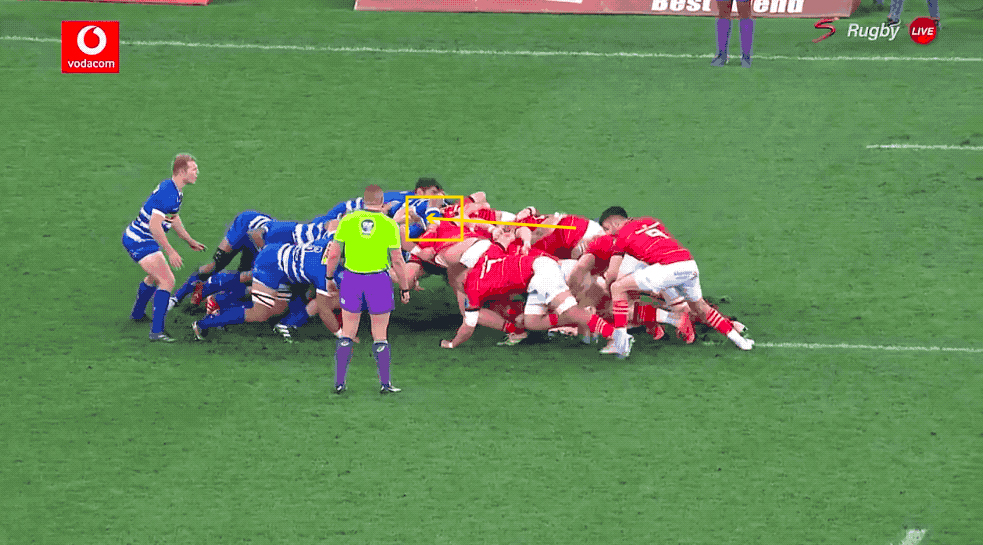
This puts Kitshoff on the backfoot just long enough for Munster to stabilise, surge and release the ball before the Stormers’ loosehead can recover and hit Archer at an angle.
When we did come under pressure against the Stormers, good hooking from Barron kept us at a point where we could stay alive in the play. This is a massive timed shove from the Stormers’ front row but an excellent channel one strike means the ball is usable so there’s no penalty, despite the AR signalling to the ref about what he’s seeing on our tighthead side.

You’re going to come under pressure – especially on your own put-in – at some stage against a unit with strong scrummaging props like that, you have to roll the dice and, to be fair, it did look like Malherbe was collapsing here as much as Loughman for the main thrust of the push.
When it came to the Stormers’ put-in, we were conservative and solid. With a properly timed counter-shove on a unit like this, you could pump all of your energy into catching the Stormers on the dip but we knew coming in that they’d strike and then hold to have a cut off us.
What you’re seeing here is Archer and Loughman, in particular, holding their positions and soaking up the attacks coming their way with our locks (and O’Donoghue) giving them absolute everything while Coombes and O’Mahony scope out the break.

Archer is able to control Kitshoff in this instance because he’s got a conservative starting point where he can lock out early. Then it comes down to handling Kitshoff’s frame to prevent him from getting an angle. From a strength perspective, resisting the driving action from a longer lever is easier than dealing with a shorter lever, especially when you’re meeting force with force.
Where Munster have really struggled this season is with shorter loosehead props who can slip underneath the strength of our looseheads.
The game earlier in the season against Connacht is a really good example;
Salanoa is exactly who I’m talking about when it comes to the physically powerful tightheads we have but in this instance, he’s getting hacked up by Denis Buckley, a short, squat loosehead who can angle in as a “short lever”.
You can see it clearly here where the 5’7″ Ox Nche and and 5’9″ Bongi Mbonambi give us a torrid time on every single put-in. We had no pocket to hit to hold them because there was no pocket.
And worse again, Nche was small and butty enough to get in and under Archer repeatedly, which drove us laterally across.

Then you have Du Toit being able to isolate and overwhelm Loughman with our front row all over the place from a height perspective almost immediately but then from a positional perspective.
You can see the same issue on this scrum on the Sharks’ 5m line. Loughman is penalised – harshly, IMO – for dropping his bind on Du Toit but the effect is enhanced by Nche getting in and under Archer so he can drive him laterally.

If Loughman hadn’t dropped his bind it was almost inevitable that Nche would have driven up and through Archer regardless. That action creates a base level of instability that we struggle to control on the tighthead side.
The basic concept of the movement is this – Nche swivels out a few degrees and, because he’s starting low anyway, can manipulate that movement around into forward movement UP.

This isn’t “illegal” scrummaging in so far as there’s a Munster penalty here. This is good scrummaging from Ox Nche specifically because it’s a horrifically bad matchup of a tall tighthead – Archer is 6’3″ – against a crafty little dagger of a loosehead.
It was really noticeable on the first scrum of the game where we tried to impose ourselves against the head and got caught dramatically by Nche, in an almost exaggerated example of the concept.

Archer is a good scrummager but he can’t control Nche in the same way that he would against a tall loosehead with a shorter hooker or, to a lesser extent, a shorter hooker with a taller loosehead. He has no space to take so he gets angled and popped.
Later in the game, however, when the Sharks brought on their taller, more dynamic loosehead and hooker combination (#17 Ntuthuko Mchunu – 6’2″, #16 Kerron van Vuuren – 6’2″) they were easily handled by Archer because they are “longer” players. Archer was easily able to handle the work of Mchunu in part because the replacement loosehead is taller and isn’t able to rotate under him as easily.

Look at the control Archer has here. He’s controlling the space excellently and locking out against Van Vurren and Mchunu really really well. Edogbo is bracing him fantastically – look at that low body position – but that wouldn’t be much use without Archer’s long lock out controlling Mchunu’s outside shoulder.
Styles make fights, styles make scrums.
