


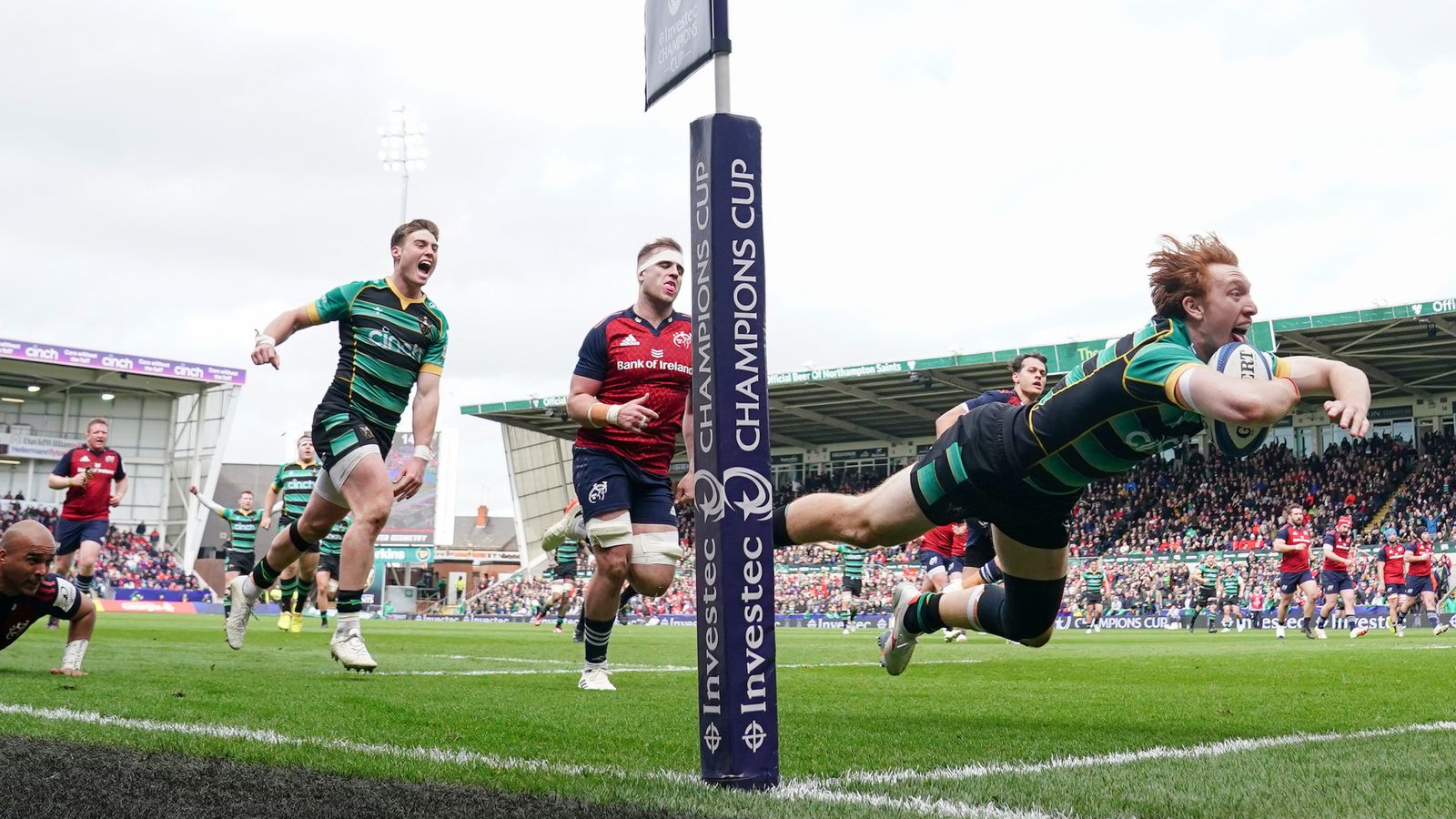
Revisiting Munster’s loss to Northampton two weeks ago was not fun.
Maybe it’s fun for Northampton fans, but I didn’t enjoy it, let’s put it like that.
With our South African tour on the horizon, I wanted to see how that Northampton game got away from us and assess my reading of our potential approach from beforehand.
Before the game, I spoke about Munster possibly looking to conserve energy by playing more of an off-ball game and essentially, rolling the dice by kicking to a good attacking side with a counter-transition core and looking to contain them. I knew we had a percentage of the matchday squad coming into the game unwell so, as defending in phase play is, collectively, a lower calorie sequence of the game compared to attacking, I thought it might be a good way to build into a performance where we were well below 100% coming in.
But even if you commit to playing an 0ff-ball style game, you have to be willing to play somewhere. You’ll rarely win a game at the elite level with just penalties – unless you have a super elite set-piece weapon like a huge maul or a scrum – so you have to pick your attacking zones based on your kicking strategy.
Here is a rough zone breakdown with a few kick profiles to illustrate the type of kicking we want with this off-ball scheme. Kicking the ball inside two phases anywhere outside the opponent’s 10m line is about as conservative as it gets in this game and it, by design, limits the ability of the opposition to force turnovers or for your players to turnover the ball in structure through handling errors.
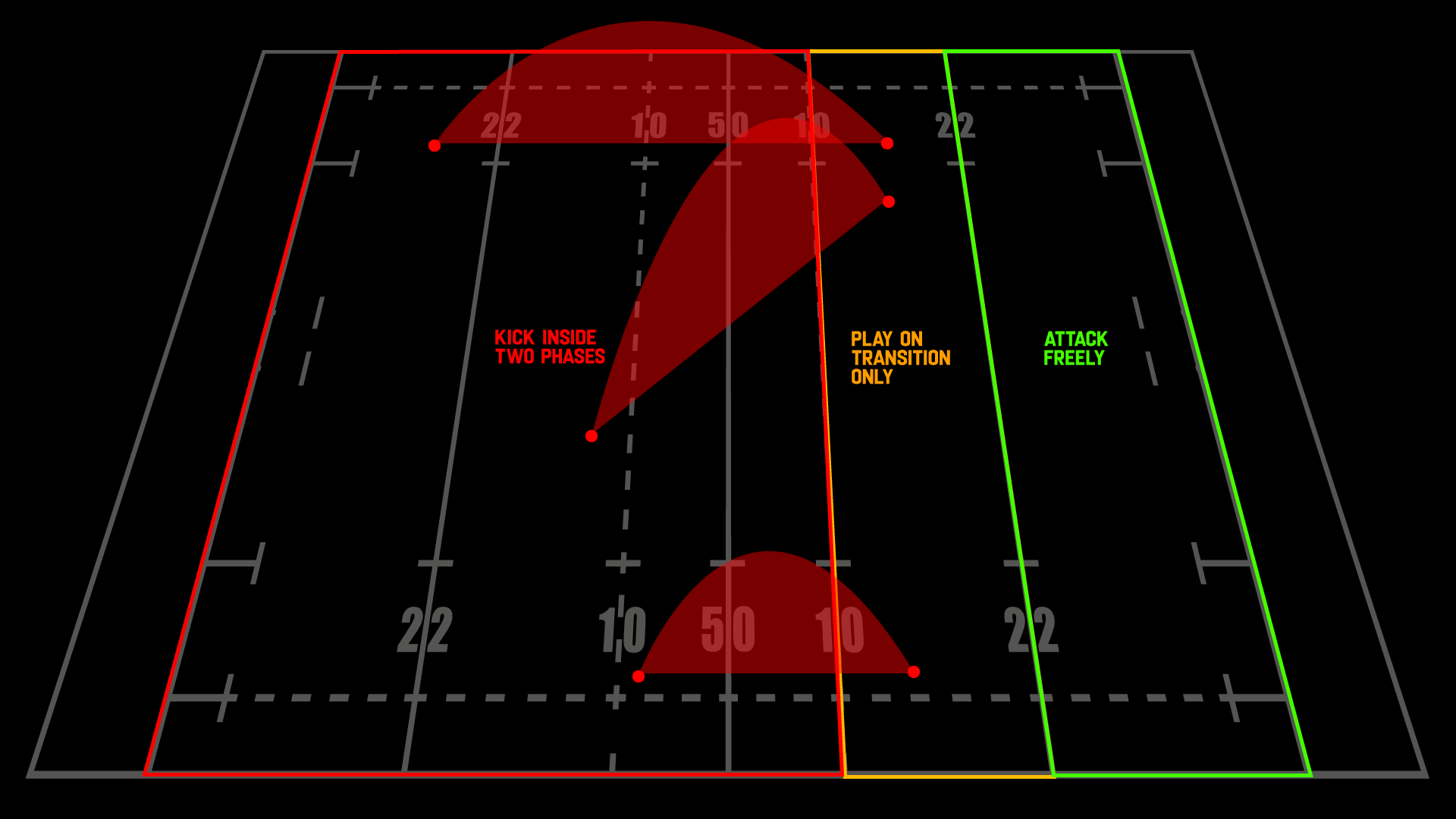
The orange zone is where we will play on transition in this scheme. If we can win the ball back in the air, or force a turnover on the ground, this is where we will go into our transition structures before settling into lower-risk tight phase play once the halfbacks judge the momentum to have gone from our attack. If we win a penalty in this zone and we’re level or ahead, we kick for three points. If we make it into the opposition’s 22, we commit the energy needed to score a try.
That would be a typical off-ball playing map, but you have to have the players to make it run – heavy tight defenders, a lockdown defensive midfield, really quick wingers as a chase unit and transition scorers, a massive scrum and a big maul. It’s designed to conserve energy for big set-piece moments and transitions, with the rest focused on defending and chasing. South Africa at their best play like this with their midfield and back three covering the high-speed edges of the play, while the bigger forwards guard the slower, middle zones. It is designed to conserve energy.
Munster’s typical play map looks a lot more like this; on-ball rugby.
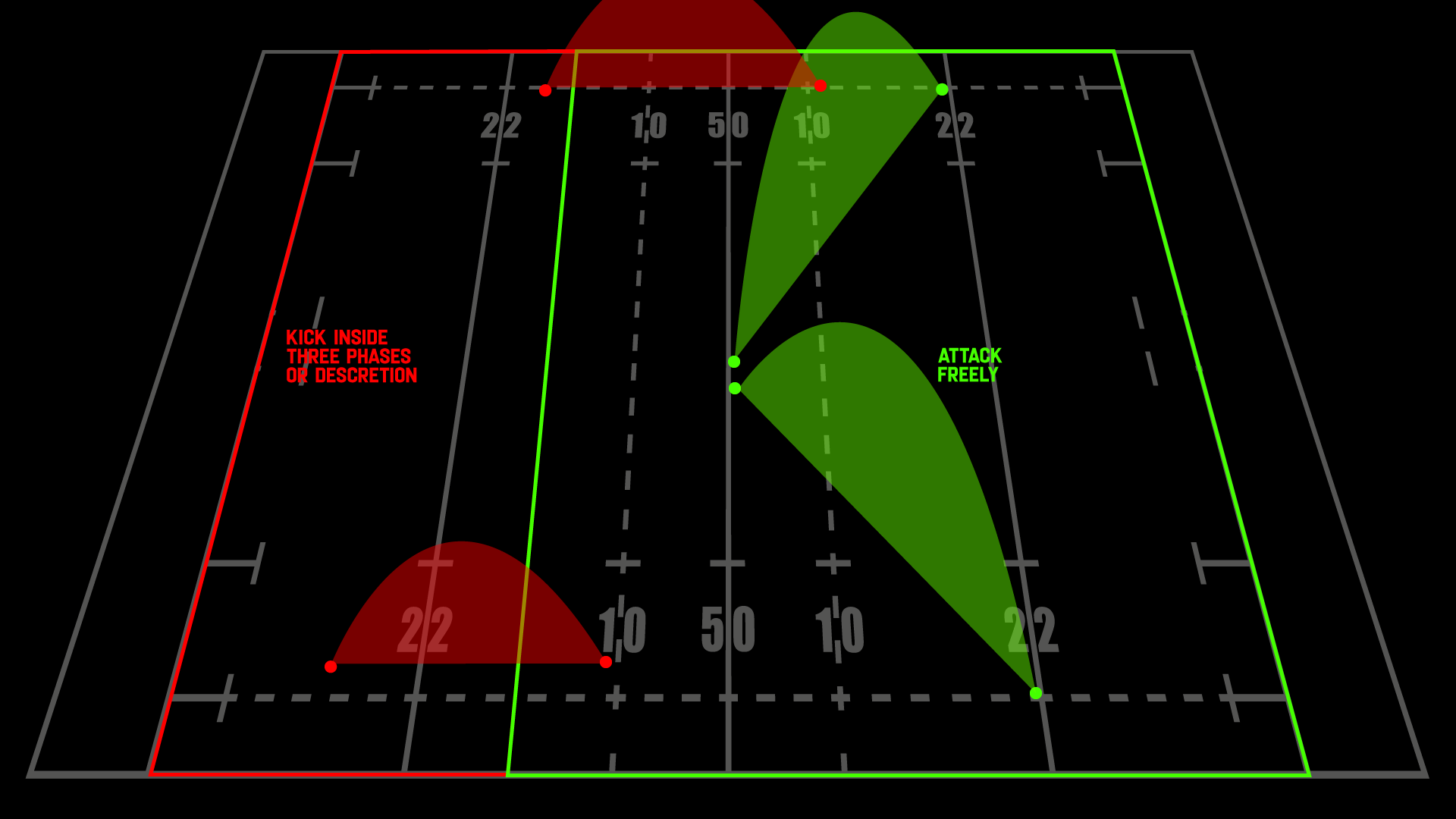
What does this mean? Players have much more freedom to play from anywhere but with that comes a much higher demand on your cardio output. Being willing to attack from deeper on the pitch also means that you have to commit to more passing and running in structure because playing tight off #9 for 10 phases on your own 10m line is a recipe for blowing your lungs out.
You intend to dominate the ball and overload teams to try to off-ball you. You, ideally, will be conditioned to play for 10+ phases at a time across multiple sequences with multiple “break plays” to find the edges of the pitch, where you can distort their defensive line, using their intent to defend against them. When done right, the off-ball team is without the ball for long stretches, especially if you shut down their attempts to hit you on transition. This is a “low kick volume” game plan because you don’t want to reset the play by kicking the opposition, you are always trying to kick to your players in this system unless you’re exiting from your 22.
This is massively energy dependent but with the right bench, you will often out-last off-ball and counter-transition teams over 80 minutes if you have the right tight five and replacements. An on-ball team will, in an ideal world, be physically bigger than the off-ball team in the pack, at least. It’s often preferable to have your backline be smaller and more mobile in on-ball systems because of the need for mobility. You’ll often be more likely to see edge forward profile players in an on-ball system – off-ball systems have no usage for these players unless they have a switch-up built on the bench (essentially a build variant where they look to play more expansively in the last 20 minutes).
The key to any on-ball system is a roster of heavy hitters in the front five to allow you to engage the opposition’s tight forwards and pin them in place, so your backline and edge forwards have more space to work on the edges, while also creating lanes for attack in the middle of the field.
The problem for Munster is that we haven’t had those players for most of the season – Jager, Edogbo, Snyman, Kleyn plus another prop we’re yet to recruit – and we didn’t have them at all against Northampton, while a lot of the players we did have were in the midst of a viral outbreak in the squad.
I think we tried to approach this game in an off-ball build, with the idea of easing ourselves into the game but circumstances took us in a different path and blew out our cardio early.
You can see it in the underlying numbers.
MUNSTER’S OFFENSIVE RUCK WORK SCORE VS NORTHAMPTON
- A Dominant Clean is an action that decisively secures possession when the ball carrier takes contact. A Dominant Clean does not have to be the first arrival at the breakdown but it is rewarded in the context of effectiveness. We will assign this action 3 points.
- A Guard Action is where a player plays a role in helping to retain possession after we have “re-won” the ball on the floor. Sometimes this can happen on a carry/ruck point where there is no active contention by the opposition. Let’s assign this action 2 points.
- An Attendance can be anything from standing as a “kick shield” on a ruck to adding a bit of bulk to ward against a counter-ruck to extending your leg to make space for a box kick. I’m marking this down as being worth 1 point.
- An Ineffective Action is a blown cleanout, a lean, a breakdown penalty or an action that I couldn’t see any direct benefit for. This will be worth -2 points.
| Dominant Clean | Guard Action | Attendance | Ineffective | Ruck Work Score | |
|---|---|---|---|---|---|
| Loughman | 21 | 1 | 4 | 35 | |
| Scannell | 1 | 14 | 5 | 4 | 28 |
| Archer | 1 | 20 | 2 | 4 | 37 |
| Ahern | 1 | 7 | 17 | ||
| Beirne | 27 | 1 | 55 | ||
| O'Mahony | 3 | 11 | 2 | 33 | |
| Hodnett | 13 | 1 | 24 | ||
| Coombes | 19 | 1 | 3 | 33 | |
| Casey | 1 | 2 | |||
| Crowley | 2 | 3 | 1 | 10 | |
| O'Brien | 1 | 6 | 1 | 2 | 12 |
| Nankivell | 9 | 1 | 16 | ||
| Frisch | 13 | 2 | 28 | ||
| Zebo | 7 | 1 | 1 | 13 | |
| Haley | 1 | 9 | 21 | ||
| Clarke | 1 | 2 | |||
| Wycherley | 1 | 2 | |||
| Donnelly | 0 | ||||
| O'Donoghue | 2 | 1 | 2 | ||
| Kendellen | 1 | 4 | 11 | ||
| Murray | 2 | 1 | 2 | ||
| Carbery | 2 | 4 | |||
| McCarthy | 0 |
Top Five ORW Scorers
- Tadhg Beirne – 55 points
- Stephen Archer – 37 points
- Jeremy Loughman – 35 points
- Peter O’Mahony/Gavin Coombes – 33 points
- Niall Scannell/Antoine Frisch – 28 points
Notes
• That breakdown performance by Tadhg Beirne while he was visibly struggling with illness is verging on the superhuman. Twenty-eight ruck entries with no inefficient actions are the kind of things that elite, elite guys give you when they’re way below 100%. Peter O’Mahony and Gavin Coombes were also badly struggling with illness but never stopped going for their 50-odd minutes on the field, despite lacking the pop they normally do.
• The front row racked up huge numbers, as you’d expect, while also leaking a bunch of ineffective entries between them as the game wore on. This is to be expected when we don’t have the physicality on the bench to replace the starters.
• Tom Ahern’s ORW numbers are way down because he was playing as an edge forward in the system for most of the game. Peter O’Mahony has taken his tighter, heavier #6 role from Ireland back to Munster, with John Hodnett playing a swing role between carrying on the edges and hitting rucks up the middle of the field.
This might suggest a tweak to the build of our back five that retains the obvious strengths of Ahern in that edge forward role, despite playing in our #4 jersey. That could translate to a bigger, heavier player taking the #6 role in the long term.
CORW Map
When we map out the ORW scoring in 10-minute blocks, we can see the way we leaked energy as the game wore on. Our massive opening 10 minutes came almost by accident. Jack Crowley put up a great kickoff that was retained by Simon Zebo right outside the Northampton 22.
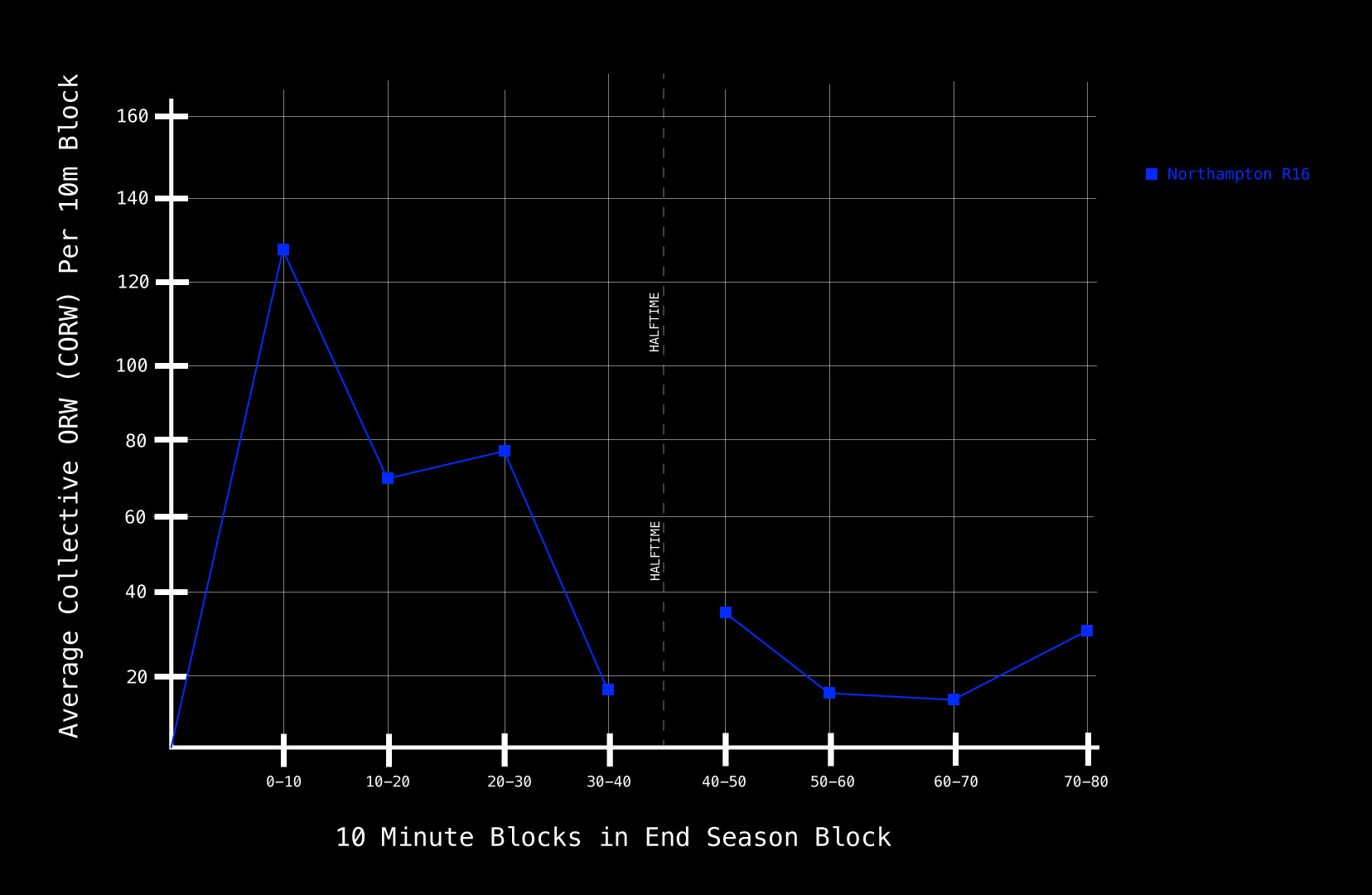
That’s exactly the zone we would have wanted to play ball in so we went into a long sequence of phase play that we seemed to pay for over the rest of the game. We scored 127 ORW points from our entries in that first 10 minutes – one of the highest 10-minute blocks of the season – before conceding right at the end. We did well to score two tries in that half while our ball retention decreased, but this was due to how well we forced turnovers from Saints – which shows how the off-ball approach might well have worked here.
We badly tapered off at the end of the first half before showing a quick bump after halftime before dropping off badly in the 50-60 and 60-70 minute blocks as Northampton went to their bench. We were visibly gassed at this point and had no heavy hitters off the bench to help anchor the middle of the field for us on both sides of the ball so we slowly drifted out of the game, first phase for phase and then on the scoreboard.
