


You’ll definitely have seen it against Wales, but it was far from the only time in the last two seasons — Jack Crowley missing kicks that he would be expected to make.
Not every kick is the same, of course. Kicks from the 5m tram — at a steep angle — are more difficult to make, and most kickers fall between 50/60% completion for those kicks. Kicks that are closer to an approximate 30m x 40m rectangle near the posts are considered much easier, and have an 80/90% completion rate for most kickers.
On Saturday against Wales, Jack Crowley missed two of those kicks, leaving four points on the table that he would otherwise be expected to land. In a game that was, in the last ten minutes, still within seven points, those could have been extremely costly.
I’m not telling you anything that you, or Jack Crowley himself, doesn’t already know.
What the research tells us — and what makes this more than a simple criticism of Crowley’s kicking — is that individual player differences are, statistically speaking, a surprisingly small part of the story. A landmark study of 6,769 kick attempts across 582 international matches between 2002 and 2011 found that distance accounts for an enormous share of whether a kick goes over, angle accounts for a moderate share, and the gap between one elite kicker and another accounts for relatively little. The best kickers in the world and the worst operate closer together than most people assume. What separates a made kick from a missed one, far more often, is the conditions surrounding it.
And that is where Crowley’s situation becomes interesting. Because the research also shows that kick success in the ten minutes before half-time drops roughly 8% below a kicker’s average — attributed to accumulated fatigue — and that a kicker who has just missed a previous attempt is 7% less likely to convert the next one. These aren’t dramatic numbers in isolation. But they compound. Physical fatigue degrades the mechanics of the kick in a specific way: fatigued kickers generate more upper-body rotation and experience stance leg collapse, both of which push the ball wide rather than short. Every missed kick on Saturday against Wales went wide — narrowly. That is not a coincidence, in my opinion. I think it’s the signature of a tired body trying to generate force and accuracy it no longer has cleanly available.
Crowley is not a bad kicker. He is a good kicker, being asked to arrive at the tee having done the work of two players.
Across multiple studies, the research framework identifies 11 constraints on kicking performance: individual constraints (expectation, fatigue), task constraints (distance, angle), environmental constraints (wind, weather, crowd), and situational constraints (previous kick outcome, time remaining, shot clock, score margin). Crowley, as a high-workload fly-half under a 60-second shot clock, is routinely arriving at a conversion with most of these constraints stacked against him simultaneously — something a dedicated kicking specialist like, say, Thomas Ramos or Finn Russell operating with more recovery time and fewer involvements wouldn’t face.
First, let’s look at Saturday.
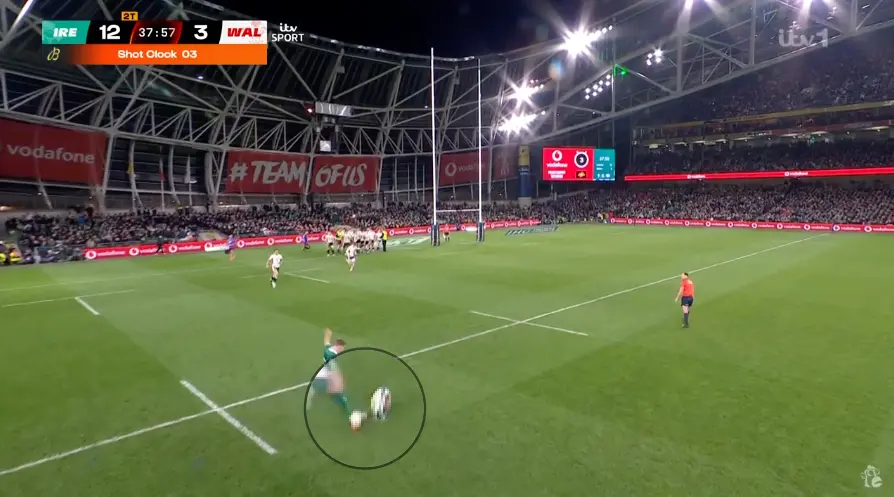
This was Crowley’s first miss, his second kick at goal for the afternoon. Let’s look at the biomechanics.
There is a specific biomechanical mechanism that explains why a fatigued kicker’s misses go wide rather than short, and it comes down to something very precise: where the support foot lands.
Research using 3D motion capture on professional kickers found that accurate kickers plant their support foot roughly 8cm behind the ball at the moment of contact. Inaccurate kickers plant it 12cm behind. That four-centimetre difference sounds trivial, but it isn’t. The position of the support foot at the moment of strike is the primary control point for the swing plane — the arc the kicking foot travels through on its way to the ball. Plant too far behind, and the swing plane steepens and rotates, directing the foot across the face of the ball rather than cleanly through it. For a right-footed kicker, that action pulls the ball left.
It is, in effect, the same shape as a deliberate draw in golf. When kickers want to draw the ball — wrapping it through the post from right to left — they manufacture exactly this: a wide approach, support foot pointing away from the target, the kicking leg swinging across the face of the ball on an inside-out path. The unintentional version of that same shape is what happens when fatigue degrades the support foot position by a few centimetres.
In this instance, I think Jack was looking to get that clean strike up the middle of the ball with a high sweet spot to land a “baby draw” that would send it straight to the posts with a slight right-to-left drift, but because his planting foot was slightly too far back before the strike, his kicking leg swing duffed the ball too far left.
The fatigue research makes the chain of causation explicit. Under physical load, kickers begin recruiting more upper-body rotation to compensate for reduced leg drive. That trunk rotation disrupts the body’s alignment at the point of planting — and the support foot, instead of landing in its habitual position just behind the ball, drifts further back. The swing plane is then corrupted. The ball goes wide — rarely short — because the leg is still generating force. Just without the finesse to manage the strike exactly.
In that first miss, I think Jack was trying to draw the ball slightly — right to left shape from the left side of the posts — to get a straight strike through the ball. Done right, the ball will just barely draw at all and, for all the world, look like a straight kick through the posts.
But the context is what happens before the kick, and this is where Jack’s heavy involvement in each block leading to a kick comes into play.
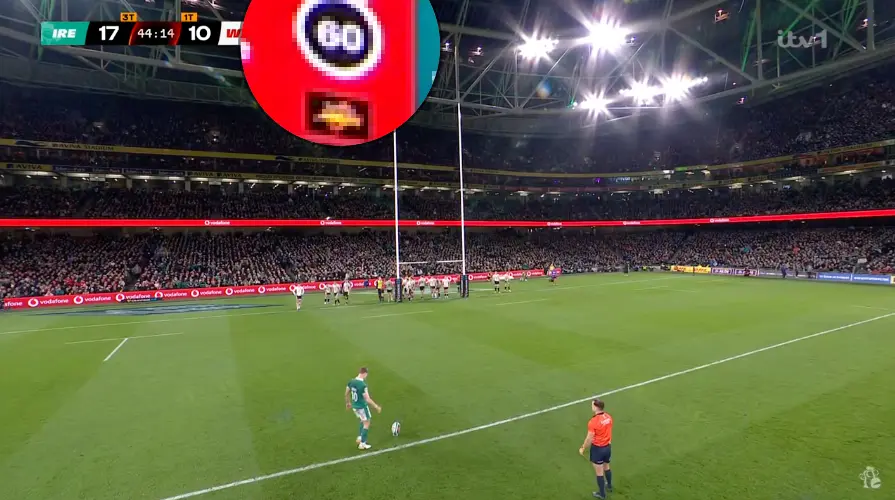
To explain that, here’s Jack’s third kick — a make — just after halftime. Sure, it’s a kinder angle to work with, but he’s able to strike it really well and get that straight, “baby-draw” on the kick.
Crucially, a lengthy TMO review meant the original shot clock was stopped at 18 seconds and then delayed for another 90 seconds, before restarting at 60.
That timing makes all the difference.
Jack is a heavy involvement flyhalf. It’s his unique strength as a player and a key differential to his rivals for the jersey. He carries, he defends, he hits rucks, and he covers ground like a fullback on transition. It’s a strength, but I believe that when it comes to his goal-kicking, it’s actually a handbrake on his accuracy.
I broke down Jack’s workload against Wales and marked it against his makes and misses. It was… interesting.
First, some definitions;
These are the definitions you provided at the start:
Sweep — a run across the back of the ruck, more than 15m each time
Offensive Ruck — an offensive ruck action
Transition Run Back — a high-intensity chase back longer than 40m
Tackle — where Crowley makes a tackle
Tackled — where Crowley carries the ball and is tackled.
I’ve listed all the kicks as “conversions” just to be clear on the fact that they’re either converted or not. I didn’t include the penalty he scored from in front of the posts, as it wasn’t relevant to the previous misses. This is Jack’s workload up to and including the missed conversion on 78 minutes, so the numbers were almost certainly higher for all of them.
That is an insanely high workload for a #10, first of all. Sweeps are a natural part of the game for any #10, but when you combine that with his tackle count, transition run backs under pressure, ruck actions and how many times he was tackled, you could tell me that these numbers belonged to a playmaking centre or a particularly busy fullback, and I’d believe you.
When you plot those involvements on a chart, you can see the correlation between short bursts of activity and accuracy. The more involvement Crowley has between kick attempts, the more likely he is to miss, at least in this game.
Against England, Ireland played with far less of the ball for a way shorter period, and Jack kicked 8 from 9.
His second miss against Wales was the most egregious on the face of it.
The build-up to this was weird. The shot clock started two seconds after Osborne dotted the try down, but the first 45 seconds of the 60 seconds were taken up by the referee, Karl Dickson, dealing with a yellow card for Tomos Williams over an action at a previous ruck.
When he stopped the clock on the ref mic, it was at 12 seconds — it took the operator three seconds to hear him on the mic, and they couldn’t put it back to 12.
Dickson told Jack that he’d give him time for his run-up and then start the countdown again, but most kickers have a set routine that they go through to cue themselves up for the kick.
When the clock started again, it was counting down from 12. When Jack struck the ball, the clock was at six seconds, but he always looked hurried here. Again, I’d look at the planting foot here.
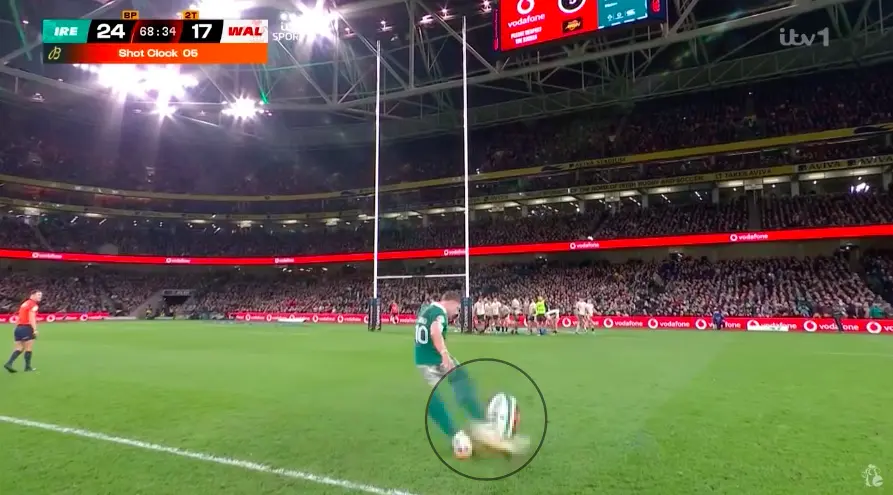
That left foot is pointing straight at the posts, and the kicking right foot strikes the ball a little low. If Jack’s default striking action is a baby draw, then that foot placement and slight loft on the ball strike risks the miss that actually happened. This is the draw shape as it flies.
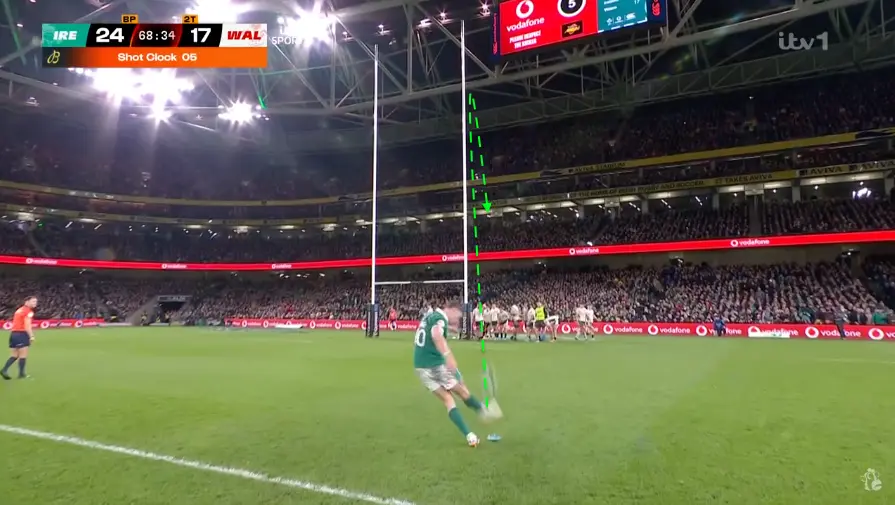
This is the kind of thing that happens under fatigue to kickers with a relatively low usage. Fine motor skills are the first thing to wobble when you’re tired. For a guy as active as Crowley — arguably too active — that can lead to moments like this, and has led to moments just like it at multiple points this season.
Of course, he should be making them, because that’s the expectation. Ultimately, a kicker is judged on his goal kicking disproportionately to anything else, and that’s a hard fact of this game.
What does he need to change about his kicking? Nothing, I would say. Not necessarily. Everything about the ball placement — while higher and more oblique to the posts than, say, Paolo Garbisi’s seam-to-target kick action, just as an example because I watched Italy vs England straight after — is fundamentally sound. The people I’ve spoken to about this since the Castres game look at small things like the foot placement, too, but that is more an expression of fatigue than anything else.
Interestingly, Jack’s ball placement has changed since 2022/23, though. In that final against the Stormers, he lined it up seam to the target, something he has changed in the last 18 months.
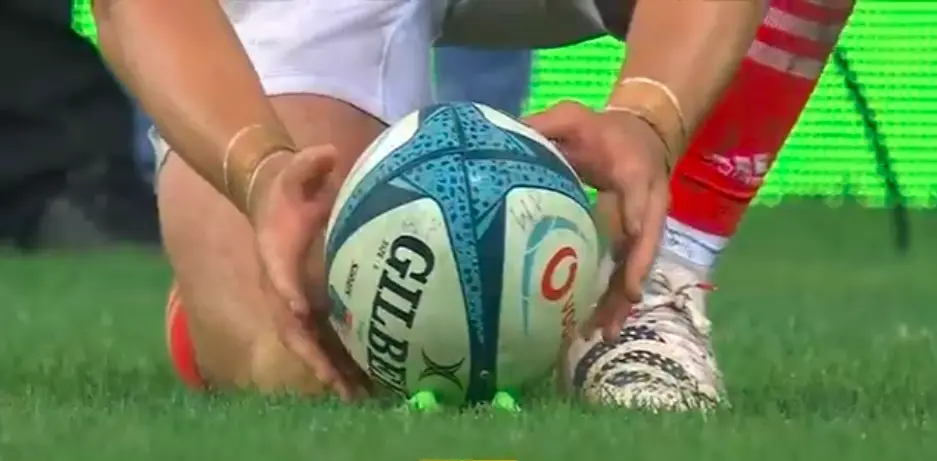
That change — seam-to-target vs high oblique — can cause unpredictable problems because it goes against years of muscle memory. You can see the difference in approach quite clearly in the Wales game, just for reference.
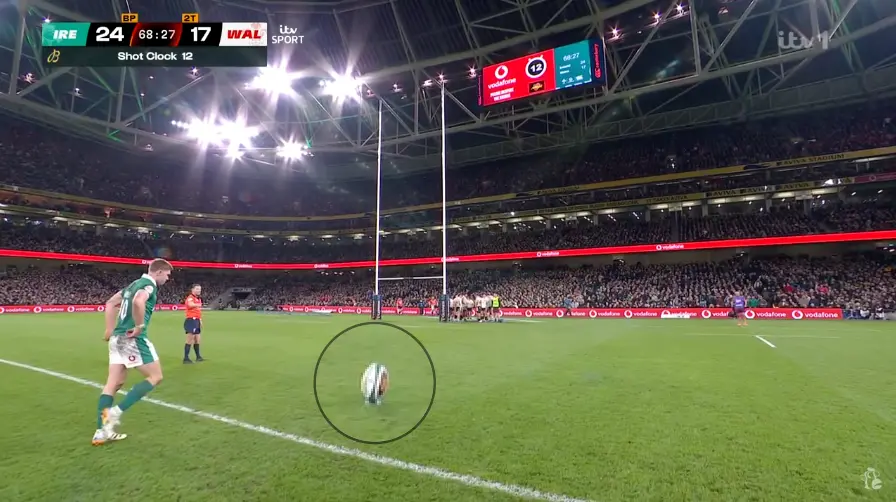
The high oblique increases the size of the sweet spot, which means if you strike it right it almost always goes where you want it, but it requires more finesse in the striking to manage direction. Seam-to-target can punish kickers who have a natural draw on their kick, though, so if that’s the reason for the change, it makes sense.
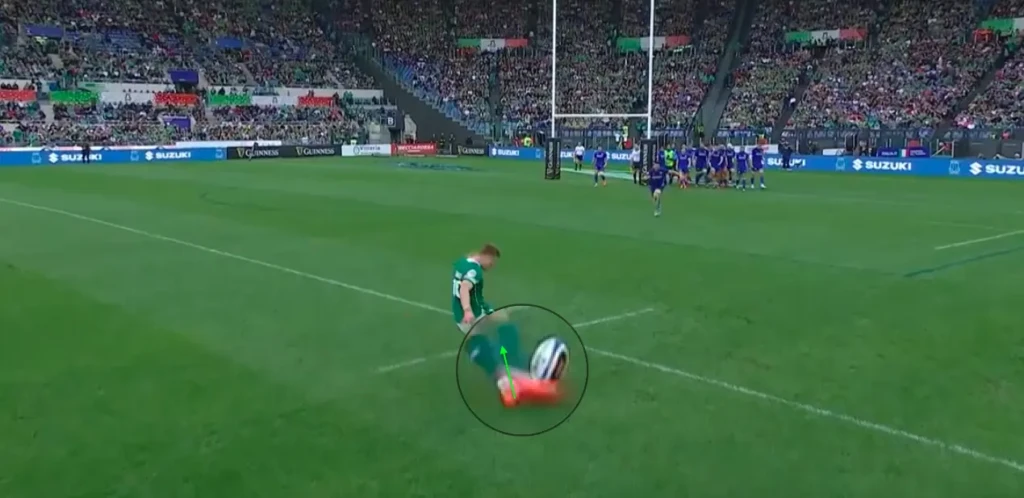
When we go back to a bad miss from last season away to Italy — where the ball hooked left, much like the first miss above — we see the same ball placement. High and oblique.
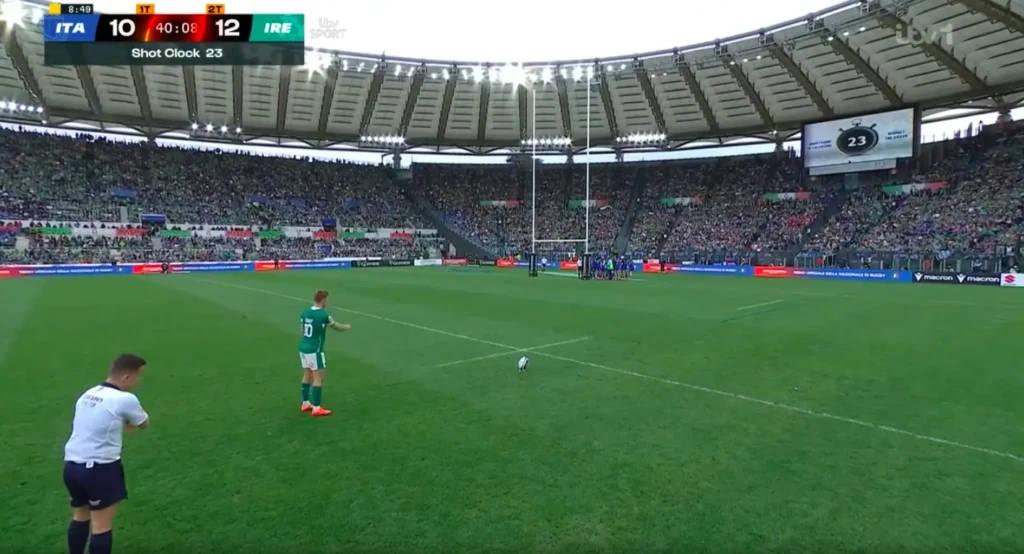
If the planting foot angle is wrong, or off even slightly, it turns the draw into a bad hook. On this one, the plant foot was slightly too far off to the left, so the ball hooked with it and never came back inside.
It either needs a rethink or finding a way to have fewer involvements as a whole to make sure he has the time and freshness to make sure his ball striking goes where he intends 85% of the time, or more.
Crowley is a great player, and I believe he’s the best #10 for Ireland in Ireland at the moment when it comes to what the system demands of him, but the issues that have sprung up with his kicking can become something of a narrative weight around his neck.
When he finds a fix — and he will — these last few games with bad strikes and misses will disappear into the ether, as they did for Johnny Sexton during a bad run when he first became an international, and as they did for Ronan O’Gara when he changed his kick mechanics for some reason during the latter half of his career.
