

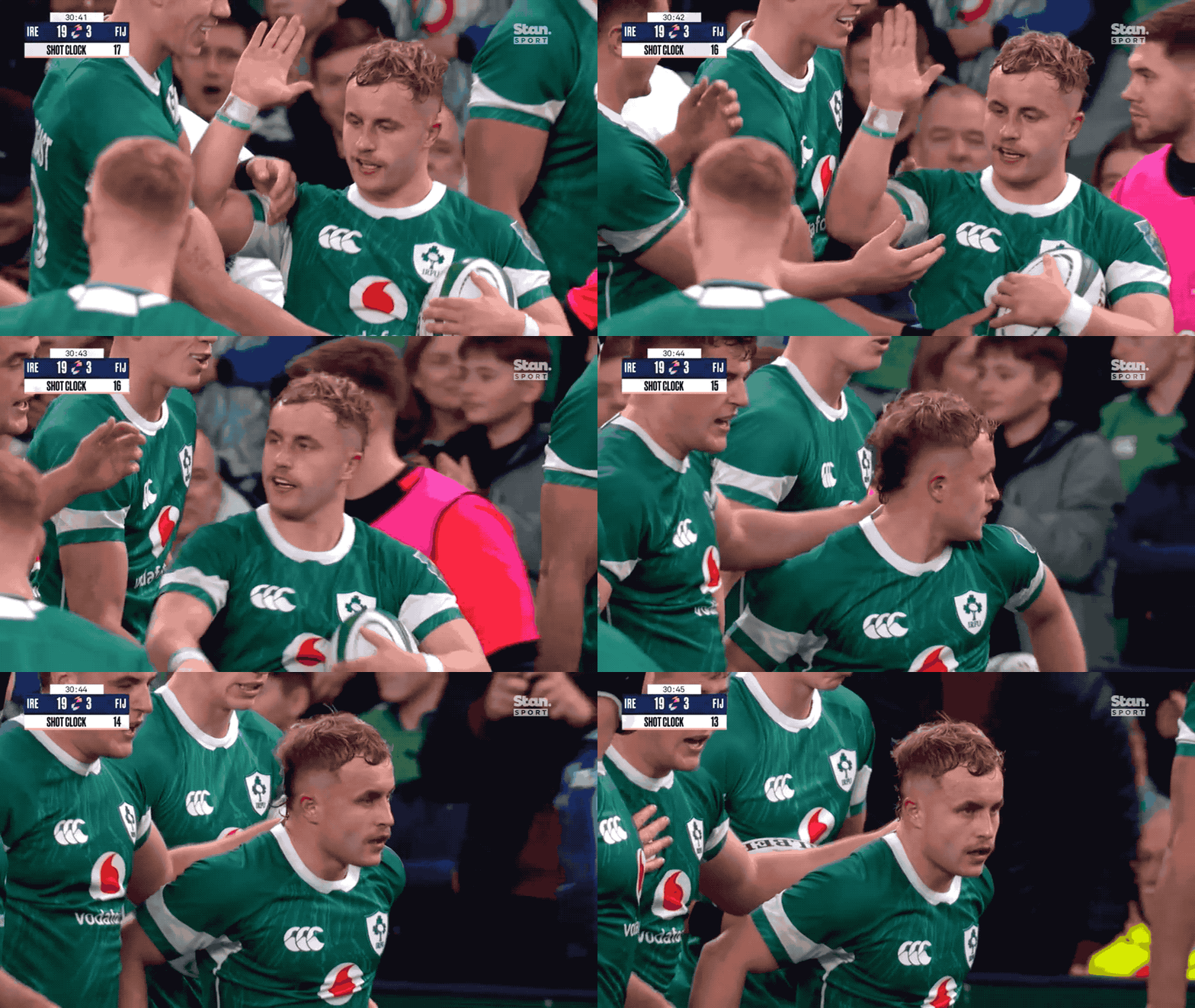
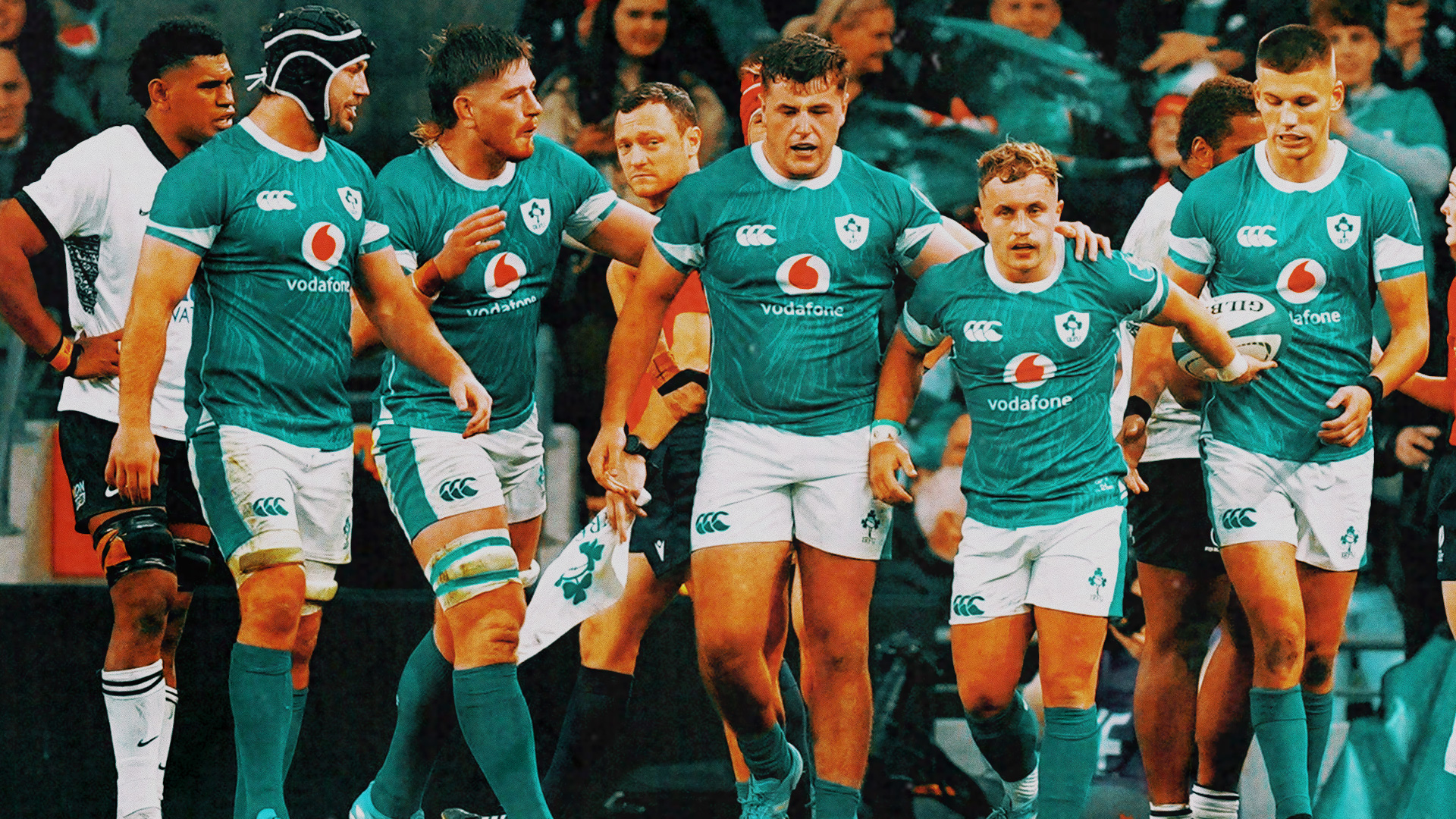
There is a reality where Fiji took advantage of a scrappy opening five minutes to really put the screws to this Irish side, but it wasn’t this one.
Frank Lomani looks like a tit now for talking about Ireland being “vulnerable” but just because Fiji got walloped here doesn’t mean he was wrong. Ireland were – are! – vulnerable at the moment, but Fiji couldn’t even hope to expose that vulnerability off the back of a pretty clueless, indisciplined, eyes on the boarding pass display that gave Ireland everything we could have wanted pre-game.
Against Argentina and New Zealand, we struggled to break down two teams who didn’t bite on our layered attack by giving us everything we’ve ever wanted; quick ball and lots of it. We had the lowest percentage of sub-three seconds rucks that we’ve had all November against Fiji – 10% fewer over the 80 minutes, a significant drop – but our attack looked far better. The received wisdom of what creates Good Attack suggests that fewer Lightning Quick Ball rucks mean a slower attack but no – with Ireland at the moment I think it’s the opposite.
Even if Fiji had worked out that equation, it would have been impossible for them to win this game when they conceded 17 penalties, and only retained 25% of their restarts, all while running a lineout at 67%. That’s not a recipe to win an AIL 2C game, never mind test match rugby away to Ireland.
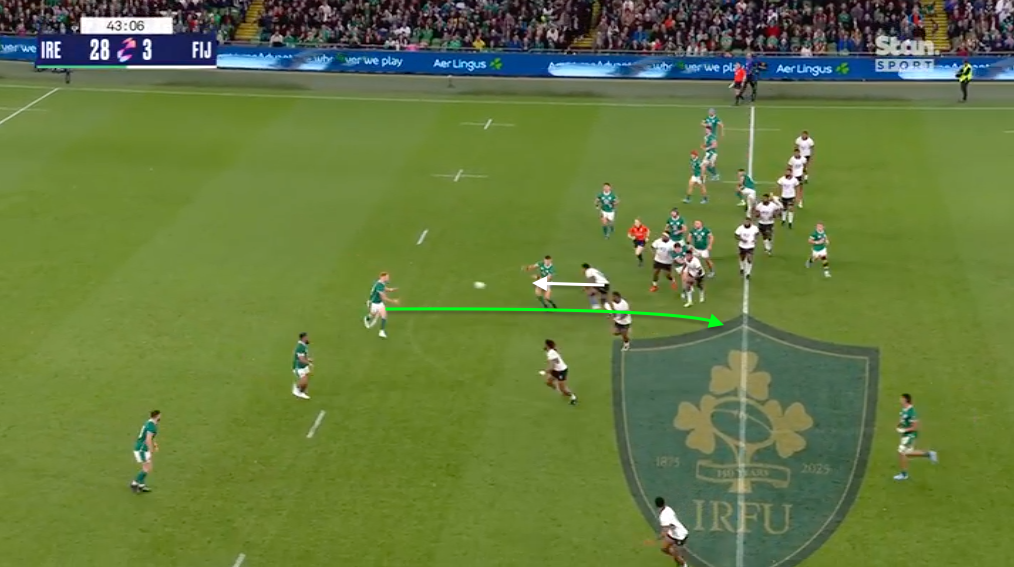
Here’s a good illustration of why Fiji lost this match. With reference to the last two weeks, spot what Fiji did wrong in this clip when it comes to making sure this Irish team don’t pull you apart.
I’ll boil it down. What is it about this screengrab that immediately stands out as something you shouldn’t do against this Irish team?
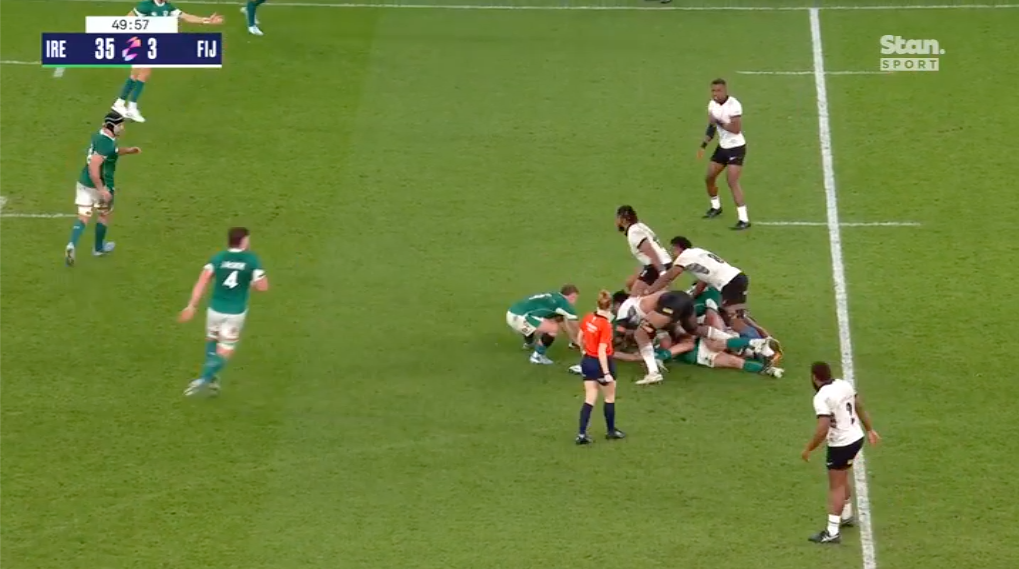
Long kick upfield that doesn’t make touch. Your forwards lose a race to the transition line and then you lose four players to a ruck that was immediately won by Ireland, leaving a massive space on the edge.
When you see this picture developing on a long kick exit infield against Ireland… trouble.
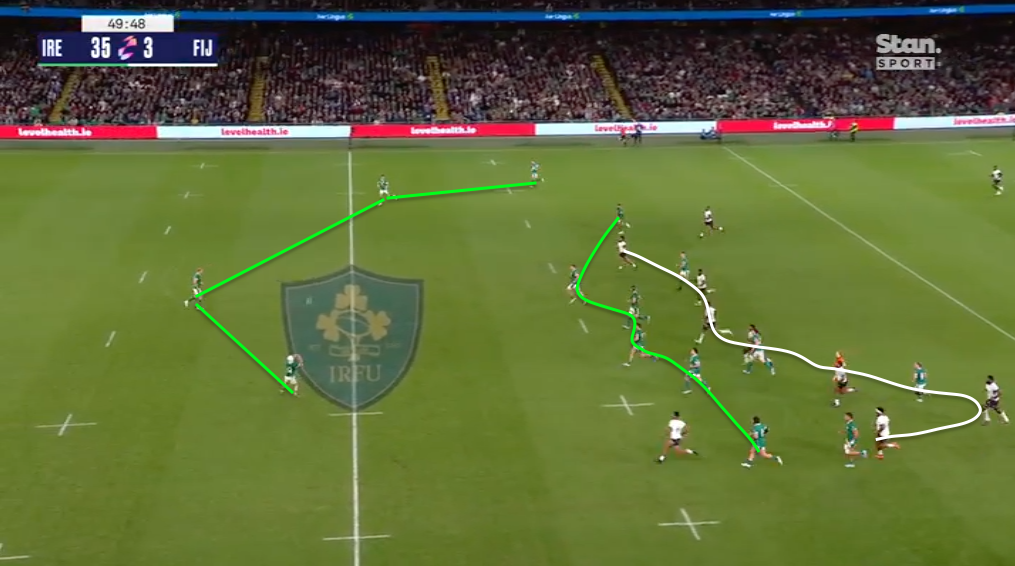
That’s why Argentina and New Zealand tended to avoid it unless they could get the kick off the field. So this alone will tell you that Fiji weren’t set up to stymie Ireland in the same way; not with their kicking game, not with their ruck work and not with their defensive press.
This allowed Ireland to play outside Fiji for most of the game and pull their heavy front five apart.
Here’s a good example from the first half. Fiji were down to 14 men here but the principle still applies. First of all, look at the space Ireland have from the gainline – that 10m of space that we love.
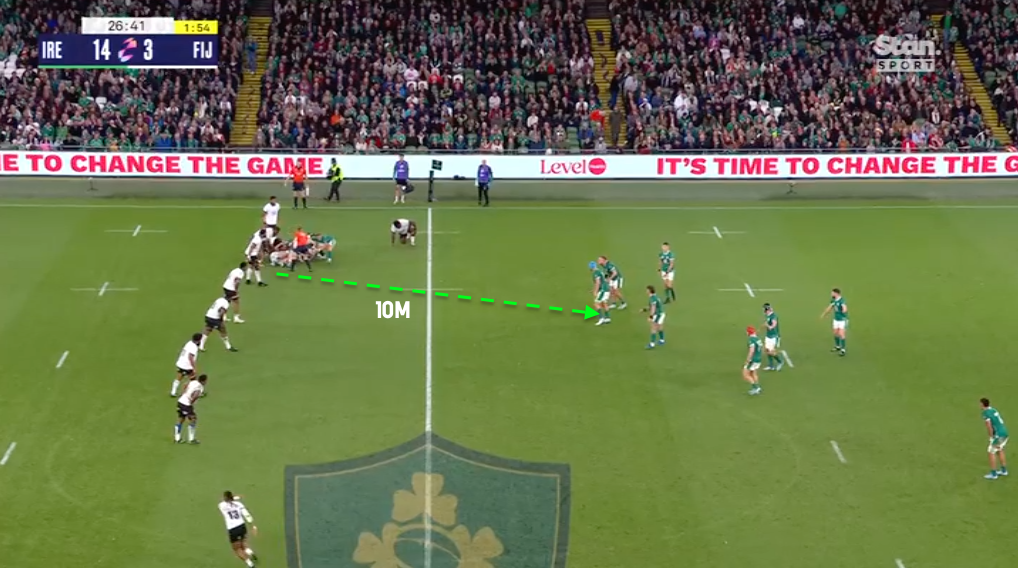
Also, check out what Fiji are showing at the ruck;
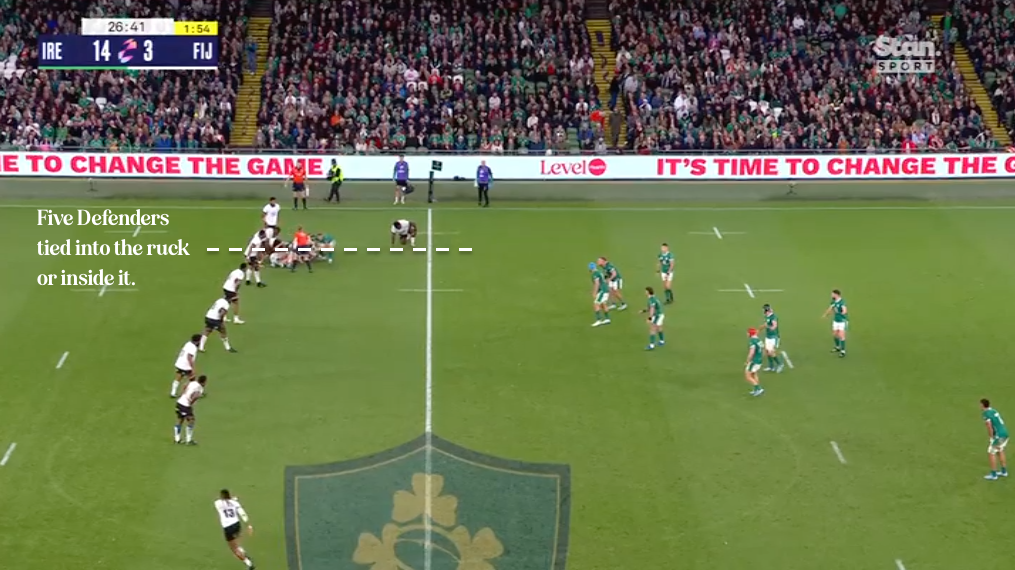
Three defenders tied into the ruck, one down hurt, one guarding the blindside that Ireland are never, ever going to attack in this instance. This means that six defenders are guarding 50 metres of lateral space against two Irish forward pods with two layered backs behind the screen.
Let’s see how it plays out.
Uh uh.
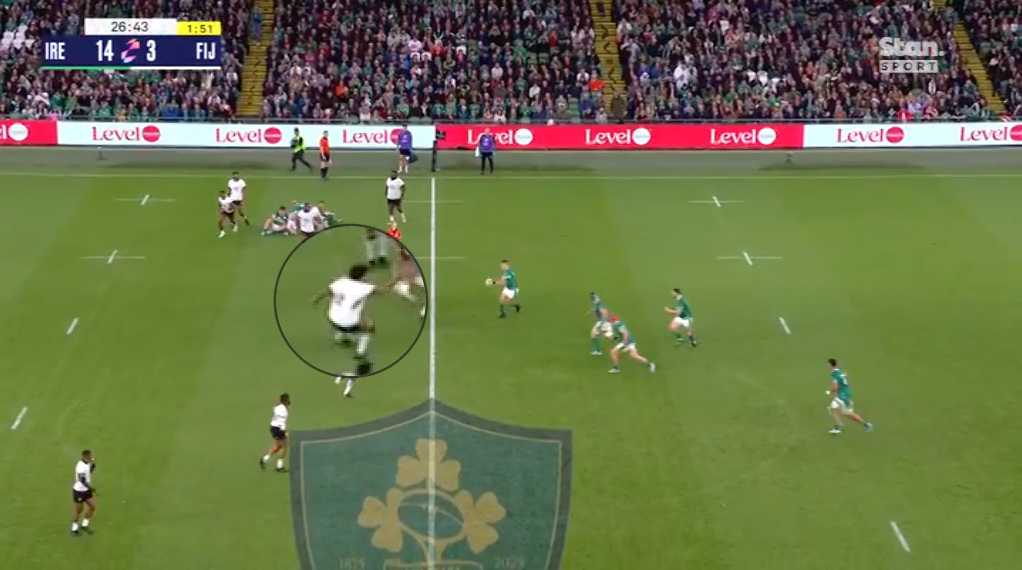
You can’t compete at a ruck like that, lose two extra defenders on top of it while you’re already down a forward and then make a bad read like this in defence off a screen pass.
Prendergast put Van Der Flier through the gap but it’s the easiest linebreak assist you’ll see all season.
Mick Byrne and his staff didn’t really learn from what they saw in the last two weeks; competing at the breakdown to slow Ireland’s ball doesn’t have a material effect on our attack unless you’re getting massive decisions every other ruck. If Ireland gets the ball but you lose two or three defenders to the ruck, the damage is already done and it’s exaggerated when you’re down a forward.
When you combine that with Fiji putting a huge line speed focus on Sam Prendergast from the first possession of the game which played right into his best game.
This pressure from Fiji looks good but they’re trying to close 9m of space – the blitz started on the line of the 22 – on a deep-lying playmaker who wants to bait that pressure.
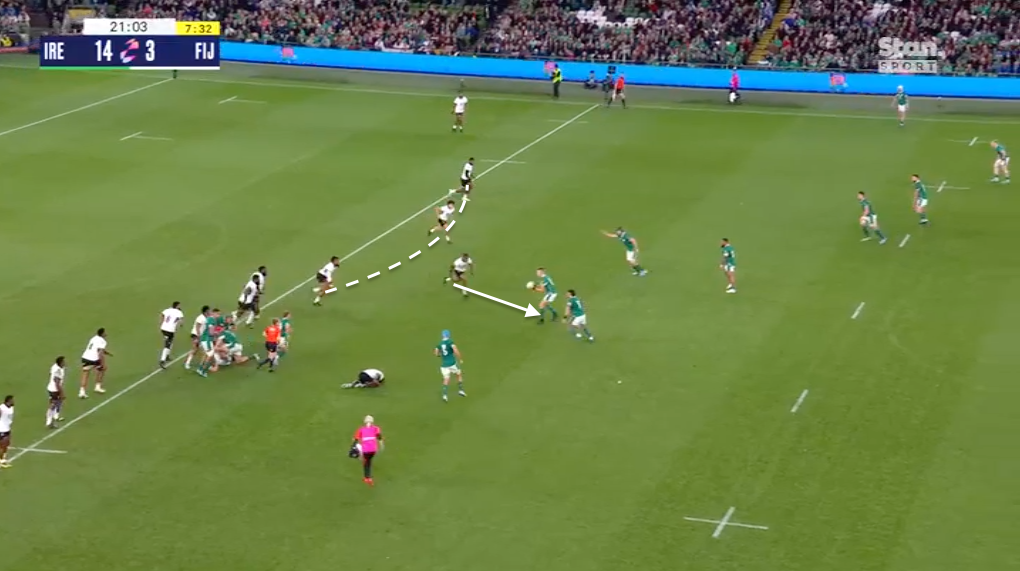
Jiuta Wainiqolo is doing what they would have schemed pre-game – pressure the young, skinny #10. But Prendergast loves that action. He turns sloppy blitzes that misjudge his depth from the gainline into moments he can “surf” into space left outside the blitzing defender.
For me, Prendergast’s game really improved when Ciaran Frawley came on the field for the injured Jamie Osbourne. Why? Frawley attacked the gainline running off screens with real pace and intent, which caused the Fijian defence to compress and fragment.
Look at this example with a bit of context that this, again, came from a long kick up field that Ireland returned on transition;
First thing you notice again; look at how this post-transition phase has battered the Fijian defensive transition after the first ruck.
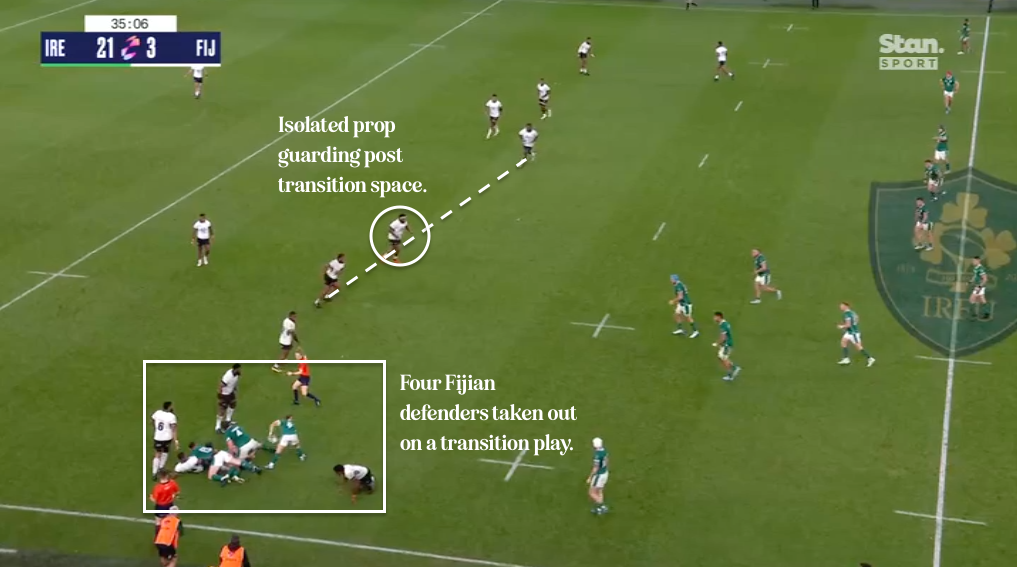
Frawley’s aggressive, pacey attack off the screen pulls four defenders out of the outside defensive shape.
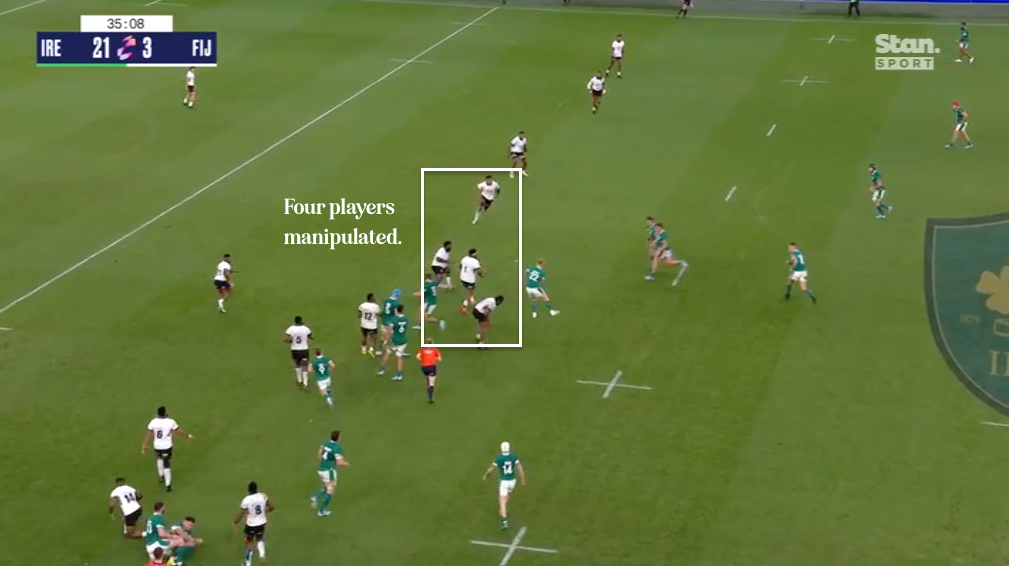
That means Prendergast can surf into a pocket of space where a defender is already frozen. Doris’ line outside draws in Nayacalevu and that gives Prendergast a clear lane to find Van Der Flier with an excellent pass.
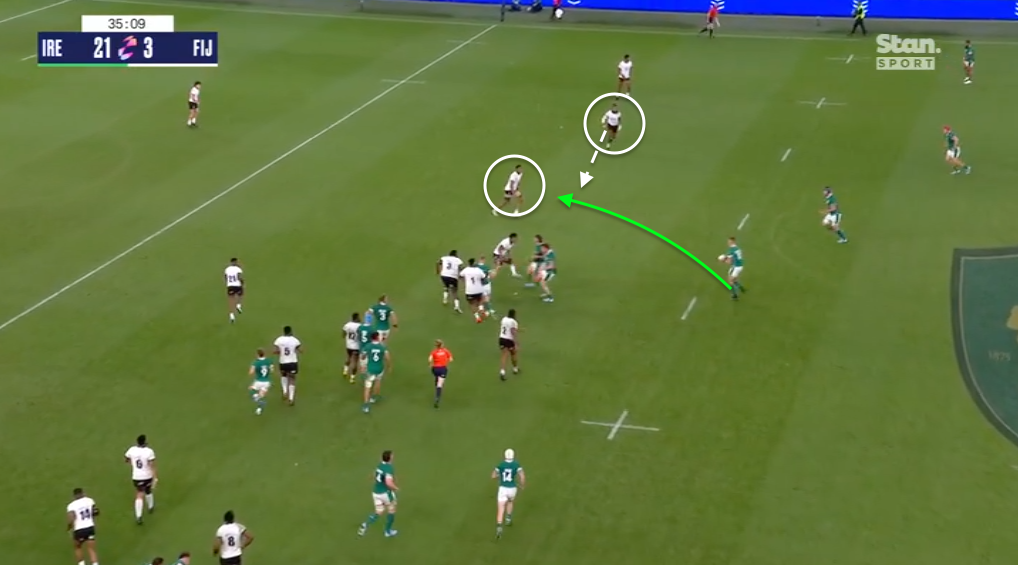
If Fiji were fanning out and filling the field, Prendergast wouldn’t get that “surf” line into space against a defender who has to be passive. When he gets it off the back of an excellent screen run from Frawley, it looks easy; he can dictate the terms of the contact so his relative lack of pace and explosivity in contact isn’t a factor.
All throughout the game, Fiji kept sending big hitters at Prendergast, despite how deep he sat in the attacking layers. Here’s another good example of a Fijian blitz leading to a linebreak assist for Prendergast.
At this point, Tuisova should have seen that Prendergast is just out of reach and the only play to make is pushing out – because Prendergast showed him repeatedly how and where he “attacks the line” – but the Fijian midfielder can’t help shooting up, leaving a gap that Frawley can cut back against.
As the game wore on, Fiji did start to realise that jockeying on Prendergast usually led to a better outcome for them; this moment probably could have done with Prendergast engaging directly with Vuate Karawalevu to release Hansen, but he stabs through a kick for Conor Murray (?) to chase.
That’s not the play to make there, in context.
Later again, Fiji even fell onto the jockey on Prendergast’s line with chase pressure coming from the inside – that led to a pressured turnover. The outside defender makes the pass incredibly difficult to execute while the inside defender gets after Prendergast’s “power hand” coming through on that long, sling pass of his.
Overall, this game was the perfect showcase that Ireland aren’t a Lightning Quick Ball team – that’s just a side effect of what makes Ireland play well. The real thing that makes Ireland tick is winning contested rucks and playing around the opposition’s blitz through layers of attacking runners where the killer pass is usually only ever 5m away.
Fiji just kept infringing, also, which meant they lost 266m of territory to Ireland’s 14 kicks down the line. And then, as expected, Ireland pieced them up at the lineout/maul. We weren’t necessarily outstanding in that area of the game but we had so many opportunities in their 22 that 83% return from 18 lineouts was more than good enough.
All in all, lots to like for Ireland on a day where almost everything seemed to go right off the back of some powerhouse individual performances. Australia will – should – be a different story but that doesn’t mean we can’t enjoy this game for what it was.
| Player | Rating |
|---|---|
| Andrew Porter | ★★★ |
| Gus McCarthy | ★★★★★ |
| Finlay Bealham | ★★★ |
| Joe McCarthy | ★★★★ |
| Tadhg Beirne | ★★★★ |
| Cormac Izuchukwu | ★★★ |
| Josh Van Der Flier | ★★★★ |
| Caelan Doris | ★★★★ |
| Craig Casey | ★★★★★ |
| Sam Prendergast | ★★★★ |
| Jacob Stockdale | ★★★ |
| Bundee Aki | ★★★★★ |
| Robbie Henshaw | ★★★★ |
| Mack Hansen | ★★★ |
| Jamie Osbourne | N/A |
| Ronan Kelleher | N/A |
| Tom O'Toole | ★★ |
| Thomas Clarkson | ★★★ |
| Iain Henderson | ★★★ |
| Cian Prendergast | ★★ |
| Conor Murray | ★★★ |
| Ciaran Frawley | ★★★★ |
| Stuart McCloskey | ★★★ |
