
Ireland 46 Australia 19

Inliers and Outliers

Ireland 46 Australia 19
Nothing For Ireland
Australia showed up to the Aviva Stadium wanting one game, but received something completely different. At a systemic level, you'll never see a worse aerial performance at test level this year, or a better one from Ireland.
Match Importance
Quality of Opposition
Attack
Defence
Set Piece
3.8

This was a bizarre game.

Ireland were good. Australia were abysmal. But that doesn’t fully explain it either.

Before we delve into the article, let’s assess the Green Eye and determine if it translates to what we saw on the grass.

Data readout – Ireland v Australia

This game looked exactly like the model we’d built for it:

  • Kicks / K:P – Ireland 45 kicks (1:4.4), Australia 25 (1:5.9). At half-time, Australia were at 1:9.1 to Ireland’s 1:5.5, so they only moved towards a kicking game once they were already behind.
  • 22 Entries / PPE – Ireland 12 entries @ 3.8 points per entry, Australia 9 @ 2.1. We got the +3 entry gap we were looking for and comfortably out-finished them.
  • Rucks / Linebreaks / LBR – Ireland 89 rucks, 7 linebreaks (~7.9 per 100); Australia 72 rucks, 2 linebreaks (~2.8 per 100). We had to work through a little more phase, but produced far more damage per ruck. Some of the linebreaks came in the last 20 for Ireland when Australia seemed more mentally checked out than the first half, but it still scans.
  • Set-piece & turnovers – Lineout: Ireland 10/10 (100%), Australia 13/19 (68%). Turnovers lost: Ireland 12, Australia 18. Our kicking game fed directly into a heavy, low-return lineout load for them, and the scrum was a complete non-factor.

How Australia looked against their own season

When we drop this game back into Australia’s season profile from the Green Eye:

  • Entries – Season average: 7.1 for, 9.1 against. Here: 9 for, 12 against. They actually improved their attacking entries slightly, but conceded even more than usual — we hit the upper end of the entries band we were targeting.
  • Points per entry – Season attack: about 3.0 ppe; here 2.1 (well below par. Season defence: ~2.2 conceded; here 3.8 conceded (much worse). Their usual net efficiency of roughly +0.8 per entry flipped hard negative.
  • Ruck volume – Season: around 110 rucks a game. Here: 72. They got into the sub-100 ruck zone we talked about, but Ireland still had more rucks and more linebreaks.
  • LBR – Season attack: ~5.4 linebreaks per 100 rucks; here ~2.8/100, down in their Japan/NZ/Italy “no punch” tier. Season defence: ~7.0/100 conceded; here ~7.9/100, slightly worse again.
  • Kick-to-pass – Season: 1:7.7. Here: 1:5.9 overall, but with that 1:9.1 first half. They only really nudged towards a Lions/Ireland-style kicking profile once the game state had already gone against them, and even then it had no accuracy or chase energy.

Where does this sit against our Green Eye scenarios?

In the Green Eye, we sketched out a few possible futures for Australia:

  • Best-case pivot – sub-1:5.4 kick-to-pass, sub-100 rucks, and still strong LBR/PPE (the South Africa 1 template).
  • Half-pivot – they kick a bit more and bring rucks down, but don’t close the entries gap or fix their defence.

This test landed in the worst version of that half-pivot scenario for Australia. The Wallabies did reduce their ruck load and moved their kick-to-pass closer to the benchmark we laid out, but they did it late, didn’t win territory, didn’t win entries, and saw both their LBR and points per entry collapse relative to their usual standards. From an Irish point of view, this was the model working exactly as drawn: we kicked more, owned more of the field, took more entries, and turned that into a decisive PPE edge that Australia’s season-long efficiency couldn’t rescue.

So, essentially, Ireland beat Australia with the exact template we’d expected from the pre-game numbers. They kicked more, controlled where the game was played and then turned that field position into a 12–9 edge in 22 entries. Once there, the gap in quality was stark: Ireland took 3.8 points per visit to Australia’s 2.1, scoring six tries from their dozen entries and leading for the entire game. Even in phase play, the picture was the same. Ireland actually had to work through more rucks (89–72), but most of those were in or around the 22. We produced seven linebreaks — roughly 7.9 per 100 rucks — against just two for Australia at about 2.8 per 100.

The result was a scoreboard that looked like a blowout but was really just the logical endpoint of Ireland winning the kicking battle first, the territory battle as a result, and then the red-zone battle.

***

One thing Australia needed to do in this game was to lock out Ireland inside the first 20 minutes to empower any kicking or off-ball state that would follow. They failed at this almost immediately. The weather conditions helped immensely. The wet track and strong wind coming in over the North Stand essentially turned every Irish kick into a 40/50m territory gain due to a combination of excellent kicking from Sam Prendergast, elite-level chasing from Hansen, and genuinely abysmal receiving from Australia under the high ball. The wind turned his spiral bombs into greasy torpedoes that rained down on a back three that looked like they were told about the concept of contestable kicking during the anthems.

So how bad was it? How good was Ireland’s kicking and contesting?

I wanted to look into it and get a feel for what I thought was an incredibly lopsided aerial contest. So I went back and watched every contestable kick Ireland put up.

In this instance, I have defined a contestable as one that is kicked with the idea of a potential regather in mind, where a chaser and a defender can reasonably be expected to contest possession. It made for staggering watching.
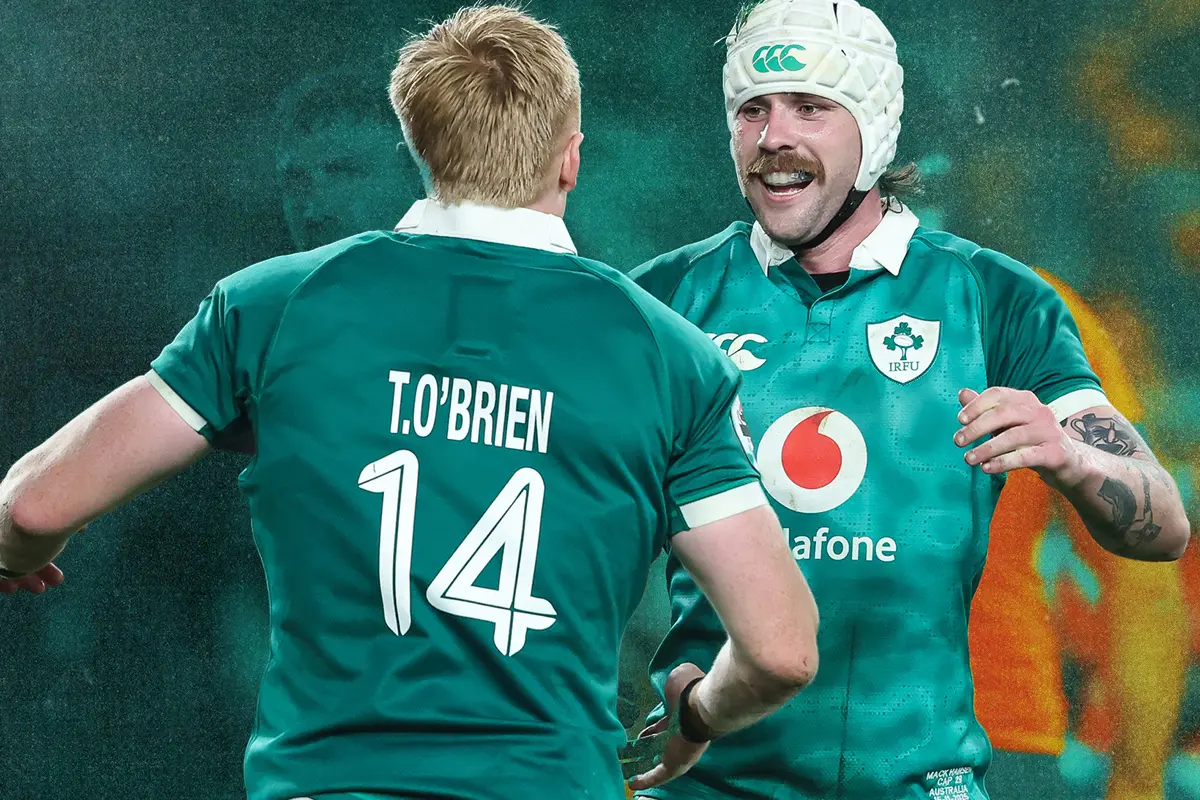

Percentages

Of all the Irish kicks

Ireland kicked 45 times in total.

Outcome Kicks % of all kicks
Contestable kicks 15 33.3%
Contestables regathered by Ireland (net) 10 22.2%
Contestables ending in Australia ball (incl. pen) 5 11.1%

So, one in every three Irish kicks was contestable, and about one in every five kicks was a contestable that Ireland actually got back.


Within the 15 contestable kicks

Outcome Kicks % of contestables
No clean Australia catch 13 86.7%
Clean Australia catch 2 13.3%
Ireland possession (net) 10 66.7%
Australia possession 5 33.3%
Australia penalty off contestable 1 6.7%

Catch-Quality vs who ends up with the ball

Catch quality & outcome Kicks % of contestables
Messy catch → Ireland ball 9 60.0%
Messy catch → Australia ball (incl. pen) 4 26.7%
Clean Aus catch → Ireland win next phase 1 6.7%
Clean Aus catch → Australia ball retained 1 6.7%

Volume:
Ireland kicked 45 times, and a full third of those (15) were deliberate contestables rather than simple clearances.

Disruption rate:
In 13 of the 15 contestables (86.7%), Australia failed to claim a clean catch. It meant they rarely got the kind of clean, multi-phase launch they wanted off the back of backfield receipts.

Hit rate on regains:
Ireland turned 10 of 15 contestables (66.7%) into their own possession. That’s roughly a two-for-one trade: for every three contestables we kicked, we got the ball back twice.

Impact across the game:
First half: 5/8 regathered (62.5%)
Second half: 5/7 regathered (71.4%)
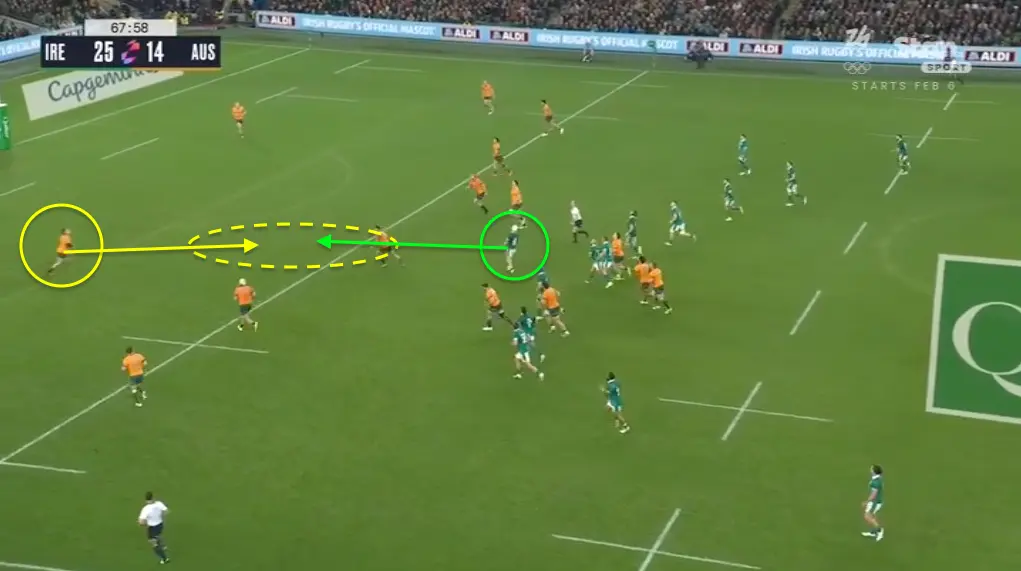
For context, URC teams regathered about 15% of their kicks from hand across last season. Ireland were up at 22% against Australia — closer to what the very best club kicking/chasing sides (Sharks, Munster, Stormers) manage across a full campaign, which is approximately 18%.

To put it another way, this was an insane, verging on unprecedented aerial performance for Ireland and Australia. A true outlier.

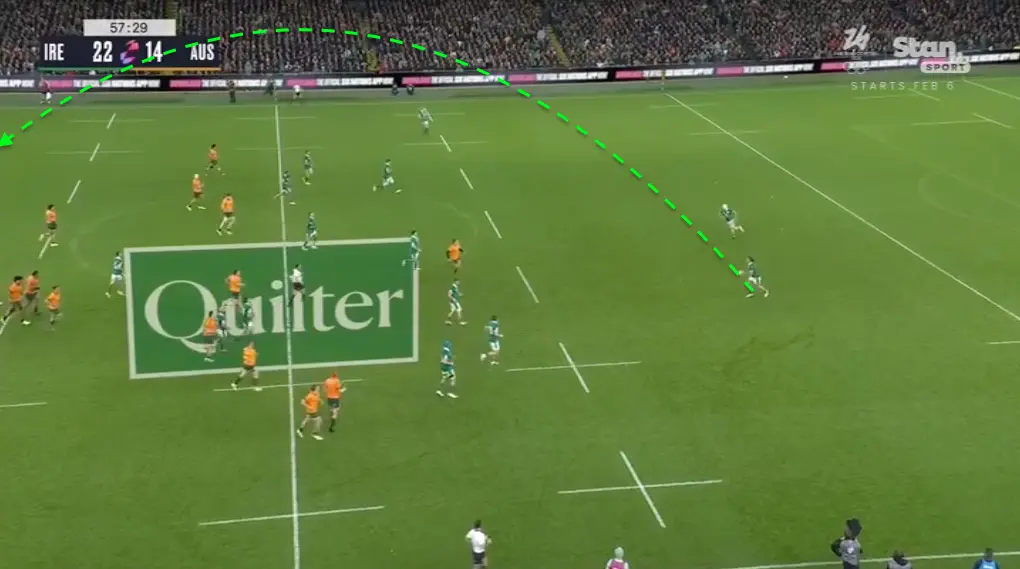
This is a good example launched from a free-kick given at a scrum, approximately four metres inside the Irish half. Prendergast launches this approximately 35m downfield, with a hangtime of 5.06 seconds.

Prendergast launches this approximately 31m into the air, at an exit velocity of around 93km/h — making approximate assumptions on distance and the time the ball was in the air. The ball comes down on Jorgensen at approximately 70 degrees, accounting for the wind blowing against the kick at the highest point.

Does an elite kick receiver take this kick still? Yeah, they do, but the pressure Ireland put on with the chase, coupled with the steepness of the kick, turned a scrum free kick in Ireland’s half into an attacking possession in the Australian 22.

This one, off a goal-line drop-out, was turned into a clean Irish possession in the 22 by Jack Crowley.

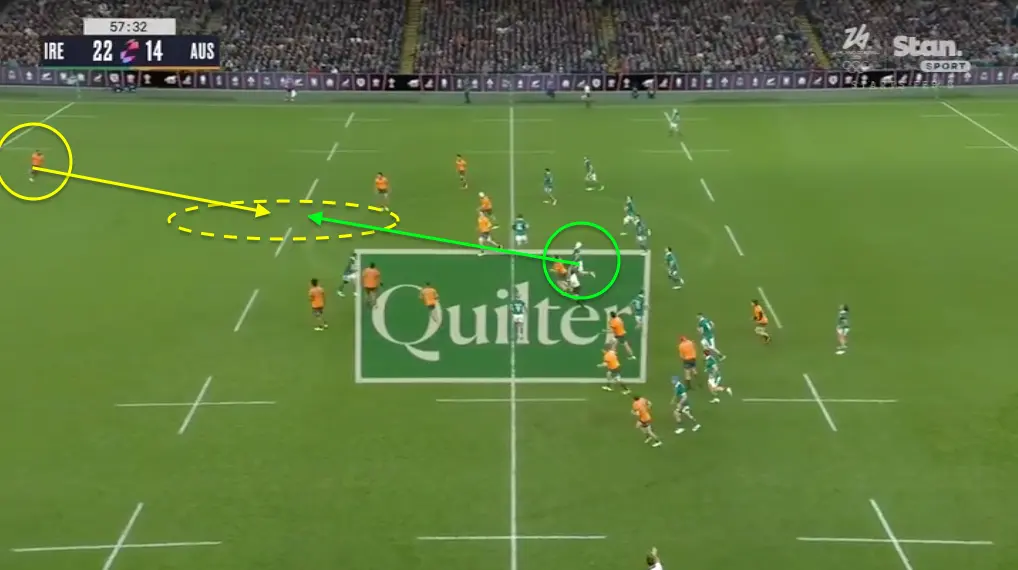
This was a shorter-range Garryowen, but it was just as good. Max 21/22m in the air, travelled approximately 20 metres with 4.11 seconds of hang time off the boot, and came down at around 75 degrees. Crucially, this targeted the area that James O’Connor, who looked like a 35-year-old guy who was doing comms last weekend (because he was), would have to defend as the back pin.

The kick was targeted at this specific spot, where it would pull O’Connor into the contest against Mack Hansen, who is Ireland’s best offensive aerial chaser in general, and specifically so in this game. There’s only one winner.

Height isn’t the be-all and end-all of contesting in the air, but Australia’s back field coverage — back three plus the #10 — averaged out at about 5’11” in total, and none of them are what I’d call aerial specialists.

When Australia tried to do the same, they didn’t have the horses.

This lineout play was always designed to be a kick chase. Potter is roughly in line with O’Connor as he takes the ball, with the intent being for the veteran Wallaby to put this high and deep beyond the Irish 10m line.

The kick was the right play, but even wind-assisted, O’Connor only gets three seconds of hang time on a kick that barely travelled 24m vertically up the field, accounting for the diagonal nature of the kick itself.

Australia only managed an approximate 10m territory gain but lost possession.

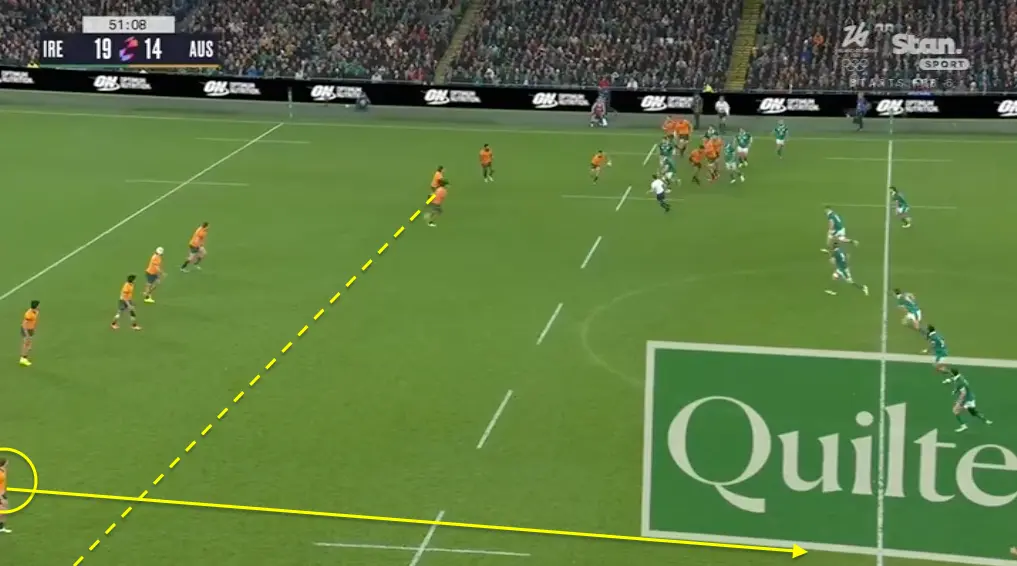
When you contrast that with how easily and regularly Ireland moved up the field through the boot, the flow of this game becomes easier to read. Here’s another perfect example. Australia exit long down the field through O’Connor. Lowe takes the kick, signals for a chase and then hits another high-bomb into the space behind the Australian chase line.

Why are Daugunu and Jorgensen so far back from that chase line? Ireland are playing into the wind and starting on the left-hand side of the field. Lowe isn’t going to bang this 40m across the pitch with the wind blowing into his face. Even if he was, it’s a bad play to make. None of the chasers on that side would be onside until the ball was a second or two in the air.

So the only play was either long down the left wing to Jorgensen, or a contestable. Which means that Daugunu should have been just halfway between the 10m line and the Australian 22, not guarding the 15m tramline on the 22.

22m gained vertically, zero carries required, and the Australian backfield so far from the action that it barely even counts as a contestable at all.

It’s impossible to win a game of any kind with kicking, catching and coverage like this against anyone, let alone an Irish side set up to play this specific type of game, in these specific weather conditions.

Australia’s dream game-state for this one was one where they held Ireland out physically — as they did really well, almost all the way through the game — but were systemically underprepared for a high-volume contestable game. I think they wanted to kick long, meet Ireland in defensive transition and then mop up Ireland physically around the halfway/10m line with the aggressive, high edge transition defenders they picked on the wings and midfield. I’m sure they expected Ireland to throw up high bombs — that was always going to happen — but not even in their worst nightmares did they expect to only have 6.7% of their catches end in structured transition possession on the next phase.

***

So does this mean that Ireland are back? Have we entered a glorious era of the People’s Republic of Backistan?

It would be comforting to think so, but I’m not so sure. The Wallabies were so bad, almost from the very first possession, that it’s hard to get a read. Even with that, they still had more than enough for Ireland in offensive collisions and the attacking maul when they managed possession inside the Irish 22, which was incrementally more difficult because their lineout was running at 68% on 19 throws.

If you’re not kicking at volume and can’t take the opposition’s kicks, who are kicking at volume, and without a functioning lineout, it’s impossible to win a test match.

You can have a bad lineout and still win if you kick well.

You can kick poorly, but do still win with dominant scrum, rock-solid lineout and counter-jump.

You can’t do both. 

Essentially, if almost every time the opposition kicks the ball, they gain both ground and possession, and you can’t hold just over half of your launch points, you lose every single time.

Joe Schmidt has to own his selection choices that empowered this loss, and hope they banked something useful for their development in the process.

Ireland did what this Irish team almost always do to a team that displays a glaring weakness mid-game — they put them away without too much fuss.

The teams that beat Ireland in 2025 take us out of our comfort zone and away from our muscle memory.

Australia were the contender who never settled into the fight — always a bit off-balance, always a fraction late — and the veteran didn’t beat them with genius, just with muscle memory, calmly cashing in on the same small mistakes that had been there from the first round.

There were more than a few worrying notes; our tight defence, maul defence and offensive collision winning outside of the 22 — but when you can kick almost everything off #10 all night long and expect to get the ball back, that wasn’t a factor outside of a few hairy moments.

The ultimate challenge in the test world in 2025 awaits next week, but that’s for next week. For now, a decent job, done well.

PlayersRating
1. Paddy McCarthy★★★★
2. Dan Sheehan★★★
3. Tadhg Furlong★★★★
4. James Ryan★★
5. Tadhg Beirne★★★
6. Ryan Baird★★★★
7. Caelan Doris★★★★
8. Jack Conan★★★
9. Jamison Gibson Park★★★★★
10. Sam Prendergast★★★★★
11. James Lowe★★★★
12. Stuart McCloskey★★★★
13. Robbie Henshaw★★★
14. Tommy O'Brien★★★
15. Mack Hansen★★★★★
16. Ronan Keller★★★
17. Andrew Porter★★★
18. Tom Clarkson★★★
19. Cian Prendergast★★★
20. Nick Timoney★★★
21. Craig Casey★★★★
22. Jack Crowley★★★★
23. Bundee Aki★★