



Just how badly can you play and still win by 31 points?
It turns out — not that badly at all, really. Ireland weren’t dire here, by any means. We were OK. And maybe that’s the issue.
To fully understand the context of this article, you should probably watch the France vs. South Africa game. Maybe you already did. I had just finished my second watchback of the Japan game at that point, and the standard of what I saw in the Stade de France shook me a little.
This Irish squad, based on what we saw last week and this week, is nowhere near the level of either side. The reasons for that? Well, there are some that we can discern from the outside, and some that we can’t.
I’ll get to those.
Here’s my read of Ireland’s win over Japan, with reference to what I predicted in the Green Eye.
22m Entries
Ireland generated 13 entries to Japan’s 5, almost tripling Japan’s access to the red zone. Even with the finishing a little clunky up to 60 minutes (22–10) — empowered by a lineout that ran at 57% in the first half — we still returned ~2.9 points per entry against Japan’s 1.4, and the late surge just dragged the scoreboard up to where the underlying dominance already was.
We repeatedly engineered entries; Japan, held to five visits, never built the volume needed to stress our defence structurally because they couldn’t force penalties until late in the first half. Sure, Japan held the ball well, but we defended them comfortably for most of the game and created the late-game collapse through kicking in the first 50 minutes. We kicked long to drain their energy in defensive transition, and this plan worked fairly well, broadly speaking.
That’s exactly the tier-one pattern Japan have struggled with: they can play plenty of rugby between the 22s, but can’t turn it into repeatable, high-quality opportunities.
Linebreak Rate (LBR) with K:P context
On similar ruck volume (Ireland 93, Japan 88), Ireland produced 10 linebreaks (~10.75 per 100 rucks) to Japan’s 3 (~3.41 per 100), with Ireland’s numbers bloating in the last twenty minutes as Japan tired and went to their bench.
Both sides had a broadly similar kick-to-pass profile (Ireland 1:8.4, Japan 1:7.6), with Ireland’s kick-to-pass ratio trending higher late in the game in conjunction with that drop-off in Japan’s linespeed I mentioned earlier. Japan’s numbers reinforce my pre-game read — lots of possession, quick ball, but a very low return in actual structural breaks — while we showed that, even without playing all that well, we can comfortably pull away from a tiring team ranked 13th in the world in the last half an hour.
The core issue, for me, is that our forwards aren’t winning offensive collisions with any regularity. In this example, you can see a newly crowned 120kg Ryan Baird getting stopped by a player who actually weighs 120kg. He gets stood upright in contact, the cleanout coming in behind him is slow and reacting backwards, and that leads to the ball squirting out the side of the ruck because we’ve lost the collision point.
Two Japanese defenders were in the collision, and three Irish forwards were tied up in the same one. Collision lost. Compression failed.
This example is a lost Irish collision that actually led to an Irish try. Japan, who were down an outside back due to a yellow card, gave up the linebreak in the exact space you’d expect when down a midfielder. But look at the setup carry.
This isn’t great.
Sure, Timoney is looking for an inside ball, which means he can’t latch on contact, but Doris loses the initial collision off #9 here to the point that Clarkson, like Beirne on the previous clip, gets stood up by the lack of forward momentum. Doris is stopped in the initial collision, but manages to ride the pressure around the outside.
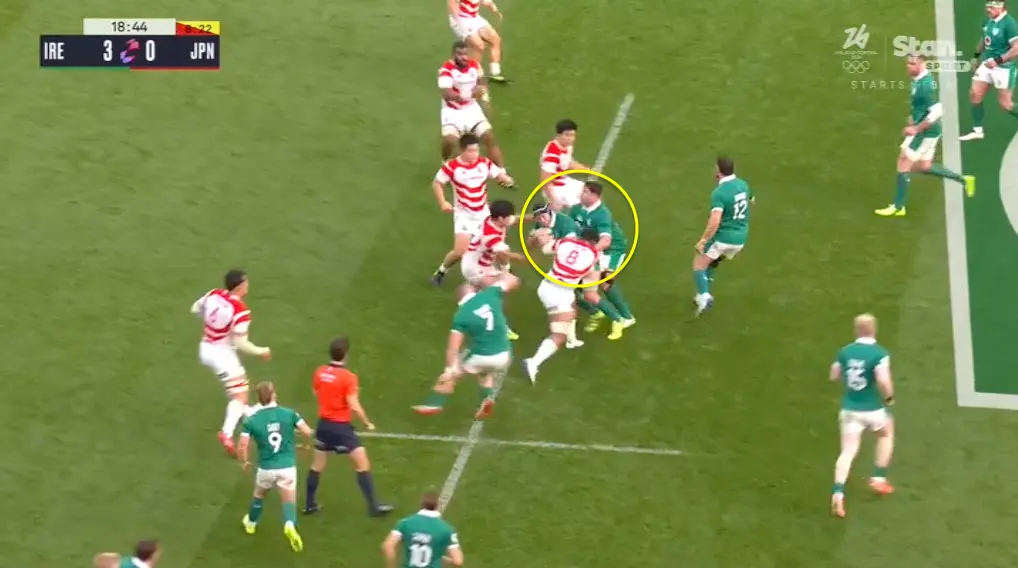
This was a seven-second collision point. Japan will be gutted to have conceded from here, but Ireland did really well to get Crowley into the one spot where Japan were scrambling to cover.
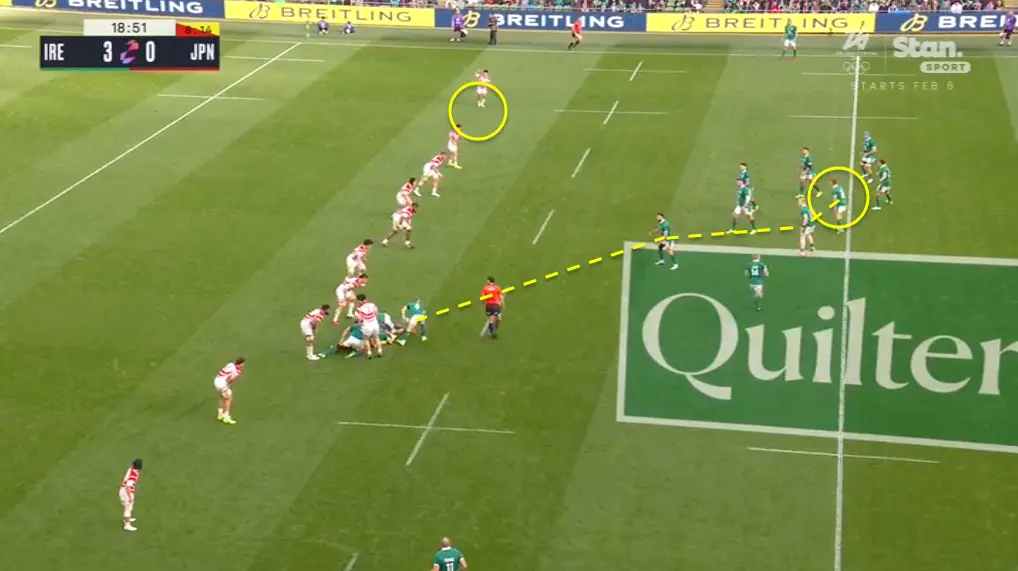
This is a classic multi-layered Irish attack, and it’s quite telling that it happened when Japan were a man down. Japan had done what the All Blacks and others have successfully managed — stuff Ireland with two-man tackles, don’t jackal, pack the pillars and blitz on the outside — but when Lawrence was off the field, they couldn’t blitz Ireland’s layers.
Baird cuts in a little too much for me here, but Beirne does really well to get an, uh, industrial cleanout on the 6’8″ Dearns to win this collision, and trap two Japanese backs on the shortside.
When the ball comes back, Crowley sees the gap.
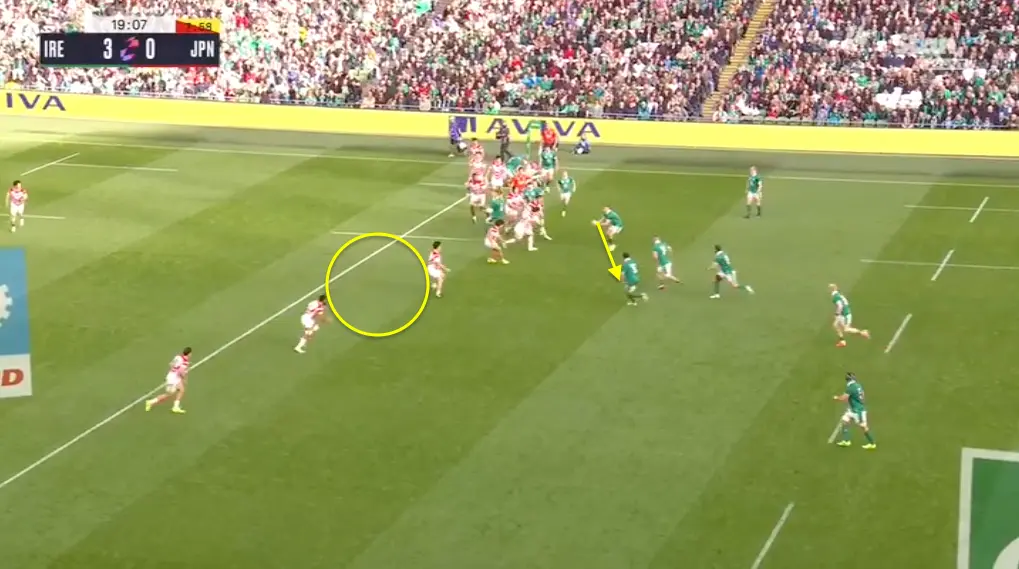
From there, it’s about work rate and finding the obvious runner. Casey scans really well, finds Doris with a great pass, and Crowley does his trademark outside loop snipe to take the pass, which Doris hits perfectly.
He stays on his feet after the tackle, shoots around to the obvious space, has the pace to get there and finishes really well.
We left a few scores out there in the rest of the yellow card period. That space in their outside backline stayed there, and we found the 3/4 space well — O’Brien will want this break back, where it seemed like he got stopped up by his own footwork.
The inside ball is a classic Ireland overplay, and the turnover comes.
When it was 15 v 15, Japan got back to that outside step up to halt our transition work, which we followed up with some fairly soft reset carries.
Osborne is worried about the intercept here and comes back inside.
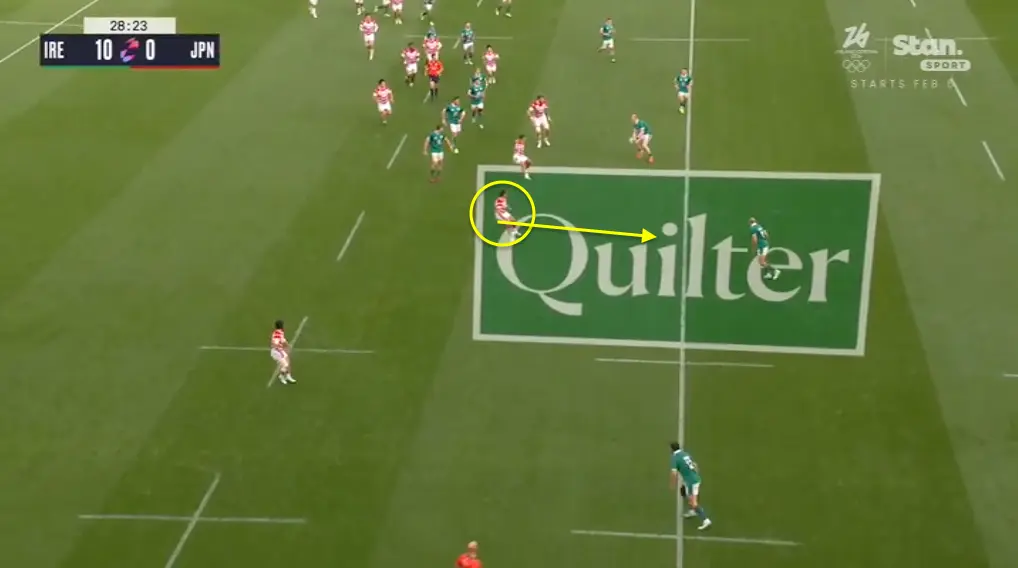
The less said about Ryan’s carry, the better.
We get some edge spacing again, but there’s some “fake” gainline here too. Doris carries well with momentum when Dearns blitzes on Crowley — Eddie Jones will kill him for that, it’s off-script — but look at how flat we look outside without the obvious overlap. We aren’t forcing compressions.
Porter is ahead of the ball here, so the Japanese edge cover can blitz out on Henshaw.
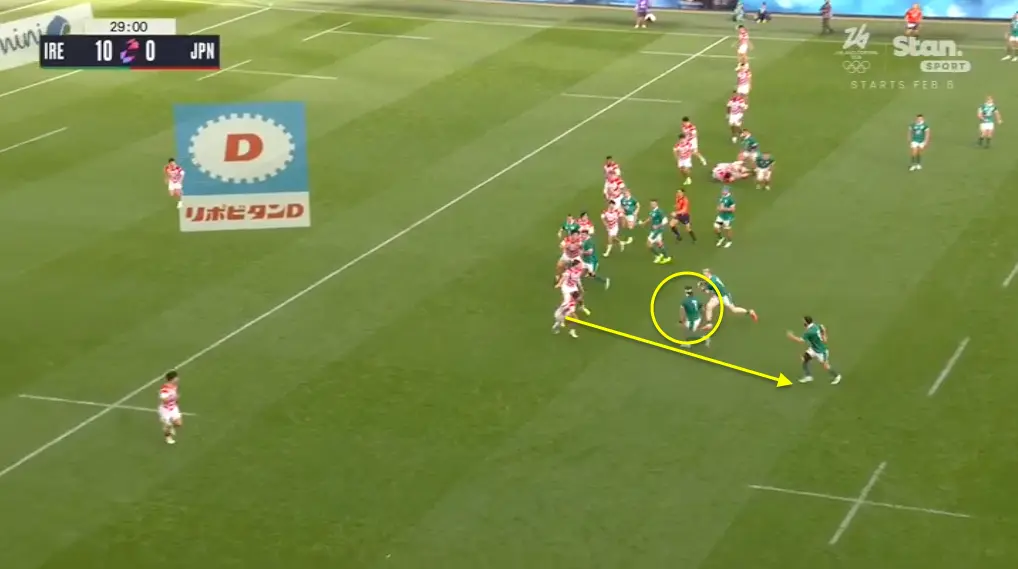
From there, Japan actually handle our carries really well — a two-man stop, followed by a one-man stop — and only the kind of “play to the whistle” stuff you’d kill an U18 side for sees Ireland go over for a freak second try.
All of a sudden, it was 17-0.
Japan forced their way back to 17-10 at halftime — we seemed to tire, something they would do soon after halftime — and we put the game beyond any doubt soon after with our best bit of attack in the 22.
This is really good.
Casey finds Crowley at range, pulling Japan into edge spaces and then hitting the gaps as we come back across. Japan were tiring, and the gaps were showing, as they always would. O’Brien really started to hit the space here — he’s a savage worker, and he got the reward for that work as the game progressed.
So what’s the issue?
That very little of this will translate against Australia, none of it will against the Springboks, and you’d have to be quite concerned about this side heading to Paris and Twickenham in 2026.
That is the fundamental issue. Ireland labouring to put away a deceptively punchy Japan side before eventually flushing them in the last half an hour would be par for the course if the team that played for Ireland XV against Spain on Saturday afternoon actually started in Dublin.
Instead, we were playing with Andrew Porter for 67 minutes because, to me, the coaches felt like we’d lose our scrum dominance — our one guaranteed way up the field — if he wasn’t on the field. Is that where we are? Is that who we are as a top-four test side in 2025?
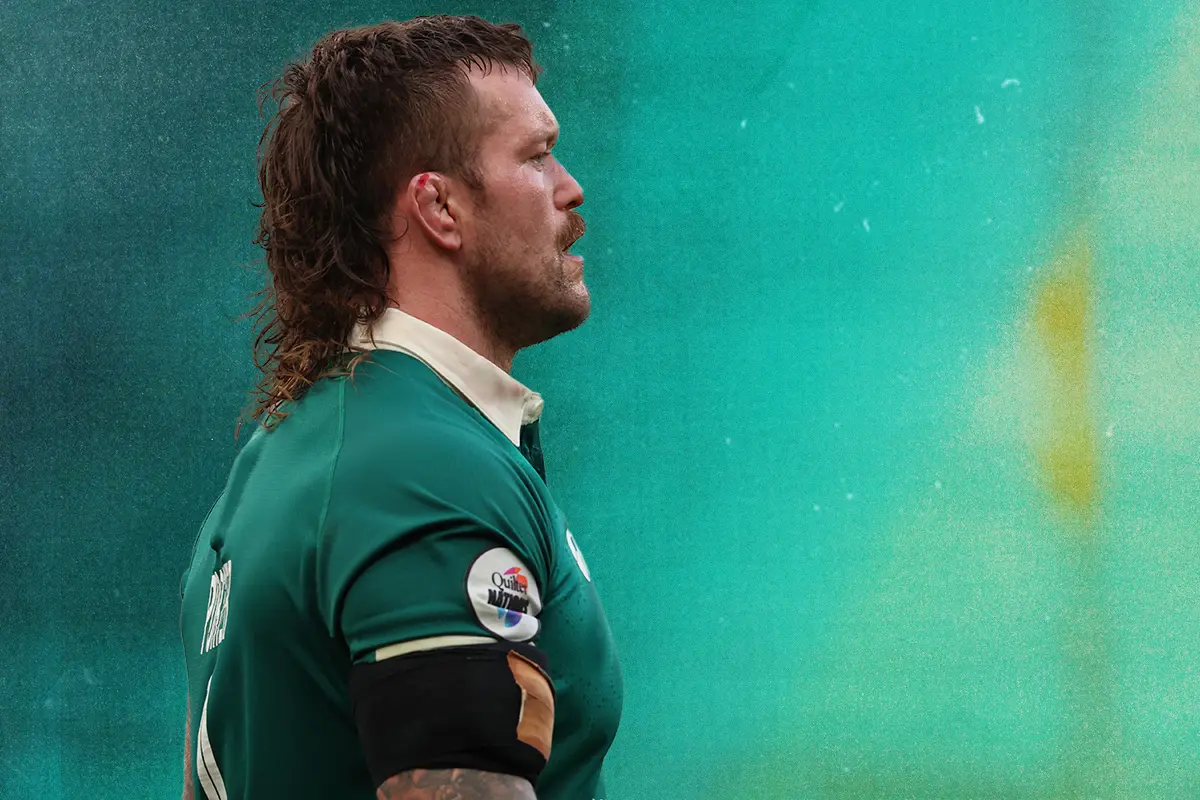
Andrew Porter is our most valuable, least replaceable player outside of Furlong, who has already drastically shifted roles from his peak, but we feel like he has to be there against a side ranked 13th in the world.
We’re in this vicious cycle where the head coach feels like we can’t rotate too deeply because we have no depth, and we don’t have depth because we don’t rotate.
It leads to the squad getting boiled down over and over again. Tom Farrell getting his first cap in this game is a great story, and wildly deserved, but he should have been capped three or four years ago. Nick Timoney has been in more or less every single Ireland camp since 2021, and this was only his fifth cap. Every game he’s played has either been against a Tier 2 side or an Argentinian side in 2021, who were in the middle of a deep reset in personnel at the time.
He is the perfect illustration of this system. An excellent player, broadly used as a cohesive training body who can help keep the flow of sessions going, with no real shot of ever moving up the internal rankings without two or three injuries, who can help prep the team for specific threats in the opposition for that week. Cian Prendergast, you could argue, is in the same. A good hand in training. Good for down-cycle summer tours. But that’s it.
They are a perfect example of this Irish squad’s inertia. In the camp, but not in the Prime Ireland conversation.
Even more concerning is that all the background noise over the last three weeks is about how Ireland are absolutely flying in training. Of course we are! It’s the same guys training the same way, with the same coaches, since 2021. We should be flying in training. The problem is that it isn’t translating the same way, especially with the same background noise talking about going back to the style we were using in 2023.
I was really concerned after this game.
I was even more concerned after the third watchback because… we didn’t play all that badly. There were a few dud performances, sure, and the lineout was a mess for the first half, but we actually played better than we did against the All Blacks.
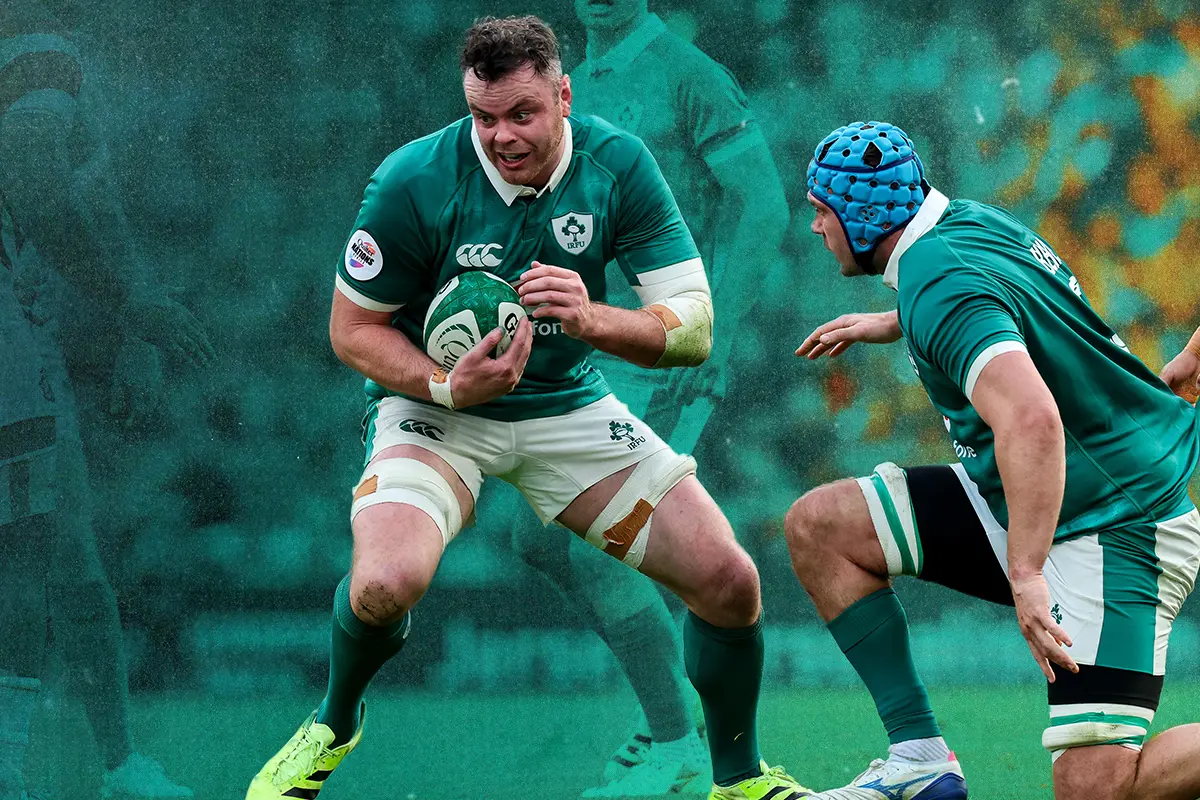
And that didn’t translate to a dominant, complete performance against a side who’ll do well to finish within 10 points of anything close to a full-strength tier-one side this year.
Another vicious cycle; we need to train well for the core of this team to be confident against any tier one level opponent, so players who aren’t familiar with that training or system find it difficult to even get into down-cycle match day 23s outside of a Lions-affected summer tour.
That stability in squad make-up means the training stays good — good, in this instance, means familiar — and the system stays fluid, but everyone is now three years older, with three huge seasons in the tank, with three more years of opposition analysis biting into our weak points.
What was true in 2023 is still true as we sit on the verge of the 2026 Six Nations.
When you consider the performances in the warm-up games when we’ve had to deviate from the Prime Ireland side we can all name, that is a genuine concern. We are a team built on cohesion, so by default, when our cohesion level goes down, so does our quality.
At this point in 2025, two years out from a defining World Cup for this group, we seem to be doubling down on what we have. Reshaping that pink dress into something we feel can pass for a time when we were at our best.
What needs to change? It’s hard to nail down.
You can talk about the players outside of this squad, but that seems to hit a rhetorical brick wall as to who’s good enough for test level. Tommy O’Brien is a great example of this conversation. A good, hardworking, industrious winger who’s far from the x-factor pace-merchant he’s billed as — check out Bielle-Biarry, Kolbe and Capuozzo to see what that actually looks like — but who can play to a functional level when given the opportunity to play for his country.
Who else is out there on this island who might do the same? At the moment, we don’t know, and, at a coaching level, we don’t want to know. We can’t risk the disruption session to session to see what a guy might look like after he’s stood for Amhrán na bhFiann.
You might reasonably ask, doesn’t that bring into question the system itself?
Of course it does. But the system is Andy Farrell. They are indistinguishable. Question the system, and you question Andy Farrell, who seems to have more credit in the bank than Apple.
His pre-game speeches often revolve around the sanctity of the shirt. That inner circle. The responsibility of wearing that green jersey. The weight of the expectation. It’s very powerful to hear, by all accounts … the first time. It’s the same the second time. Probably the same the tenth time, too. But, by the 30th time, five years in, the risk is that you’re selling the sanctity of the test jersey to a core of players who never have to worry about losing one for a big game if they’re even 50% fit.
At a certain point, credit runs out.
Then it comes back to earning it the hard way. Australia are the next challenge, followed by the Springboks. Two wins is the minimum a team that refuses to develop new (genuine) options outside a select core should demand. One win and one loss is a credit extension.
Two losses and the slow-motion decline we’ve seen might become one we experience all at once.
| Players | Rating |
|---|---|
| 1. Andrew Porter | ★★ |
| 2. Ronan Kelleher | ★★ |
| 3. Tom Clarkson | ★★ |
| 4. James Ryan | ★ |
| 5. Tadhg Beirne | ★★ |
| 6. Ryan Baird | ★★★ |
| 7. Nick Timoney | ★★★ |
| 8. Caelan Doris | ★★★ |
| 9. Craig Casey | ★★★★ |
| 10. Jack Crowley | ★★★★ |
| 11. Jacob Stockdale | ★★ |
| 12. Robbie Henshaw | ★★★ |
| 13. Tom Farrell | ★★★ |
| 14. Tommy O'Brien | ★★★★ |
| 15. Jamie Osbourne | ★★★ |
| 16. Gus McCarthy | ★★★ |
| 17. Paddy McCarthy | ★★★ |
| 18. Finlay Bealham | ★★★ |
| 19. Cian Prendergast | ★★★ |
| 20. Jack Conan | ★★★ |
| 21. Caolin Blade | ★★★ |
| 22. Sam Prendergast | ★★★ |
| 23. Jimmy O'Brien | ★★★ |
