


Five minutes into this game, England were 3-0 up on the scoreboard but I had a feeling that they could not beat Ireland over the 75 minutes that were to follow. There were key issues that undermined them, even then. Five minutes later, I was certain. I’ll show you why in a minute.
In the meantime, though, I’ll say that a lot has been written about England’s malaise over the last 18/24 months but, even after this loss – which should have been by 40 points, not 19 – I still think there’s the core of a good team in there, certainly one that was better than what we saw on Saturday. Their problems run deep but they are not completely insurmountable. Neither are they certain to have a bad World Cup given the weakness of their pool. Argentina will be a tough, but winnable, game first up. Even if they lose that game, they should still coast to the quarter-finals where they’ll fancy their chances in a one-off game against Australia, Wales or Fiji.
All that being said, this was a lower-quality workout for Ireland ahead of a fiendishly difficult World Cup pool, where our two biggest challenges will come from teams who play a radically different style of rugby than England.
Before this game, I felt that kicking would play a big part in how the game played out, for good or ill, and it did. Ireland kicked 32 times, England 27. Almost an exact reversal of the kicking trends this year where England have kicked 31 times per game on average this year. Ireland have kicked 28.5 times per game on average this year. This happened back in the Six Nations too. England are rarely outkicked, just from a raw numbers perspective, against anyone but that is almost always inverted against Ireland.
It’s why I wrote that this game would be relatively tight until the last third. My thought process was that both sides kick the ball a lot and that shared tendency
England’s work after the kick further illustrates to me that Steve Borthwick didn’t understand why Ireland beat them back in March and he’s even less sure now.
I wrote on Twitter after the game on Saturday that “Borthwick’s England are a mismatch of different ideas. The good things they do are in isolation – nothing is joined up.” I think it sums them up quite well. England have a good attacking lineout and a good defensive lineout. They have a good roster of ball carriers who get over the gainline more than the average test team. Yet they are incapable of working those three things into a coherent system that wins games against elite opposition with any regularity. Essentially, if you don’t repeatedly hand this team penalties or produce unforced defensive mistakes on a platter, Steve Borthwick’s England will struggle to beat you.
At a conceptual level, England’s game relies on kicking at a mid-range distance – average 25m+ per kick – contesting the kick directly and/or pressuring the opponent on the first few phases of transition so that you can force an error, a penalty or a kickback of the ball from the opposition. If the opposition returns the ball with a short-range box kick, England are really good at contesting for those and with their roster of kickers, they should be able to double down on the pressure by then kicking deep into the opposition’s territory, squeezing the reception of the kick with a good chase and then forcing the opposition to kick into touch.
Against Ireland, they kicked with the frequency expected but the quality of their transition defence across the first few phases was really poor right from the very first whistle.
England kicked deep off the caterpillar ruck, which slowed down their forward chase line – this impacted their ability to turn their kick into something that actually earned them a territorial foothold. They kicked to the Irish 10m line but they weren’t able to sustain an effective defensive presence there. When you’re playing a phase transition team like Ireland – who hurt you on the second, third and fourth phases after you kick to them – you can’t afford to lag off on those crucial post-transition phases. It isn’t enough to make a tackle on the first runner because that’s not even 10% of the job. If you’re slipping up on phase two/three/four, Ireland will run through you.
The warning signs of the first minute were not heeded by England and they stuck to what became a high-risk kicking strategy for the rest of the game.
That kicking strategy executed as sloppily as that will always lead to defeat against this Ireland side. The frustrating thing for Andy Farrell will be that we didn’t punish them enough, the worrying thing will be the windows of opportunity we handed to England that a better, more complete side will hurt us with.
My big takeaway from this warmup game was that England does not have the pack build or midfield to use the volume of kicking that they currently do and, until that changes – the build or the kicking – they will always lose to the serious teams. England are, at once, selecting a pack that is too big to play at the distance they kick to, while also being too small to affect the set piece in a way that might possibly compensate. They need a massive rethink when it comes to the composition of their back five and the role types they are selecting to implement their game plan in midfield.
France have a big pack and a heavy back five without a small forward archetype (outside of Marchand, at hooker). They also kick at the same volume that England do, more or less, with a lot of it being long distance and infield off #9, as England did here. France also select outstanding defensive operators in midfield and on the wing to compensate, with Gabin Villiere, Damian Penaud, Louis Bielle-Biarrey, Arthur Vincent, Gael Fickou and Jonathan Danty all being outstandingly complete defenders, both intellectually and athletically.
England don’t have that right now in any of their midfielders or wingers, and it’s crucially undermining their kick dependent game plan.
Ireland are such a smooth-running machine that we will beat a team playing bad-fit rugby on autopilot. At no point did we ever look like losing to this England side.
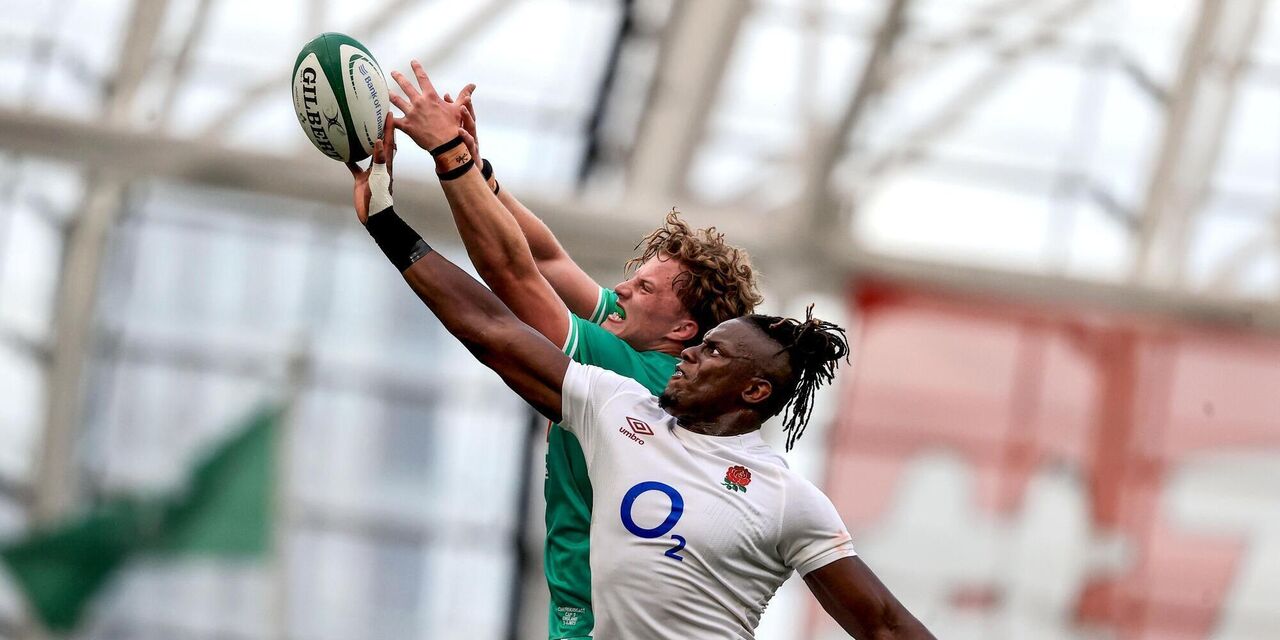
From a build perspective, we also saw exactly why Farrell made the decision to move ahead with Cian Prendergast as opposed to Gavin Coombes. Forget about the early knock-on and rip conceded to Itoje – these are small things in the grand scheme of what Ireland are doing – he covered Caelan Doris-like ground, did well in the lineout on both sides of the ball and looked like the same kind of utility wrench, Heavy Combo Flanker that Andy Farrell loves in his back five. If Ireland turn into a team that kicks less often and needs to hang onto the ball on phases other than post-transition, that type of player will come under massive strain, but for now, in this system, that type of player works perfectly.
Schematically, however, I felt that Ireland’s kicking was frustratingly short of where it needed to be, both literally and metaphorically. Keenan and Lowe were really good, as per usual, but I found Ross Byrne’s tactical kicking to be frustratingly inconsistent.
Byrne’s counter-transition starters were often too long to be directly contested on the ground by our chasers. Counter-transition style kicking off the first receiver has replaced box kicking as the primary mode of moving the ball up the field through the book for Ireland in the last three years.
Shorter box kicking relies on the landing of the ball and the contest from the chaser to intersect directly to pressure the opposition. The counter-transition style doesn’t require that direct intersection of chaser and kick receipt. You’ll see Ireland and Leinster kick shorter off #10 to, in effect, replicate that box kick-style intersection, but for the most part, you just have to put the ball down the field with as much time for your chaser to pressure the opponent as possible. Ideally, the player receiving the kick would have 1-2 seconds of time with the ball in hand before your chase line pressures them into either taking contact on your terms, passing to someone who your other chasers are pressuring or hastily putting the ball off the field.
Byrne consistently left England with space and time on the ball in the backfield – 3/4/5 seconds on average – and that won’t do against Scotland and South Africa. Willie Le Roux with 4 seconds of space/time and Kurt Lee Arendse or Cheslin Kolbe to work with is not something we want to experience in a few weeks. On this game’s evidence, we need to see tighter kicking and better backfield coverage from Ross Byrne if he’s to be an actual stand-in for Sexton at this level.
The lineout was also an area of concern. I spoke before the game about England consistently disrupting 20% of the opposition’s lineouts and they were close to that here – Ireland lost 18.5% of our lineouts directly and had another small percentage disrupted. This is 4% below the norm for Ireland, especially on 19 lineouts which, in and of itself, showcases another area where England didn’t understand how to beat us. Watching the lineouts back, it seems like we went a lot more to the back of the middle and tail than we do normally. Our retention rate at the lineout is based on throwing 39% of our throws to the front, so perhaps the more complex lineout schemes here were a pre-game adjustment to England’s excellent lineout defence.
The team who can force that complexity out of us while also limiting the number of lineouts we have will cause us a lot of trouble but, for the moment, that isn’t England.
Farrell will be relatively happy but he’ll also feel that we haven’t been properly tested given Italy’s lower-quality game relative to ours and England being a brilliant system match-up for us at the moment, probably the best in the entire top ten. A team that kicks more than anyone while also having sub-elite transition defence and transition attack? That’s too easy for Ireland and not reflective of what’s to come.
