


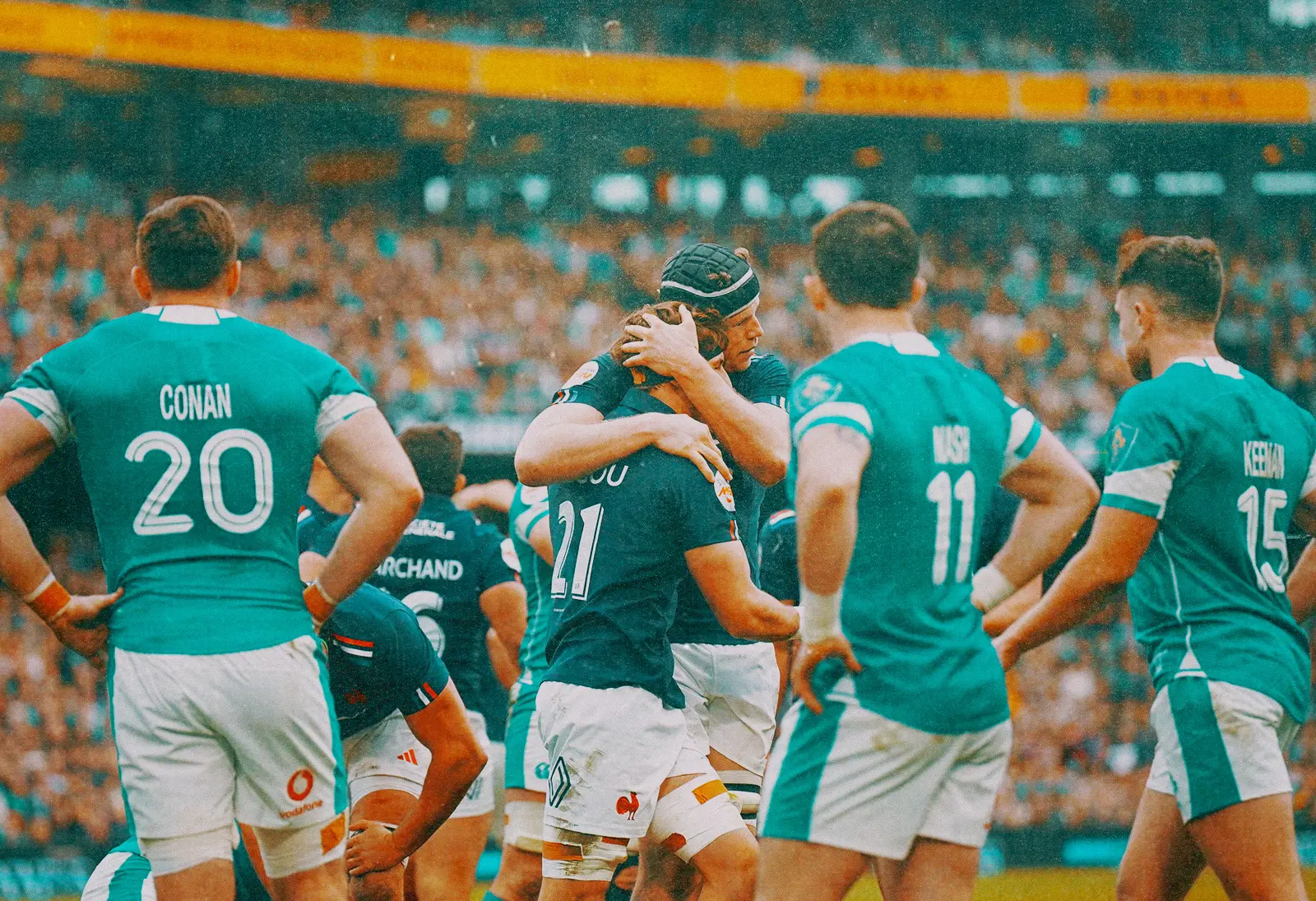
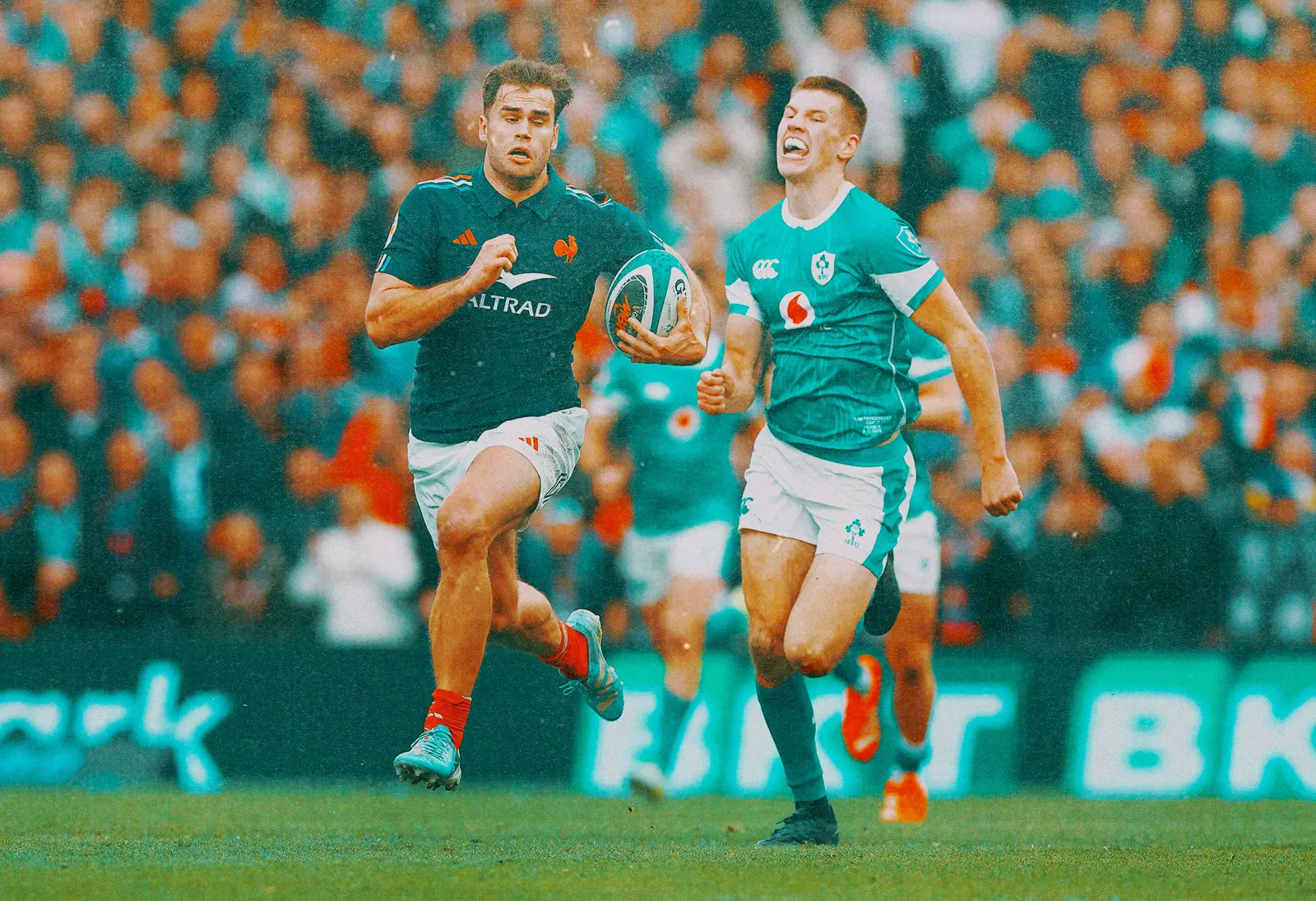
When you suffer a defeat like this, you go looking for the simple questions to unearth an easily digested answer.
Did the lineout implode? Were you destroyed in the scrum? No. It would be easier if both were true, but they aren’t. Scrum was at 100%, with the lineout at 95%. About as close to faultless as you can get.
Was there a red card? Well, the modern equivalent of one across two periods, yeah, but that doesn’t fully explain it either.
Were you wildly overwhelmed by a much stronger team in a mismatch? Well, we were certainly overwhelmed – something I spoke about as the only other possibility here other than a narrow Irish win – but Ireland are the back-to-back Six Nations champions who were essentially playing off against France in this game for a historic third title in a row and a second Grand Slam in three seasons. We beat this French team last season with more or less the same squad.
Once you’ve exhausted these questions, you find the more complex, uncomfortable ones. The most uncomfortable of the lot is this one; are you declining year on year from where you were to a new, scary place where the certainties about what this Irish team is no longer apply?
The answer to that is undeniably … yes.
***
But why are we worse?
What’s happened? From an injury perspective, we were missing four players from that match day squad. Furlong, Kelleher, Casey and Lowe, the latter of whom pulled right before the game with a nasty looking back spasm. That explains some of it. Furlong, in particular, has been an enormous loss for the whole tournament as that spooky calf injury keeps biting him for weeks and weeks at a time.
There’s no point blaming individuals either. It’s bigger than that.
It’s Ireland’s new style of play. At this stage, I think it’s undeniable that (a) we are playing a new style of rugby from last season and (b) we’re worse off because of it at this level.
I’ve included most of my reasoning here, but I think this game demonstrates the other side of the theory. We are no longer a team that attacks effectively on transition because we have boiled our game back to a lower risk, kick pressure focused scheme that prioritizes territory and executing from close range mauls or set piece strike plays over unstructured rugby.
My theory on this is simple; Leinster are playing a broadly similar style under Nienaber, so there’s no point in disrupting that week to week cohesion when most of the test side will feature the same players en masse. At test level, the key is simplicity. How easily can you get a winning system – and the winning is the most important part – onto the group of players you have at your disposal? If these players come from different environments, the system you use at that higher level has to be easily and quickly embedded into all of them. Any time you spend onboarding, any time you spend explaining schemes at a conceptual level to a disparate group of people, is time you are wasting relative to your opponents.
England and France, for example, have relatively simple game plans at the moment. I say “relatively” because to say that any scheme at this level is “basic” would be a mistake. You want to have a certain amount of work understood inherently when you get the squad you intend to play into the room. You want most of the team understanding the language of your camp, the core concepts, the big rocks of your game intimately and then you can start adding on bits and pieces when necessarily. The more guys you have with that inherent understanding, the better you train. The better you train, the more likely you are to win big rugby games.
An example for you; a few years ago, Munster played the South African Select XV in Páirc Uí Chaoimh. If we just consider the two team sheets, Munster should have not have been anywhere close to beating them. So why did they? Because Munster had cohesion and clarity, the South African Select XV did not.
Ireland’s secret sauce in the last few years has been that clarity – a majority of the squad coming from the Leinster environment and bringing with them top quality players and a system already bedded in. Players from other provinces, who integrated without disrupting the team’s familiarity, filled any gaps in the Leinster squad. That became the Ireland we know over the last few years.
It’s easier to get 30% of a squad in sync a unified block of 70% than it is to get four groups of 40, 20, 20 and 20 to do the same.
So when Leinster adjust their style at provincial level, the smart, pragmatic play is that Ireland’s style should adjust as well. If you intend to keep broadly the same starting XV in green, which they do, because of central contracting, changing your style accordingly is the only plausible option.
So that’s what Ireland did.
November was a test run, but they fully committed to the change this spring with Sam Prendergast installed as the primary vector of controlled tactical kicking, aided by Lowe.
The actual story was Ireland handing over most of the playmaking focus to Jamison Gibson Park. Ireland felt that having Gibson Park – widely regarded as the second best scrumhalf in the game behind Dupont – calling the shots, especially inside the opposition 10m line, would sync better with Prendergast. Combine that with one of the best defences in the game up until this year and it made sense. Defence is easier to drill; most of Ireland’s pack are better defenders than they are ball carriers anyway, and it fit with the established core of the squad.
Kicking more and playing fewer phases outside the opposition 10m line is synonymous with winning rugby. This means when the opposition kick to you, you take one or two phases to explore their transition defence, but the primary move is to kick back to them inside three phases with a contestable.
The new kicking laws improved this game-state by increasing pressure on opposition receivers. It has never been easier to get hands on a receiver, win back a contested kick or force a scrum. This forces a choice; when you receive a kick from the opposition, which is the common play starter in the modern game, what do you do? Take the territory and play it safe and pragmatic? Or play transition rugby, acknowledging its inherent handling errors because it can’t be trained effectively in short blocks.
Ireland have the second highest number of up and under kicks in the Championship – second only to Italy – and the same number of long range clearances as England, an average of 10 per game.
Kick returns have dried up as a try-scoring origin at the same rate as Leinster’s have in the Nienaber era.
This season, Leinster’s tries overwhelmingly originate from set pieces – 71.4%.
Just 7.9% of Leinster’s tries this season have an origin in either kick return or turnovers. Why? Because Leinster kick downfield in those moments and now Ireland do too.
How many of Ireland’s tries have come on transition in this Six Nations? 7.7%. Our reliance on the set piece is absolute, with 84.6% of our tries coming from that area of the game. No team has scored fewer tries on transition this season than Ireland.
So what does that mean?
It means that if you kick to Ireland you are more likely to get a kickback inside three phases than any other side, Wales and Italy included.
This is exactly what France did, and overloaded Ireland’s stripped back offensive system, while denying Ireland any purchase at the scrum. When you deny this Irish team go forward penalties in the scrum between the 22s, we aren’t securing linebreaks of them at any serious rate, so it almost always ends in a turnover.
Is it any surprise that Ireland’s highest scoring game in this Six Nations came against a Scottish side that we hammered in the scrum?
Leinster are seventh in all of Europe for scrums won via penalty. Second in the URC. That means regularly advancing up the field via penalty, into the areas of the field where they convert tries at a fairly efficient level.
Ireland are second from bottom in the Six Nations in that category bar one game – away to Scotland in round 2. Why aren’t we scoring tries like we were last season?
We’re kicking more contestables, engaging in more scrums, not winning the same volume of scrum penalties, which means we’re getting fewer 22 entries. I think we’re seeing the difference in power compared to club level – even European level – that we’re converting the entries we get at historically low levels; only Italy are worse this year. But then again, this scans with club level as well.
Leinster are less efficient with their 22 entries than both Ulster and Munster. They get more entries per game, but are scoring tries less efficiency. This is now translating up to test level where mostly the same players are involved across the 80 minutes.
We lost this game the same way that Leinster would have.
Here’s a good example of how France did it; first a big maul drive that makes a heavy seven metres because Ireland can’t risk committing numbers to counter-shove France because Doris has to protect Prendergast if the maul is a feint.
Ireland react late, as a result, and Dupont kicks a good contestable into the Irish backfield. Of course France are going to contest but I don’t think this play revolves around winning the ball back at all costs. I think it’s a pragmatic play that is because Ireland will always, always exit back down the field on plays like this at 0-0 and try to bloat the Ball In Play time as a secondary aim.
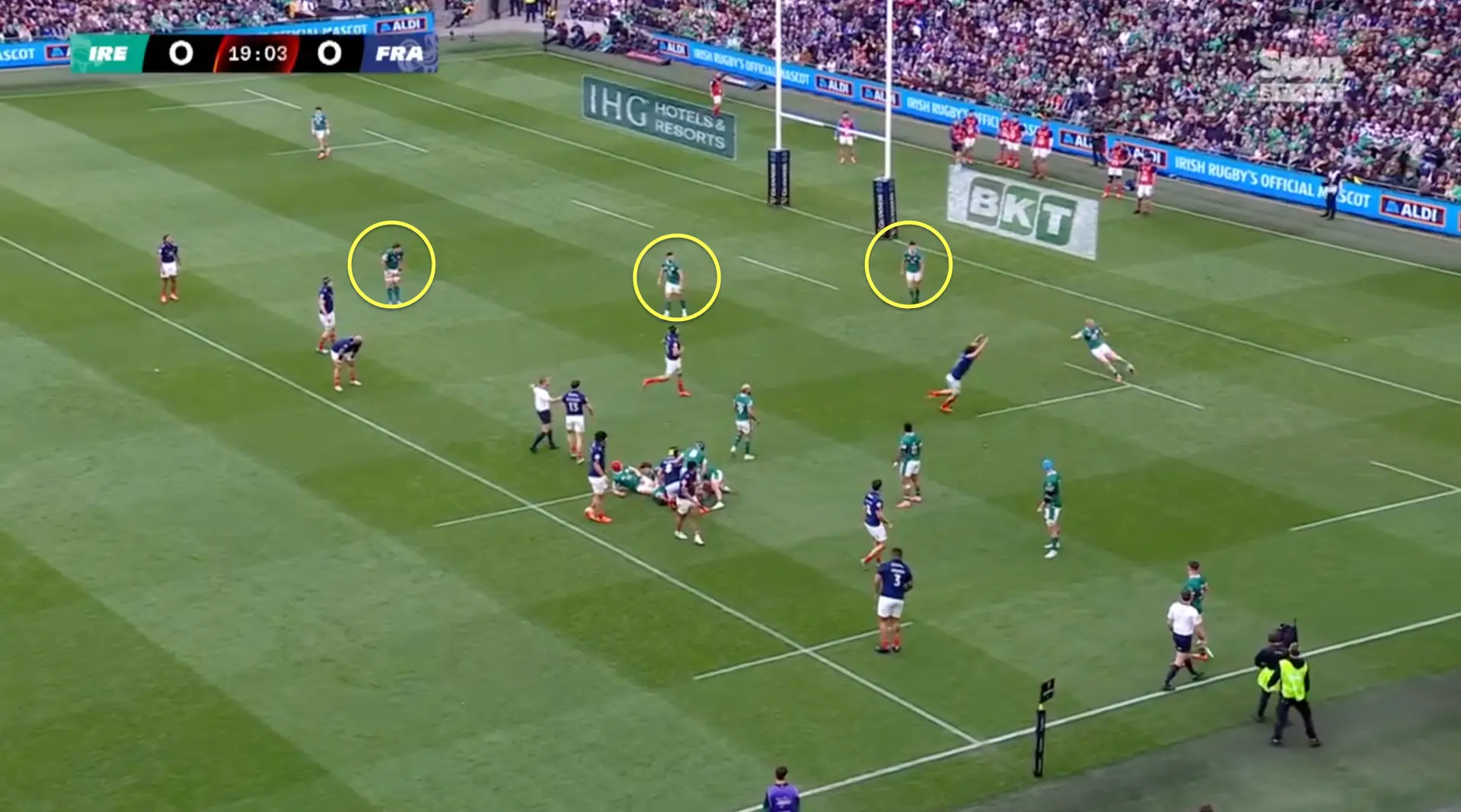
What do you see as the exit happens? Three things.
- It’s a left sided exit so Osbourne – the Lowe stand in – will kick it but because it’s on the left of the field, Keenan will have to be the chaser.
- This mean’s Prendergast is now the de facto covering fullback on the other side of the field.
- Henshaw is the only other back on his feet in the central pressing area as this kick is made. Nash is covering right side press, as you’d expect.
- McCarthy is tired already after 19 minutes, and even worse, the kick will leave him trapped inside Nash as the play unfolds because he’s the last man.
- This is a half hearted press by France – they haven’t packed the line to get at Ireland.
Osbourne kicks this really deep, which is entirely in line with Ireland’s philosophy in this position. But I think France baited this reaction.
Look at the chain when Dupont takes this on his 10m line.
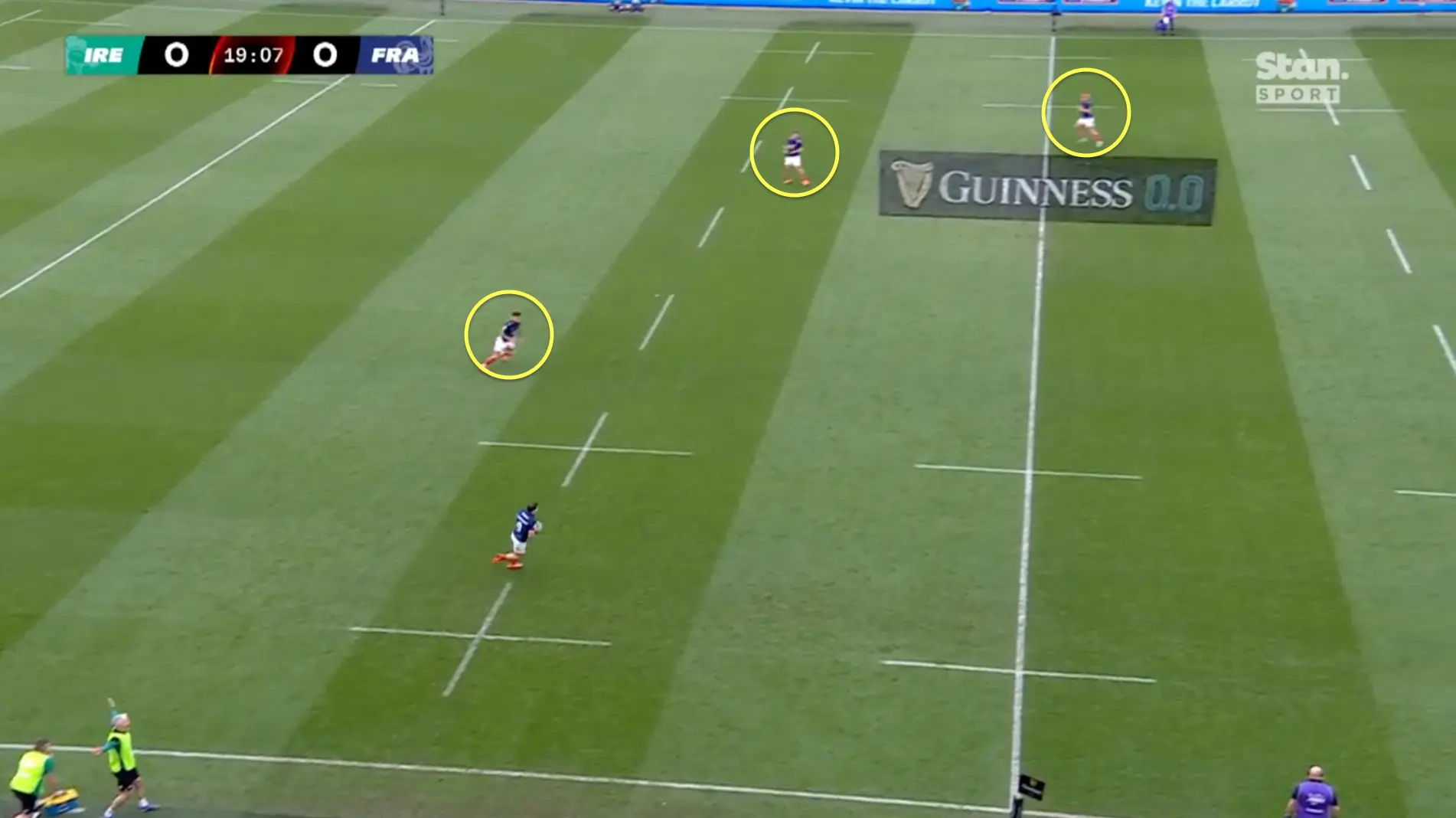
Also, check out Aled Walters telling Ireland to spread out on defensive transition in the bottom left-hand corner because he sees the threat developing in front of him.
Let’s see how it played out;
Nash can’t step on Bielle-Biarrey’s line because, if he does, Ramos skates past McCarthy for a certain try infield. So he has to jockey, Ramos finds Bielle-Biarrey and McCarthy knows that if he doesn’t take out Ramos, the obvious play is a pass back infield from the wing and France going under the posts.
He gets a yellow card, rightly, but I can see his thought process. He made a choice between a sure-fire seven pointer and a yellow card for himself.
On the next maul, France hit another big maul but, interestingly, Ireland hid Prendergast on the blindside wing instead of in the usual #10 spot where Calvin Nash was stacked instead.
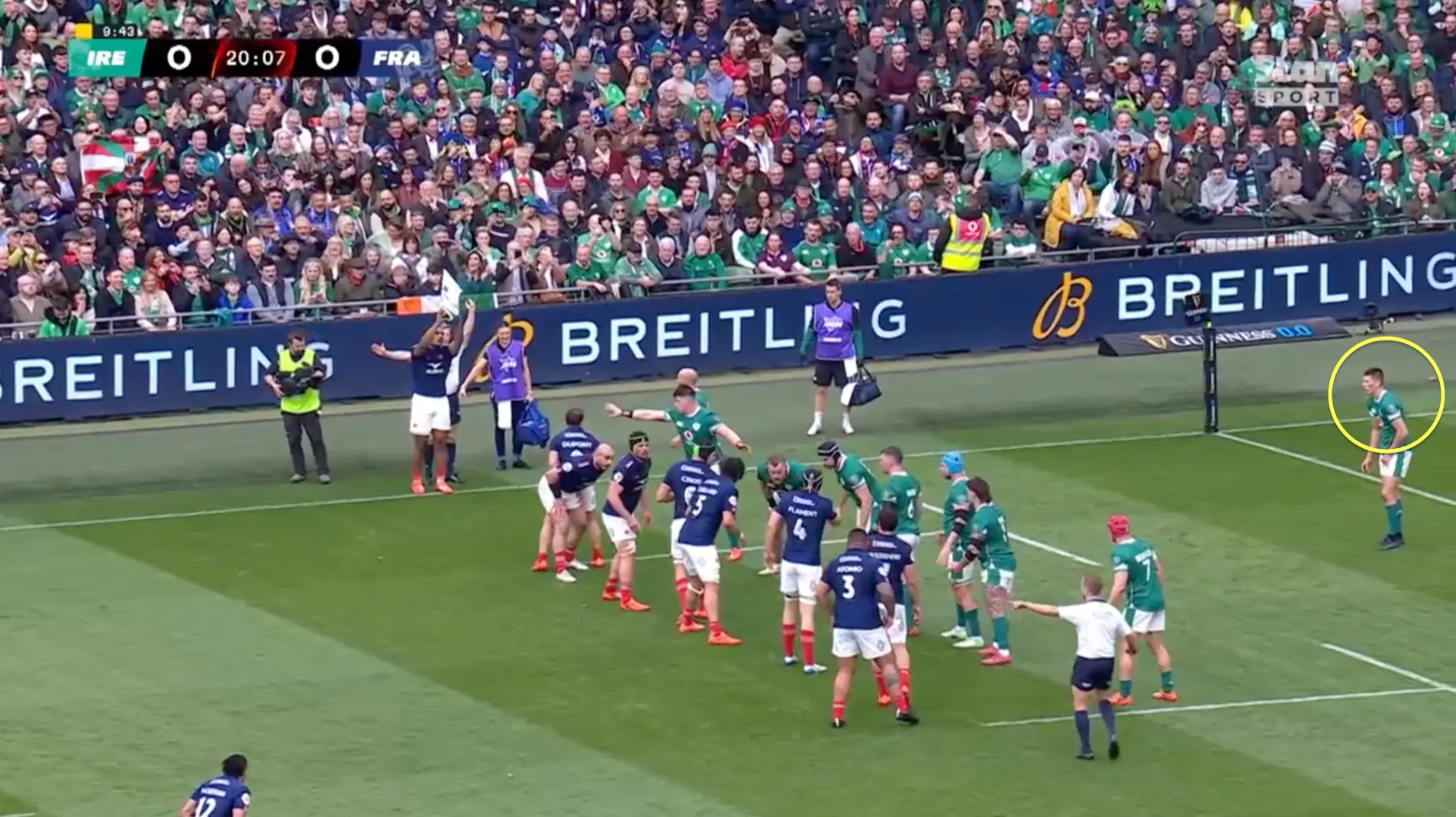
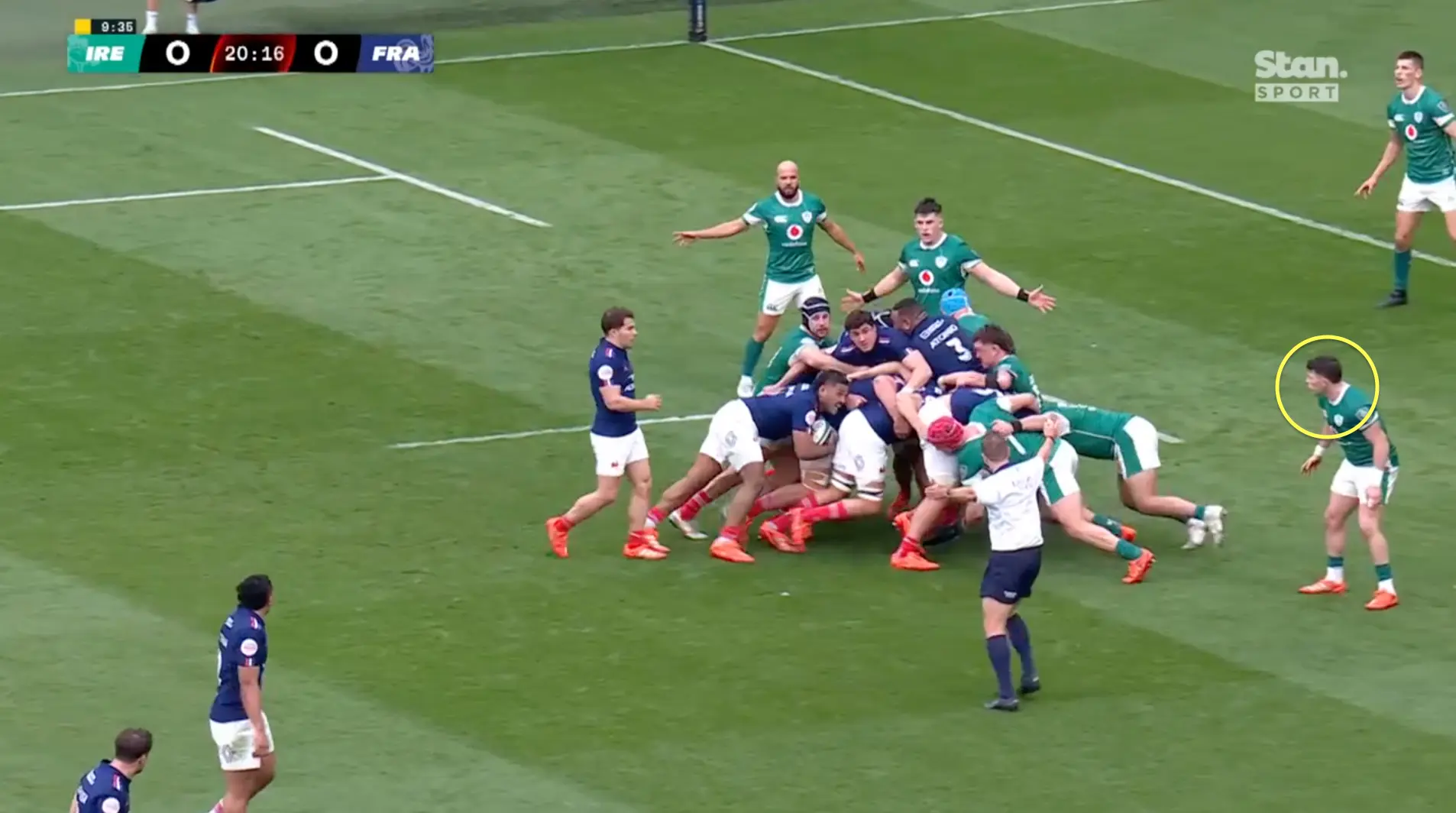
When France broke left off the maul – why wouldn’t they? – Prendergast could never hope to cover the gap with the only credible play available to him being blitzing on Bielle-Biarrey rather than shooting on Ntamack, in the hope the inside cover has his back.
France had the lead.
From there, they kept kicking because they knew we would always kick it back. If you live with the contestable, Ireland’s attacking threat outside the 22 evaporates. Ireland kick long into the 22 off a set piece strike play, Dupont goes long to Prendergast because he knows there is only one outcome – a kick back.
If not for some excellent dark arts from O’Mahony – no better man for that – who knows how this transition ends up? It was consistent all game long. France kicked long, knowing that Ireland were always going to kick back – even when the first action was a runback.
When Ireland were under pressure on the scoreboard, France kept to the principle. Make Ireland play. All they got from Ireland in return were split percentage contestables. Look at how narrow we are on this transition in the backfield – because it’s always a kick chase.
Ntamack takes the ball cleanly and France end up with the ball bouncing in the Irish 22 a few phases later.
We could not reliably advance upfield against France because we based most of the possessions we had on the logic of “well, they have to blow one of these contestables at some point” rather than trying to move the ball through unstructured play, as we have done previously.
France didn’t need to play the lottery when they wanted to hurt us – they hurt us on transition and turned on the narrow, tight power. Look at this collision from Meafou on Caelan Doris right before the killer try.
How do you live with that?
By making sure you engage more than France’s work under the highball on every other possession. This was not an accident. This was the system we adopted working as designed, just without the physical advantage we enjoyed in the last 20 minutes against England, the first 30 minutes against Scotland and the last 15 minutes against Wales.
France knew exactly how to unpick our system because they knew how we would react to their kicking down to the phase count. It’s right there in the data. France are a fantastic transition team. We are not. They knew if they kicked to us, we’d kick back to them because that’s what we do now. That gave them the opening they needed at key points.
Forget about the 7-1 and the yellow cards. The yellow cards were a predictable by-product of our new system running into a pack that it couldn’t bully.
It’s time for a rethink. A radical one.
| Player | Rating |
|---|---|
| 1. Andrew Porter | ★★ |
| 2. Dan Sheehan | ★★ |
| 3. Finlay Bealham | ★★ |
| 4. Joe McCarthy | ★ |
| 5. Tadhg Beirne | ★ |
| 6. Peter O'Mahony | ★★ |
| 7. Josh Van Der Flier | ★★ |
| 8. Caelan Doris | ★★ |
| 9. Jamison Gibson Park | ★ |
| 10. Sam Prendergast | ★ |
| 11. Jamie Osbourne | ★★ |
| 12. Bundee Aki | ★★ |
| 13. Robbie Henshaw | ★★★ |
| 14. Calvin Nash | ★★ |
| 15. Hugo Keenan | ★★★ |
| 16. Rob Herring | ★★ |
| 17. Cian Healy | ★★ |
| 18. Tom Clarkson | ★★ |
| 19. James Ryan | ★★ |
| 20. Ryan Baird | ★★ |
| 21. Jack Conan | ★★ |
| 22. Conor Murray | ★★★ |
| 23. Jack Crowley | ★★★ |
