


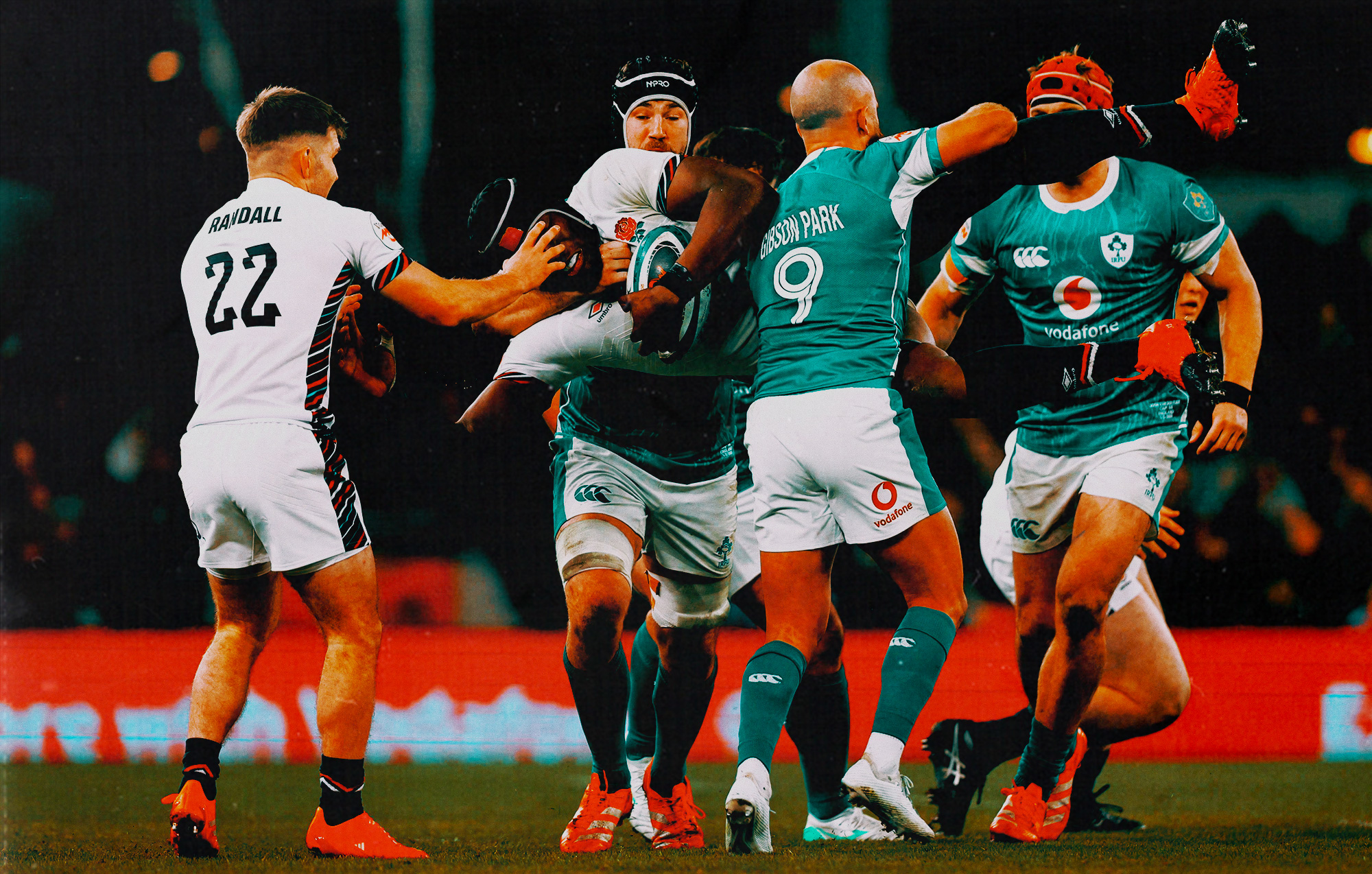
This game highlighted all the good and all the bad of this current iteration of the Irish squad.
To their credit, England worked out the formula for stifling this Irish team, but couldn’t close the door fully with their discipline or the defensive abilities of their edge-covering halfbacks. Most teams around the world now see the recipe for attacking this Irish team; lots of kicking, lots of contestables, cede central rucks to keep numbers on the feet, target rucks in the wide channels, nail your set piece and avoid cheap penalties, like going after dud rucks or allowing Ireland to trap players in the same dud rucks to milk cheap penalties.
If you can do that for 70 minutes while taking your own chances and kicking any three in range, you have a great chance of outlasting Ireland in the final 10 minutes. Do it well enough, and you’ll win. Argentina, Australia and now England know what it’s like to walk right up to the door of that win, only to fumble the handle at key points.
Ireland will take it. One down, four to go and the three Six Nations titles in a row are still very much on.
But we can’t talk about this game without the ever-growing and ever-toxifying debate over the Irish #10 shirt. Let me be clear on my opinion to start this off; I think Jack Crowley is the better, more athletic, more complete player right now and his performance in the second half of this game proves that decisively as far as I’m concerned. I also think that Prendergast is quite a talented young player who has obvious qualities to his game – kicking range, kicking variety, pass quality and game IQ – and all at just 21 years of age.
I’ve lived through three different eras of the Irish #10 jersey where there was either the starter played the full 80, or Ireland were boned. I spent too many days in the mid-2000s wondering what would happen if Ronan O’Gara missed an entire Six Nations because the alternative was playing Paddy Wallace. No offence to Paddy here, but I’m bald for a reason.
I also got to live through the “if Johnny isn’t here we can’t train” era, where the #10 jersey was Sexton, Sexton in Paris, Sexton with a limp, Sexton on a stretcher and then a million miles of nothing. Then Joey Carbery emerged late in the decade but he was always Johnny’s stand-in. They were never peers or rivals. Sexton was the #1 guy and everyone knew it.
That wasn’t healthy. The nadir of this ill-health was Johnny Sexton shambling around the field in a World Cup quarter-final like an extra from The Walking Dead. Andy Farrell was never going to substitute him because It’s Johnny and he deserved to go out on his own terms. I can only assume those terms were as slowly as humanly possible.
I think that a test side with designs on competing for the biggest prizes in this sport at test level has to have two or more flyhalves of real, proper quality. The Springboks’ reliance on Handre Pollard almost cost them in 2023 and had to roll the dice to get him back into the squad after injury. Would they have won a World Cup with Manie Libbock alone? No, I don’t think so. He was whipped off the field at 44′ and 30′ minutes in back-to-back weeks in the World Cup knockouts before being dropped for the final.
For Ireland to move beyond Quarter-final tier basketcases, I believe that we need to have the kind of quality that the All Blacks do at #10. They can run with Mo’unga – or did, and probably will again – and they can use Beauden Barrett or they can use Damian MacKenzie.
For Ireland to be classed as being a proper titan of this sport – something I feel is impossible without a World Cup win – we need to have Crowley, Prendergast and someone like Frawley or someone with his versatility operating at the highest level.
So this idea that Crowley – or Prendergast – should be the unquestionable #10 come hell or high water is, for me, outdated thinking and the only thing that matters is how each player plays in their role, either starting or finishing.
One of the reasons why I think Prendergast, as raw as he currently is – something I feel is an undeniable fact – is favoured to start the last two games and likely next week against Scotland is that he acts as an extension cord for Jamison Gibson-Park, who I think is the primary creative fulcrum for this Irish team. Gibson-Park isn’t a great scrumhalf – his pass quality is all over the place, even on his best days – but he is arguably the best rugby player in this Irish backline. Anything that involves him more in the game is something Ireland associates with winning big games.
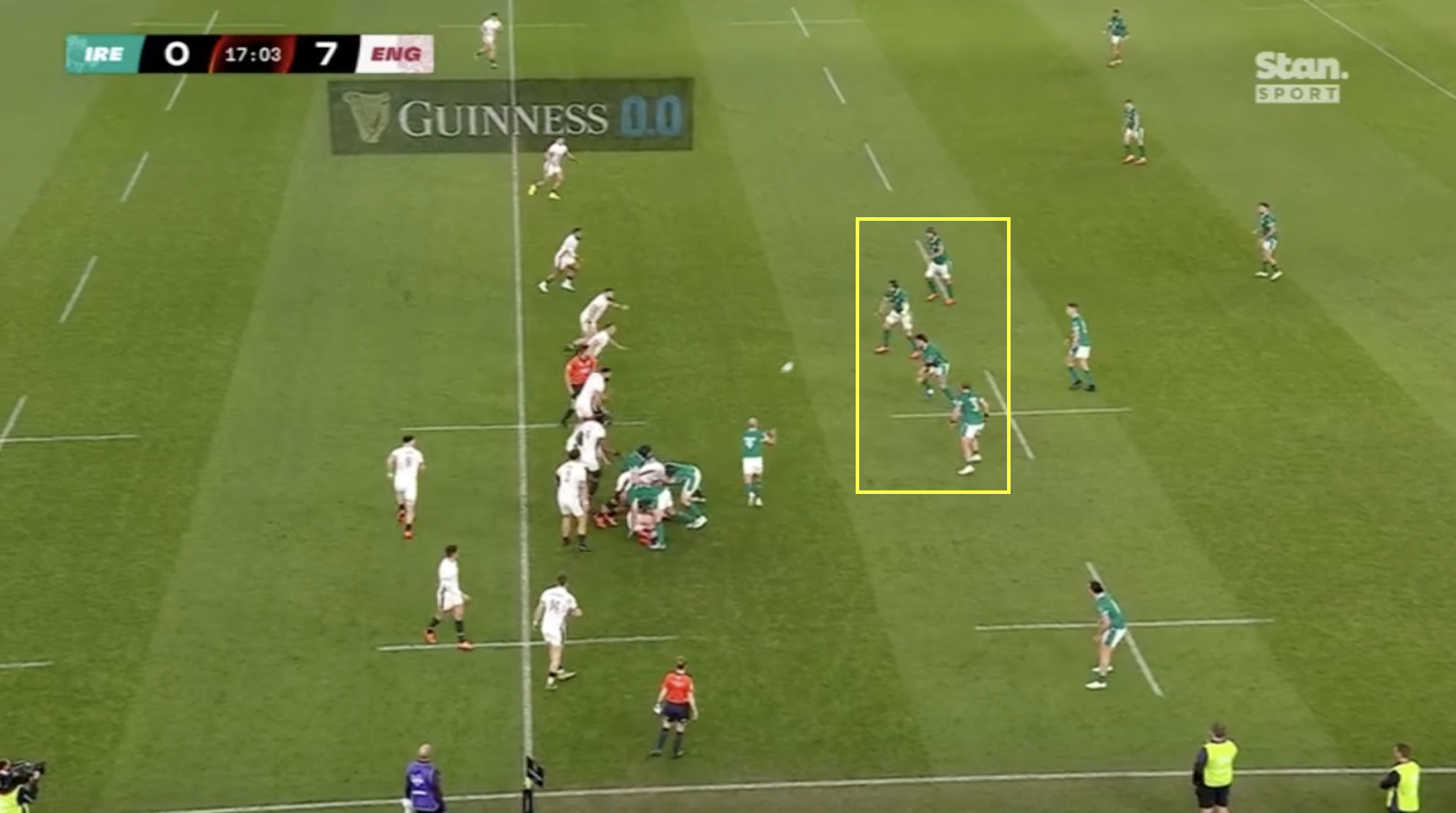
Prendergast’s big strength at the moment is the length and accuracy of his passing to get outside Ireland’s new central four-pod attacking shape. You can see it clearly in this clip.
You can make out the four-man pod here and the compression it automatically creates in the English centre-field defence. When this ball pops back off the screen, Prendergast is pretty quickly able to move the ball to Keenan and allow the rest of the Irish backline to step a slot out.
What do I mean by that – they started the play locked into a defensive line with the defender opposite to them but the gravitational pull of that four pod freed them up to drift away from the defender and create multiple 2 v 1 scenarios with Hansen at the edge of the play.
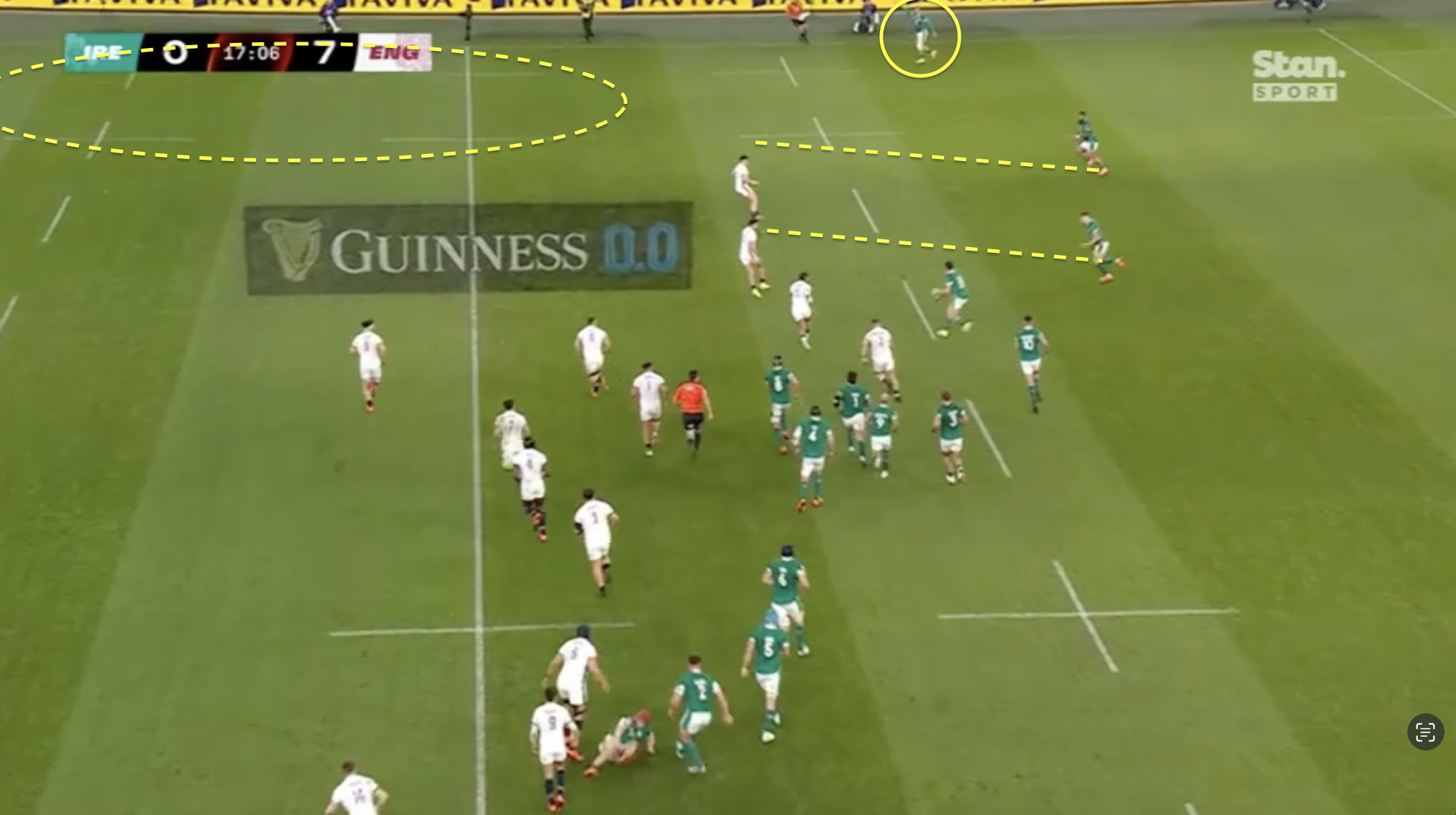
This isn’t remarkable passing from Prendergast. It’s a simple pass executed pretty well but he puts himself in a position to always extend Gibson-Park’s passing. He’s often framed as a “maverick” for some reason but most of what I’ve seen from Prendergast in the last 18 months has been his tactical discipline and, at his best, being someone willing to orbit Gibson-Park, as opposed to the other way around.
Prendergast very rarely carries the ball from a central position and, as a result, he’s almost always in position on a screen or at first receiver to handle the ball. Ireland, being a scrumhalf first team at the moment, really value that quality.
Here, for example, Jack Crowley, Marcus Smith, Owen Farrell or Beauden Barrett all attack this compression created by Henshaw’s screen and look to cut back inside for a killer pass or maybe even a try themselves.
They either score a try, or get taken out by a fairly impactful tackle at speed and it’s up to their skill set to decide how and when the pass goes to Ringrose, in this instance, or if a pass goes at all. This is the kind of attacking scenario that requires direct running to hold the defenders and build a compression that you can then send Ringrose around.
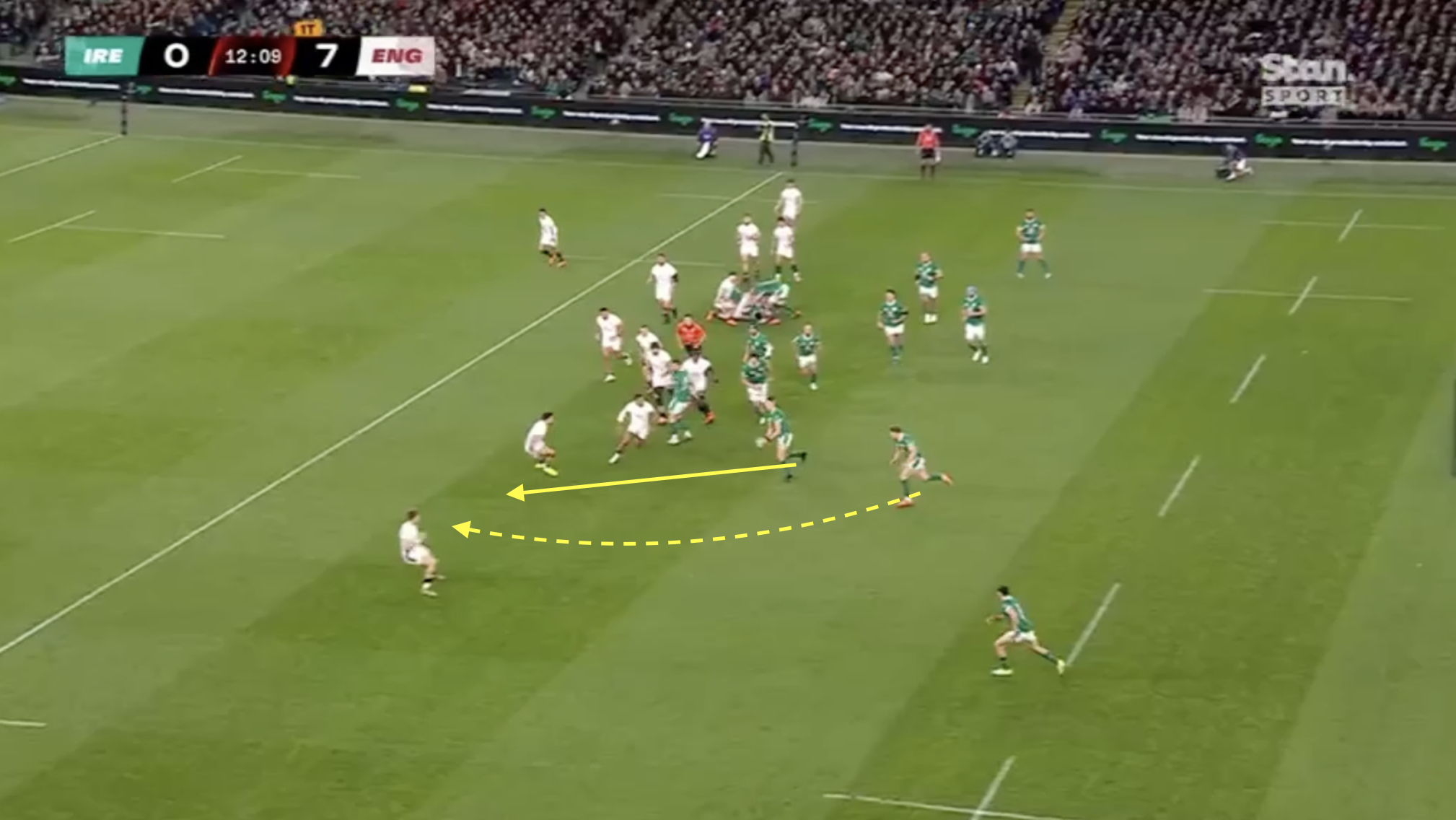
I think Prendergast was a little spooked by the potential of getting hammered by Lawrence here so bailed out on the primary play in favour of a more difficult – and less effective – pass to Keenan on the outside who got swallowed up by scrambling English defenders using the touchline as an extra defender.
But Prendergast is on his feet for the next phase and the scrumhalf just has to find him, if that’s the play. I think Ireland’s new desire for passing width is, in part, designed to create sniping lanes for Gibson-Park or deep trail lines that he can latch onto post-break. That’s how he scored his try – more on that in a minute – but you can see the potential downside to it also. In this instance, Prendergast is, once again, an extension cord who sets up the play exactly as Ireland would have schemed it in training with a sling pass to Hansen and Gibson-Park lurking as he transits from ruck point to line break.
In this instance, though, the pass to Hansen merely moves three English defenders onto him with the touchline creeping ever closer.
This isn’t a good attack. It asks too much of the winger and puts the edge ruck in huge jeopardy because who is going to win an engagement with three defenders? Well, Bundee Aki can, but it’s very much a “looks good in training” thing rather than being something you can rely on over and over again.
And yet, through the hapless Alex Mitchell, Ireland scored two tries in this very fashion. Look for the concept – pass quickly to width, watch Gibson-Park’s transit and see what happens. Prendergast hits a simple pass again here – literally nothing remarkable about it, only that it was reasonably accurate – and Ringrose hits the sling pass to Lowe who shrugs off the tackle attempt of Alex Mitchell and finds Gibson-Park on the inside.
This is a perfect illustration of the extension cord concept because it opens the lane for Gibson-Park to the primary attacking threat in the middle of the field. Prendergast, for his part, does his job in facilitating the transit of the ball to the wide spaces.
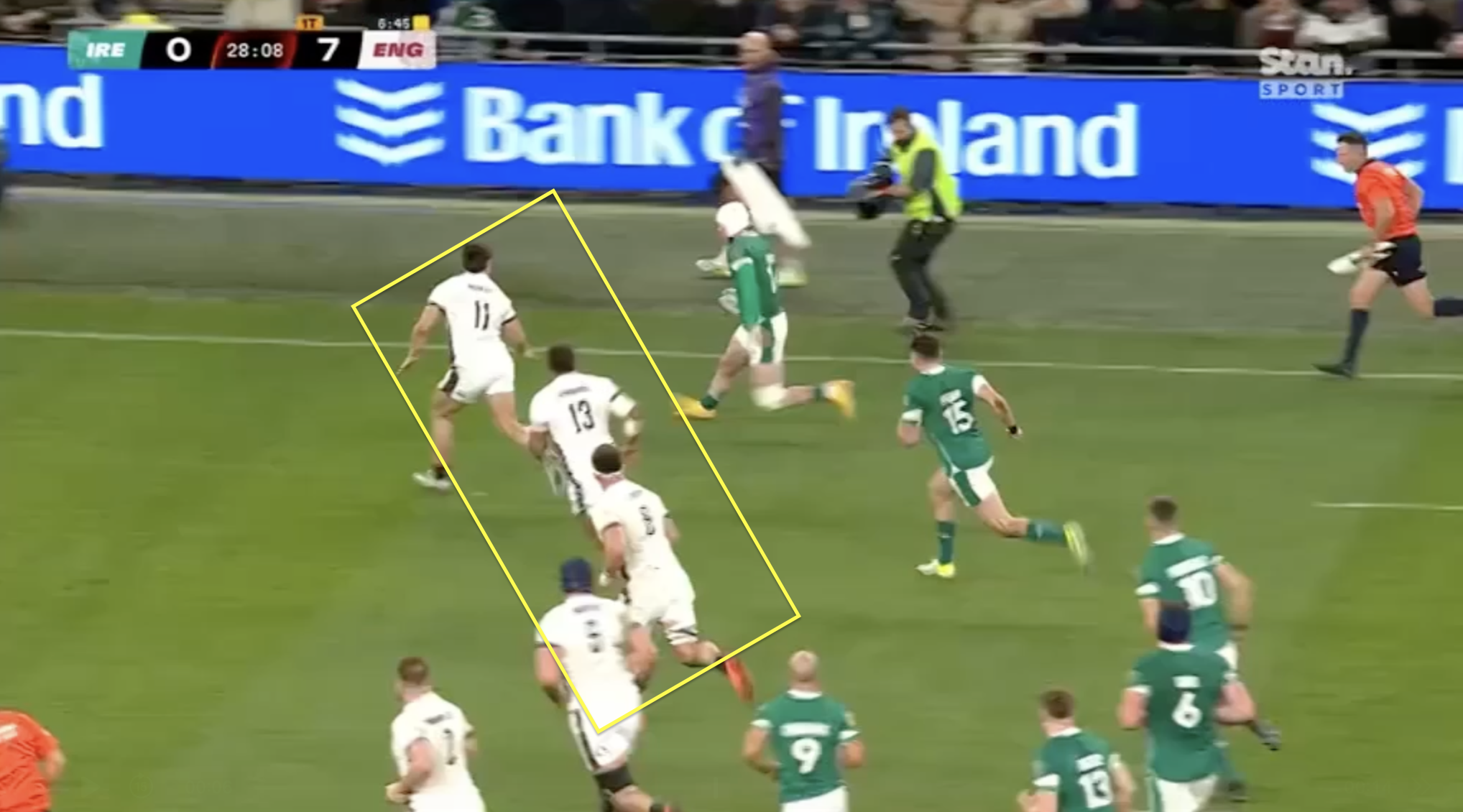
Here’s another example – probably the most extreme one. If this features any other players than Bundee Aki, Alex Mitchell and Marcus Smith in the initial going, it’s a try maybe 1 in 20 times. Any other defenders with any kind of physicality get enough of Aki into touch to stop this try one way or another.
Quite simply, this should never be a try at this level but somehow Aki makes it happen.
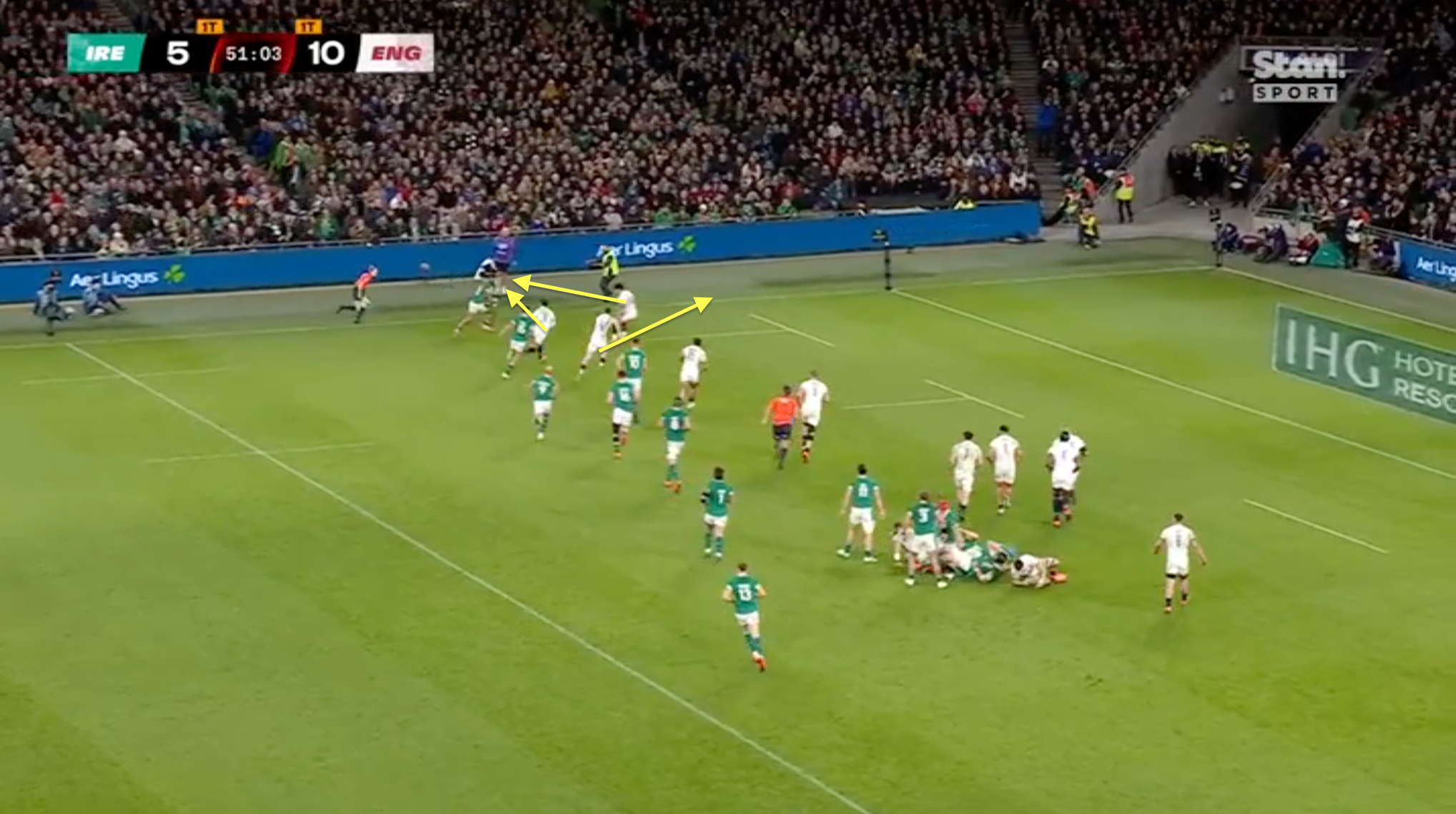
This also contributes to Ireland being easier to defend than in previous years, especially from further out the field. Even when we create linebreak opportunities, Prendergast’s first, second and third options are to pass or kick the ball. On this linebreak, for example, I think he got spooked by Freeman not making a defensive move that Prendergast could react to and, as a result, blew a clear try-scoring opportunity.
Does he have the gas to convert this? I think he got a little spooked by Freeman here and felt the pressure from Slade and Genge behind him enough to dump the ball off instead of backing himself to cut back inside. Prendergast’s big strength is that he extends the range of Gibson-Park’s passing but runs the risk of becoming a non-factor for any defence adequately focused on him.
This is a great example from the game where England began to ignore Prendergast and squeeze his targets in the outside channels. Prendergast creates no compressions here – he merely sends the pass to the edge because that is what he almost always does.
It’s often said that Prendergast “doesn’t carry the ball” but that, of course, isn’t true. He carries the ball when he is 80% sure he can run into open space with no possibility of contact. He doesn’t attack off screens very often for this reason and, as a result, teams learn either before the game or during it that you can sit off him because the threat is always going to be outside you, not inside when Prendergast is handling.
Ireland try to disguise this with tight screen runners to add their gravity to Prendergast’s near non-existent running threat anywhere near realistic contact but that is part of the scheme. I think that the Irish coaching staff think that Prendergast currently creates a better environment for Gibson-Park to impact the game around flow rucks in edge spaces.
When Crowley came on, the equation changed for England, who now had to worry about a direct running threat around screens in the middle of the field. That threat led directly to Ireland’s decisive try. Remember that four-man pod from earlier?
On this one, Slade – who had just missed a ball and man tackle on Crowley in the second layer a few plays earlier – shot directly at Crowley to cut him off.
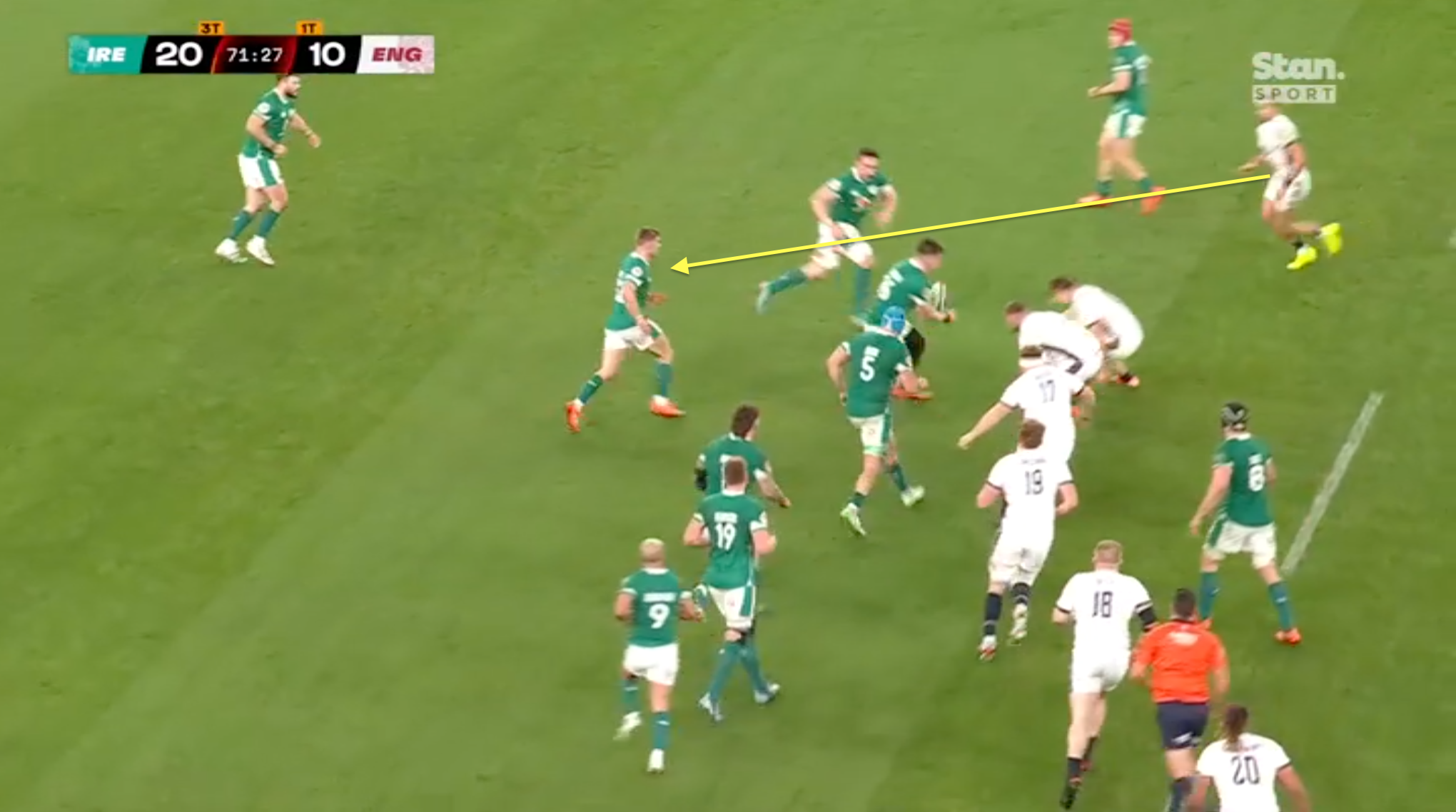
That opened up the space for Sheehan to pop the ball to Conan on the burst and Ireland were away. We scored on the next phase.
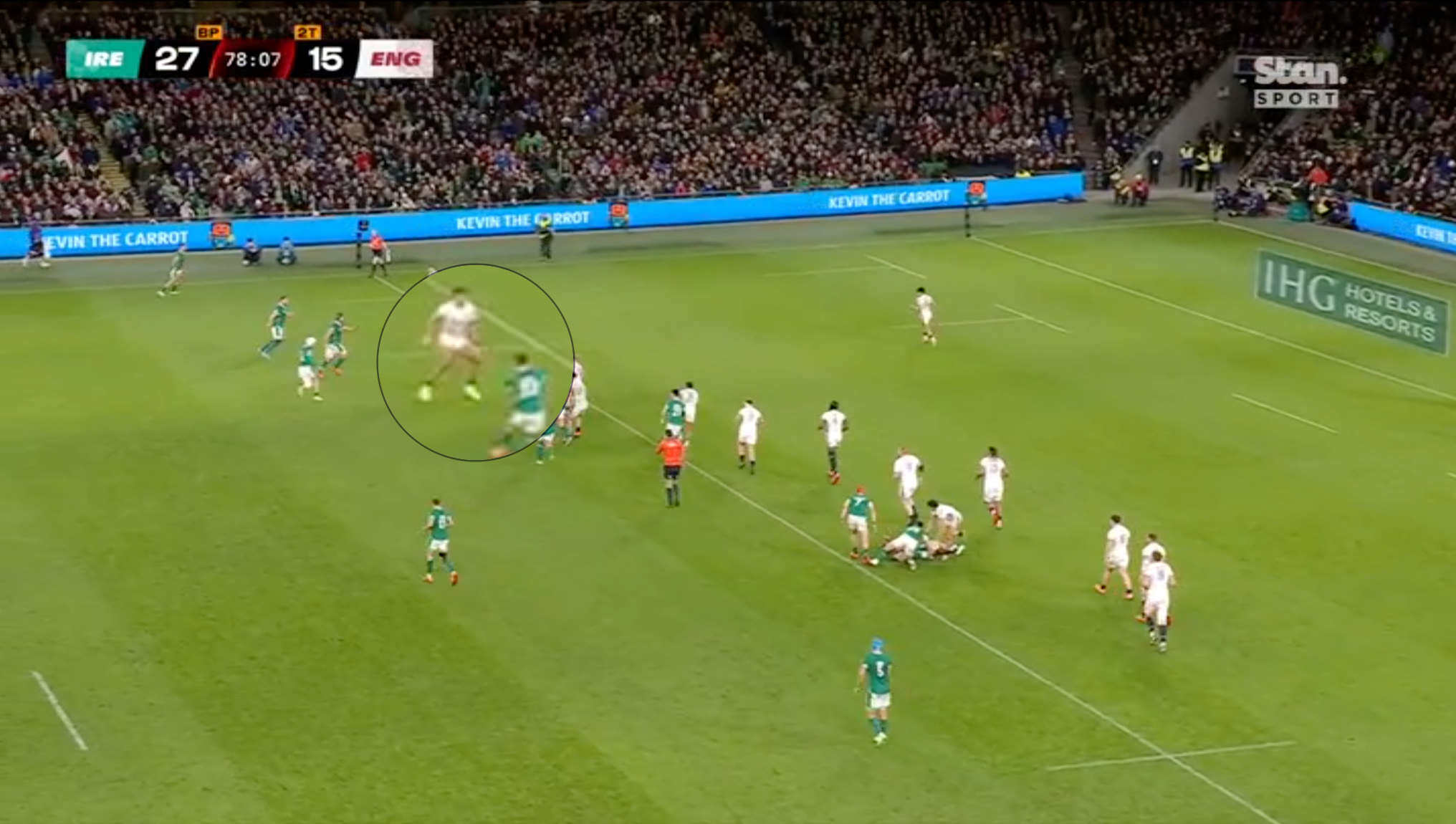
Crowley established his running threat early and often off the bench and England immediately had to unlearn what they’d seen from Prendergast. Even here – and, as an aside, look at Ireland looking that one-man forward pod as the extension cord – Crowley showcased enough in his time on the pitch to freeze in an outside defender.
If Doris makes the pass here, Ireland score another in the corner with Keenan or Henderson. Crowley’s gravity makes the gap, and his pass puts Doris through it.
All in all, I think England can feel hard done by in a lot of ways. The game was pretty close – they rode their luck and executed their tactics pretty well, which is a great place to be – but unforced errors under the high ball hurt them at key points, as did some avoidable penalty concessions.
For Ireland, the key was getting through the sticky first 50 minutes with any kind of lead and finishing strong against a big English bench.
I feel that while this game was close enough to be sweaty, bigger challenges await on the road and with the dark spectre of France looming on the horizon, we cannot afford to get twisted by wearing goggles that only show us what we wish were true, rather than what is. I think this Irish team have problems in the pack – too many big players disappear against bigger opposition too often and we were too reliant on miracle plays on the edges to keep in touch in this game for comfort.
The target is getting bigger and hotter.
Let’s see if we can live with the heat and the weight.
| Player | Rating |
|---|---|
| Andrew Porter | ★★★ |
| Ronan Kelleher | ★★★ |
| Finlay Bealham | ★★★ |
| Tadhg Beirne | ★★ |
| James Ryan | ★★★ |
| Ryan Baird | ★★★ |
| Josh Van Der Flier | ★★★★ |
| Caelan Doris | ★★ |
| Jamison Gibson Park | ★★★★ |
| Sam Prendergast | ★★ |
| James Lowe | ★★★★ |
| Bundee Aki | ★★★★ |
| Garry Ringrose | ★★★ |
| Mack Hansen | ★★ |
| Hugo Keenan | ★★★ |
| Dan Sheehan | ★★★★ |
| Cian Healy | ★★ |
| Tom Clarkson | ★★★ |
| Iain Henderson | ★★★★ |
| Jack Conan | ★★★★ |
| Conor Murray | N/A |
| Jack Crowley | ★★★★ |
| Robbie Henshaw | ★★★ |
