


Sometimes you can want something to be true so badly that you will convince yourself that it is true.
There was a lot of that this November. I’ve done it enough myself to see the signs.
This isn’t going to be an article focused on Sam Prendergast vs Jack Crowley because there is no debate on who is the better player for Ireland in 2024/25 as far as I’m concerned. This isn’t about who started on Saturday either because it’s prudent and sensible to try out multiple options in important positions. Andy Farrell’s reluctance to do that with positions other than #10 has created a bigger debate than he intended, but there’s nothing that can be done about that now.
My theory is this; it doesn’t matter who plays at #10 because Ireland’s system has been fundamentally rumbled by most test analysts. If they hadn’t before this November, they certainly do now. Now, not every test coach has the weapons to do anything with that knowledge, but the ones who do will cause Ireland problems until something changes in this team’s core attacking and lineout concepts.
I feel this November has seen Andy Farrell and his coaching staff realise that something is off with the performances, but that their read on the fix is also off. The essential question is whether or not Andy Farrell and his team know that the secret is out, or if they believe that the problem is an internal one i.e. the system is fine, we’re just not playing well.
My feeling is that it’s the latter and, until that is addressed, the air will continue to leak out of the balloon.
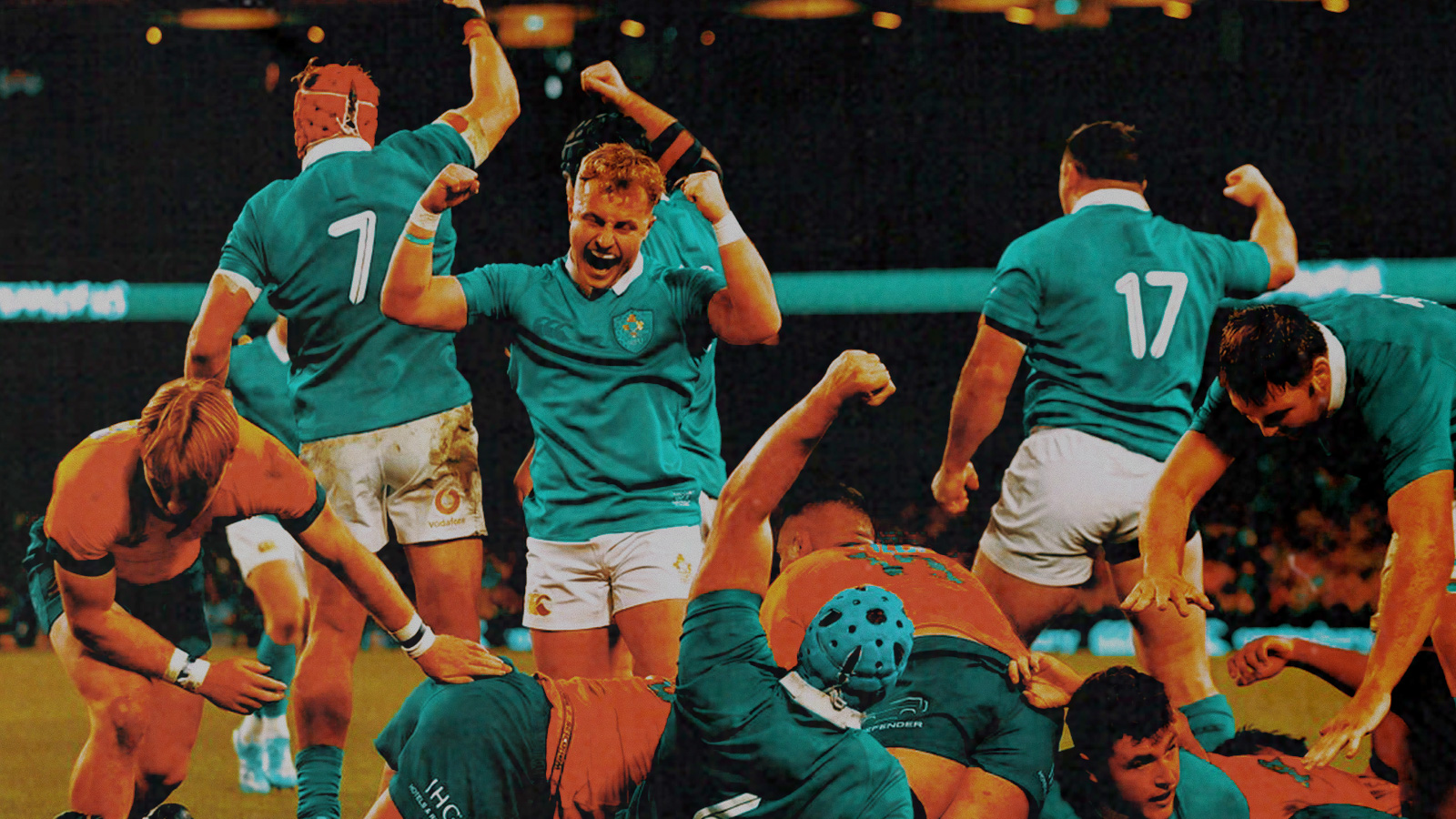
The start of this article reads like Ireland lost – we didn’t – but Ireland have gone from being a team that most people might expect to be putting away Argentina and Australia with a level of panache and comfort, to one who just about limps over the line against both.
A slightly stronger Australian side than this one lost comfortably to Scotland last week. Argentina, who were a knock-on 10m out away from getting Irish arse’s squeaking Dancing In The Moonlight by Toploader in unison were comfortably put away by France a week later. Australia have improved since the Rugby Championship but they are still a deeply incomplete team. Yet they could and should have won this game in the same general manner that the All Blacks did.
Things are going backwards.
We need to see it for what it is now before it becomes so obvious even the Irish papers are talking about it.
Giving Us What We Want
Would it surprise you to hear that all three of our performances against Tier 1 sides this November have featured one weird statistical quirk?
Against New Zealand, Argentina and now Australia, we have had over 61% of our rucks completed in under 3 seconds. Against Australia, it was 63%, the highest of the three. So why did everything look so difficult? Doesn’t quick ball = good attack?
No. It can sometimes be produced during good attacking sequences but it’s not indicative of good attack in and of itself.
This comes back to my theory about Ireland’s system – and the core parts of the system – being rumbled under scrutiny over the last few years. It’s come to a head this November where teams were able to demonstrate it in back-to-back weeks and then give a control group of what happens when you don’t apply the theory.
So what is the theory?
Ireland’s attack is based on lateral speed, layers of attacking runners, skilled forward handlers and rotating playmakers (albeit with a primary playmaker ideally) and it’s specifically built to kill teams who try to contest heavily on central breakdowns and use heavy blitz style defence.
During the formative years of Farrell’s system as Ireland’s head and attack coach, England and particularly France used defensive styles that would fit a “blitz” categorization. Farrell decided that he wasn’t going to (and, indeed could not) compete man for man with the heavy defences of both England and France at the time, so he decided to use a very involved attacking structure to play around and through them, while also utilizing the new found length in the game post 50/22.
I think Farrell was particularly impressed with the manner of Japan’s 2019 Rugby World Cup performance. He knew all about it after seeing his defensive system get rumbled by Japan’s 3-2-X shape and deeply cohesive attacking work. Jamie Joseph and Tony Brown essentially treated the Brave Blossoms like a club side 2019. They had Japan in camp from January 2019 until the World Cup in September and it showed.
Andy Farrell didn’t just borrow Brown’s 3-2-X shape, he took the same reliance on cohesion to make it work to new levels. After a rough bedding-in period in 2020/21, everything clicked for Farrell and Ireland – I spoke about this in the Green Eye – but now it’s four years later and teams have worked out that if you don’t do the things the system is designed to exploit, the system itself stops working.
Essentially, if Ireland’s system breaks teams who compete at the ruck and blitz high with line speed… don’t compete at the ruck. Don’t blitz high.
When you deny Ireland these attack points, a lot of Ireland’s other attacking sub-systems, like the Randwick Loop, play out in front of your defence – rarely outside it or behind it.
Why is it that Australia consistently left space like this behind Ireland’s attacking rucks? We don’t normally see that much space behind a ruck, right?
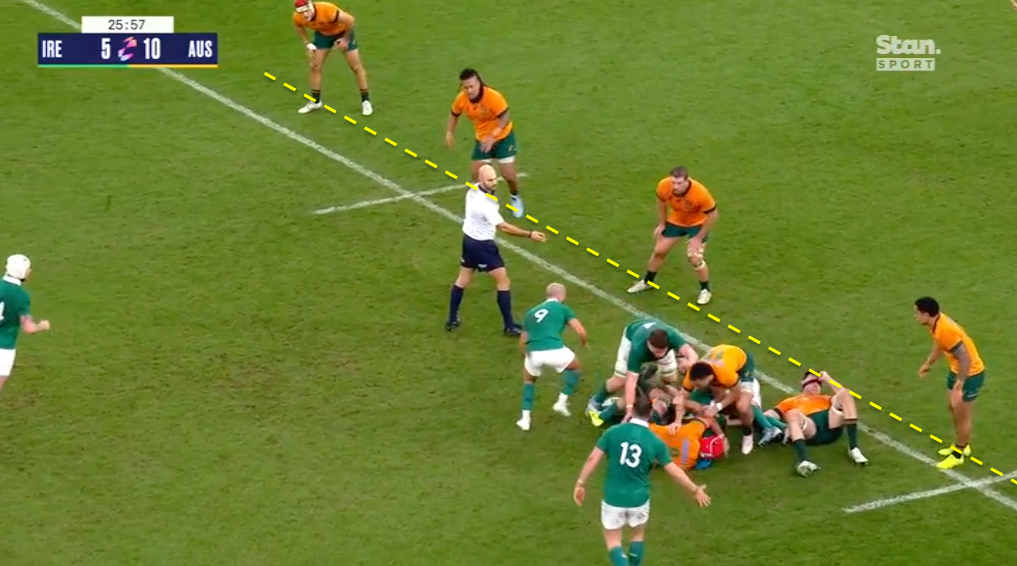
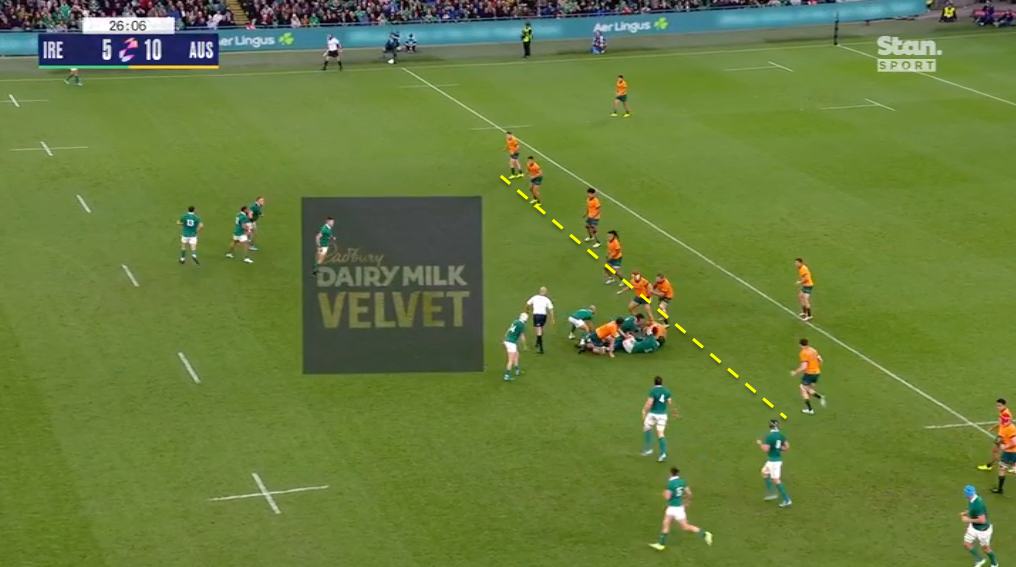
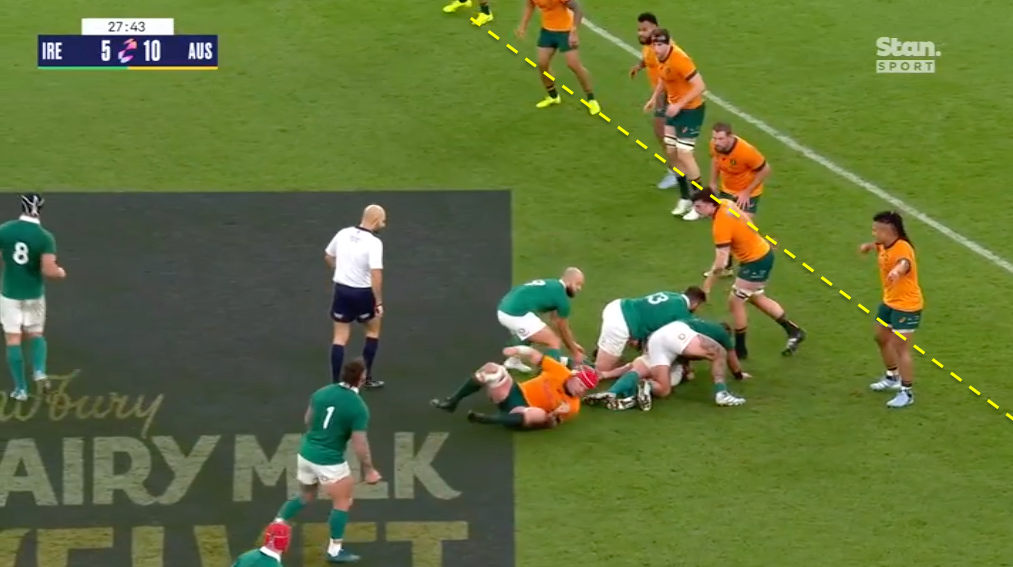
The reasons for this are three-fold;
- Ireland are disproportionally reliant on close-range lineouts to score tries in 2024. As an example, look at this very game; all three tries were scored from 5m lineout scenarios. So don’t give any cheap penalties for offside when you’re going to be giving Ireland quick ruck ball in the middle of the field on most rucks. By being this far behind the ruck, there is no hope of a daft off-side penalty.
- It prevents Gibson-Park from flowing through the ruck with his agility. Gibson Park loves picking off pillar defenders who plant themselves flat in front of him. He dummies, they look away and he’s gone by them. When you are giving Ireland quick ruck ball, you can’t allow this to happen so stand back and keep him in front of you at all times.
- Australia had no intention of blitzing in this game so being fast off a very aggressive offside line was of no value, especially as Ireland doesn’t have any primary ball-carrying forwards. Australia wanted to push up and drift out, not shoot straight up to cut the legs off big ball carriers who were going to move directly.
All of this attacks Ireland’s core offensive philosophy and was exacerbated by having Sam Prendergast heavily involved as a primary playmaker with 55 attacking involvements during his 60 minutes on the field. The reason why Australia managed to frustrate Ireland for so long was because they used Prendergast’s superstrength – his speed, accuracy and range of passing – against him.
How? By applying all these other concepts to defending Ireland but also pressing on Sam Prendergast’s passing targets as they know he doesn’t carry the ball into contact.
A lot has been made of Prendergast’s ability to pass the ball late but what if the defenders know that the late pass will always come if the early pass didn’t? Do you have to worry about Prendergast hitting the line himself? No, at the moment you don’t.
So Australia did from the start what Argentina started to do after 10 minutes of Prendergast two weeks ago; they shifted all their defenders out by one slot and left an inside defender to guard Prendergast. That meant that Australia could just file out and go man for man on every Irish runner. With no compressions to work with, Ireland got stuffed and stymied.
You can see it clearly here.
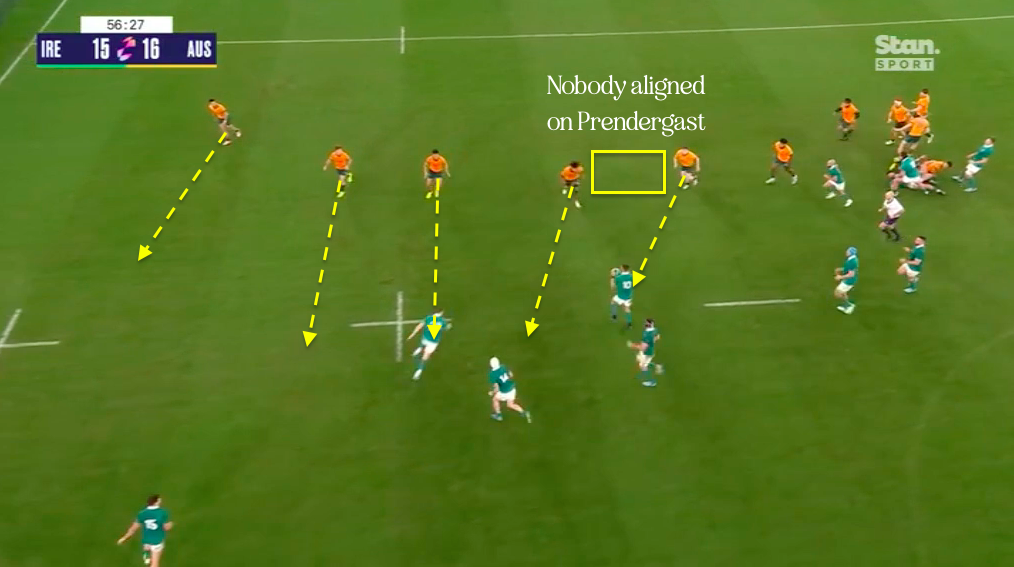
When the ball moves on you see it even clearer again; they had us as covered as it is possible to be on an edge ruck play like this.
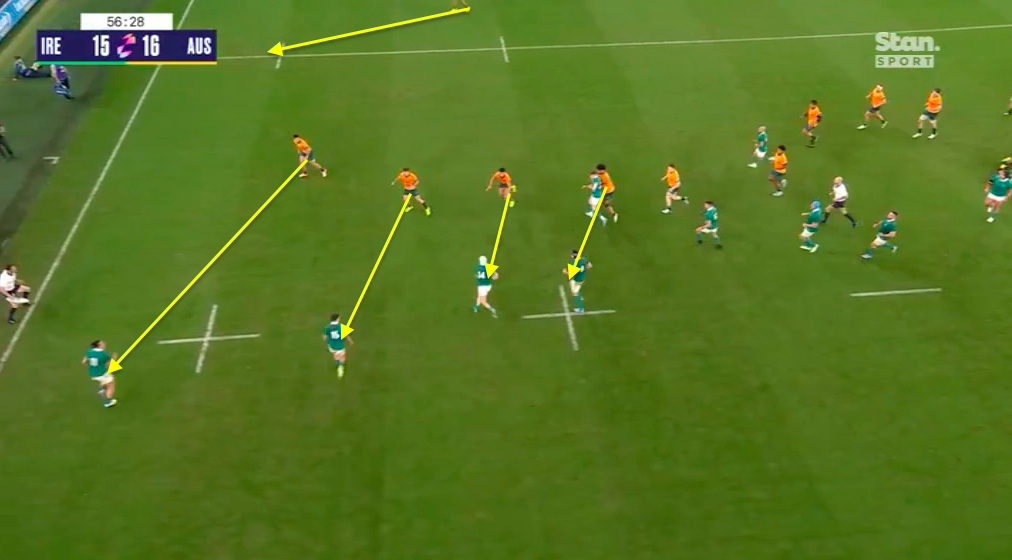
Almost all of Ireland’s attacking work in this game was, like this, played in front of the Wallabies and never outside them because they almost always followed the key principles. This is another example of what looks like a well executed Randwick/Sexton Loop play but that fails fundamentally because there is never any moment when the player that the loop targets is caught in two minds.
I was watching this game in a hotel and when this loop happened a group of people from Dublin were up on their feet because it looked like a great play.
But was it?
No. When Mack Hansen gets the ball, he’s instantly covered by two defenders and the sideline.
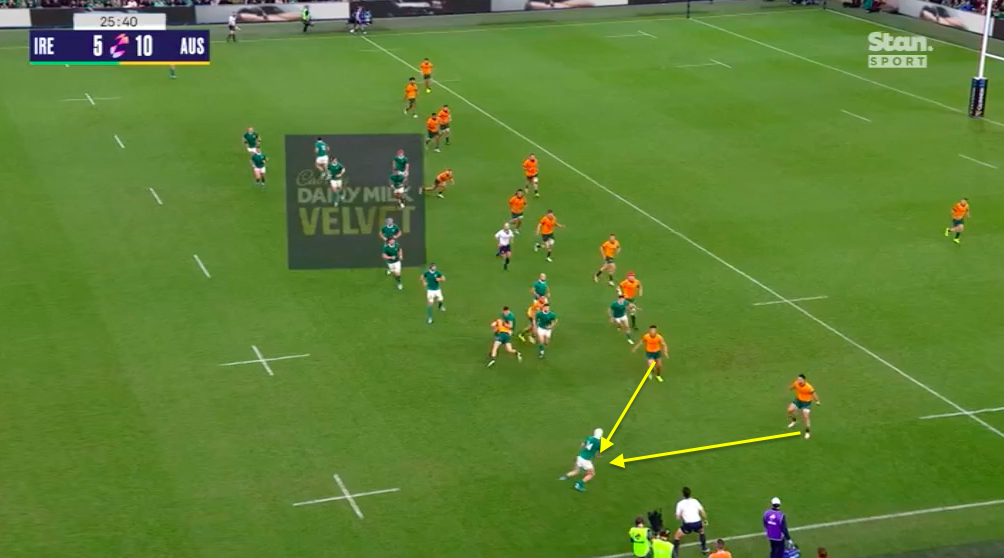
Even mid-loop, you can see Sua’ali’i realise that the play is to get Prendergast around on the loop so he can completely disengage from Keenan and flow across into the edge space to cover Hansen because he knows that there’s no way Prendergast avoids the tackle.
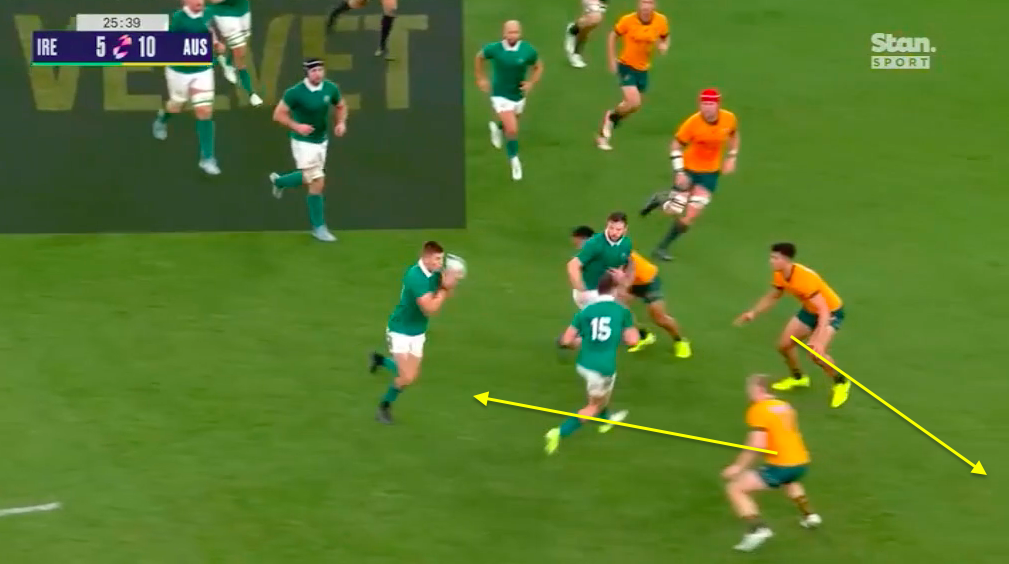
It looks like good attack, but isn’t because Australia are never compressed and always covering the runners. There’s never any moment when Australia look like giving up an uncovered corner because they always had defenders on their feet. When Ireland did get a corner to work with, Fraser McReight punished the isolated breakdowns with a ruthless poaching display.
Ireland’s momentum only changed when Jack Crowley and Craig Casey came on the field and immediately started forcing compressions and punishing floating defenders.
But this isn’t about Prendergast, who I think is a good young player. He was not put in a position to succeed. I think that he was put in a position where it was hoped that his excellent passing and IQ might provide a Sexton 2022-like experience in Farrell’s system – almost a way to revive the magic. Did Farrell and his staff believe that what happened against Fiji would translate to Australia? If so, I think that my read of the staff’s feeling that this is an internal problem – we’re not running the system well enough – is closer to the truth. I think this is a mistake.
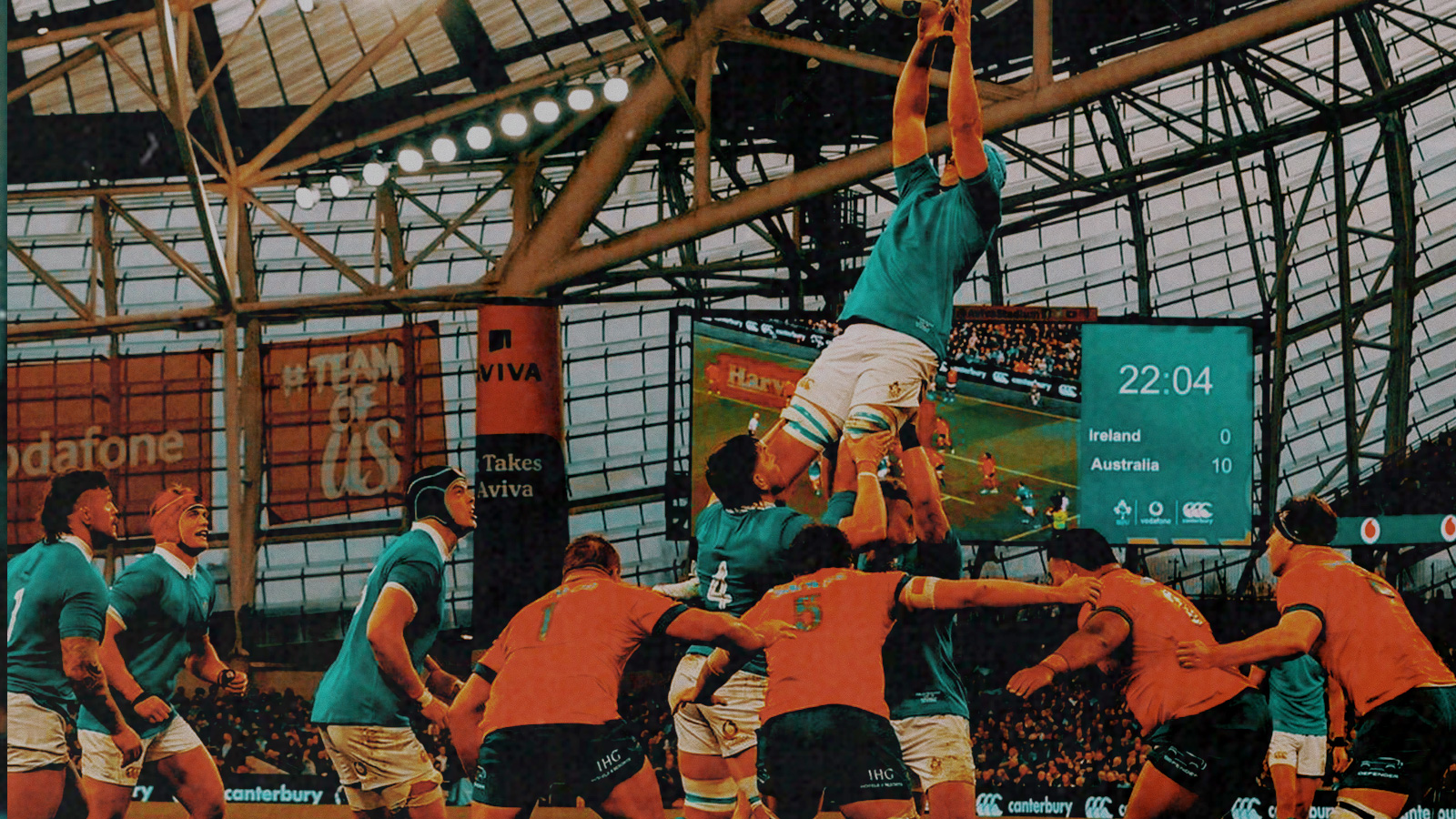
So how do you rectify the mistake? In theory, that’s easy; just select more explosive ball carriers in the tight and middle spaces. That might mean bringing in guys from outside the environment and some acceptance that carrying the ball into contact and drawing 2+ defenders to that collision point isn’t a moral failing. But that will need to be balanced by ensuring that Ireland’s wobbling lineout isn’t compromised further. We had 23 lineouts in this game – in part because Australia realised that you can deny Ireland counter-transition space by simply getting the ball off the field – and we looked badly caught for ideas by the end of the game as well as missing some key opportunities earlier.
87% return off 23 lineouts isn’t bad by any means, but that still means three lineouts were missed and those three were quite important. Quite simply, for a team who scored 60%+ of our tries in 2024 from the lineout, we can’t afford to miss any of them. And part of the reason we’re using Beirne at #6 – where his offensive value to the team almost disappears – is that we can’t keep the back five rotation of McCarthy, Ryan, Van Der Flier and Doris in situ without Beirne’s lineout work.
I think we need more ball-dominant forwards in the middle of the field, more gas in the back three and some variety at the lineout. Furlong helps our ball retention but his days as a power forward are gone. Can Joe McCarthy step up to become a 10+ carries-a-game-every-game type of player who we can justify including even with his lack of lineout IQ as a secondary jumper? If Beirne can only be accommodated in the #6 jersey does that mean you leave him out? Or change what the #6 jersey does? If you do that, do you have to change what we want from the #7 and #8 roles? If you do that… Who Do You Drop?
That’s where things get difficult for Simon Easterby over the Six Nations. How much scope does he have for change? Is there even an appetite for change amongst the people who matter? We will see. I firmly believe that if we don’t change core areas of our game, all the fake, entirely fabricated drama down to the things the head coach said in pressers and later acted on about who plays #10 will only be a smokescreen for so long.
Maybe it’s not the #10 that’s the problem. Maybe it’s everything else.
| Player | Rating |
|---|---|
| Andrew Porter | ★★ |
| Ronan Kelleher | ★★★ |
| Finlay Bealham | ★★ |
| Joe McCarthy | ★★ |
| James Ryan | ★★★ |
| Tadhg Beirne | ★★★ |
| Josh Van Der Flier | ★★★★ |
| Caelan Doris | ★★ |
| Jamison Gibson Park | ★★ |
| Sam Prendergast | ★★★ |
| James Lowe | ★★★ |
| Bundee Aki | ★★★ |
| Robbie Henshaw | ★★★★★ |
| Mack Hansen | ★★★ |
| Hugo Keenan | ★★★ |
| Gus McCarthy | ★★★★ |
| Cian Healy | ★★★ |
| Tom O'Toole | ★★★ |
| Iain Henderson | ★★★ |
| Peter O'Mahony | ★★★ |
| Craig Casey | ★★★★ |
| Jack Crowley | ★★★★ |
| Garry Ringrose | ★★★ |
