


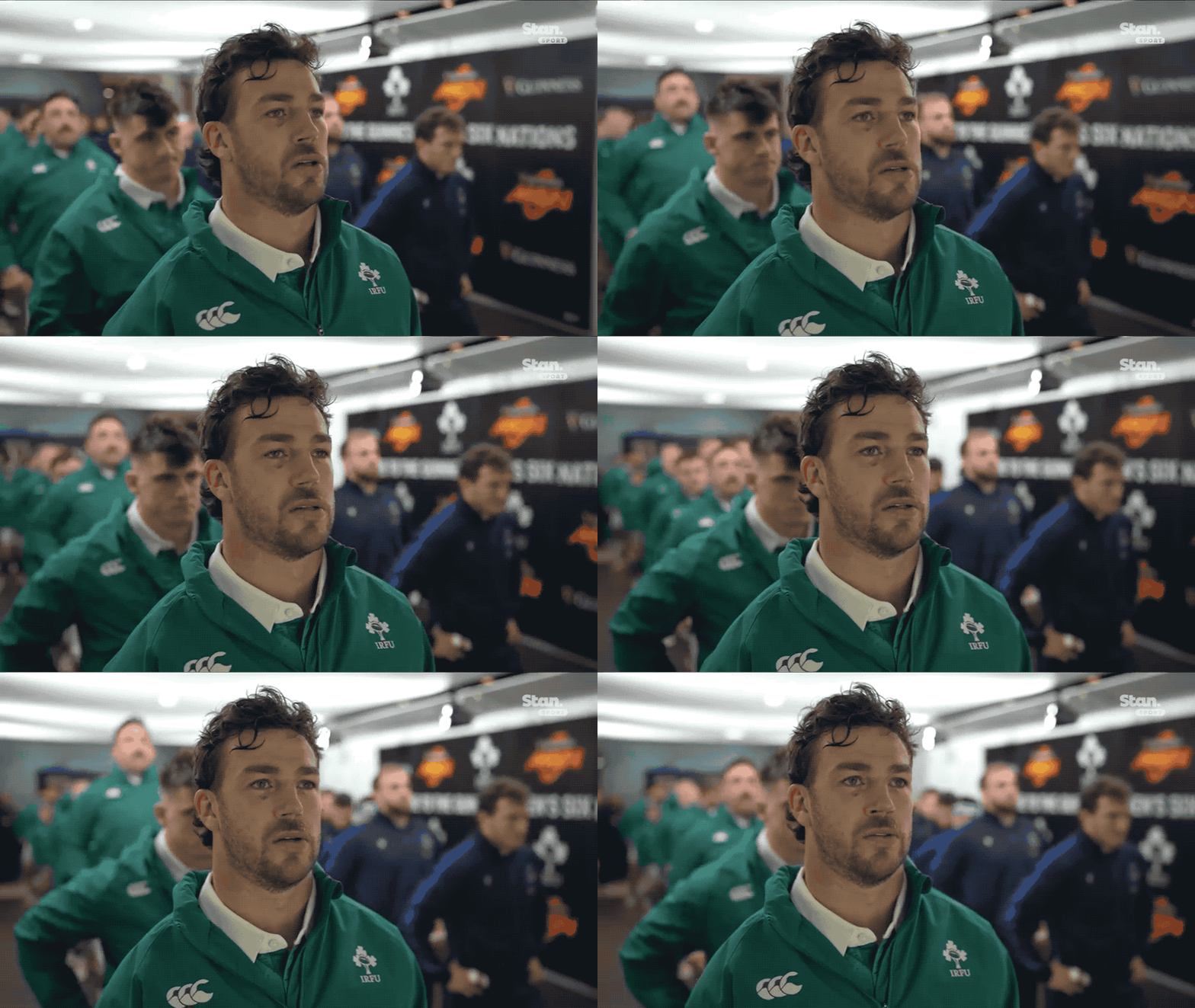

I’ve watched this game back three times now.
Ireland didn’t play too badly here, and that’s the problem. If we try to apply the universal theory of rugby maths, Italy are better than they were, and Ireland worse. When both trajectories meet, you would expect a natural narrowing of the scoreline and the game itself.
Not this much, though. And that’s the problem. The fear.
I don’t want to focus too much on what would have happened at some point in the recent past, but I feel like this is true; if Ireland played decently, and Italy played decently, I would expect Ireland to win by 20+ points, all things being equal. But they aren’t.
That’s the scary thing.
As improved as Italy is, a decent Irish performance — as this was — would usually be enough for a relatively comfortable win. I think that’s what we’ll see when France and England play Italy, for example, even in Rome, but my overriding feeling is that we are far closer to Italy’s current level than anyone is comfortable with, and that what we saw here wasn’t Ireland playing badly against a resurgent underdog, it was two relative peers slugging it out.
It was a great game. Italy played well — and deserved a draw, at least — but that’s what worries me.
This game was never going to provide catharsis, only a reprieve from the lack of it. Instead, it highlighted new issues with Ireland that follow the same theme: fixing one problem, only to find that something else is spewing black smoke, soot and loosened screws.
***
As it almost always does now, the focus of any Irish performance — good or bad — finds its way to the #10 jersey.
It’s what we know. Comfortable discourse. At a certain point, it’s the prism through which Irish Rugby is most comfortable parsing its ills. Tony Ward vs Ollie Campbell. O’Gara vs Humphries. O’Gara vs Sexton. Sexton vs the linear progress of time. Crowley vs Frawley. Crowley vs Prendergast.
The latter has been an enthusiastically debated shibboleth over the last 18 months. We grab hold of it like a drowning man tears at the people trying to rescue him from the waves. It’s familiar.
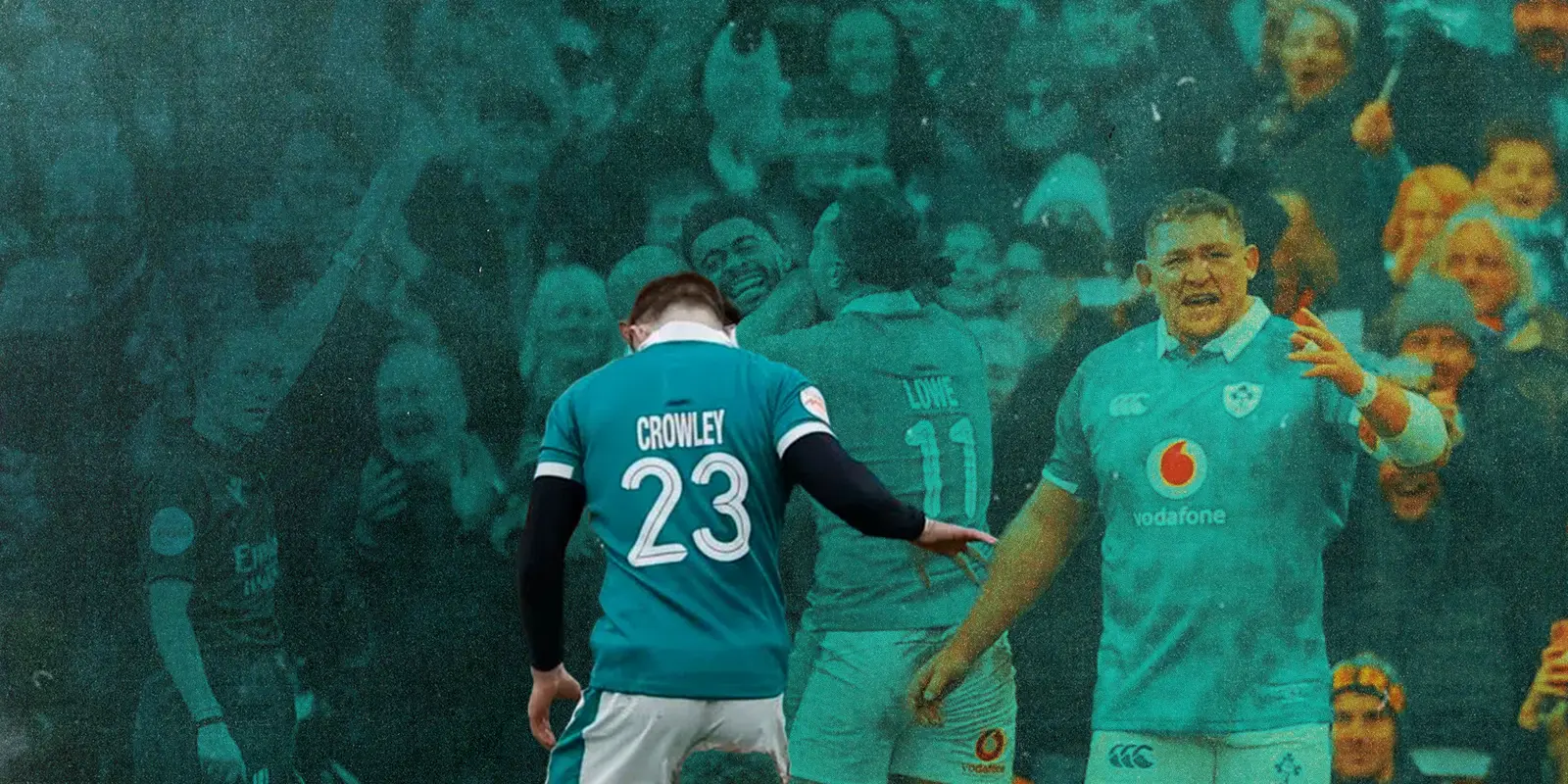
At a fundamental level, if we’re not discussing Crowley vs Prendergast, we’d be discussing Andy Farrell and his coaching team. In that regard, Crowley vs Prendergast has been a very useful homunculus for the Irish head coach and the recently up-jumped Johnny Sexton, without whom this Irish setup can’t seem to function for so much as a year without needing whatever it is that Johnny Sexton does as a coach in 2026.
Prendergast vs Crowley works in the same way as O’Gara vs Sexton. You’re not talking about Ireland, not really; you’re mostly talking about Our Guy vs Your Guy. Munster vs Leinster. Last season, when Crowley was unceremoniously dropped for Prendergast, much to the delight of the majority of the Irish press, Andy Farrell bought time. We weren’t playing well — and didn’t play well overall — in 2024/25, but there was so much invested in Prendergast working out (in the coaching box and on the podcasts that Farrell regularly listens to) that all of the cues we’re now seeing play out in front of us could be and had to be looked past. Ireland almost lost to the worst Welsh side in the professional era, and the focus after the game was Sam Prendergast kicking a 50/22.
Nobody is exempt from the discourse, and everyone gets to see it on their social media app of choice. Munster fans’ reaction to Crowley being dropped — the same year as he started at #10 during a Six Nations title-winning campaign — for the latest hot young thing from Leinster. The criticism was often scathing and very often way over the line. Journalists see this on their feed, feel the need to protect “their guy” and double down. Farrell and Easterby doubled down, too, right up until Farrell’s personal reputation on the Lions came into question. When it came to it, he’d prefer to bring Johnny Sexton and Owen Farrell, rather than the fuse he lit in November 2024, before leaving it fizzle away towards detonation when he was, technically at least, out of the building.
If Sam Prendergast is our guy in this culture war, and Farrell consistently selects Prendergast — soothing our emotions on match week — then Farrell can’t be wrong. How could he be? He does the thing I like. Further to that, if he’s wrong on Prendergast and Crowley, what else might he be getting wrong from a selection perspective?
That’s too much to think about.
Last week, after the loss to Paris, I saw an English guy criticising Sam Prendergast’s performance on Twitter, only to have two or three replies underneath from anonymous accounts asking what part of Munster he was from. He lived closer to Münster in Germany rather than the Munster south of Offaly, but it didn’t matter. He criticised Prendergast; therefore, he must be from Munster and can therefore be safely ignored. After all, why else would you criticise him?
The population of the province seemed to swell with a few thousand extra English, Welsh, Scottish, French, Kiwi and South African posters, at least on the evidence of Thursday night and Friday morning. The project player pathways are open. Andrew Trimble, speaking on Second Captains, seemed to believe that most of the online animus about Prendergast after the game in Paris was the work of “Munster trolls”, some of whom went to great lengths to disguise themselves, such as living in France their entire lives, tweeting exclusively in French for the last ten years, and literally being French. Playing the long game.
It creates a cycle of rhetorical violence where anonymous criticism begets an emotional journalist backlash, which produces more venom from even more people who watch these games and feel like they’re being told up is down, and black is white by pundits and journalists who have wandered into the woods in a daze of social media-fueled madness. They are both radicalising and being radicalised by their own audience.
And everyone loses, because we lose sight of what reality is, because what reality is comes up for debate.
My point is, the discourse has become an end unto itself, and it distracts from the real problem: that Andy Farrell has successfully stalled the careers of two promising flyhalves, for reasons known only to himself. Sam Prendergast had another poor performance here. Well over half of his starting appearances have looked like this, in whole or in part, when we’re not grading him on a curve. He’s a promising young player who does some things incredibly well, while having multiple large holes in his game that go far beyond his defence and affect the team that Ireland says they want to be.
We want to be a short-passing, on-ball team, and while Prendergast can certainly do the passing side of it, his lack of pace and power means that Ireland almost always have to end up firing the ball out to the wing with a long bridge pass because opposition defences know well that they can clog the short passing lanes off the screens we consistently run. Prendergast is no threat himself with the ball in hand, either off the screen or on transition, and every side that can afford to pay analysts full-time and see Ireland as a game that matters knows.
At the same time, we want his usually excellent contestable game and consistency kicking out of hand, so we contradict ourselves by selecting for that at the expense of the other parts of the game that he can’t do, either currently or, possibly, ever at anything close to a high level.
The alternative is starting Crowley, himself an incomplete player, who is the stylistic opposite of Prendergast in almost every facet. Crowley is a running threat, a good defender and excels in Ireland’s short passing, multi-option structure, but he kicks inconsistently out of hand, off the tee and takes too much on himself in the face of Ireland’s forward line getting repeatedly stuffed by almost every serious team at test level.
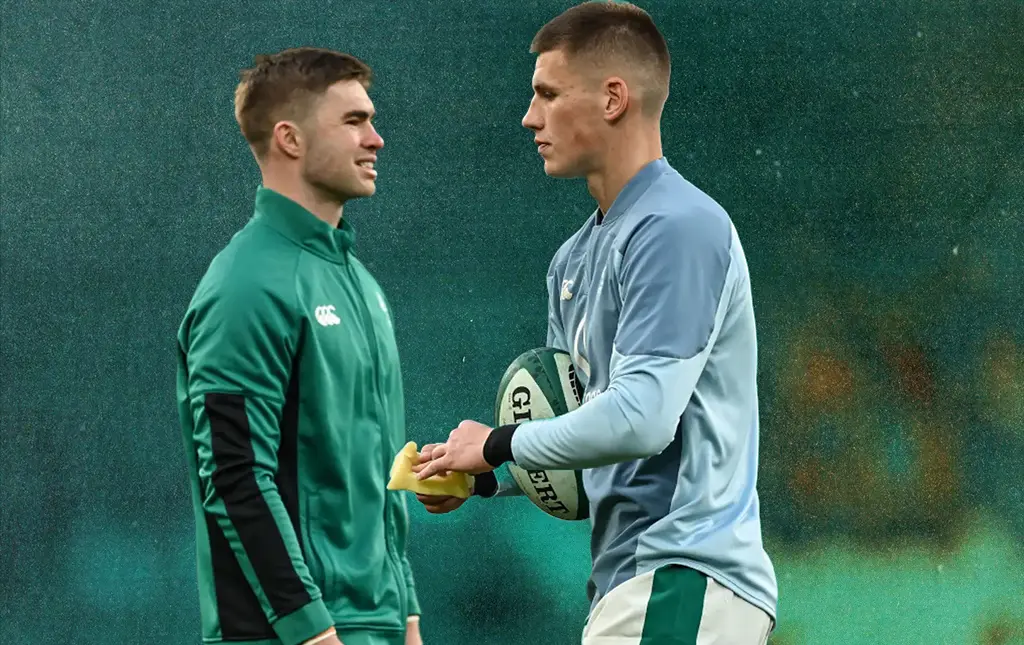
In the last two years, Crowley should have been building his game at test level as Ireland’s #10 with Prendergast offering a change-up off the bench, mostly, as he builds his own game away from the white heat of being Ireland’s starting #10 and everything that comes with that.
Ireland would still have lost the games they lost and underperformed in the games they did, but you’d have two better #10s at the end of it, as an upside.
Instead, that’s been inverted. Prendergast has been thrown into a role that I believe he’s not ready for, all off the back of Farrell focusing on what Crowley couldn’t do, rather than what he could. That dithering has put the weight of Ireland’s game on Prendergast, who is almost always the focus during Ireland’s downturn in the last two seasons, when he should be a secondary component of match day 23s and who primarily builds his game out at Leinster. His confidence has taken a battering. How could it not?
Moments like this, against Italy, help absolutely no one.
The crowd popping because Prendergast is coming off and Crowley is coming on in a game Ireland were drawing at that point. Prendergast jogging off the field, looking like what confidence he had left evaporated there and then.
What are we doing here?
Crowley’s confidence, too, has visibly been knocked. He plays every other game for Ireland like one mistake will hang him with a coach who doesn’t back him, and that in itself produces more mistakes. The Sword of Farrellcles dangles over some, but not others.
We’ve got the worst of both worlds: a culture war over two varying levels of incomplete flyhalves, both of whom have been tarnished by their usage, and it can’t be discussed freely without accusations of Leinster or Munster bias, depending on your location. I think the reality of some of Prendergast’s performances in the last 12 months, in particular, has been hard for people to parse because it would mean accepting that the “trolls” were right, even in their venom and bile. I know myself that that can be an unacceptable pill to swallow, and the temptation to skew reality is hard.
Andy Farrell has to own this, but he won’t. In a way, it’s impossible for him to put the toothpaste back into the tube at this point without making even more of a mess. He’s got a decision to make ahead of Twickenham next week that should be a formality, but has been made more difficult because of every decision he’s made up to this point.
Crowley should start against England, but he’ll know that one bad moment will be all the justification Farrell needs to bench him again. If Prendergast starts — as Farrell arguably should do now, to prevent him from spiralling even further — you risk exposing his weaknesses again, in front of an even bigger audience, in the biggest game Ireland will play since the 2023 World Cup quarter-final.
That isn’t competing for the jersey; it’s running two players into the ground while spiking the temperature of the entire rugby bubble to nobody’s benefit. Is Sam Prendergast better for the last two years as Ireland’s starting #10? No. All the issues that were in his game in November 2024 are still there. He’s a marginally better defender, but only just. He’s still not committing defenders off screens. His goal-kicking is as inconsistent as Crowley’s, if not moreso — both players not feeling the benefit of Johnny Sexton’s kicking coaching as of yet — and his USP of kicking the ball from hand is hit and miss.
At some point, we’re going to have to reckon with what’s happened here, and what it means for the post-Farrell era, whenever that is.
***
That little diversion is going to inform this bit; we didn’t underperform here — if that’s how you want to frame it — because of Sam Prendergast, or Craig Casey, who seems to have taken pelters by proxy in the aftermath of this game in the same way that Frawley and Crowley did against New Zealand two years ago.
It’s unpalatable for most to just blame Sam Prendergast — and rightly so — so the blame has to be spread around. To Casey, in this instance.
60% of Ireland’s rucks in this game were completed in under three seconds. The speed of the ruck ball that Gibson Park was credited with off the bench was there for the whole game. That’s the point, and the problem. Every team worth beating in 2026 knows that ceding quick ball to Ireland is, for the most part, something you do on the way to beating them.
This is a really good sequence that Ireland produced in the first ten minutes, which ended disappointingly when Sheehan was penalised for a jump into contact off a tap-and-go, which you learn you can’t do in your first rugby session, be that aged five, fifteen or twenty-five.
You’ll see most of the rucks are quick here.
The kick at the end by Prendergast isn’t a bad option in and of itself. A pass was the wrong option. I’d have liked him, in an ideal world, to hit the line himself here and force a fold point in an awkward spot for Italy, but I get the kick, too. The execution wasn’t great, but that’s the risk when you kick the ball.
If you go back to before Lowe’s carry, you see the “bridge” issue we keep running into. Ringrose sees Lowe in space, but our line is artificially narrowed and, crucially, Italy have thrown two “spikes” into the passing lanes.
One pressures Prendergast, the other his targets, who have to take a less-than-optimal option thereafter. There’s no direct way to move this to Balocoune or McCloskey without running defenders onto them.
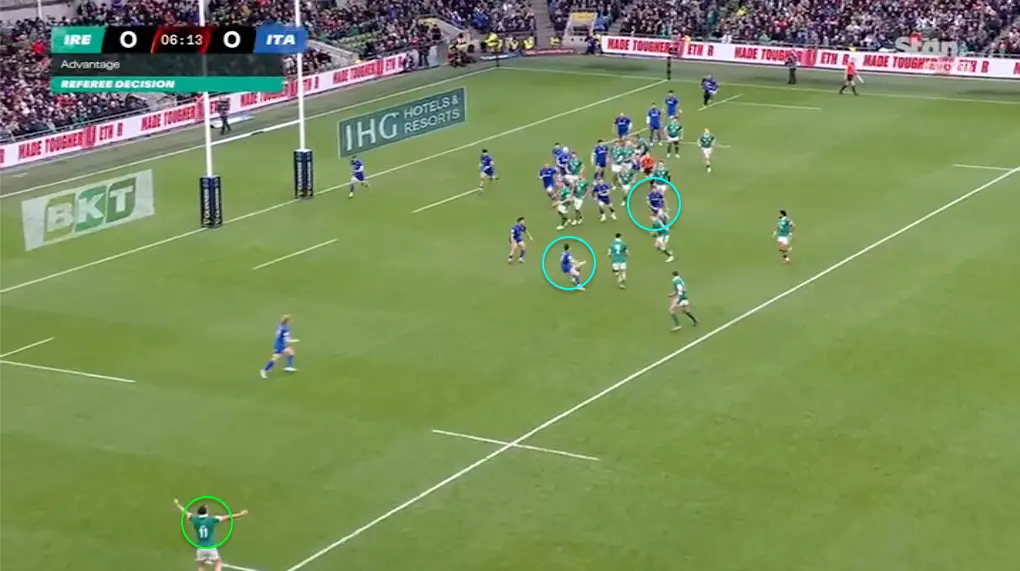
A lot of it comes back to “fake” gainline wins that look dominant, but aren’t really.
We had penalty advantage in this phase, and it looks like a dominant carry, but look at it more closely.
We lose three players to the collision, Italy have two on the floor, and that opens a clear jackal window for Italy. Conan does well to secure it after his latch, but it slows down the next phase.
It’s not a dominant carry. We don’t carry dominantly, in anything other than technical stats, in the vast majority of cases.
Most of these carries get to the gainline, more or less, but we lose the collision from a numbers perspective.
Most of these are “quick ruck ball”, but we’re losing the initial contact point. Here’s another one I forgot to add to the mix.
Craig Casey, Sam Prendergast, Jamison Gibson Park, Jack Crowley, fuck it, even Jaques Fourie or Dan Carter — they can’t play off the back of this.
What changed around the 55-minute mark wasn’t just Prendergast — it was the quality of Italy’s defensive work combined with the amount of first-receiver movement from Crowley.
He’s arriving late to screens, drawing runners directly but also holding that outside blitz, so Ireland have an attacker “over” on every phase.
Crowley is the extra man on these phases in a way that Prendergast can’t be, because he isn’t fast enough. Crowley sees the opportunity here and is pointing to the backline to filter out because he’s going to be a late-arriving option on the screen.
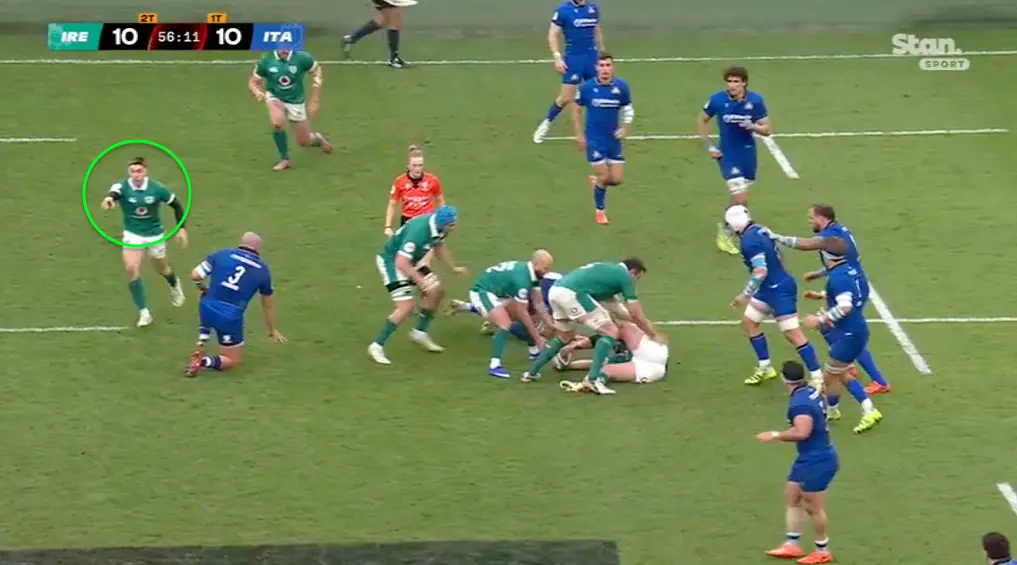
At the point of release, Crowley is nowhere near the three pod near the point of the pass.
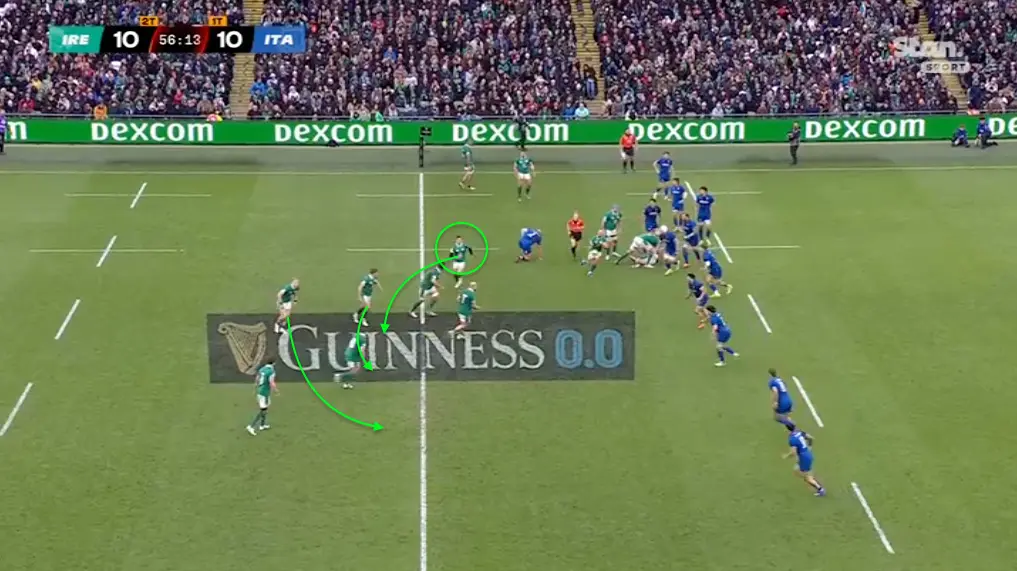
He’s telling Ringrose and Osbourne to shift out a spot, so instead of Menoncello cutting off the strike here, he’s had to sit back here.
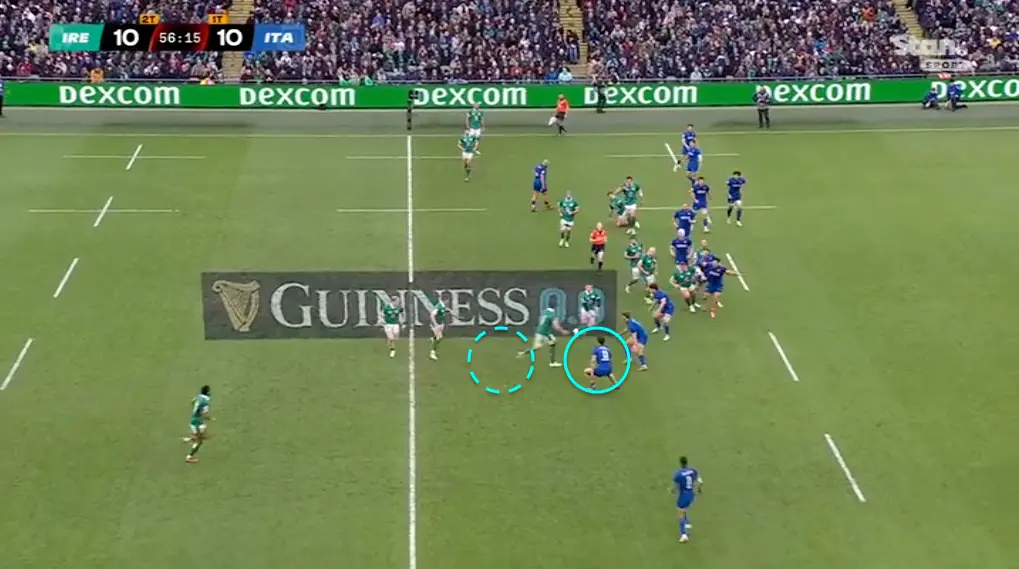
In the next phase, it’s the same. Crowley’s tight line to the three pod — and his pace outside it — drags Italy’s cover defence in, rather than freeing them to step up. Look at how Ferrari has to step in here, rather than filling out. That has an impact on the outside defenders, who have to sit back themselves to cover the option.
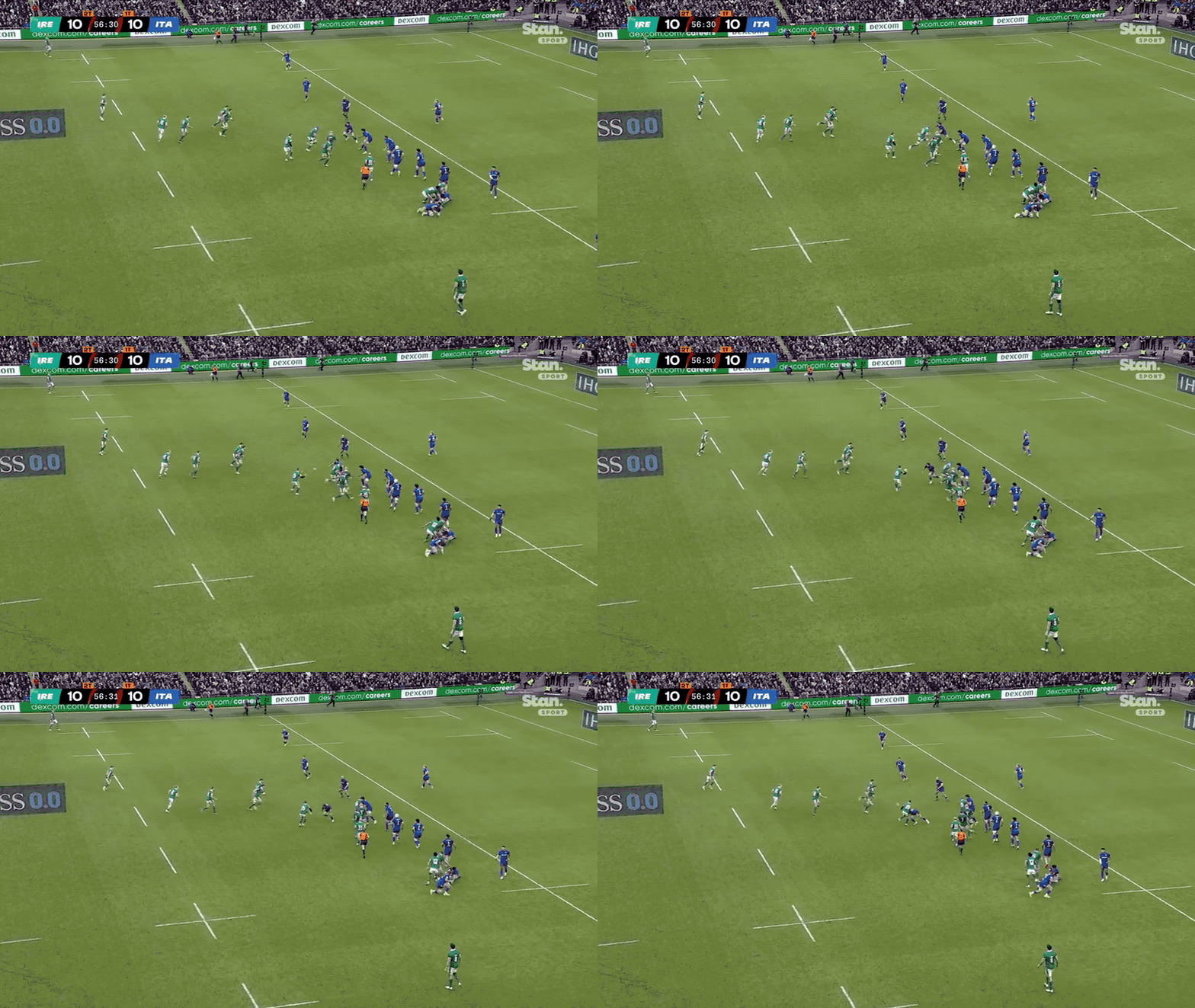
It’s a small change, but empowered by Italy dropping off physically (they made five changes soon after), it was enough to produce the “old Ireland” for a few phases.
After that, we ran into the same problem. Collisions that looked good, but still only committed two Italian defenders at every turn, relative to the multiple Irish players resourcing the ruck.
This one looked good, but really wasn’t.
On the next phase, Italy were happy to cede quick ball at the ruck because they’d already slowed it in the collision itself.
Ringrose faced a wall of Italian defenders and had to cut back inside. How often have we seen that?
Scrumhalf didn’t matter because the problem was in the collision, not in quick ball or whatever the #10 was doing. It’s no surprise to me that the breakthrough for Ireland came right after we’d made changes in the first 15 minutes of the second half, and before Italy had done the same. I keep seeing how Craig Casey dragged Sam’s performance down, but bar the ultra-harsh yellow card and one below-average box kick, I just saw a relatively decent performance as part of a team that doesn’t really know who they are.
Sam was… OK. Like, there wasn’t any mad howlers or anything like that, and while his defence was worse than his recent baseline, ultimately, he’s playing into the same headwind of our forwards struggling to win collisions dominantly. Unfortunately, his own relative lack of athleticism is something of an anachronism in the modern game, and it will continue to hold him and whatever team he’s starting for until that changes. Either get more powerful, or quicker, or, ideally, both. If not, he does not have a long-term future at the top end of this sport as it currently stands, even with the things he does well.
***
When both teams were fresh, we didn’t have a power advantage. Until that changes, or we can become a more dangerous, creative threat on transition, the problems we saw here — enhanced by a worrying scrum performance — will continue to manifest against everyone.
There’s no team in the top ten that we can dismiss because the truth is, we’re closer to the bottom five teams in the world than we are to the top as it stands. That is the decline that we’ve seen in the last two seasons, and we can rage against the changing tides, or lean into the skid and see where we are.
Whatever happens next week in Twickenham will decide it, one way or the other.
| Players | Rating |
|---|---|
| 1. Jeremy Loughman | ★★ |
| 2. Dan Sheehan | ★★ |
| 3. Tom Clarkson | ★★ |
| 4. Joe McCarthy | ★★ |
| 5. James Ryan | ★★ |
| 6. Cormac Izuchukwu | ★★★ |
| 7. Caelan Doris | ★★ |
| 8. Jack Conan | ★★★ |
| 9. Craig Casey | ★★★ |
| 10. Sam Prendergast | ★★ |
| 11. James Lowe | ★★★ |
| 12. Stuart McCloskey | ★★★★ |
| 13. Garry Ringrose | ★★★ |
| 14. Robert Baloucoune | ★★★★ |
| 15. Jamie Osbourne | ★★★ |
| 16. Ronan Kelleher | ★★★★ |
| 17. Tom O'Toole | N/A |
| 18. Tadhg Furlong | ★★ |
| 19. Edwin Edogbo | ★★★ |
| 20. Tadhg Beirne | ★★★ |
| 21. Nick Timoney | ★★★ |
| 22. Jamison Gibson Park | ★★★★ |
| 23. Jack Crowley | ★★★★ |
