


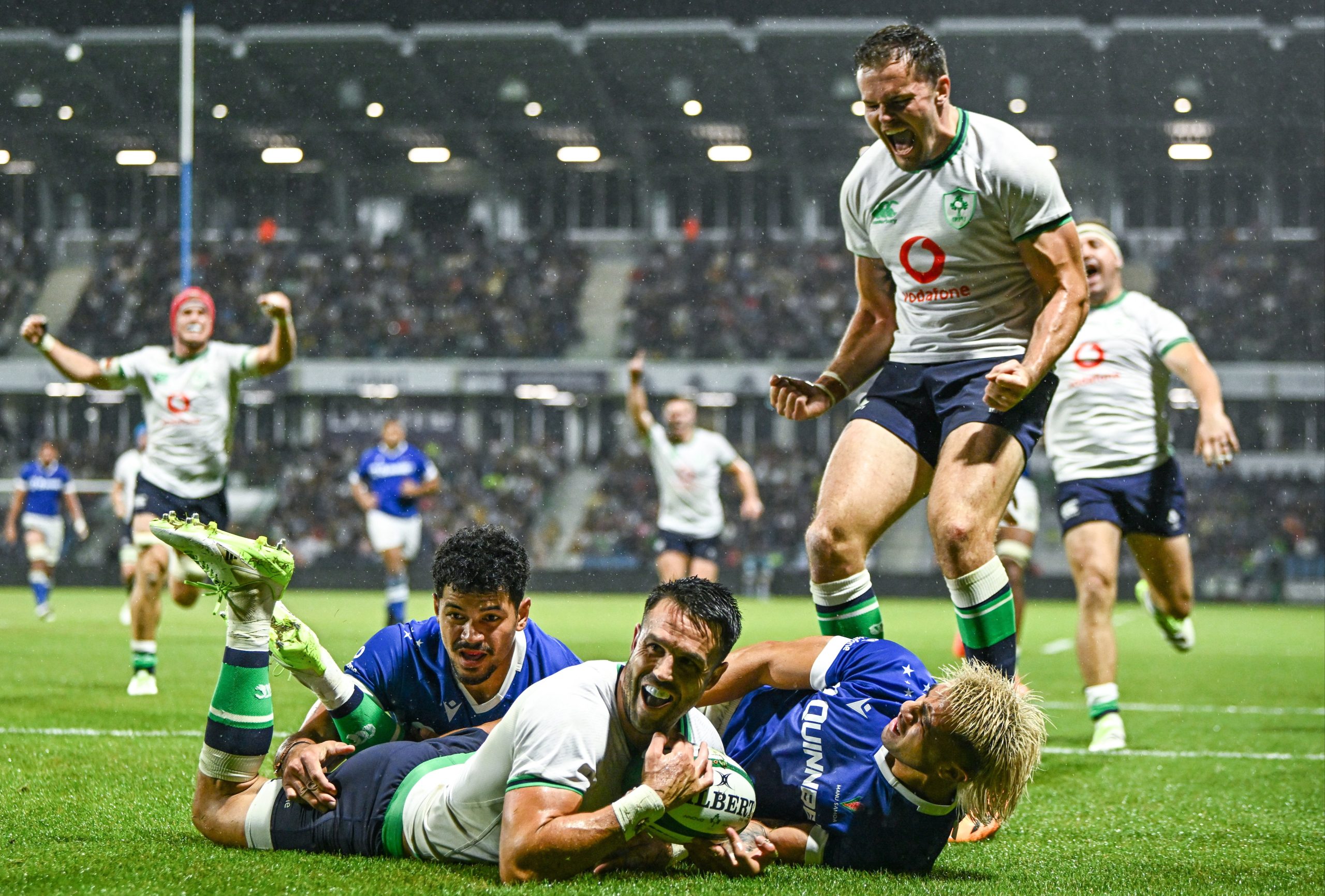
Ireland could easily have lost this game if Samoa had a functioning lineout. That sounds a lot like “if Samoa had scored more points they would have won” but I think pointing out that system differential as being a crucial part of this game is fair. Ireland would have known that the Samoan lineout was a weakness coming into this game – and so it proved – but there was a lot more to this game than that.
This game was a very credible style check before we get to tangle with the Springboks in a few weeks. The physicality and directness of the Samoans mixed with the incredibly difficult weather conditions turned this game into the exact match we’d be capable of losing, regardless of the reputation of the opposition.
This is the last Wally Ratings where I won’t give players actual star ratings so let me use this last article to explain to you why what you saw against Samoa was so unlike the Ireland we have come to know in the last few years and why a team with Beirne, Henderson, Doris, Van Der Flier, Henshaw, Ryan and Ringrose could – and should – have lost this game.
For me, it all comes down to Ireland’s system. How it works, what it does that weakens the opposition and strengthens us, and how it can be taken away from us. Talk about nervousness about the World Cup squad being named is, for me, a minor issue not really worthy of discussion. Nineteen of the matchday squad were as good as nailed on for this squad from a way out and that would have been twenty had Keith Earls started as planned.
Did the three guys purportedly on the bubble cause this underperformance? No. And it’s silly to suggest otherwise. The idea of lads minding themselves before the World Cup is another huff of copium too because trying to bail out against a team as physical as this Samoan side is how you ensure you get hurt. Even then, you can get hurt just doing your job like Cian Healy so no, I don’t think that washes.
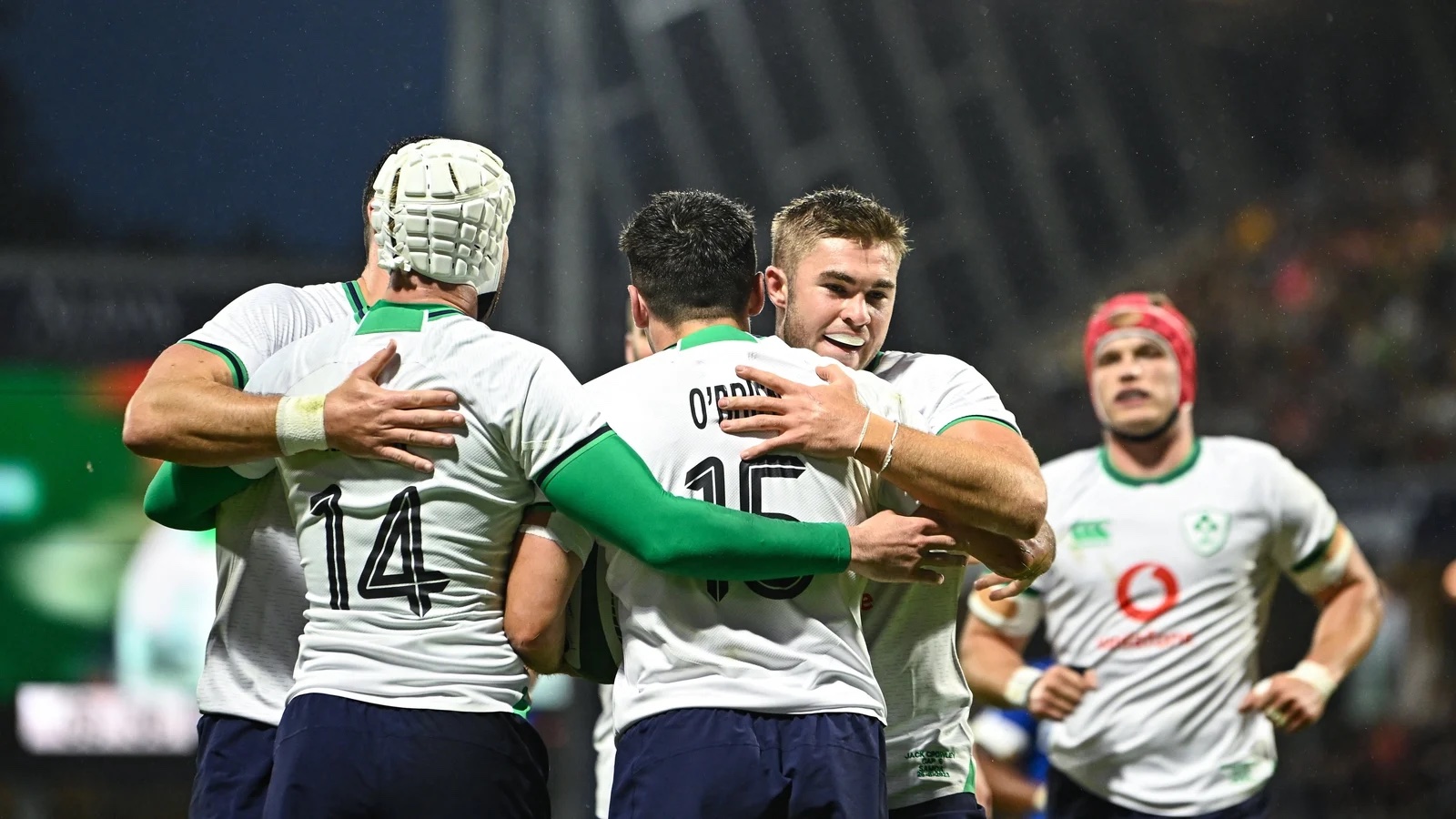
For me, this game was a good example of the scenarios that counter-transition is designed to produce. We can see those things in the negative space left behind by their absence.
Ireland’s counter-transition game is, at its core, designed to unbalance the opposition, drag them away from where they are comfortable defending and then blitz them with a high-tempo offence that utilises a lot of forward passing to compress and then bypass the opposition forwards.
If you look at the profile of Ireland’s pack, you won’t see any true heavyweights. This is entirely by design. The only player who might qualify for that tag these days is Tadhg Furlong but everyone else is on the lighter end of the modern-day forward pack. None of Ireland’s back five are north of 120kg, not even our locks. The nearest player to that weight is Joe McCarthy at 119kg. He’s big – by the standards of this Irish pack – but he would be on the smaller end of tight five forwards by general test standards at the highest level. Beirne, Ryan, Baird and Henderson play between 113KG and 117KG, with James Ryan being the heaviest out of those four core players.
In the back row, Caelan Doris plays at 106KG, Van Der Flier at 103KG, O’Mahony at 107KG and Jack Conan is the heaviest at 110KG.
Why mention this at all? Because this Irish team is perfectly constructed to play a particular style of rugby, the physical profile of the players selected to play that style is vitally important. Any player not ideally suited to play this style gets bumped out eventually.
Ireland are in the top three for average kicks per game and the highest average distance per kick in the world this year.
We are also one of the highest volume ball handling teams and nobody hits more offensive rucks than we do. No other team has the raw volume of forward passes that we do and no teams forwards are expected to cover as much ground on transition, both offensively and defensively.
This is an extremely taxing way of playing but when it’s done right, it burns out the opposition. Their backs will kick too long on a return, which will stretch the limits of what the pack can cover. As a result, the pack will step in on an Irish transition phase and then the Irish forwards will pass around them for a linebreak and possibly a try. It’ll all seem like child’s play.
When Ireland receives the ball deep on transition, they love to spread the ball to the edges to draw up the opposition pack that extra 20/30 metres so that Lowe, Keenan or Hansen can stab the ball long and deep into the opposition’s backfield and get them moving again.
Ireland beat up bigger packs in the way a light heavyweight MMA fighter would beat up a super heavyweight opponent – we get them moving at our pace, we only engage with them on our terms, we keep them at range and then we clock them when they overextend to grab a hold of us. Our pack is constructed around that fundamental truth. It’s not just about being mobile – it’s being just mobile and skilful enough to keep out of their range while packing as much of a punch as we can on the set piece.
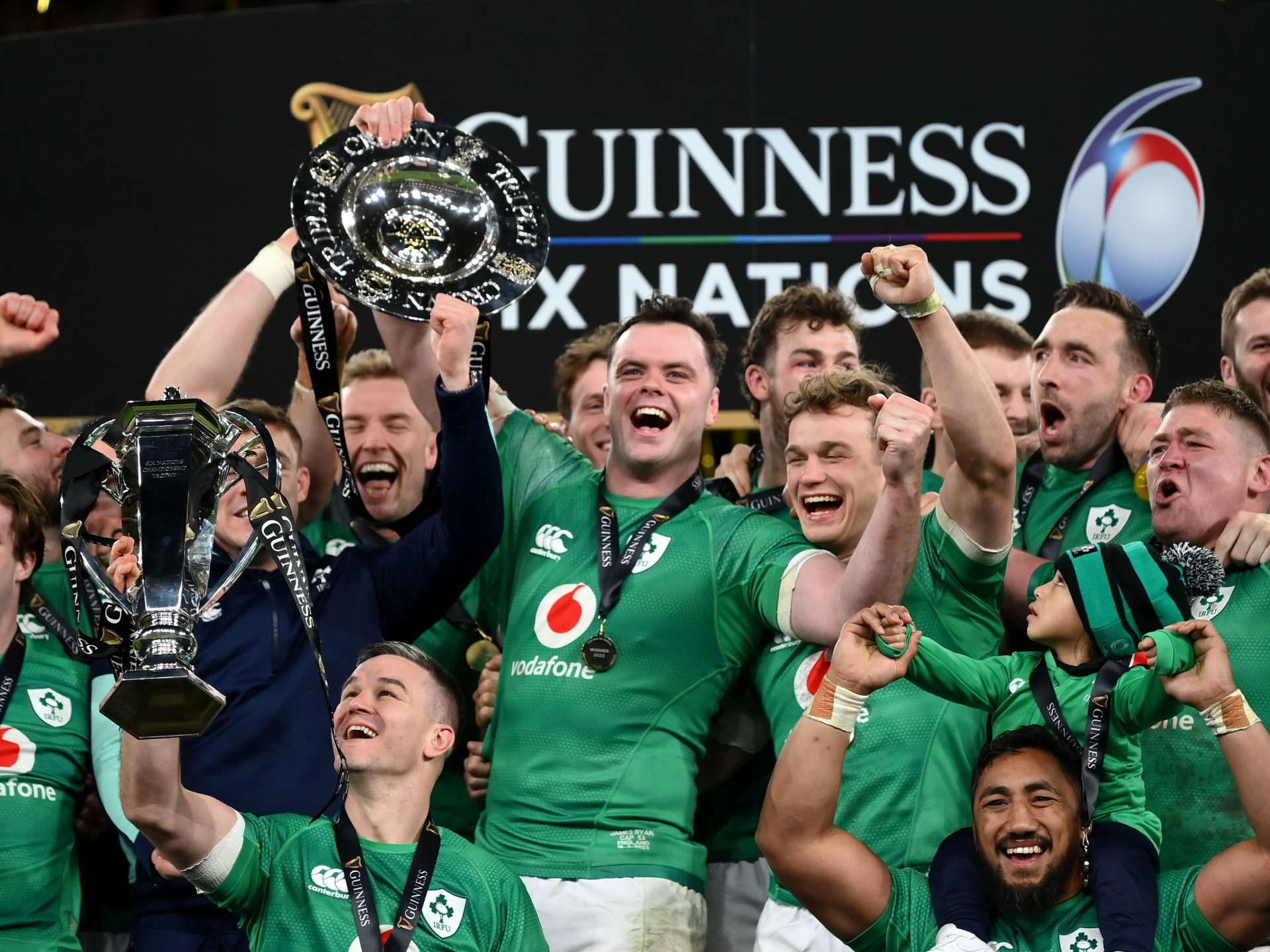
Our broadly illegal maul set-up is a device to maximise the size differential we know we give up to England, Australia, South Africa and, in particular, France when we have to engage with them like for like. As a scrummaging unit, we use a variety of tricks, slips and gimmicks to keep that set piece out of the game as much as possible because we know that if the referee just wants to use it as a restart rather than a contest, the scrum will never matter if everything else works as planned.
When you visualise Ireland as the rangy light heavyweight and Samoa as the big-hitting super heavyweight, it all becomes clear.
What would a super heavyweight fighter want in an ideal contest with a lighter fighter? He’d want the fight to take place in a shortened space – a phone box – so he isn’t chasing after the faster man, he’d want the light heavyweight in arms’ reach at all times and he’d want to engage him in direct contests where he can make his weight count in a place where the lighter man can’t escape.
Now we’re ready to talk about the game.
Let’s look at this sequence;
What’s very interesting to me is that Leinster attack coach Andrew Goodman is coaching Samoa for this World Cup and his attack for this game kicked more – even allowing for the weather – and kicked directly and mostly onto the back left pin of Ireland’s defence, where James Lowe would typically defend.
Time and again, that’s where they went with the same kick – contestable off #10.
When Samoa won a knock-on, they had the scrummaging power to negate Bealham’s driving across which then allowed the Samoan tighthead to pop Loughman, slide inside the pocket between the loosehead and hooker and then drive through straight onto Steward, who got blown out of this scrum for a full penalty to Samoa. They would kick to take the lead into halftime.
Watch Steward lose his bind as Bealham wheels out of the scrum.

Samoa knew all our tricks – on transition, in the scrum, at the lineout. Goodman has us well scouted, as well he might. He worked with most of these players every day of the week last season.
When Samoa did kick long to get out of their own 22, they mostly did so off #10 and when they went to that extra range, we obviously saw a huge opportunity to get our transition phases into action.
Samoa did really well in the below instance to stuff our initial run back with heavy tackling but they also followed that up with really strong breakdown pressure to make sure that we couldn’t start running those sub-three-second rucks because the ball presentation was so messy and the contact zone consistently contested.

We wanted to play quickly and with enough width on each transition phase that Samoa would get pulled apart with each ruck but they made that very difficult with their immense physicality and, in tandem with the rain, we struggled to get around them all night. That heavy counter-rucking kept them in the game right up to the last five minutes where a big Fritz Lee turnover on a sequence of narrow phases gave them a lifeline that they would eventually spurn.
The really interesting thing for Andy Farrell is the weak points in our system that this showcased. If the Springboks can unlock some of the weaknesses we saw here, it’ll make life very very difficult.
The easy stuff is over. Now we’re onto the real high-stakes, high-pressure rugby.
