


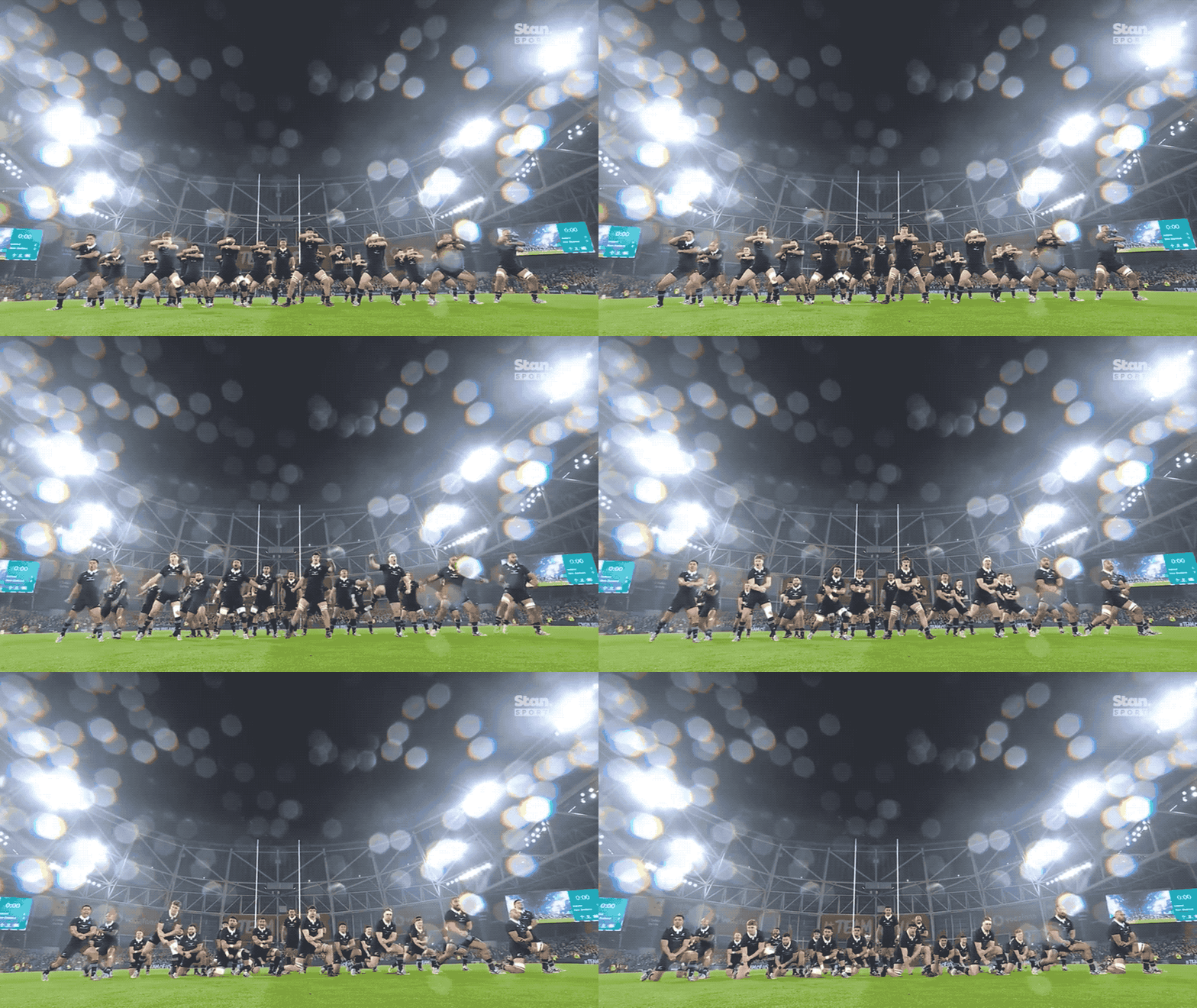
I was thinking of what framing device to use at the start of this article since Friday night.
You know framing devices; they’re the bits at the start of an opinion piece that don’t really have anything to do with the matter at hand but attempt to frame the stuff that does in a context that can illuminate and entertain the reader.
There was the played-out dictionary definition of a word—in this case, I wanted that word to be “cohesion,” but that’s so corny at this point that even the guy who ghostwrites for Matt Williams might baulk at it. Then I remembered the “Marge Simpson’s Pink Dress” analogy but I used that just over a year ago. Too recent. Maybe a little too esoteric for the people who aren’t obsessed with the Simpsons between Series 2 and Series 10, and exclusively through the vehicle of memory. I will never watch those episodes again. Someone told me last week that they prefer the new Simpsons, and my internal reaction would have been the same if they said they just finished eating their cat.
But I digress.
Here’s the framing device I settled on.
The old reliable.
The “literary quote of a book I’ve never read” layup that I have written at the start of every notebook I’ve had since 2019 when I first heard it in therapy.
Slowly at first, then all at once.
– Ernest Hemingway, The Sun Also Rises
When something happens – good or bad – it rarely just happens. All the way along, there are signs of what’s to come. A car doesn’t just crash, after all. Maybe you left a little late so you’re driving a little faster than normal to make up time, maybe you’re a little frazzled and you’re not fully paying attention to the road. Maybe it started to rain half an hour earlier and that changed the grip of your tyres on the road, the tyres you said you wouldn’t bother changing until you got paid next month.
Only in hindsight do you see the slow moments along the way that lead to the fast conclusion.
I can’t help but feel that, while this loss isn’t a crash in and of itself, it is perhaps that odd pull of the steering wheel on the motorway as the wipers struggle to clear the rain off the windshield. A sign that we’ll look back on and apply more meaning to in hindsight, should the worst happen – which is far from a guarantee.
What is “the worst” in this context? For me, it would be this Ireland team collapsing to being third or worst in the Six Nations due to a mass fall off of the experienced heads that the coaches have repeatedly gone back to, well beyond the point of what might have been prudent.
I saw it happen at Munster in 2013. A decorated bunch of icons in their early or mid-30s all ended up either retiring or falling off dramatically in the space of two seasons, leaving a callow and under-developed second layer – dotted with individual quality thought it was – to labour through the next few years. Worse again, they would traipse through those years under the yoke of on-field expectations set by players they could never live up to because the window when they could have been developed alongside them had long passed.
The same can’t happen at Ireland level, right?
The matchday squad that took the field for Ireland in this game had more international caps accumulated than any other team playing this weekend, more than even a Springboks side that had multiple-time World Cup winners in it. The average age of Ireland’s match-day squad was older than every side except for one, the Springboks, and by just half a year on average.
The average age of the pack replacements on the bench was 32.7 years of age.
And all in a week where Andy Farrell felt compelled to get Johnny Sexton back into the camp with a vague “mentorship” role that nobody can seem to nail down. Is he just a mentor? If so, why is it official? Is he a kicking coach? They can’t say.
I think it’s a fundamental truth to say that Andy Farrell’s Ireland is an ageing team that is currently harder to get out of than it is to get into. I think it’s been this way for three or four years but, for those three or four years, it’s been very successful. Ireland hadn’t lost in Dublin in November for eight years, until Friday night. Ireland had been unbeaten at home for 19 games before this. We have either won or finished second in the Six Nations in the last three years. We have beaten South Africa away from home, beaten them in the World Cup pool stages and won a series in New Zealand in that timespan.
We were #1 in the world coming into this week and rightly so; we earned that somewhat meaningless honorific by winning most of the games put in front of us.
So who would you drop?
I agreed with the selection for this game insofar as this selection is mostly the guys who have almost always been part of winning Irish teams in the last few years. Andy Farrell is big on experience, loyalty and cohesion. That cohesion has been his secret weapon. Where other teams have to compromise with their training or system to accommodate players from disparate environments, Andy Farrell has been able to train – and play – with a level of complexity that others only reach at the end of a long tour or during a World Cup.
The team that took the field here has endless layers of cohesion with each other, in every position bar half back That matchday squad has trained together for the last five or more years, maybe longer, at Ireland level or year-round with Leinster. It’s why Ireland almost always hits the ground running in November, July or February.
The central control of the Irish provinces also means that stuff like lineout calls and structure is centralised – all of this cuts down on the noise that can disrupt or slow down a session when new players are brought up. Yet, even with this, getting into the Irish HPU is extraordinarily difficult if you’re not in Leinster.
Ireland’s “chassis” is, basically, Leinster’s system, with a few spots taken up by players who compensate for the weaknesses inherent to Leinster’s system. Back in 2020/21, it was inherently sensible for Andy Farrell to take this approach as he struggled to generate results post-Schmidt.
Anywhere in Leinster’s first choice team that is a question mark or, perhaps, a non-elite option, that is a spot you’ll see a non-Leinster player in for Ireland with everyone fit.
Think about it; 4, 6, 10, 12 (kinda), 14, 18, 19 and 21.
At the Ireland level, those spots have been taken up by Beirne, O’Mahony, Crowley (in the last year), Aki mostly, Hansen or Nash, Bealham, Henderson, and Murray.
If you’re not able to come in and hit the ground running in training – and Irish training is incredibly involved, high-demand and complex – it is almost impossible to force yourself into the matchday squad for serious games barring injury. If you don’t fit a role that is already established in that squad, it’s almost impossible to get into the wider squad.
In my opinion, this has created a cave ecosystem effect that has made the training environment uniquely complex and involved but also uniquely difficult to introduce new players into. In doing so, it has created something of a Catch-22. You can’t play for Ireland without training well, you can’t train well unless you’re already playing for Ireland.
It’s exacerbated by the fact Ireland were beaten by a New Zealand side that featured 12 changes from the one that beat us last year in the World Cup. In just 12 months, the All Blacks have moved on from hugely experienced icons like Sam Whitelock, Brodie Retallick, Dane Coles, Aaron Smith, and Richie Mo’unga, as well as establishing new young talent like Williams, Sititi, Vaa’i and Roigard. They took their lumps, and still aren’t the finished article, for sure, but a year or so later look to be on an upward trajectory.
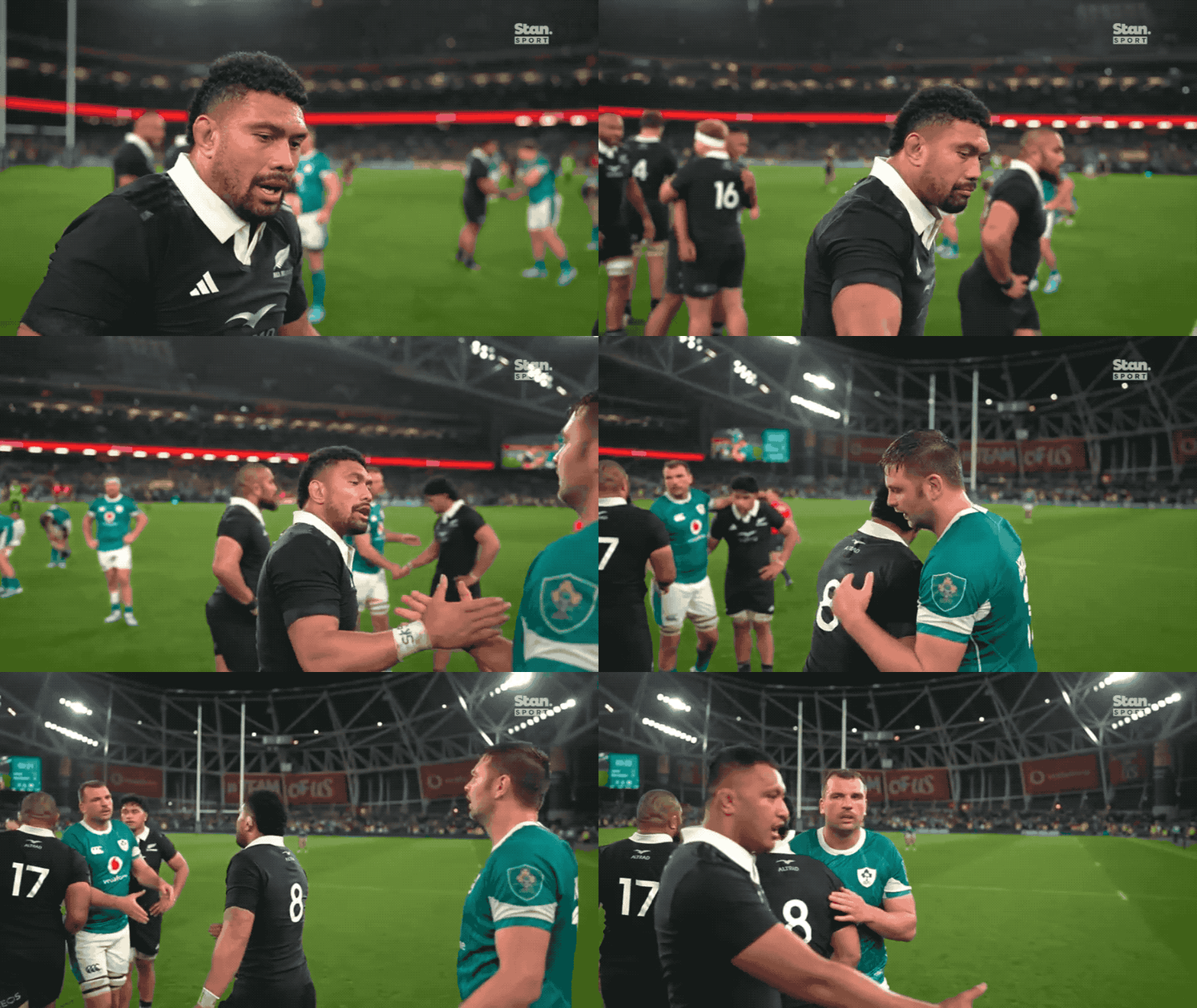
As an illustration, the oldest player in this All Blacks squad – the 32-year-old Sam Cane – would be joint seventh oldest in the Irish squad with Beirne, Lowe, Gibson-Park and Iain Henderson.
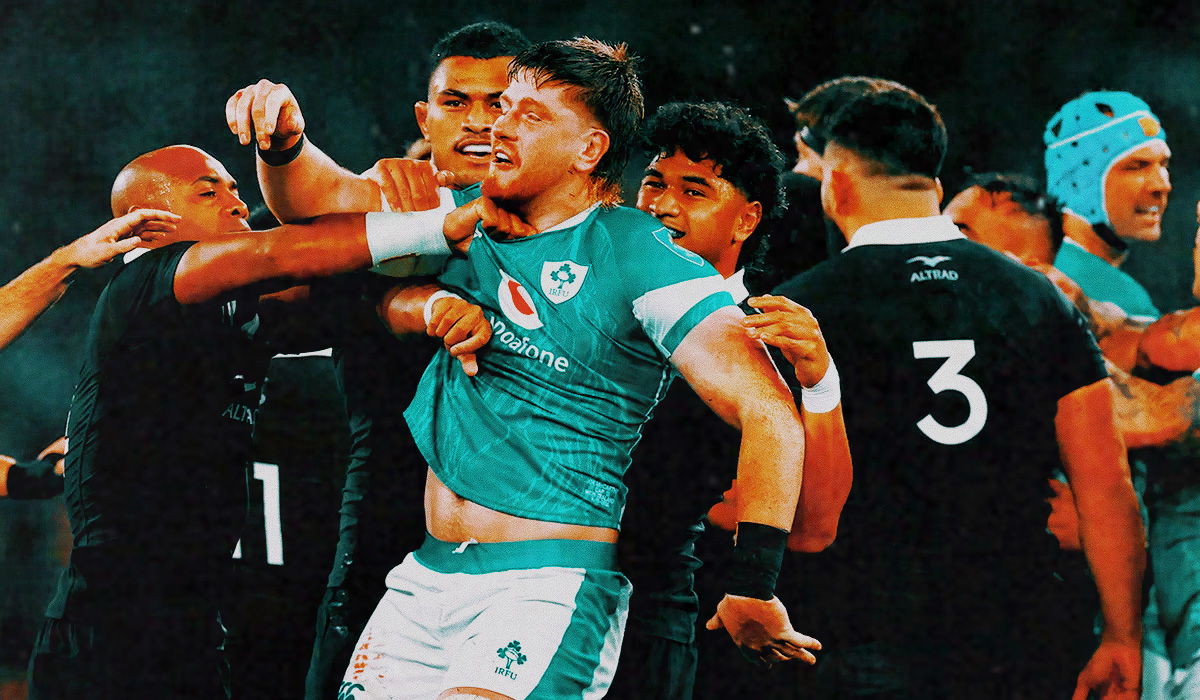
This loss isn’t a disaster, by any means, but it is a wake-up call. We looked tired, rusty and laboured. This squad badly needs an infusion of fresh blood and it needs it in the next 8-12 months, ideally the next six.
Ten of the matchday squad are 32 years old and older. Five are between 28 and 31. Only three players who might be considered matchday regulars for games of this scale as of now – Jack Crowley, Joe McCarthy and Jamie Osbourne – will be under the age of 26 at the end of this season.
If you don’t see the problem there, you’ll never see it. We’re not quite at the “all at once” stage now, and that gives us time. But that time is ticking away.
***
This was a high-level game between two very good teams.
As you’d expect, of course, but I think it’s worth saying, despite the lack of tries scored and some of the razzle-dazzle and drama we’ve come to expect between these two teams being conspicuously absent.
At a headline level, Ireland lost this game because of our defensive discipline being ruthlessly punished off the tee by Damian McKenzie and our lineout running at 70%, including some bad misses in key parts of the field at key times.
At a more subtle level, however, I think it was Ireland’s attacking structure that failed, despite 62% of our ruck possession being under 3 seconds, which is normally a sign of a winning Irish performance.
Ten of our 13 points came off the back of the new kick chase law interpretation, for example. We are credited with one linebreak in the post-game stats, the lowest in this calendar year after the loss to England. That is… unusual. So much so to be notable. Some of that comes down to excellent All Blacks defence and uncharacteristic errors at key moments but, at the same time, we’ve never had this much quick ball with so little return when it comes to linebreaks.
The first thing to look at is Ireland’s relatively narrow forward structure – inherited from Leinster – and Andy Farrell’s use of the back three as alternate handlers to extend the Irish backline beyond the narrow structure to create the attacking layers that have become this team’s signature.
Here’s a decent example of the narrow structure from early in the game. Ireland set up with a 3-2+1 with Doris operating as a tied runner to the classic Irish midfield two pod that’s been a stable of Ireland’s game post-2019.
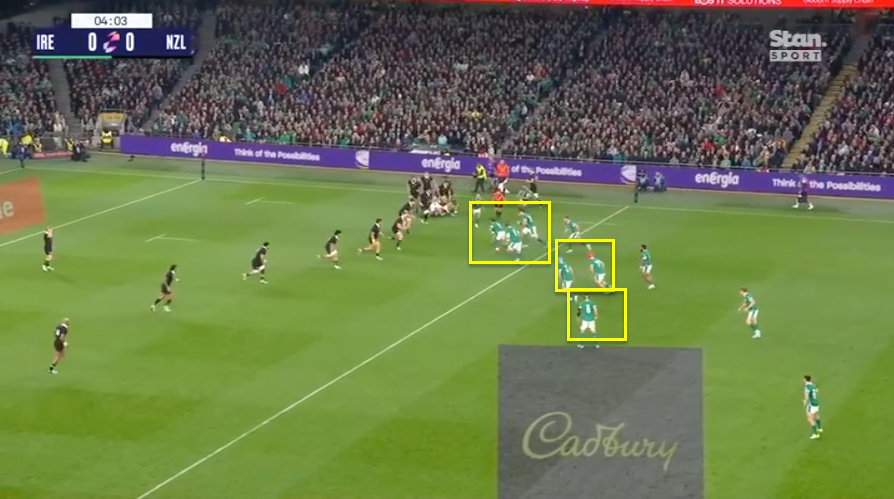
When we look at how this play ran out, we can see a core Irish attacking concept under Farrell. A nice pass to Beirne which opens up the inside swivel ball to Aki, who started inside Van Der Flier, and Doris running a hard line which creates a corner for Ringrose to attack around.
Except the ball didn’t go to Ringrose in this instance, which is a little uncharacteristic from Bundee Aki in this position. Ringrose probably doesn’t score directly from this moment – I think Tele’a or Jordan stops him – but it’s the kind of linebreak we normally rack up off movements like this.
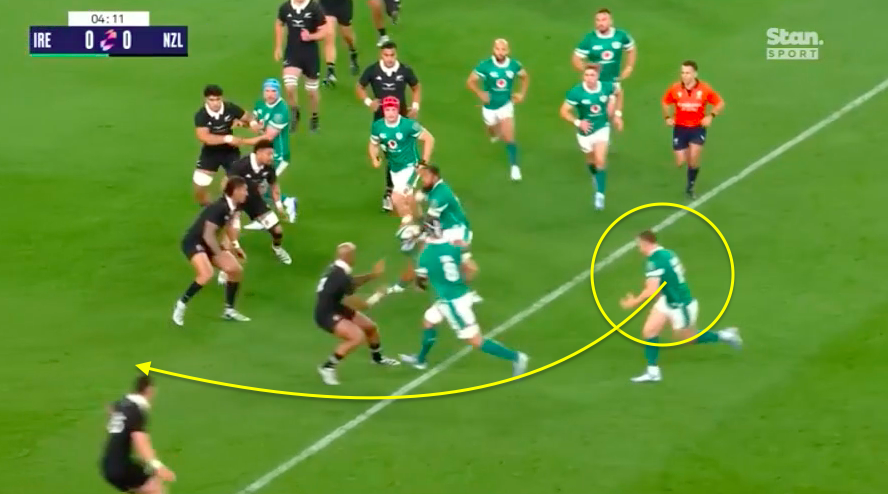
As a result, we can probably write this one off as a bad pass option.
A lot of Ireland’s best work is usually done on transition, but that was also absent in this game.
This is a classic example of an Irish transition structure in the last year or so. Keep in mind that Crowley – guarding the backfield on this play – was involved in the ruck the clip starts in.
Hansen rotates in as the first receiver to run a corner line with Van Der Flier in that midfield pod and Aki as the corner runner. Ringose is in the 3/4 space with Hugo Keenan acting as a traditional winger. Lowe holds width on the other wing.
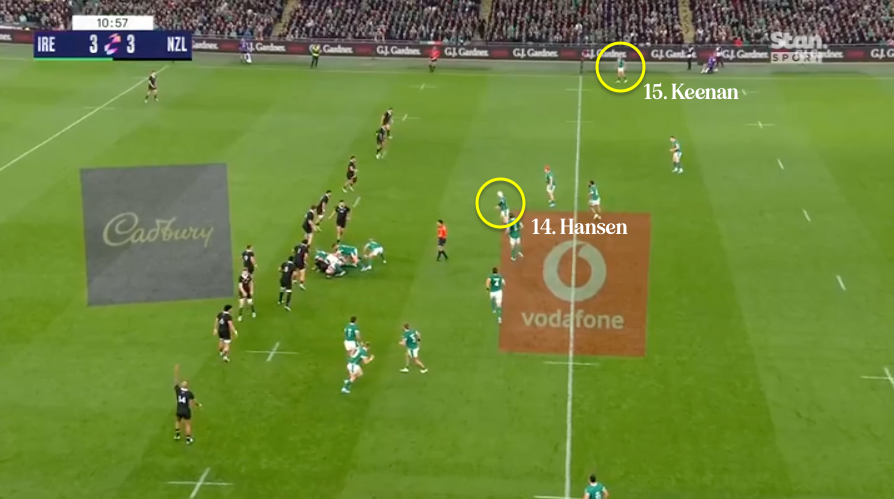
Again, you look at Aki dropping this pass as being something of an aberration. He doesn’t tend to make mistakes like that but, once again, I feel like he was covered by New Zealand’s edge defence.
An interesting quirk is Ireland’s set-piece attack, which will be under quite a bit of attention with the addition of Andrew Goodman over the summer. Ireland’s set-piece has been traditionally very good once we get the ball out of the scrum or lineout. The whole “power play strike movez” stuff was always a little overdone but it doesn’t hide the fact that, typically, we’re quite inventive in this part of the game.
In this scrum launch in the second half, for example, you can see Ireland striking narrow in the middle of the field through the forwards after a good inside loop between Crowley and Gibson Park put Ringrose away to the left 15m channel.
https://streamable.com/b7axa4
For me, there’s a big opportunity in the second phase if Crowley gets the pass off the screen. Ireland’s scrum structure puts the #6 on the touchline to hold width while Van Der Flier supports the break to the openside, before staying on the far touchline once the ball comes back.
That opened up this look if McCarthy sent this pass back to Crowley.
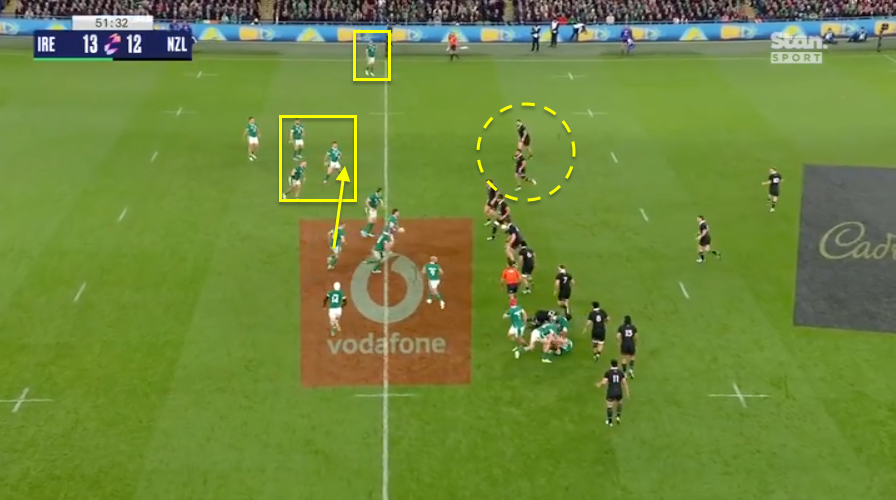
In the next phase, Crowley couldn’t take the pass from Gibson-Park but you can see the same structure variation in that phase. The 2+1 forward structure with overlapped backs but this time with Beirne on the edge. The key here is Hansen behind the two pod, Lowe behind Kelleher as the pinch with Beirne as the edge threat.
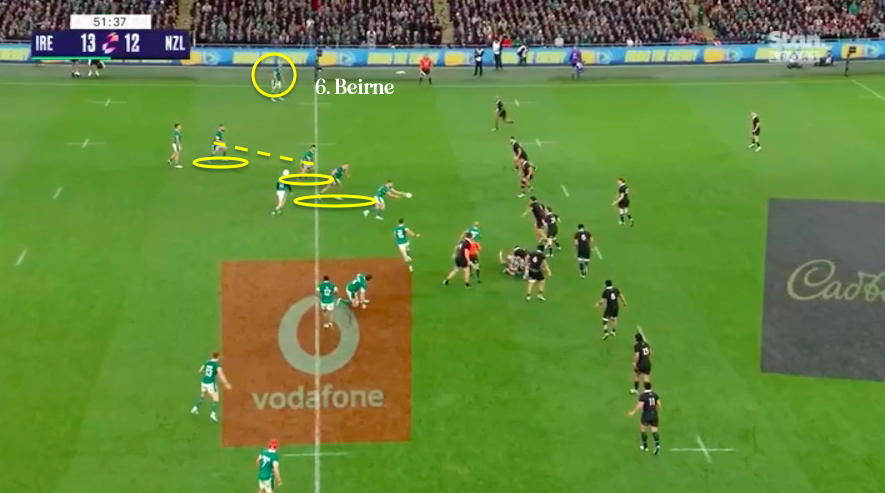
I’m not sure if Beirne is a killer piece on the edge here, to be honest, but you can see the concept at least. Now watch this version from later in the game. Same behaviour from the flankers; Beirne hugs the touchline, and Van Der Flier supports the play with the key this time being staying central because the plan became to launch a contestable into the backfield to get an isolation for Hansen to chase, in case the offload structure on the first phase didn’t work.
This is also the first time in the game that the flyhalf got to touch the ball as the key handler two phases in succession. This team runs on cohesion so it’s no surprise to see that the least cohesive unit by some distance – Crowley and Gibson-Park – has a long way to go. Gibson Park probably feels that he’s the senior man at halfback now – in terms of status, rather than age – and my bet is that he feels more comfortable with Frawley, who he has years of cohesion with at Leinster. He has less than 12 months with Crowley, and it shows in every janky Irish performance where we aren’t running over a hapless opposition pack.
Goodman’s set piece style loves to include an offload as part of the key strike. Here’s an example of where I think the play was either an offload to Crowley around the corner or a solo edge ruck after gainline by McCarthy that would allow Gibson Park to hit Crowley, with Lowe and Keenan swarming the tramline.
It would have been effective against a shorthanded All Blacks backline due to Jordi Barrett’s yellow card, but McCarthy spilt the ball in contact.
Watch a lot of Ireland’s strike plays and you’ll see the offload option on phase one or two. This one is a good example of one that maybe should have gone, especially with Crowley running the hard offload line outside Kelleher.
This was the moment right here but it was a difficult one to execute under pressure.
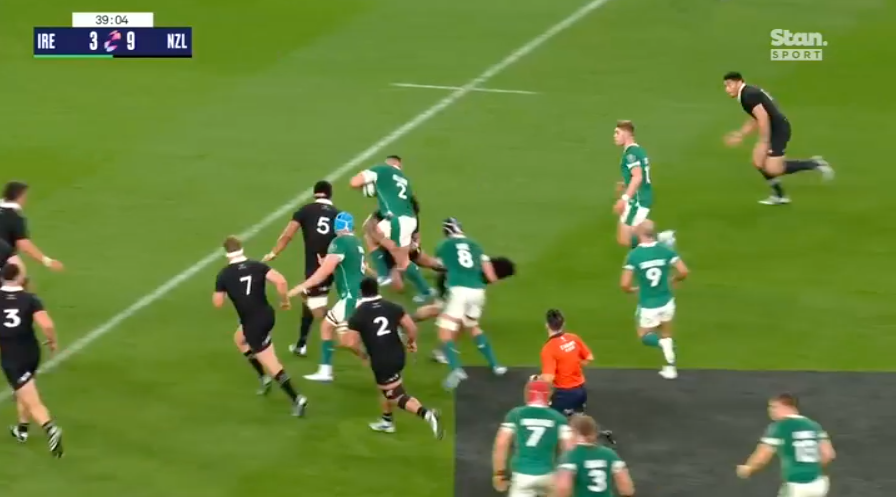
This is really on Crowley to sort out week to week with this group. The Irish attacking system really does split a lot of the playmaking between the #10 and the back three, especially when it’s working on counter-transition sets. Sexton was in the same boat but, obviously, at 34 years of age with a 14-year-plus career at the top end of the game in your back pocket when Farrell brought this system in, you learn how to maximise your moments.
I fundamentally believe that this Irish attacking system needs to be comfortable in working its way out of a slowdown and allowing itself to play through #10 a little more if Crowley (or Frawley, or Prendergast) is to get the most out of their skills with this group.
Because here’s the real issue with this game; New Zealand completely denied us counter-transition possession until the last 20 minutes, and even then they shut down the transition window so quickly it’s like they never made the kicking error in the first place. MacKenzie’s contestable here is OK but Hansen’s take is superb. If Ireland could get shape off this – we’re right in business.
But look at this All Blacks transition defence. Snapped right in.
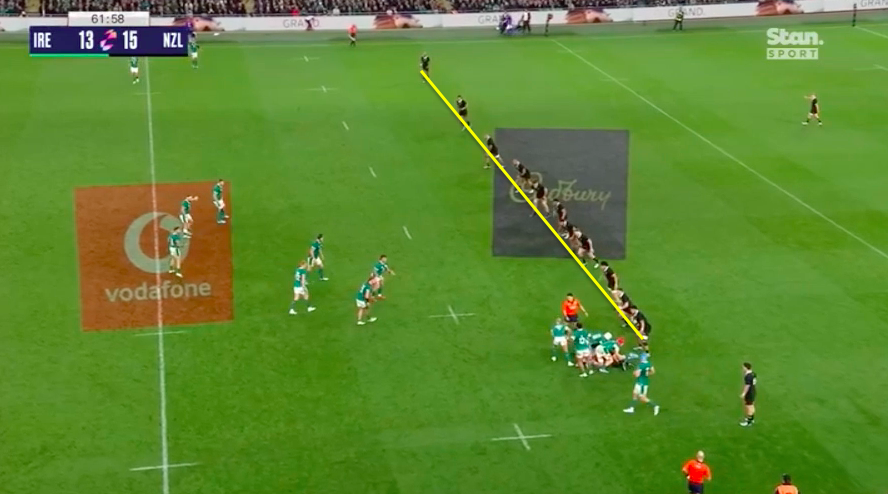
And then it hit me. The All Blacks did to Ireland what teams have done to Leinster repeatedly – Saracens in particular – and what England did to Ireland back in the Six Nations.
The new law interpretation has completely changed the logic on kicking that had been in place until two weeks ago. Post 50/22, box kicking became a tactically ineffective move because the opposition could escort the catcher and take possession back less than 30m from where you kicked it. That brought in the age of expansive counter-transition rugby from 2021 on as teams naturally found more value in kicking long.
But now that escorting a catcher = a full penalty, box kicking has become ridiculously overpowered. The All Blacks box-kicked eight times in this game for an average of just 25.5m per kick which meant that not only did Ireland have to stress the taking of every single kick but the short distance meant that the All Blacks defence was always set when the ball came back. And, because the All Blacks essentially surrendered the ruck to Ireland in all but the most obvious poach attempts, it meant they had 13/14 men on their feet right in the line of the Irish attack, which has done so well getting set on counter-transition sets while the opposition got into defensive positions.
If it felt like we just couldn’t get separation from the All Blacks, it’s because of this. They kept us trapped inside that short-range radius with a strong scrum that didn’t give us easy metres – we earned just 33m off the three penalties we kicked down the line. We kicked the other two for six points.
The All Blacks, on the other hand, got 111m of the six kicks they sent down the line.
A wobbling lineout running at 70% completion and a scrum that ran at 60% completion meant that we had very little platform to work with when it came to literally advancing up the field. We tried to kick our way around it but the All Blacks gave us very little change on that also.
What happens if – and it is “if” because not everyone is capable of it – other teams can duplicate the All Blacks counter to our base game? Well, we have two options. Lean into off-ball rugby, which will require a change in roles and personnel, or move into on-ball rugby, which means the same thing.
Change is now inevitable.
How soon Andy Farrell – or perhaps Simon Easterby – realises that remains to be seen.
| Player | Rating |
|---|---|
| Andrew Porter | ★★★ |
| Ronan Kelleher | ★★★ |
| Finlay Bealham | ★★ |
| Joe McCarthy | ★★ |
| James Ryan | ★★★ |
| Tadhg Beirne | ★★ |
| Josh Van Der Flier | ★★★★ |
| Caelan Doris | ★★ |
| Jamison Gibson Park | ★★★ |
| Jack Crowley | ★★★ |
| James Lowe | ★★★ |
| Bundee Aki | ★★★ |
| Garry Ringrose | ★★★ |
| Mack Hansen | ★★★ |
| Hugo Keenan | ★★★ |
| Rob Herring | ★★ |
| Cian Healy | N/A |
| Tom O'Toole | N/A |
| Iain Henderson | ★★ |
| Peter O'Mahony | N/A |
| Conor Murray | N/A |
| Ciaran Frawley | ★ |
| Jamie Osbourne | ★★★ |
